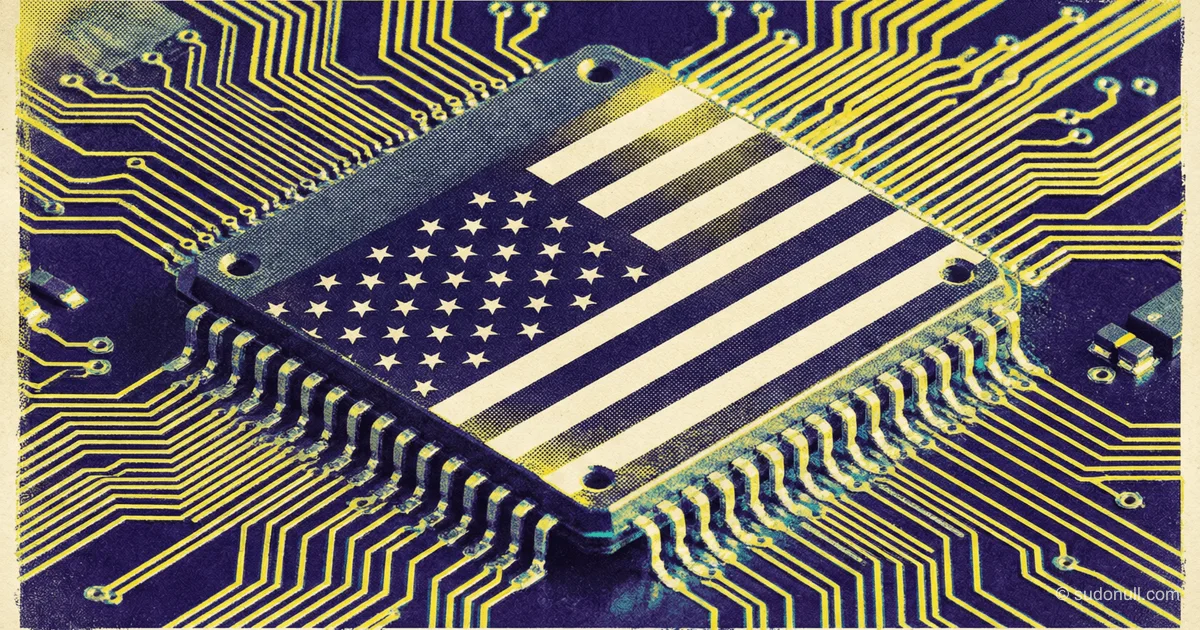
US Invests €2 Billion in Quantum Computing Under CHIPS Act
IBM became the biggest beneficiary, receiving €1 billion, followed by GlobalFoundries with €375 million; seven other companies, including D-Wave and Quantinuum, each received €100 million.
Quantum 'Manifesto' of CHIPS: Why €2 Billion Is Not Just Subsidies, but a Paradigm Shift
[The Gist]: What's Really Happening
On May 20, 2026, the US Department of Commerce officially signed letters of intent with nine companies totaling $2.013 billion under the CHIPS and Science Act. IBM gets $1 billion, GlobalFoundries gets $375 million, and seven other companies (Atom Computing, Diraq, D-Wave, Infleqtion, PsiQuantum, Quantinuum, Rigetti) split the remaining $638 million, with six of them receiving $100 million each and Diraq getting $38 million.
At first glance, it's just another tranche of government subsidies. But the deal's structure and terms reveal a much deeper shift.
Key non-obvious fact that everyone misses: The US Department of Commerce, for the first time in history, receives an equity stake in each of the nine companies. Formally, it's a 'minority, non-controlling stake.' In practice, the US government becomes a direct shareholder in quantum technology startups and corporations. This is not grants or subsidies with reporting requirements. It's state venture capital with upside participation in value growth.
In other words, the US is no longer just 'supporting the industry.' It's entering it as a co-owner. If any of these companies goes public or is sold, taxpayers get a share of the profits. This is a fundamentally new model of technological protectionism.
Timeline and Context
The deal was in preparation for at least six months. Back in January 2026, D-Wave announced an accelerated roadmap for building a gate-based quantum system, promising a first prototype in 2026. In March 2026, IBM updated its quantum roadmap, confirming the goal of demonstrating 'quantum advantage' in 2026 on the Nighthawk platform (three modules of 120 qubits each, 360 qubits total).
But the signing date—May 20, 2026—was chosen deliberately. It comes amid two important trends: (1) China, two weeks earlier, unveiled a 504-qubit processor called 'Xiaohong-3,' and (2) the Trump administration is finalizing an executive order for federal agencies to migrate to post-quantum cryptographic standards. In other words, the quantum race is already on, and the US decided that the time for talk is over.
Who Wins and Who Loses
IBM wins. $1 billion is not just money. It's recognition that IBM's superconducting approach has become the 'de facto national standard.' IBM will use the funds to create a subsidiary foundry for producing quantum-grade superconducting silicon wafers. This transforms IBM from a mere quantum computer maker into a component supplier for the entire US industry.
GlobalFoundries wins. $375 million plus the creation of a new business unit, Quantum Technology Solutions, which will manufacture quantum processors for all modalities: superconducting, ion trap, photonic, topological, and spin qubits. Additionally, the Department of Commerce receives 1% of GlobalFoundries' shares under a separate agreement. This makes the government a shareholder in one of the largest US semiconductor manufacturers.
Quantum startups win. $100 million each is not huge compared to their venture rounds (Quantinuum raised $300 million in 2024), but it's non-dilutive capital. The government doesn't take a stake from founders—it gets newly issued shares. This is pure added value. Moreover, the letters of intent allow companies to attract co-financing from private investors, who now see a government 'blessing.'
Quantinuum wins (formerly Honeywell Quantum Solutions). Their ion trap technology received federal recognition. Just a week before the announcement, on May 20, 2026, a paper in Nature by researchers from Caltech and Quantinuum demonstrated digital quantum magnetism on the H2 computer with two-qubit gate fidelity of 99.94%. This is one of the best records in the industry.
D-Wave wins. Despite many skeptics considering quantum annealing 'not real' quantum computing, D-Wave got $100 million. Moreover, the company reported a 314% increase in usage of its Advantage2 systems over the past year. They have paying customers, and now they have the government as a shareholder.
China loses. Not because it lacks money, but because the US is now synchronizing industrial policy with investment. Commerce Secretary Howard Lutnick stated directly: 'These investments leverage our domestic industry, creating thousands of high-paying jobs.' This is trade war in quantum clothing.
Europe loses. The EU has the Quantum Flagship program with a budget of about €1 billion over 10 years. The US is allocating $2 billion in one go. And European companies like Quandela (photonic qubits) or IQM (superconducting) have no access to this funding—it's strictly for US legal entities.
'Mid-tier' quantum startups lose. Not all modalities received equal funding. Diraq (silicon spin qubits) got only $38 million—significantly less than the $100 million of its competitors. This signals to the market: spin qubits are considered less promising or less mature.
What the Media Isn't Saying
First. This $2 billion is not pure R&D. It's money for scaling production and addressing specific engineering bottlenecks. The CHIPS R&D Office, led by Bill Frauenhofer, selected 7 companies for specific problems: PsiQuantum for 'photonic loss and packaging,' Rigetti for 'miniaturization of readout electronics and cryostats,' Atom Computing for 'system integration for tens of thousands of qubits.' This is not fundamental science. It's applied engineering with concrete KPIs.
Second, and this is the main insight. The Department of Commerce gets an equity stake, but also gets veto power over sales of companies to foreign buyers. According to standard terms of such deals (not publicly disclosed but known from precedents), the government can block a merger or acquisition if it deems it a threat to national security. In other words, neither Quantinuum, D-Wave, nor PsiQuantum can be sold to a Chinese, European, or even Japanese company without Washington's approval.
Third. Seven companies received letters of intent, but these are not final contracts. As Nextgov writes, 'final awards may differ in amount after due diligence.' Moreover, the letters represent a government commitment to allocate funds, but companies must meet certain milestones. If a startup fails its technological goals, the money won't come. This is not free aid.
Fourth, purely pragmatic. IBM got $1 billion to build a foundry for superconducting wafers. But IBM already has its own production in New York (the quantum center in Poughkeepsie). So the money goes to expand what IBM already does. This is not creating a new industry from scratch, but accelerating an existing leader. The question: will this lead to monopolization of the superconducting approach at the expense of other modalities? So far, yes—$1 billion versus $375 million for GlobalFoundries, which works with all modalities.
Forecast: Next 30 Days and 90 Days
30 days:
Expect final agreements to be signed with at least three of the nine companies—likely IBM, GlobalFoundries, and Quantinuum, as the most mature. Due diligence for startups (Atom, Rigetti, PsiQuantum) may take longer. Also likely are initial critical statements from China: Beijing will announce increased funding for its own quantum programs by a comparable amount.
On the stock market, watch public companies: D-Wave (QBTS on NYSE) and Rigetti (RGTI on Nasdaq). Both received confirmation of government support, which could cause short-term price increases. But be cautious: letters of intent are not contracts, and the market may overestimate their significance.
90 days:
By the end of August 2026, first results will emerge: will actual construction of the IBM foundry begin? Will GlobalFoundries launch its first production line for quantum chips? If so, it's a sign that money is being put to work quickly.
The main indicator to watch is announcements of partnerships between funded companies. For example, PsiQuantum (photonic qubits) and GlobalFoundries (photonic chip manufacturing) is a logical pairing. Or Atom Computing (neutral atoms) and Infleqtion (also neutral atoms)—they are competitors but could join forces for scaling. If such collaborations are announced, it means the ecosystem is truly consolidating.
If not, companies will quietly work on their roadmaps, and the next big announcement will come only at the end of 2026, when IBM claims first 'quantum advantage' on Nighthawk and D-Wave launches its gate-based system. That's when we'll see if this $2 billion paid off.
— Editorial Team








No comments yet.