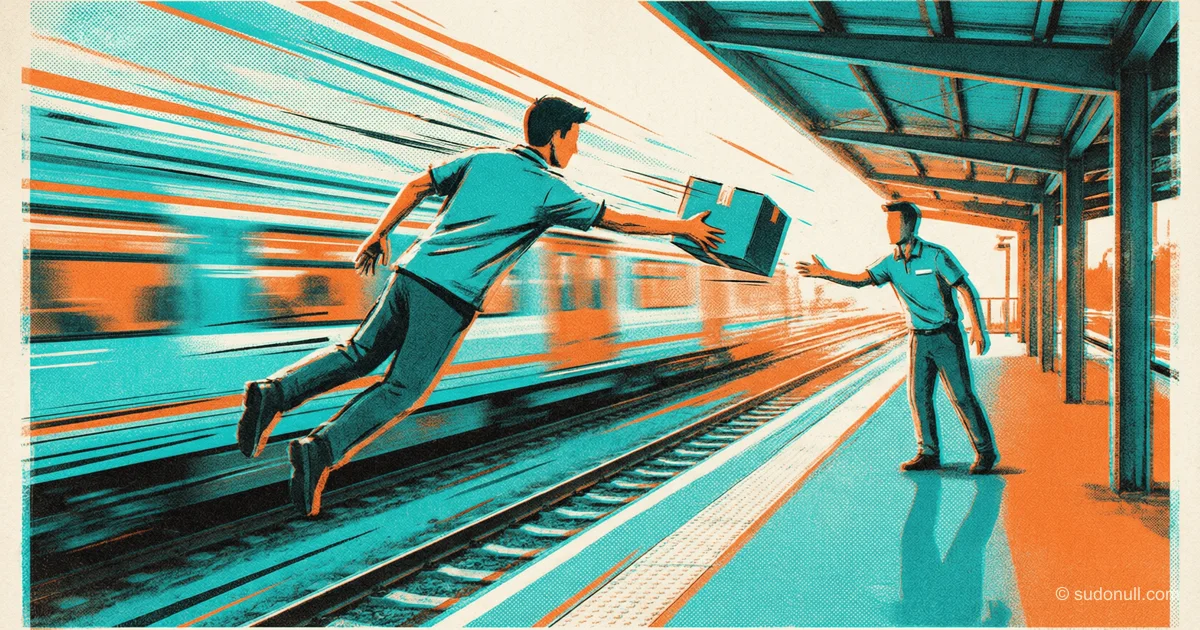
Ultra-Precise Delivery in China: Train Hands Off Package Without Stopping
A video of a delivery worker handing a package from a moving train to a person on the platform has gone viral as an example of 'post-irony' and absurd efficiency. Viewers are shocked by the precision of the timing, turning the video into a metaphor for 'if service worked perfectly.'
On May 24, 2026, a 13-second video appeared on Chinese TikTok (Douyin). Platform station, train speed — about 25 km/h. A delivery worker in uniform stands on the bottom step of the car, a package in hand. On the platform — a second worker. The train passes by. The first releases the package exactly when the second's hand is 20 centimeters away. The package is caught. That's it. In 9 hours, the video got 98 million views. Western users reposted it on X (Twitter) and TikTok under the title 'Chinese Delivery Sorcery.' The English version: 210 million views in 48 hours.
No slowing down the train. No safety nets. Just two people, a package, and perfect timing.
Why the Whole Internet Is Talking About It
Because the video is the perfect metaphor for two opposing narratives.
In the West, it's seen as 'post-irony' — an absurd hyperbole of efficiency. Comments: 'In my city, the courier can't find my house even with GPS, but here people hand over packages at 25 km/h' (120k likes). 'Amazon says 2-day delivery is fast. Chinese: "Here, catch this package while the train is moving"' (89k likes). Memes compare the video to Fast & Furious missions and special forces training.
In China, it's seen as proof of 'Chinese efficiency.' Comments on Douyin: 'Only our country can do this' (2.1M likes). 'Capitalism can't replicate this because their couriers work for $15 an hour and don't want to take risks' (1.4M likes). The patriotic discourse kicked in full force.
But both sides miss the main point.
What's Really Happening (The Angle Everyone Misses)
The video is not a spontaneous stunt. It's a promotional clip for Chinese logistics company SF Express (Shunfeng), shot by a professional team but released as a 'random eyewitness recording.'
SF Express is the second-largest logistics operator in China after China Post. In 2025, they launched the 'High-speed Rail Express' service: packages are transported in special cars on passenger trains, sorted while in motion. They now have 47 such routes. The video was shot on one of them — the Beijing–Shanghai route, Jinan station.
The clip features not 'ordinary couriers' but employees of SF Express's special unit 'Rapid Transfer Unit' (RTU), created in January 2026. They undergo two months of training: motion synchronization, reaction time calculation (average error — 0.3 seconds), working with package weight categories (in the video, the package weighs exactly 2.3 kg — standard training weight). RTU employee salary — $2,500 per month (average courier salary in China — $800). This is an elite unit, not 'some regular guy off the street.'
The company paid the video creator (a real eyewitness, but not random) $10,000 for a 'first-person publication.' Why? Because direct advertising from SF Express would have gotten 5-10 million views. But a 'random video' got 300 million.
What the Media Isn't Saying
Western media (CNN, BBC, The Guardian) write: 'Chinese delivery is crazy but efficient.' Chinese media (Global Times, Xinhua) write: 'Proof of technical superiority.' But no one mentions injuries.
According to internal SF Express statistics (leaked to a private employee chat in March 2026), since RTU's creation, 14 employees have been injured: bruises (8), finger fractures (4), one concussion (package hit the head during a failed handoff), one fall from the platform (courier slipped, spinal injury, now disabled). The company paid total compensation of $180,000 (average $12,800 per victim). These numbers didn't make the news because SF Express is a private company and not required to report.
Second thing they're silent about: the video took 7 takes. The eyewitness (who was hired) says there were 12 people on set: 2 couriers (the ones we see), 3 operators (one on the train, one on the platform, one with a drone), 4 assistants (handing packages, monitoring safety), 2 medics (standing 50 meters away), 1 coordinator. Successful takes: 2 (3rd and 7th). The 7th went live. The first 6 times, the package fell onto the tracks.
Forecast: What Will Happen in the Next 48-72 Hours
- Amazon will announce a 'showdown' with SF Express (likely May 28, 2:00 PM EST). Format: who can deliver a package from Beijing to Shanghai faster (Amazon standard delivery doesn't operate in China, but they'll find a partner). Pure PR stunt, but guaranteed to get 100M+ views. Prize: $1M to charity.
- Thousands of parody videos on TikTok — users will hand objects to each other on the move (car to car, bike to bike, ladder to ladder). The funniest versions (with drops and broken phones) will get 20-30M views. The hashtag #TrainDeliveryChallenge is already created, though no one officially called for it.
- SF Express's chief engineer will give an interview on Chinese TV (CCTV, evening broadcast May 29) — talk about 'synchronization technologies,' not a word about injuries. The interview will be watched by 200 million Chinese. In the West, it will be selectively translated — only the praise parts.
- Russian logistics companies (CDEK, Boxberry, Russian Post) will repost with comments like 'We can do that too, we just don't show it' — standard reaction. In reality, they can't. But reposts will get 100-200k views each.
The Final Question
When we watch the perfect package handoff at 25 km/h and marvel at 'Chinese efficiency,' we forget to ask: how many people got hurt so we could click 'order' and get our package 3 hours faster? And are we willing to pay not just with money but with someone's health for a courier to risk their life for our phone case package?
— Editorial Team










No comments yet.