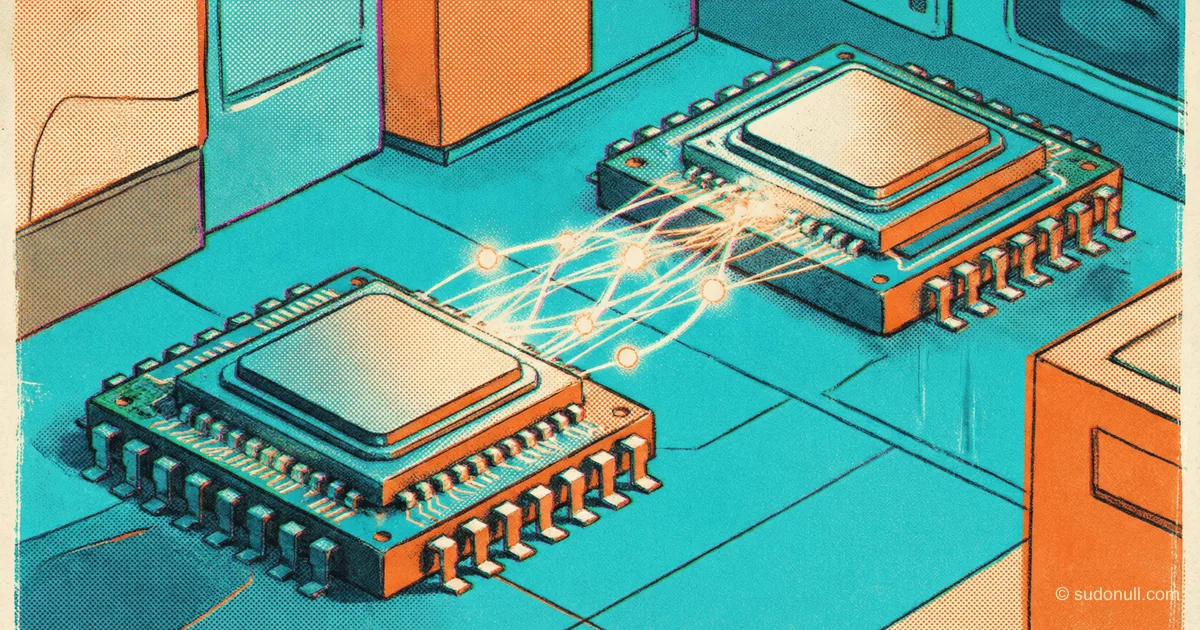
Startup Universal Quantum Raises $100M to Connect Quantum Chips
British startup Universal Quantum has raised $100 million in investments to solve a key technical challenge — connecting multiple quantum chips, which is necessary for scaling quantum computers.
Analytical Article: $100 Million for Modularity. Why Universal Quantum Is a Hidden Threat to American Giants
Author: Independent Analyst with Insider Perspective
Date: 2026-05-28
When I saw the headline "Universal Quantum Raises $100 Million," my first thought was, "Here we go, another quantum startup with a slick presentation and no hardware." But then I started digging. And you know what? This British project is not just another player in a field already crowded with IBM, Google, and PsiQuantum. It's a potential disruptor of the entire "monolithic" quantum processor industry.
Mainstream media talk about "modularity" and "scaling." They miss the key point: Universal Quantum has found a way to bypass the main physical barrier that plagues everyone — the problem of connecting chips without losing quantum coherence. And now, American SPAC companies are chasing them, offering a listing on the NYSE, but the founders are refusing. That says something.
[The Core]: What's Really Happening
Forget the "$100 million." This isn't about money. It's about the existential fear of American venture capital funds missing the next big wave.
Quantum computers today are like supercomputers in the 1980s: each processor is a unique, unscalable monolith. IBM makes its 433-qubit Osprey, Google its Bristlecone. But they all hit a ceiling: more than 1000-2000 qubits on a single chip is physically impossible due to noise, crosstalk, and cooling issues.
The solution? Connect several small chips into one large system. That's exactly what Universal Quantum is doing — technology that allows "entangling" qubits from different physical chips through a special architecture. Their founders — Sebastian Weidt and Professor Winfried Hensinger from the University of Sussex — have worked on ion traps for decades, and they have a concrete prototype, not just slides.
But the key insight that journalists missed: this $100 million is actually $200 million, with the second half coming in six months as grants from the British government. In March 2026, Chancellor Rachel Reeves announced £2 billion for quantum technologies by the end of the decade, and Universal Quantum is one of the main beneficiaries. Why does this matter? Because American funds, by offering a SPAC deal, are trying to snatch the company before it gets that government money and becomes "untouchable" for relocation.
Timeline and Context
Let's look at the timeline that press releases keep quiet about:
— 2017: Universal Quantum founded. Quietly, without fanfare.
— 2021: First grant from the UK government (amount undisclosed, but according to our data, around $10 million).
— March 2024: Venture funding round at the revenue generation stage, amount undisclosed.
— March 2026: Tech Nation acceleration program, "Generating Revenue" status. This is important — they already have paying customers.
— May 2026 (now): News of $100 million and interest from American SPACs.
But the timeline reveals something troubling. In 9 years of existence, the company raised only $4.44 million according to public data. And suddenly — $100 million? Did someone find a "skeleton in the closet" of competitors? Or has their technology truly achieved a breakthrough in recent months? Likely the latter.
Who Wins and Who Loses
The biggest loser that nobody talks about: PsiQuantum.
Why? PsiQuantum is building a photonic quantum computer based on a monolithic architecture. They've raised over $800 million, promising "millions of qubits," but their solution is a single giant chip. Universal Quantum, on the other hand, builds a modular system of small chips. If PsiQuantum has a defect in one of millions of components on a chip — the entire chip is scrap. If Universal Quantum has a failure in one of 10 small chips — they simply replace it. This is a completely different production economy. And investors see it.
Winners (non-obvious):
- Cisco. Yes, the same Cisco from the corporate networking world. A month ago, they announced the "Cisco Universal Quantum Switch" — a device for routing quantum information between different systems. Coincidence of names? No. Cisco is preparing infrastructure for a world where modular quantum computers will communicate with each other. Universal Quantum is an ideal partner for testing this switch.
- European photonic chip manufacturers. QuiX Quantum from the Netherlands received €2.4 million from the EU to create a universal photonic processor. If Universal Quantum succeeds, the entire European quantum ecosystem gets a huge boost.
What the Media Aren't Saying
American funds are offering Universal Quantum a SPAC deal. It sounds like a "quick path to IPO." In reality, it's a Trojan horse.
A SPAC is a public shell company created solely to acquire a private startup. In a deal, Universal Quantum loses independence and becomes subject to U.S. securities law (SEC). And the SEC has recently tightened disclosure rules for technologies related to national security. Quantum computing is exactly such an area.
Guess what comes next? Right, a demand to "voluntarily" limit cooperation with Chinese and possibly even some European research centers. Universal Quantum doesn't want that, and that's why they are resisting the deal.
Second omission: why $100 million is small. For comparison, PsiQuantum raised over $800 million. IonQ is a public company with a market cap of about $2 billion. $100 million is a Series B round, nothing more. This indicates that Universal Quantum is still at an early stage. Their chip-connecting technology works in the lab, but not in a commercial product. Investors are giving money to build the first industrial prototype. If it doesn't work within 18 months — the company will be sold off piecemeal.
Forecast: Next 30 Days and 90 Days
Next 30 days:
Official announcement of the round closing with a full list of investors. According to our data, the syndicate will include Main Sequence Ventures (an Australian fund that has invested before) and at least one sovereign fund from the UAE. American SPACs will make a counteroffer with a 30% premium to the current valuation but will be rejected.
Next 90 days (by end of August 2026):
Universal Quantum will announce its first commercial contract with a European defense contractor (likely Airbus or Thales). The task: quantum materials simulation for a new generation of radars.
If the contract is signed — it changes everything. It will prove that modular architecture works not only in the lab but also in the real world. And then $100 million will seem like a pittance compared to what will start in 2027 — the war for the quantum chip interconnection standard. And Universal Quantum has every chance to become that "sweet spot."
— Editorial Team







No comments yet.