March 6, 2016 at 03:01
AudioCodes Routers
Good afternoon.
Today a new review - AudioCodes routers. Yes, you were not mistaken and read correctly, namely routers. Life does not stand still, and AudioCodes has long been a pioneer of VoIP and the world-famous brand of voice gateways of all sizes, from one FXS port to several STM-1s, has become a manufacturer of complex and complex solutions not only for the operator, but also for the corporate market . Now in the company's product profile there are more solutions that are not related to the category of “voice gateway” than traditional gateways.
What is an AudioCodes business router?
After a visual inspection of the interfaces, many will say that this is a typical and many familiar gateway Mediant 500, Mediant 800 or Mediant 1000. However, let's take a closer look at all series of devices.

Not all models in these series have analog or digital TDM interfaces. So, it’s not a gateway anymore. Although this statement does not mean that devices without TDM interfaces do not have VoIP support. But first things first. AudioCodes routers are the Mediant 500 / 500L MSBR, Mediant 800 MSBR, and Mediant 1000 MSBR. Each name is a series of devices with different configurations that differ in the presence and number of specific WAN / LAN interfaces and / or TDM interfaces.
The abbreviation MSBR (Multi Service Business Router) is added to the name of ordinary gateways, which speaks of the primary purpose of this type of device as a router. In terms of software (firmware), Mediant and Mediant MSBR are different. However, by replacing the Mediant MSBR firmware, it can turn into a regular voice gateway or SBC, which we wrote about earlier here and here .
Being a router, models with TDM ports simultaneously receive additional voice gateway functionality (from several FXS to 1-2 E1 streams). Models with LAN ports (up to 12 on the Mediant 800 MSBR) are simultaneously a LAN switch, and when using the SBC license, the device also receives SBC functionality. There are models with a built-in WiFi access point. This is not enough, there are models with built-in OSN modules, which are an Intel server. And this feature can be used to install any operating systems and third-party applications or IP-PBX, implementing on the device complex boxed (one device) all-in-one solutions.
Consider an example. In a typical case, when connecting an office to a provider or different offices between themselves, you have to use several devices. Each of these devices performs its function (channel-forming device, router, Firewall, switch, SBC, gateway, QoS / QoE agent, etc.). If you use AudioCodes routers, you do not need to use multiple devices. One of our devices can simultaneously perform some or all of the following roles:
A schematically voiced approach looks like this:

As a result, in the ideal case, you get one device on which all or most of the tasks for ensuring communication in offices are launched and implemented. Typical schemes for office enablements using a SIP trunk and for connecting to the cloud look like this:

All of the above raises many questions about the stability and performance of such an inclusion circuit. Multiservice imposes a ton of performance limitations. How tenacious is this application? How will the device behave when loaded with several functions? Different types of traffic exacerbate the situation: HTTP traffic is characterized by a small number of large packets, voice traffic - by a large number of relatively small packets. What data to use when evaluating performance? Should I use encryption (encryption + a large number of packets leads to CPU utilization up to 50% and higher)? Do transcoding (as you know, performance suffers from this too)? But what if you enable NAT or QoS (these functions alone can reduce packet speeds by more than 80%)?
AudioCodes has the answers to such questions. The Mediant architecture contains several computing resources. We use different CPUs for voice and data processing and our own DSPs. This means that there are separate resources for encryption, transcoding, NAT and QoS processing. As a result, it gives stable performance. The processing of data and voice does not affect each other. And stable performance is an IMPORTANT advantage. And the total figures in assessing performance in the context of the above are not only bits per second, but packets per second (PPS) as well.
Below are some PPS performance test data for some other manufacturers compared to the Mediant 800 for NAT and QoS modes.

Another important issue when talking about routers is its actual ability to route traffic and other traditional router functions. We will not go into lengthy discussions, for the review we will restrict ourselves to basic information, and for details we will direct the reader to the descriptions on the website ( http://www.audiocodes.com/multi-service-business-router-msbr ).
Data Routing
• PPP, MLPPP, PPPoE, PPPoA, L2TP, IPoE, IPoA
• ATM: Up to 8 PVCs
• OAM-F5 (send / receive): loopback, continuity check
• Shaping: UBR, VBR-NRT, VBR-RT, CBR
• DHCP Client, Relay, server
• VLAN, VRF
• Layer 3 routing and Layer 2 bridging, Jumbo frames
• Internal layer 2 switching
• Static and dynamic routing (RIP1, RIP2, OSPFv2, BGPv4), Policy-Based Routing
• Multicast routing: IGMPv2 / 3
• IPv6, IPv6 / IPv4 Dual Stack, ICMPv6, DHCPv6, SLAAC
Data Security
- Malformed Request
- Ping of Death
- Properly formed request from unauthenticated source
- DDoS attack
- SYN flood
All configuration can be done through the command line. The command syntax is not much different from the generally accepted approaches, which have long become the hallmark of other manufacturers. Other management methods are supported:
For ease of consideration of the entire line of routers, we present a generalized comparative table of devices of all series.

* Depending on the configuration of a specific device from the series.
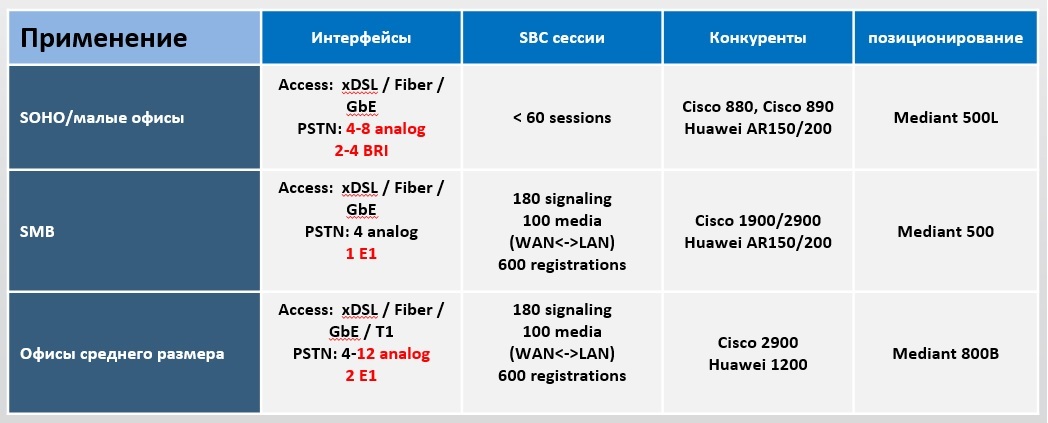
And finally, another comparison table for understanding the positioning of MSBR devices in relation to competitors' solutions.
I’ll try not to delay for a long time and in the near future to draw up and consider several practical examples of using AudioCodes routers in projects of various telecom operators and not only, as well as show configuration examples for some switching schemes.
Have a good connection!
Today a new review - AudioCodes routers. Yes, you were not mistaken and read correctly, namely routers. Life does not stand still, and AudioCodes has long been a pioneer of VoIP and the world-famous brand of voice gateways of all sizes, from one FXS port to several STM-1s, has become a manufacturer of complex and complex solutions not only for the operator, but also for the corporate market . Now in the company's product profile there are more solutions that are not related to the category of “voice gateway” than traditional gateways.
What is an AudioCodes business router?
After a visual inspection of the interfaces, many will say that this is a typical and many familiar gateway Mediant 500, Mediant 800 or Mediant 1000. However, let's take a closer look at all series of devices.
Not all models in these series have analog or digital TDM interfaces. So, it’s not a gateway anymore. Although this statement does not mean that devices without TDM interfaces do not have VoIP support. But first things first. AudioCodes routers are the Mediant 500 / 500L MSBR, Mediant 800 MSBR, and Mediant 1000 MSBR. Each name is a series of devices with different configurations that differ in the presence and number of specific WAN / LAN interfaces and / or TDM interfaces.
The abbreviation MSBR (Multi Service Business Router) is added to the name of ordinary gateways, which speaks of the primary purpose of this type of device as a router. In terms of software (firmware), Mediant and Mediant MSBR are different. However, by replacing the Mediant MSBR firmware, it can turn into a regular voice gateway or SBC, which we wrote about earlier here and here .
Being a router, models with TDM ports simultaneously receive additional voice gateway functionality (from several FXS to 1-2 E1 streams). Models with LAN ports (up to 12 on the Mediant 800 MSBR) are simultaneously a LAN switch, and when using the SBC license, the device also receives SBC functionality. There are models with a built-in WiFi access point. This is not enough, there are models with built-in OSN modules, which are an Intel server. And this feature can be used to install any operating systems and third-party applications or IP-PBX, implementing on the device complex boxed (one device) all-in-one solutions.
Consider an example. In a typical case, when connecting an office to a provider or different offices between themselves, you have to use several devices. Each of these devices performs its function (channel-forming device, router, Firewall, switch, SBC, gateway, QoS / QoE agent, etc.). If you use AudioCodes routers, you do not need to use multiple devices. One of our devices can simultaneously perform some or all of the following roles:
- Channel-forming equipment - various types of WAN interfaces (optics, copper, SHDSL 2/4 wire, E1). You can use up to 3 WAN interfaces simultaneously
- Router with support for static and dynamic routing (RIP1, RIP2, OSPFv2, BGPv4)
- Switch with GE / FE
- Firewall
- Voice gateway
- SIP server or IP-PBX
- Session Border Controller (SBC)
- QoS / QoE agent for voice and data quality control
- Resiliency methods for various voice solutions (SAS, CRP, SBC). Depending on the solution used and the connection scheme, it is possible to build fault-tolerant schemes in different ways (IP-PBX, virtual PBX, TDM backup).
A schematically voiced approach looks like this:
As a result, in the ideal case, you get one device on which all or most of the tasks for ensuring communication in offices are launched and implemented. Typical schemes for office enablements using a SIP trunk and for connecting to the cloud look like this:
All of the above raises many questions about the stability and performance of such an inclusion circuit. Multiservice imposes a ton of performance limitations. How tenacious is this application? How will the device behave when loaded with several functions? Different types of traffic exacerbate the situation: HTTP traffic is characterized by a small number of large packets, voice traffic - by a large number of relatively small packets. What data to use when evaluating performance? Should I use encryption (encryption + a large number of packets leads to CPU utilization up to 50% and higher)? Do transcoding (as you know, performance suffers from this too)? But what if you enable NAT or QoS (these functions alone can reduce packet speeds by more than 80%)?
AudioCodes has the answers to such questions. The Mediant architecture contains several computing resources. We use different CPUs for voice and data processing and our own DSPs. This means that there are separate resources for encryption, transcoding, NAT and QoS processing. As a result, it gives stable performance. The processing of data and voice does not affect each other. And stable performance is an IMPORTANT advantage. And the total figures in assessing performance in the context of the above are not only bits per second, but packets per second (PPS) as well.
Below are some PPS performance test data for some other manufacturers compared to the Mediant 800 for NAT and QoS modes.
Another important issue when talking about routers is its actual ability to route traffic and other traditional router functions. We will not go into lengthy discussions, for the review we will restrict ourselves to basic information, and for details we will direct the reader to the descriptions on the website ( http://www.audiocodes.com/multi-service-business-router-msbr ).
Data Routing
• PPP, MLPPP, PPPoE, PPPoA, L2TP, IPoE, IPoA
• ATM: Up to 8 PVCs
• OAM-F5 (send / receive): loopback, continuity check
• Shaping: UBR, VBR-NRT, VBR-RT, CBR
• DHCP Client, Relay, server
• VLAN, VRF
• Layer 3 routing and Layer 2 bridging, Jumbo frames
• Internal layer 2 switching
• Static and dynamic routing (RIP1, RIP2, OSPFv2, BGPv4), Policy-Based Routing
• Multicast routing: IGMPv2 / 3
• IPv6, IPv6 / IPv4 Dual Stack, ICMPv6, DHCPv6, SLAAC
Data Security
- IPSec, GRE, L2TP
- ESP - Tunnel mode
- Encryption (AES, DES, 3DES)
- Authentication Header
- IKE mode - IPsec VPN
- IDS / IPS:
- Malformed Request
- Ping of Death
- Properly formed request from unauthenticated source
- DDoS attack
- SYN flood
- Stateful packet inspection firewall
- Dmz
- Port trigger
- Packet filtering
- Application layer gateway
All configuration can be done through the command line. The command syntax is not much different from the generally accepted approaches, which have long become the hallmark of other manufacturers. Other management methods are supported:
- Graphical WEB interface for configuration and basic monitoring - active crashes and load schedules
- Command line for technical personnel, scripts for configuration and in-depth technical analysis using Telnet / SSH / serial
- EMS management system to control and manage any AudioCodes product
- Support for automatic updates - the ability to automatically change device configuration files and software versions using HTTP / HTTPS
- Support TR-069
For ease of consideration of the entire line of routers, we present a generalized comparative table of devices of all series.
* Depending on the configuration of a specific device from the series.
And finally, another comparison table for understanding the positioning of MSBR devices in relation to competitors' solutions.
I’ll try not to delay for a long time and in the near future to draw up and consider several practical examples of using AudioCodes routers in projects of various telecom operators and not only, as well as show configuration examples for some switching schemes.
Have a good connection!