Euclidean algorithm for generating traditional musical rhythms
Translation of an article by Godfried Toussaint The Euclidean Algorithm Generates Traditional Musical Rhythms .
In Sonic Pi is a function of spread, which takes two parameters and returns the numerical value set for generating a rhythm. In the description of this function there is a link to the work "The Euclidean Algorithm Generates Traditional Musical Rhythms". This brilliant article, published already in 2005, seems to have never been translated into Russian. Not being a translation specialist, I tried, however, to fill this gap.
A little explanation about the word “necklace”: in the text of the article “necklace” - in musical theory there is no such term, as far as I know. I believe that this is just some kind of visual intuition of the author, indeed, the rhythmic ring, in the form in which it is presented in the drawings, resembles a necklace - that's why I translate it.
The Euclidean algorithm (which came to us from the " Beginnings " of Euclidean) calculates the largest common divisor of two integers. This work demonstrates that the structure of the Euclidean algorithm can be used to very efficiently generate a large family of rhythms used as pulsations ( ostinato ), in particular in the music of tropical Africa, and in traditional music in general. These rhythms, here referred to as Euclidean rhythms, have the property that their percussion patterns are distributed as evenly as possible. Euclideanrhythms also find application in accelerators in atomic physics and computer science, and are closely related to several word families and sequences studied by word combinatorics, such as Euclidean strings with which Euclidean rhythms are compared .
What do African rhythms, fission neutron accelerators (S N S - spallation neutron source) have in common in atomic physics, string theory in computer science, and the ancient algorithm described by Euclid? The short answer is: patterns are distributed as evenly as possible. To get a longer answer, read on.
Mathematics and music are closely related to the time of Pythagoras. However, for the most part, their interaction was in the sphere of tones and scales. For historical examples of such interaction, we will refer the reader to Coxeter's excellent report [9]. On the other hand, the rhythm throughout history has been largely ignored. In this work, we establish certain mathematical connections between musical rhythm and other fields of knowledge, such as atomic physics and computer science, as well as with the work of another famous ancient Greek mathematician, Euclid of Alexandria.
Björklund considers the following problem [5], [4] in connection with the operation of some components (such as high-voltage power sources) of fission neutron accelerators (SNS) used in atomic physics. The time is divided into intervals (in the case of the SNS accelerator, 10 seconds). At some of these intervals, the time system includes a shutter, generating pulses to perform this task. For a given number n of time intervals and another number k < n - the number of pulses, the task is to distribute the pulses as evenly as possible over these intervals. Björklund [5] presents this problem as a binary sequence of k units and n - kzeros, where each number denotes a time interval, and units denote impulses. The task then comes down to the following: construct a binary sequence of n bits with k units, so that the units are evenly distributed among the zeros. If k is completely divisible (without remainder) by n , then the solution is obvious. For example, if n = 16 and k = 4, then the solution is [1 0 0 0 1 0 0 0 1 0 0 0 1 0 0 0]. The problem is of interest when k and n are coprime [23], that is, when k and n do not have common factors other than unity.
We will describe the Björklund algorithm using one of its examples. Consider a sequence with n = 13 and k = 5. Since 13 is 5 = 8, we start by looking at a sequence of 5 units followed by 8 zeros, which can also be represented as 13 sequences from one bit:
[1 1 1 1 1 0 0 0 0 0 0 0 0]
We begin to move the zeros, placing zero after each unit, and we get five sequences of two bits, and three more zeros:
[10] [10] [10] [10] [10 ] [0] [0] [0]
Then we distribute the three remaining zeros in the same way, placing [0] after each sequence [10], and we get:
[100] [100] [100] [10] [10]
Now we have three sequences of three bits each, and two sequences of two bits remain. Therefore, we continue in the same way, placing the sequence [10] after each sequence [100], and we get:
[10010] [10010] [100]
The process ends when the remainder contains only one sequence (in our case, the sequence [100]), or we run out of zeros. The final sequence is thus the concatenation of [10010], [10010] and [100]:
[1 0 0 1 0 1 0 0 1 0 1 0 0]
Note that you can take another step and insert [100] between [10010] and [10010]. However, Björklund argues that since the sequence is cyclic, it does not matter (hence his stopping rule). Björklund [5] proved that the final sequence can be constructed from the original sequence using O (n) arithmetic operations in the worst case.
One of the oldest known algorithms described in the " Beginnings " of Euclid (c. 300 BC) in Proposition 2 of Book VII, which today is called the Euclidean algorithm, finds the largest common divisor of two given integers [12], [14]. The idea is very simple. The smaller of the numbers is sequentially subtracted from the larger until we reach zero, or we get a number that is less than the smaller of the two given numbers, in which case it is called the remainder. This remainder is then sequentially deducted again from a smaller number to obtain a new remainder. This process continues until the remainder is zero. For more specificity, consider the example with the numbers 5 and 8, which we used above. First 8 is divided by 5 with remainder 3. Then 5 is divided by 3 with remainder 2. Then 3 is divided by 2 with remainder 1. Finally 2 is divided by 2 with remainder 0. The largest common factor is thus 1. Although the original Euclidean algorithm used sequential subtraction in this way, regular division will also work, and even faster. The steps of this process can be summarized by the following sequence of equalities:
8 = (1) (5) + 3
5 = (1) (3) + 2
3 = (1) (2) + 1
2 = (1) (2) + 0
This algorithm can be briefly described in a recursive way, as this is done in [8]. Let m and k be initial numbers, where m> k .
EUCLID ( m, k )
1. if k = 0
2. then return m
3. else return EUCLID ( k , m mod k )
Running this algorithm with m = 8 and k = 5, we get:
EUCLID (8.5) = EUCLID (5.3) = EUCLID (3.2) = EUCLID (2.1) = EUCLID (1.0) = 1
From the description of the Euclidean algorithm it is clear that if m and k are equal to the number of zeros and ones, respectively, in a binary sequence (where n = m + k ), then the structure of the Euclidean algorithm is the same as the structure of the Björklund algorithm described above. Indeed, the Björklund algorithm uses division in the form of sequential subtraction, in the same way as Euclid did in the Beginnings [12]. It is also well known that the EUCLID ( m, k ) algorithm , when applied to two O (n) -bit numbers (binary sequences of length n ), will require O (n) arithmetic operations in the worst case [8].
A common method of representing musical rhythms in the form of binary sequences is where each bit is considered a unit of time (for example, a sixteenth note) and the zero bit represents silence (or an unaccented note), while a single bit represents the attack (or beginning) of a note [31 ]. Therefore, the binary sequences generated by the Björklund algorithm as described above can be considered as one family of rhythms. Moreover, since the Björklund algorithm has the same structure as the Euclidean algorithm, we will call these rhythms Euclidean rhythms, and denote them as E (k, n) , where k is the number of units and n is the total length of the sequence (zeros and units). For example, E(5, 13) = [1001010010100]. The notation of zeros and ones is not ideal for representing binary rhythms, since it is difficult to visualize the position of the beats and the length of the interstitial intervals. In musicology literature, the symbol 'x' for a single bit and the symbol 'are commonly used.' for the zero bit. In this more traditional notation, the previous rhythm is written as E (5, 13) = [x .. xx. xx.].
Rhythm E (5, 13) is a cyclic rhythm with a length (size) of 13 beats. This is not the most common size in world music. For contrast, consider two common values of k and n ; namely, what is E(3, 8)? Applying the Euclidean algorithm to the corresponding sequence [1 1 1 0 0 0 0 0], the reader can easily verify that the result will be the Euclidean rhythm E (3, 8) = [x .. x .. x.]. This rhythm is illustrated by the polygon (triangle) in Figure 1 (a), another convenient and common way of representing cyclic rhythms [31], where it is assumed that the rhythm starts at the point designated as “zero”, time moves clockwise, and the numbers clockwise the sides of the triangle indicate the interstitial intervals. In fact, this is an even more compact representation of the rhythm in the form of an interval vector connecting the inter-shock durations [32].
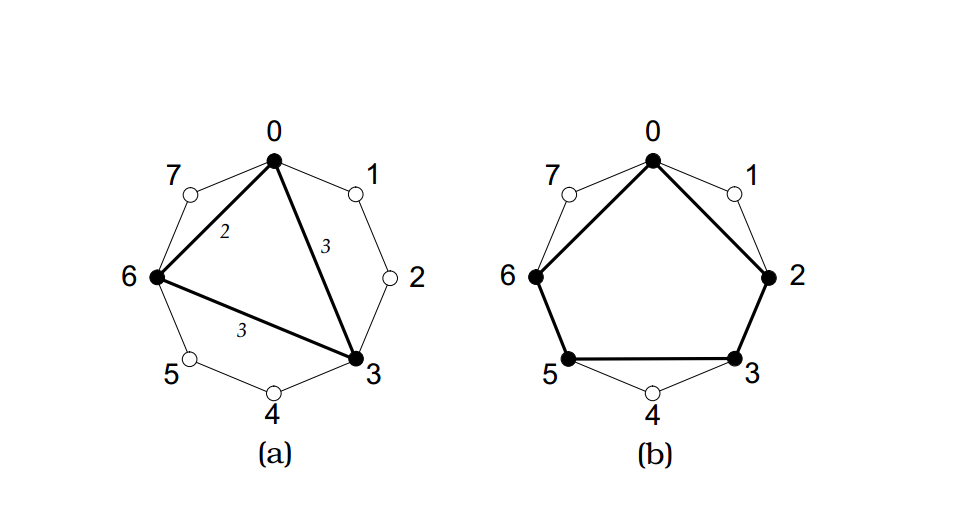
Figure 1: (a) Euclidean rhythm E (3, 8) is the Cuban tresillo , (b) Euclidean rhythm E(5, 8) is a Cuban cinquillo .
The Euclidean rhythm E (3, 8) depicted in Figure 1 (a) is one of the most famous on the planet. In Cuba, it is called tresillo , and in the United States it is known as the Habanera rhythm used in hundreds of rockabilly songs throughout the 1950s. It can often be heard in early rock and roll hits in the figures in the left hand on the keyboard or performed in the part of double bass or saxophone [7], [15], [22]. A good example is the rhythm of the bass part in Elvis Presley's Hound Dog . The tresillo figure is also widespread in West African folk music. For example, she plays the atok e bellin the dance of Sohu and Ew e from Ghana [16]. One can also recognize tresillo in the first measure of the ubiquitous clav e Son , given as [x .. x .. x ... xx. .].
In the two previous examples ( E (5, 13) and E (3, 8)), the number of units is less than the number of zeros. If instead the number of units is greater than the number of zeros, the Björklund algorithm gives the following steps, for example, for k = 5 and n = 8.
[1 1 1 1 1 0 0 0]
[10] [10] [10] [1] [1]
[101] [101] [10]
[1 0 1 1 0 1 1 0]
Euclidean-derived rhythm E(5, 8) = [x. x x xx.]. This rhythm illustrates the polygon (pentagon) in Figure 1 (b). This is another famous rhythm on the world stage. In Cuba, it is known as cinquillo and is internally related to tresillo [15]. It has been used in jazz throughout the 20th century [27], as well as in rockabilly music of the 1950s. For example, this is a drawing of the clapping of hands in Hound Dog by Elvis Presley [7]. The cinquillo figure is also widespread in the traditional music of West Africa [26], [31].
In the remainder of this section, we describe some of the most common Euclidean rhythms in world music. In some cases, the Euclidean rhythm is reversed (rotated, formed by rotation - trans.) version of the widely used rhythm. If the rhythm is reversed version of the other, we say that both belong to the same necklace (necklace). Thus, a rhythm necklace is a model of interstitial durations that does not take into account the starting point of the cycle. An example of two rhythms that are instances of the same necklace is shown in Figure 2.
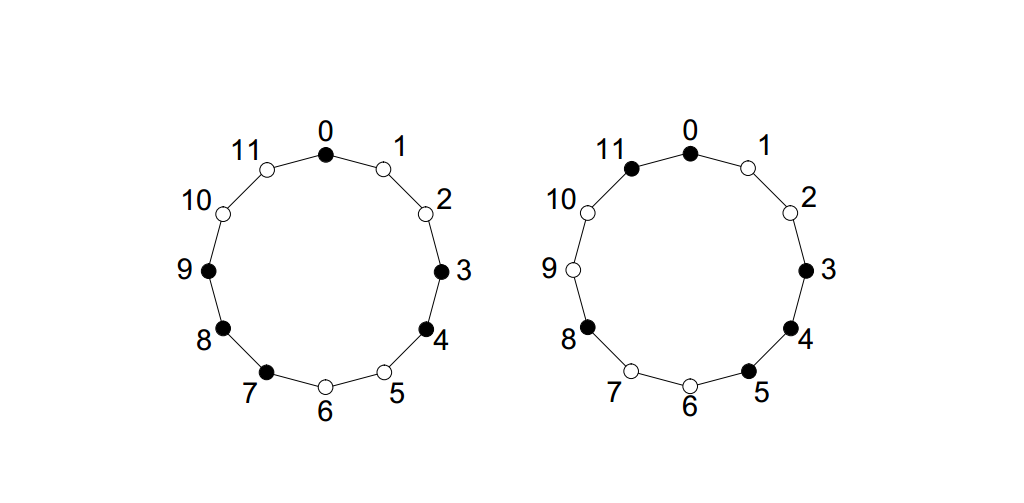
Figure 2. These two rhythms are variants of the same rhythmic necklace.
The simplest rhythms have a value of k = 1. This subfamily of Euclidean rhythms gives:
E (1, 2) = [x.]
E (1, 3) = [x. .]
E (1, 4) = [x ...], Etc.
Note that since we are interested in cyclic non-periodic rhythms, there is no need to list the rhythms in which the factors k and n are used . For example, multiplying (1, 3) by 4, we get (4, 12), which gives the rhythm:
E (4, 12) = [x .. x .. x .. x ..],
which in turn is periodic with four repetitions E (1, 3) = [x. .]. By the way, E (4, 12) = [x .. x .. x .. x. .] Is a 12/8 Fandango pattern in flamenco music in northern Spain, where 'x' stands for loud bang, and '.' soft cotton [10].
E (2, 3) = [x. x] is a common Afro-Cuban percussion figure. For example, it occurs in the rhythm of conga inSwing Tumbao (at a rate of 6/8) [18]. It is also common in Latin American music, such as in Cueca [33].
E (2, 5) = [xx.] Is the 13th century Persian rhythm called Khafif-e-ramal [34]. This is also a metric drawing of the second part of Tchaikovsky's Symphony No. 6 [17]. When it starts with a second accent ([x .. x.]), Then this is a metric figure from Dave Brubeck 's Take Five , as well as from Mars in the Planets by Gustav Holst [17].
E (3, 4) = [x. xx] is the archetypal ripple of Cumbia from Colombia [20], as well as the rhythm of Calypsofrom Trinidad [13]. This is also a 13th-century Persian rhythm called Khalif-e-saghil [34], and a rhythmic trochoid choreic pattern from ancient Greece [21].
E (3, 5) = [xx x], when it begins on the second accented beat - this is another Persian rhythm of the thirteenth century, called Khafif-e-ramal [34], as well as the rhythm of Romanian folk dance [25].
E (3, 7) = [xxx.] - this is the rhythm of Ruchenitza used in Bulgarian folk dance [24]. This is also a metric drawing in Money Pink Floyd.
E (3, 8) = [x .. x .. x.] Is the Cuban tresillo pattern that we discussed above [15].
E (4, 7) = [xxx x] - this is another version of the rhythm of the Bulgarian folk dance Ruchenitza [24].
E (4, 9) = [xxxx.] Is the Turkish rhythm of Aksak [6]. This is also a metric drawing used by Dave Brubeck in the play Rondo a la Turk [17].
E (4, 11) = [x .. x .. x .. x.] Is the metric figure used by Frank Zappa in his play called Outsid e Now [17].
E (5, 6) = [x. xxxx] gives a drawing of York-Samai , a popular Arabic rhythm when it begins on a second accented beat [30].
E (5, 7) = [x. x x xx] is a drawing of Nawakhat, another popular arabic rhythm [30].
E (5, 8) = [x. x x xx.] is the Cuban cinquillo rhythm discussed above [15]. When it begins with a second accent, it is also the Spanish tango [13] and the thirteenth-century Persian rhythm Al-saghilal-sani [34].
E (5.9) = [xxxx x] is the popular Arabic rhythm Agsag-Samai [30]. When it begins on the second accented beat, it is the drum pattern used by Venda in South Africa [26], as well as the Romanian folk dance rhythm [25].
E (5.11) = [xxxxx.] Is the metric design used by Mussorgsky in “ Pictures from the Exhibition ” [17].
E(5,12) = [x .. xx. x. x.] is a drawing of Venda claps from a South African children's song [24].
E (5.16) = [x .. x .. x .. x .. x ....] Is the rhythmic necklace of the Brazilian bossa nova . Usually the bossa nova’s rhythm begins on the third accented beat as follows: [x .. x .. x ... x .. x. .] [31]. However, there are other starting points, such as [x .. x .. x .. x ... x. .] [3].
E (7.8) = [x. xxxxxx] is a typical rhythm performed on Bendir (the frame drum) and used as accompaniment in Tuareg songs in Libya [30].
E (7,12) = [x. x xx x x. x.] is a typical drawing of a West African bell. For example, it is used in the rhythm of Mpr eAshanti in Ghana [32].
E (7.16) = [x .. xxx. xx x.] is a rhythmic samba necklace from Brazil. The rhythm of samba [xx. xxx. x. x.] is obtained if you start E (7.16) on the last beat. When E (7.16) begins on the fifth accented beat, it is a pattern of pops from Ghana [24].
E (9.16) = [x. x xxx x xx x.] is a necklace of rhythms from the Central African Republic [2]. When it begins on the fourth beat, this is the rhythm performed in West and Central Africa [15], as well as the drawing of the kau-bell in the Brazilian samba [29]. When it starts on the penultimate beat, this is a bell drawing from Ngbaka-Maibo rhythmsin the Central African Republic [2].
E (11.24) = [x .. xxxxx. xxxx x.] is a necklace of rhythms of aka pygmies from Central Africa [2]. It usually starts on the seventh lobe.
E (13.24) = [x. x xxxxx x xxxx x.] This is another necklace of aka pygmy rhythms from the upper Sang [2]. It usually starts on a fourth beat.
In the study of the combinatorics of words and sequences, there is a family of strings called Euclidean strings [11]. In this section, we examine the relationship that exists between Euclidean strings and Euclidean rhythms. We will use the terminology and notation introduced in [11].

Figure 3: Two right turns of a Bembé string : a) Bembé b) a rotation by one division c) a rotation by seven divisions
Let P = (p 0 , p 1 , ..., p n − 1 ) denote a string of positive integers. Let ρ (P) denote the rotation of P one position to the right, i.e., ρ (P) = (p n − 1 , p 0, p 1 , ..., p n − 2 ) , and let ρ d (P) denote the rotation of P to the right by d positions. Figure 3 illustrates the ρ (P) operator with P equivalent to the Bembé bell rhythm in West Africa [32]. Figure 3 (a) shows the rhythm of the Bembé bell , figure 3 (b) shows ρ (P) , this is the rhythm of pops from West Africa [24], and Figure 3 © shows ρ 7 (P) , which is the rhythm of Tambú from Curacao [28 ].
Ellis et al. [11] define the string P = (p 0, p 1 , ..., p n − 1 ) as a Euclidean string , if increasing p 0 by one and decreasing p n − 1 by one gives a new line, denoted as τ (P) , which is the rotation of P , i.e. ., P and τ (P) are instances of the same necklace. Thus, if we represent rhythms as binary sequences, Euclidean rhythms cannot be Euclidean strings, because due to the properties of the algorithm used, all Euclidean rhythms begin with one. Increase p 0one will make a double out of it, and the string will cease to be a binary sequence. Therefore, in order to investigate the relationship between Euclidean strings and Euclidean rhythms, here we will present rhythms by connecting inter-impact durations of interval vectors (interval vectors for short), which also form strings of non-negative integers. As an example, consider the Turkish rhythm Aksak [6] defined as E (4.9) = [xxxx.]. In the interval-vector notation, we get that E (4.9) = (2223). Now τ (2223) = (3222), which is the rotation of E (4,9), and is thus a Euclidean string. In fact, for P = E(4.9), τ (P) = ρ 3 (P) . As a second example, consider the West African clap rhythm shown in Figure 3 (b) and defined by P = (1221222). We see that τ (P) = (2221221) = ρ 6 (P) , the figure depicted in Figure 3 ©, which is also a mirror image of P along the (0.6) axis. Thus, P is a Euclidean string. However, note that P is not a Euclidean rhythm. However, P is the rotation of the Euclidean rhythm E (7,12) = (2122122).
Ellis et al. [11] receive many excellent results regarding Euclidean strings. They show that Euclidean strings exist if and only if n and (p 0 , p 1 , ..., p n − 1 ) are coprime, and that when they exist, they are unique. They also show how to create Euclidean strings using an algorithm that has the same structure as the Euclidean algorithm. In addition, they correlate Euclidean strings with many other families of sequences studied in the combinatorics of words [1], [19].
Let R (P) denote the inverse of P (mirror reflection), i.e., R (P) = (p n − 1, p n − 2 , ..., p 1 , p 0 ) . For example, for the Aksak rhythm , where P = (2223), we get R (P) = (3222), that is, R (P) implies the performance of the P rhythm backward starting from the same beat . Now we can determine which of the Euclidean rhythms used in the music of the world listed above are Euclidean strings or reverseEuclidean strings. The length of a Euclidean string is determined by the number of numbers included in it. In the sphere of rhythms, this is the number of accented beats that the rhythm contains. In addition, it is obvious that single character strings are Euclidean strings. Thus, all trivial Euclidean rhythms with one accented beat, such as E (1,2) = [x. ] = (2), E (1,3) = [x. .] = (3), and E(1,4) = [x ...] = (4), etc., are both Euclidean strings and inverse Euclidean strings. In the following list, Euclidean rhythms are shown both in traditional notation and in the interval-vector representation. Music styles that use these rhythms are also listed. Finally, if only the reverse version of the Euclidean rhythm is performed, it is included in the list, but is described as a necklace.
The following Euclidean rhythms are Euclidean strings:
E (2,5) = [xx.] = (23) (classical music, jazz, and Persian music).
E (3,7) = [xxx.] = (223) (Bulgarian folk music).
E (4.9) = [xxxx.] = (2223) (Turkish).
E (5.11) = [xxxxx.] = (22223) (classical music).
E(5.16) = [x .. x .. x .. x .. x ....] = (33334) (Brazilian necklace).
The following Euclidean rhythms are inverse Euclidean strings:
E (2,3) = [x. x] = (21) (West Africa, Latin America).
E (3,4) = [x. xx] = (211) (Trinidad, Persia).
E (3,5) = [xx x] = (221) (Romanian and Persian necklaces).
E (3.8) = [x .. x .. x.] = (332) (West Africa).
E (4.7) = [xxx x] = (2221) (Bulgaria).
E (4.11) = [x .. x .. x .. x.] = (3332) (Frank Zappa).
E (5,6) = [x. xxxx] = (21111) (Arabic music).
E (5.7) = [x. x x xx] = (21211) (Arabic music).
E(5.9) = [xxxx x] = (22221) (Arabic rhythms, South African and Romanian necklaces).
E (5,12) = [x .. xx. x. x.] = (32322) (South Africa).
E (7.8) = [x. xxxxxx] = (2111111) (Tuareg rhythm in Libya).
E (7.16) = [x .. xxx. xx x.] = (3223222) (Brazilian necklace).
E (11.24) = [x .. xxxxx. xxxx x.] = (32222322222) (Central Africa).
The following Euclidean rhythms are neither Euclidean nor inverse Euclidean strings:
E (5.8) = [x. x x xx.] = (21212) (West Africa).
E (7,12) = [x. x xx x x. x.] = (2122122) (West Africa).
E(9.16) = [x. x xxx x xx x.] = (212221222) (West and Central Africa, and Brazilian necklaces).
E (13.24) = [x. x xxxxx x xxxx x.] = (212222212222222) (Central African necklace).
We described a new family of musical rhythms called Euclidean rhythms, which can be obtained using the Björklund algorithm for generating sequences that has the same structure as the Euclidean algorithm. It has been shown that many of the rhythms used in world music are Euclidean rhythms. Some of these Euclidean rhythms are also Euclidean strings [11].
The three groups of Euclidean rhythms presented in the previous section reveal an attractive pattern. Those Euclidean rhythms that are also Euclidean strings (the first four from the first group) are used in classical music, jazz, Bulgarian, Turkish and Persian music, but are not popular in African music. Euclidean rhythms, which are neither Euclidean strings nor inverted Euclidean strings (the first two of the third group), are used only in the music of Black Africa. Finally, Euclidean rhythms, which are reverse Euclidean strings (second group), seem to have much greater appeal. The search for musicological explanations for the obvious preferences of these mathematical properties gives rise to an interesting ethno-musicological problem.
The Euclidean lines described in [11] define another family of rhythms, many of which are also used in world music, but are not necessarily Euclidean rhythms, such as (1221222), the Afro-Cuban bell rhythm. Thus, it would be interesting to empirically investigate the relationship between Euclidean strings and rhythms in world music, and formally determine the exact mathematical relationship between Euclidean rhythms and Euclidean strings.
From translator
In Sonic Pi is a function of spread, which takes two parameters and returns the numerical value set for generating a rhythm. In the description of this function there is a link to the work "The Euclidean Algorithm Generates Traditional Musical Rhythms". This brilliant article, published already in 2005, seems to have never been translated into Russian. Not being a translation specialist, I tried, however, to fill this gap.
A little explanation about the word “necklace”: in the text of the article “necklace” - in musical theory there is no such term, as far as I know. I believe that this is just some kind of visual intuition of the author, indeed, the rhythmic ring, in the form in which it is presented in the drawings, resembles a necklace - that's why I translate it.
Abstract
The Euclidean algorithm (which came to us from the " Beginnings " of Euclidean) calculates the largest common divisor of two integers. This work demonstrates that the structure of the Euclidean algorithm can be used to very efficiently generate a large family of rhythms used as pulsations ( ostinato ), in particular in the music of tropical Africa, and in traditional music in general. These rhythms, here referred to as Euclidean rhythms, have the property that their percussion patterns are distributed as evenly as possible. Euclideanrhythms also find application in accelerators in atomic physics and computer science, and are closely related to several word families and sequences studied by word combinatorics, such as Euclidean strings with which Euclidean rhythms are compared .
1. Introduction
What do African rhythms, fission neutron accelerators (S N S - spallation neutron source) have in common in atomic physics, string theory in computer science, and the ancient algorithm described by Euclid? The short answer is: patterns are distributed as evenly as possible. To get a longer answer, read on.
Mathematics and music are closely related to the time of Pythagoras. However, for the most part, their interaction was in the sphere of tones and scales. For historical examples of such interaction, we will refer the reader to Coxeter's excellent report [9]. On the other hand, the rhythm throughout history has been largely ignored. In this work, we establish certain mathematical connections between musical rhythm and other fields of knowledge, such as atomic physics and computer science, as well as with the work of another famous ancient Greek mathematician, Euclid of Alexandria.
2. Time systems in neutron accelerators
Björklund considers the following problem [5], [4] in connection with the operation of some components (such as high-voltage power sources) of fission neutron accelerators (SNS) used in atomic physics. The time is divided into intervals (in the case of the SNS accelerator, 10 seconds). At some of these intervals, the time system includes a shutter, generating pulses to perform this task. For a given number n of time intervals and another number k < n - the number of pulses, the task is to distribute the pulses as evenly as possible over these intervals. Björklund [5] presents this problem as a binary sequence of k units and n - kzeros, where each number denotes a time interval, and units denote impulses. The task then comes down to the following: construct a binary sequence of n bits with k units, so that the units are evenly distributed among the zeros. If k is completely divisible (without remainder) by n , then the solution is obvious. For example, if n = 16 and k = 4, then the solution is [1 0 0 0 1 0 0 0 1 0 0 0 1 0 0 0]. The problem is of interest when k and n are coprime [23], that is, when k and n do not have common factors other than unity.
We will describe the Björklund algorithm using one of its examples. Consider a sequence with n = 13 and k = 5. Since 13 is 5 = 8, we start by looking at a sequence of 5 units followed by 8 zeros, which can also be represented as 13 sequences from one bit:
[1 1 1 1 1 0 0 0 0 0 0 0 0]
We begin to move the zeros, placing zero after each unit, and we get five sequences of two bits, and three more zeros:
[10] [10] [10] [10] [10 ] [0] [0] [0]
Then we distribute the three remaining zeros in the same way, placing [0] after each sequence [10], and we get:
[100] [100] [100] [10] [10]
Now we have three sequences of three bits each, and two sequences of two bits remain. Therefore, we continue in the same way, placing the sequence [10] after each sequence [100], and we get:
[10010] [10010] [100]
The process ends when the remainder contains only one sequence (in our case, the sequence [100]), or we run out of zeros. The final sequence is thus the concatenation of [10010], [10010] and [100]:
[1 0 0 1 0 1 0 0 1 0 1 0 0]
Note that you can take another step and insert [100] between [10010] and [10010]. However, Björklund argues that since the sequence is cyclic, it does not matter (hence his stopping rule). Björklund [5] proved that the final sequence can be constructed from the original sequence using O (n) arithmetic operations in the worst case.
3. Euclidean algorithm
One of the oldest known algorithms described in the " Beginnings " of Euclid (c. 300 BC) in Proposition 2 of Book VII, which today is called the Euclidean algorithm, finds the largest common divisor of two given integers [12], [14]. The idea is very simple. The smaller of the numbers is sequentially subtracted from the larger until we reach zero, or we get a number that is less than the smaller of the two given numbers, in which case it is called the remainder. This remainder is then sequentially deducted again from a smaller number to obtain a new remainder. This process continues until the remainder is zero. For more specificity, consider the example with the numbers 5 and 8, which we used above. First 8 is divided by 5 with remainder 3. Then 5 is divided by 3 with remainder 2. Then 3 is divided by 2 with remainder 1. Finally 2 is divided by 2 with remainder 0. The largest common factor is thus 1. Although the original Euclidean algorithm used sequential subtraction in this way, regular division will also work, and even faster. The steps of this process can be summarized by the following sequence of equalities:
8 = (1) (5) + 3
5 = (1) (3) + 2
3 = (1) (2) + 1
2 = (1) (2) + 0
This algorithm can be briefly described in a recursive way, as this is done in [8]. Let m and k be initial numbers, where m> k .
EUCLID ( m, k )
1. if k = 0
2. then return m
3. else return EUCLID ( k , m mod k )
Running this algorithm with m = 8 and k = 5, we get:
EUCLID (8.5) = EUCLID (5.3) = EUCLID (3.2) = EUCLID (2.1) = EUCLID (1.0) = 1
From the description of the Euclidean algorithm it is clear that if m and k are equal to the number of zeros and ones, respectively, in a binary sequence (where n = m + k ), then the structure of the Euclidean algorithm is the same as the structure of the Björklund algorithm described above. Indeed, the Björklund algorithm uses division in the form of sequential subtraction, in the same way as Euclid did in the Beginnings [12]. It is also well known that the EUCLID ( m, k ) algorithm , when applied to two O (n) -bit numbers (binary sequences of length n ), will require O (n) arithmetic operations in the worst case [8].
4. Euclidean rhythms in traditional ethnic music
A common method of representing musical rhythms in the form of binary sequences is where each bit is considered a unit of time (for example, a sixteenth note) and the zero bit represents silence (or an unaccented note), while a single bit represents the attack (or beginning) of a note [31 ]. Therefore, the binary sequences generated by the Björklund algorithm as described above can be considered as one family of rhythms. Moreover, since the Björklund algorithm has the same structure as the Euclidean algorithm, we will call these rhythms Euclidean rhythms, and denote them as E (k, n) , where k is the number of units and n is the total length of the sequence (zeros and units). For example, E(5, 13) = [1001010010100]. The notation of zeros and ones is not ideal for representing binary rhythms, since it is difficult to visualize the position of the beats and the length of the interstitial intervals. In musicology literature, the symbol 'x' for a single bit and the symbol 'are commonly used.' for the zero bit. In this more traditional notation, the previous rhythm is written as E (5, 13) = [x .. xx. xx.].
Rhythm E (5, 13) is a cyclic rhythm with a length (size) of 13 beats. This is not the most common size in world music. For contrast, consider two common values of k and n ; namely, what is E(3, 8)? Applying the Euclidean algorithm to the corresponding sequence [1 1 1 0 0 0 0 0], the reader can easily verify that the result will be the Euclidean rhythm E (3, 8) = [x .. x .. x.]. This rhythm is illustrated by the polygon (triangle) in Figure 1 (a), another convenient and common way of representing cyclic rhythms [31], where it is assumed that the rhythm starts at the point designated as “zero”, time moves clockwise, and the numbers clockwise the sides of the triangle indicate the interstitial intervals. In fact, this is an even more compact representation of the rhythm in the form of an interval vector connecting the inter-shock durations [32].
Figure 1: (a) Euclidean rhythm E (3, 8) is the Cuban tresillo , (b) Euclidean rhythm E(5, 8) is a Cuban cinquillo .
The Euclidean rhythm E (3, 8) depicted in Figure 1 (a) is one of the most famous on the planet. In Cuba, it is called tresillo , and in the United States it is known as the Habanera rhythm used in hundreds of rockabilly songs throughout the 1950s. It can often be heard in early rock and roll hits in the figures in the left hand on the keyboard or performed in the part of double bass or saxophone [7], [15], [22]. A good example is the rhythm of the bass part in Elvis Presley's Hound Dog . The tresillo figure is also widespread in West African folk music. For example, she plays the atok e bellin the dance of Sohu and Ew e from Ghana [16]. One can also recognize tresillo in the first measure of the ubiquitous clav e Son , given as [x .. x .. x ... xx. .].
In the two previous examples ( E (5, 13) and E (3, 8)), the number of units is less than the number of zeros. If instead the number of units is greater than the number of zeros, the Björklund algorithm gives the following steps, for example, for k = 5 and n = 8.
[1 1 1 1 1 0 0 0]
[10] [10] [10] [1] [1]
[101] [101] [10]
[1 0 1 1 0 1 1 0]
Euclidean-derived rhythm E(5, 8) = [x. x x xx.]. This rhythm illustrates the polygon (pentagon) in Figure 1 (b). This is another famous rhythm on the world stage. In Cuba, it is known as cinquillo and is internally related to tresillo [15]. It has been used in jazz throughout the 20th century [27], as well as in rockabilly music of the 1950s. For example, this is a drawing of the clapping of hands in Hound Dog by Elvis Presley [7]. The cinquillo figure is also widespread in the traditional music of West Africa [26], [31].
In the remainder of this section, we describe some of the most common Euclidean rhythms in world music. In some cases, the Euclidean rhythm is reversed (rotated, formed by rotation - trans.) version of the widely used rhythm. If the rhythm is reversed version of the other, we say that both belong to the same necklace (necklace). Thus, a rhythm necklace is a model of interstitial durations that does not take into account the starting point of the cycle. An example of two rhythms that are instances of the same necklace is shown in Figure 2.
Figure 2. These two rhythms are variants of the same rhythmic necklace.
The simplest rhythms have a value of k = 1. This subfamily of Euclidean rhythms gives:
E (1, 2) = [x.]
E (1, 3) = [x. .]
E (1, 4) = [x ...], Etc.
Note that since we are interested in cyclic non-periodic rhythms, there is no need to list the rhythms in which the factors k and n are used . For example, multiplying (1, 3) by 4, we get (4, 12), which gives the rhythm:
E (4, 12) = [x .. x .. x .. x ..],
which in turn is periodic with four repetitions E (1, 3) = [x. .]. By the way, E (4, 12) = [x .. x .. x .. x. .] Is a 12/8 Fandango pattern in flamenco music in northern Spain, where 'x' stands for loud bang, and '.' soft cotton [10].
E (2, 3) = [x. x] is a common Afro-Cuban percussion figure. For example, it occurs in the rhythm of conga inSwing Tumbao (at a rate of 6/8) [18]. It is also common in Latin American music, such as in Cueca [33].
E (2, 5) = [xx.] Is the 13th century Persian rhythm called Khafif-e-ramal [34]. This is also a metric drawing of the second part of Tchaikovsky's Symphony No. 6 [17]. When it starts with a second accent ([x .. x.]), Then this is a metric figure from Dave Brubeck 's Take Five , as well as from Mars in the Planets by Gustav Holst [17].
E (3, 4) = [x. xx] is the archetypal ripple of Cumbia from Colombia [20], as well as the rhythm of Calypsofrom Trinidad [13]. This is also a 13th-century Persian rhythm called Khalif-e-saghil [34], and a rhythmic trochoid choreic pattern from ancient Greece [21].
E (3, 5) = [xx x], when it begins on the second accented beat - this is another Persian rhythm of the thirteenth century, called Khafif-e-ramal [34], as well as the rhythm of Romanian folk dance [25].
E (3, 7) = [xxx.] - this is the rhythm of Ruchenitza used in Bulgarian folk dance [24]. This is also a metric drawing in Money Pink Floyd.
E (3, 8) = [x .. x .. x.] Is the Cuban tresillo pattern that we discussed above [15].
E (4, 7) = [xxx x] - this is another version of the rhythm of the Bulgarian folk dance Ruchenitza [24].
E (4, 9) = [xxxx.] Is the Turkish rhythm of Aksak [6]. This is also a metric drawing used by Dave Brubeck in the play Rondo a la Turk [17].
E (4, 11) = [x .. x .. x .. x.] Is the metric figure used by Frank Zappa in his play called Outsid e Now [17].
E (5, 6) = [x. xxxx] gives a drawing of York-Samai , a popular Arabic rhythm when it begins on a second accented beat [30].
E (5, 7) = [x. x x xx] is a drawing of Nawakhat, another popular arabic rhythm [30].
E (5, 8) = [x. x x xx.] is the Cuban cinquillo rhythm discussed above [15]. When it begins with a second accent, it is also the Spanish tango [13] and the thirteenth-century Persian rhythm Al-saghilal-sani [34].
E (5.9) = [xxxx x] is the popular Arabic rhythm Agsag-Samai [30]. When it begins on the second accented beat, it is the drum pattern used by Venda in South Africa [26], as well as the Romanian folk dance rhythm [25].
E (5.11) = [xxxxx.] Is the metric design used by Mussorgsky in “ Pictures from the Exhibition ” [17].
E(5,12) = [x .. xx. x. x.] is a drawing of Venda claps from a South African children's song [24].
E (5.16) = [x .. x .. x .. x .. x ....] Is the rhythmic necklace of the Brazilian bossa nova . Usually the bossa nova’s rhythm begins on the third accented beat as follows: [x .. x .. x ... x .. x. .] [31]. However, there are other starting points, such as [x .. x .. x .. x ... x. .] [3].
E (7.8) = [x. xxxxxx] is a typical rhythm performed on Bendir (the frame drum) and used as accompaniment in Tuareg songs in Libya [30].
E (7,12) = [x. x xx x x. x.] is a typical drawing of a West African bell. For example, it is used in the rhythm of Mpr eAshanti in Ghana [32].
E (7.16) = [x .. xxx. xx x.] is a rhythmic samba necklace from Brazil. The rhythm of samba [xx. xxx. x. x.] is obtained if you start E (7.16) on the last beat. When E (7.16) begins on the fifth accented beat, it is a pattern of pops from Ghana [24].
E (9.16) = [x. x xxx x xx x.] is a necklace of rhythms from the Central African Republic [2]. When it begins on the fourth beat, this is the rhythm performed in West and Central Africa [15], as well as the drawing of the kau-bell in the Brazilian samba [29]. When it starts on the penultimate beat, this is a bell drawing from Ngbaka-Maibo rhythmsin the Central African Republic [2].
E (11.24) = [x .. xxxxx. xxxx x.] is a necklace of rhythms of aka pygmies from Central Africa [2]. It usually starts on the seventh lobe.
E (13.24) = [x. x xxxxx x xxxx x.] This is another necklace of aka pygmy rhythms from the upper Sang [2]. It usually starts on a fourth beat.
5. Euclidean strings
In the study of the combinatorics of words and sequences, there is a family of strings called Euclidean strings [11]. In this section, we examine the relationship that exists between Euclidean strings and Euclidean rhythms. We will use the terminology and notation introduced in [11].
Figure 3: Two right turns of a Bembé string : a) Bembé b) a rotation by one division c) a rotation by seven divisions
Let P = (p 0 , p 1 , ..., p n − 1 ) denote a string of positive integers. Let ρ (P) denote the rotation of P one position to the right, i.e., ρ (P) = (p n − 1 , p 0, p 1 , ..., p n − 2 ) , and let ρ d (P) denote the rotation of P to the right by d positions. Figure 3 illustrates the ρ (P) operator with P equivalent to the Bembé bell rhythm in West Africa [32]. Figure 3 (a) shows the rhythm of the Bembé bell , figure 3 (b) shows ρ (P) , this is the rhythm of pops from West Africa [24], and Figure 3 © shows ρ 7 (P) , which is the rhythm of Tambú from Curacao [28 ].
Ellis et al. [11] define the string P = (p 0, p 1 , ..., p n − 1 ) as a Euclidean string , if increasing p 0 by one and decreasing p n − 1 by one gives a new line, denoted as τ (P) , which is the rotation of P , i.e. ., P and τ (P) are instances of the same necklace. Thus, if we represent rhythms as binary sequences, Euclidean rhythms cannot be Euclidean strings, because due to the properties of the algorithm used, all Euclidean rhythms begin with one. Increase p 0one will make a double out of it, and the string will cease to be a binary sequence. Therefore, in order to investigate the relationship between Euclidean strings and Euclidean rhythms, here we will present rhythms by connecting inter-impact durations of interval vectors (interval vectors for short), which also form strings of non-negative integers. As an example, consider the Turkish rhythm Aksak [6] defined as E (4.9) = [xxxx.]. In the interval-vector notation, we get that E (4.9) = (2223). Now τ (2223) = (3222), which is the rotation of E (4,9), and is thus a Euclidean string. In fact, for P = E(4.9), τ (P) = ρ 3 (P) . As a second example, consider the West African clap rhythm shown in Figure 3 (b) and defined by P = (1221222). We see that τ (P) = (2221221) = ρ 6 (P) , the figure depicted in Figure 3 ©, which is also a mirror image of P along the (0.6) axis. Thus, P is a Euclidean string. However, note that P is not a Euclidean rhythm. However, P is the rotation of the Euclidean rhythm E (7,12) = (2122122).
Ellis et al. [11] receive many excellent results regarding Euclidean strings. They show that Euclidean strings exist if and only if n and (p 0 , p 1 , ..., p n − 1 ) are coprime, and that when they exist, they are unique. They also show how to create Euclidean strings using an algorithm that has the same structure as the Euclidean algorithm. In addition, they correlate Euclidean strings with many other families of sequences studied in the combinatorics of words [1], [19].
Let R (P) denote the inverse of P (mirror reflection), i.e., R (P) = (p n − 1, p n − 2 , ..., p 1 , p 0 ) . For example, for the Aksak rhythm , where P = (2223), we get R (P) = (3222), that is, R (P) implies the performance of the P rhythm backward starting from the same beat . Now we can determine which of the Euclidean rhythms used in the music of the world listed above are Euclidean strings or reverseEuclidean strings. The length of a Euclidean string is determined by the number of numbers included in it. In the sphere of rhythms, this is the number of accented beats that the rhythm contains. In addition, it is obvious that single character strings are Euclidean strings. Thus, all trivial Euclidean rhythms with one accented beat, such as E (1,2) = [x. ] = (2), E (1,3) = [x. .] = (3), and E(1,4) = [x ...] = (4), etc., are both Euclidean strings and inverse Euclidean strings. In the following list, Euclidean rhythms are shown both in traditional notation and in the interval-vector representation. Music styles that use these rhythms are also listed. Finally, if only the reverse version of the Euclidean rhythm is performed, it is included in the list, but is described as a necklace.
The following Euclidean rhythms are Euclidean strings:
E (2,5) = [xx.] = (23) (classical music, jazz, and Persian music).
E (3,7) = [xxx.] = (223) (Bulgarian folk music).
E (4.9) = [xxxx.] = (2223) (Turkish).
E (5.11) = [xxxxx.] = (22223) (classical music).
E(5.16) = [x .. x .. x .. x .. x ....] = (33334) (Brazilian necklace).
The following Euclidean rhythms are inverse Euclidean strings:
E (2,3) = [x. x] = (21) (West Africa, Latin America).
E (3,4) = [x. xx] = (211) (Trinidad, Persia).
E (3,5) = [xx x] = (221) (Romanian and Persian necklaces).
E (3.8) = [x .. x .. x.] = (332) (West Africa).
E (4.7) = [xxx x] = (2221) (Bulgaria).
E (4.11) = [x .. x .. x .. x.] = (3332) (Frank Zappa).
E (5,6) = [x. xxxx] = (21111) (Arabic music).
E (5.7) = [x. x x xx] = (21211) (Arabic music).
E(5.9) = [xxxx x] = (22221) (Arabic rhythms, South African and Romanian necklaces).
E (5,12) = [x .. xx. x. x.] = (32322) (South Africa).
E (7.8) = [x. xxxxxx] = (2111111) (Tuareg rhythm in Libya).
E (7.16) = [x .. xxx. xx x.] = (3223222) (Brazilian necklace).
E (11.24) = [x .. xxxxx. xxxx x.] = (32222322222) (Central Africa).
The following Euclidean rhythms are neither Euclidean nor inverse Euclidean strings:
E (5.8) = [x. x x xx.] = (21212) (West Africa).
E (7,12) = [x. x xx x x. x.] = (2122122) (West Africa).
E(9.16) = [x. x xxx x xx x.] = (212221222) (West and Central Africa, and Brazilian necklaces).
E (13.24) = [x. x xxxxx x xxxx x.] = (212222212222222) (Central African necklace).
6. Concluding observations
We described a new family of musical rhythms called Euclidean rhythms, which can be obtained using the Björklund algorithm for generating sequences that has the same structure as the Euclidean algorithm. It has been shown that many of the rhythms used in world music are Euclidean rhythms. Some of these Euclidean rhythms are also Euclidean strings [11].
The three groups of Euclidean rhythms presented in the previous section reveal an attractive pattern. Those Euclidean rhythms that are also Euclidean strings (the first four from the first group) are used in classical music, jazz, Bulgarian, Turkish and Persian music, but are not popular in African music. Euclidean rhythms, which are neither Euclidean strings nor inverted Euclidean strings (the first two of the third group), are used only in the music of Black Africa. Finally, Euclidean rhythms, which are reverse Euclidean strings (second group), seem to have much greater appeal. The search for musicological explanations for the obvious preferences of these mathematical properties gives rise to an interesting ethno-musicological problem.
The Euclidean lines described in [11] define another family of rhythms, many of which are also used in world music, but are not necessarily Euclidean rhythms, such as (1221222), the Afro-Cuban bell rhythm. Thus, it would be interesting to empirically investigate the relationship between Euclidean strings and rhythms in world music, and formally determine the exact mathematical relationship between Euclidean rhythms and Euclidean strings.
Bibliography
[1] J.-P. Allouche and J. O. Shallit. Automatic Sequences. Cambridge University Press, Cambridge, England, 2002.
[2] Simha Arom. African Polyphony and Polyrhythm. Cambridge University Press, Cambridge, England, 1991.
[3] Gerard Behague. Bossa and bossas: recent changes in Brazilian urban popular music. Ethnomusicology, 17(2):209–233, 1973.
[4] E. Bjorklund. A metric for measuring the evenness of timing system rep-rate patterns. SNS ASD Technical Note SNS-NOTE-CNTRL-100, Los Alamos National Laboratory, Los Alamos, U.S.A., 2003.
[5] E. Bjorklund. The theory of rep-rate pattern generation in the SNS timing system. SNS ASD Technical Note SNS-NOTE-CNTRL-99, Los Alamos National Laboratory, Los Alamos, U.S.A., 2003.
[6] C. Brauloiu. Le rythme aksak. Revue de Musicologie, 23:71–108, 1952.
[7] Roy Brewer. The use of Habanera rhythm in rockabilly music. American Music, 17:300–317, Autumn 1999.
[8] Thomas H. Cormen, Charles E. Leiserson, Ronald L. Rivest, and Clifford Stein. Introduction to Algorithms. The MIT Press, Cambridge, Massachussetts, 2001.
[9] H. S. M. Coxeter. Music and mathematics. The Canadian Music Journal, VI:13–24, 1962.
[10] Miguel Díaz-Bañez, Giovanna Farigu, Francisco Gómez, David Rappaport, and Godfried T. Toussaint. El compás flamenco: a phylogenetic analysis. In Proceedings of BRIDGES: Mathematical Connections in Art, Music and Science, Southwestern College, Winfield, Kansas, July 30 — August 1 2004.
[11] John Ellis, Frank Ruskey, Joe Sawada, and Jamie Simpson. Euclidean strings. Theoretical Computer Science, 301:321–340, 2003.
[12] Euclid. Elements. Dover, 1956. Translated by Sir Thomas L. Heath.
[13] Bob Evans. Authentic Conga Rhythms. Belwin Mills Publishing Corporation, Miami, 1966.
[14] Philip Franklin. The Euclidean algorithm. The American Mathematical Monthly, 63(9):663–664, November 1956.
[15] S. A. Floyd Jr. Black music in the circum-Caribbean. American Music, 17(1):1–38, 1999.
[16] R. Kauffman. African rhythm: A reassessment. Ethnomusicology, 24(3):393–415, Sept. 1980.
[17] Michael Keith. From Polychords to Pólya: Adventures in Musical Combinatorics. Vinculum Press, Princeton, 1991.
[18] Töm Klöwer. The Joy of Drumming: Drums and Percussion Instruments from Around the World. Binkey Kok Publications, Diever, Holland, 1997.
[19] M. Lothaire. Algebraic Combinatorics on Words. Cambridge University Press, Cambridge, England, 2002.
[20] Peter Manuel. The anticipated bass in Cuban popular music. Latin American Music Review, 6(2):249–261, Autumn-Winter 1985.
[21] Thomas J. Mathiesen. Rhythm and meter in ancient Greek music. Music Theory Spectrum, 7:159–180, Spring 1985.
[22] Craig Morrison. Go Cat Go: Rockabilly Music and Its Makers. University of Illinois Press, Urbana, 1996.
[23] C. Stanley Ogilvy and John T. Anderson. Excursions in Number Theory. Oxford University Press, New York, 1966.
[24] Jeff Pressing. Cognitive isomorphisms between pitch and rhythm in world musics: West Africa, the Balkans and Western tonality. Studies in Music, 17:38–61, 1983.
[25] Vera Proca-Ciortea. On rhythm in Rumanian folk dance. Yearbook of the International Folk Music Council, 1:176–199, 1969.
[26] Jay Rahn. Asymmetrical ostinatos in sub-saharan music: time, pitch, and cycles reconsidered. In Theory Only, 9(7):23–37, 1987.
[27] Jay Rahn. Turning the analysis around: African-derived rhythms and Europe-derived music theory. Black Music Research Journal, 16(1):71–89, 1996.
[28] Rene V. Rosalia. Migrated Rhythm: The Tambú of Curaçao. CaribSeek, 2002.
[29] Doug Sole. The Soul of Hand Drumming. Mel Bay Productions Inc., Toronto, 1996.
[30] James A. Standifer. The Tuareg: their music and dances. The Black Perspective in Music, 16(1):45–62, Spring 1988.
[31] Godfried T. Toussaint. A mathematical analysis of African, Brazilian, and Cuban clave rhythms. In Proceedings of BRIDGES: Mathematical Connections in Art, Music and Science, pages 157–168, Towson University, Towson, MD, July 27-29 2002.
[32] Godfried T. Toussaint. Classification and phylogenetic analysis of African ternary rhythm timelines. In Proceedings of BRIDGES: Mathematical Connections in Art, Music and Science, pages 25–36, Granada, Spain, July 23-27 2003.
[33] Pedro van der Lee. Zarabanda: esquemas rítmicos de acompañamiento en 6/8. Latin American Music Review, 16(2):199–220, Autumn-Winter 1995.
[34] O. Wright. The Modal System of Arab and Persian Music AD 1250-1300. Oxford University Press, Oxford, England, 1978.
Literature
[1] J.-P. Allouche and J. O. Shallit. Automatic Sequences. Cambridge University Press, Cambridge, England, 2002.
[2] Simha Arom. African Polyphony and Polyrhythm. Cambridge University Press, Cambridge, England, 1991.
[3] Gerard Behague. Bossa and bossas: recent changes in Brazilian urban popular music. Ethnomusicology, 17(2):209–233, 1973.
[4] E. Bjorklund. A metric for measuring the evenness of timing system rep-rate patterns. SNS ASD Technical Note SNS-NOTE-CNTRL-100, Los Alamos National Laboratory, Los Alamos, U.S.A., 2003.
[5] E. Bjorklund. The theory of rep-rate pattern generation in the SNS timing system. SNS ASD Technical Note SNS-NOTE-CNTRL-99, Los Alamos National Laboratory, Los Alamos, U.S.A., 2003.
[6] C. Brauloiu. Le rythme aksak. Revue de Musicologie, 23:71–108, 1952.
[7] Roy Brewer. The use of Habanera rhythm in rockabilly music. American Music, 17:300–317, Autumn 1999.
[8] Thomas H. Cormen, Charles E. Leiserson, Ronald L. Rivest, and Clifford Stein. Introduction to Algorithms. The MIT Press, Cambridge, Massachussetts, 2001.
[9] H. S. M. Coxeter. Music and mathematics. The Canadian Music Journal, VI:13–24, 1962.
[10] Miguel Díaz-Bañez, Giovanna Farigu, Francisco Gómez, David Rappaport, and Godfried T. Toussaint. El compás flamenco: a phylogenetic analysis. In Proceedings of BRIDGES: Mathematical Connections in Art, Music and Science, Southwestern College, Winfield, Kansas, July 30 — August 1 2004.
[11] John Ellis, Frank Ruskey, Joe Sawada, and Jamie Simpson. Euclidean strings. Theoretical Computer Science, 301:321–340, 2003.
[12] Euclid. Elements. Dover, 1956. Translated by Sir Thomas L. Heath.
[13] Bob Evans. Authentic Conga Rhythms. Belwin Mills Publishing Corporation, Miami, 1966.
[14] Philip Franklin. The Euclidean algorithm. The American Mathematical Monthly, 63(9):663–664, November 1956.
[15] S. A. Floyd Jr. Black music in the circum-Caribbean. American Music, 17(1):1–38, 1999.
[16] R. Kauffman. African rhythm: A reassessment. Ethnomusicology, 24(3):393–415, Sept. 1980.
[17] Michael Keith. From Polychords to Pólya: Adventures in Musical Combinatorics. Vinculum Press, Princeton, 1991.
[18] Töm Klöwer. The Joy of Drumming: Drums and Percussion Instruments from Around the World. Binkey Kok Publications, Diever, Holland, 1997.
[19] M. Lothaire. Algebraic Combinatorics on Words. Cambridge University Press, Cambridge, England, 2002.
[20] Peter Manuel. The anticipated bass in Cuban popular music. Latin American Music Review, 6(2):249–261, Autumn-Winter 1985.
[21] Thomas J. Mathiesen. Rhythm and meter in ancient Greek music. Music Theory Spectrum, 7:159–180, Spring 1985.
[22] Craig Morrison. Go Cat Go: Rockabilly Music and Its Makers. University of Illinois Press, Urbana, 1996.
[23] C. Stanley Ogilvy and John T. Anderson. Excursions in Number Theory. Oxford University Press, New York, 1966.
[24] Jeff Pressing. Cognitive isomorphisms between pitch and rhythm in world musics: West Africa, the Balkans and Western tonality. Studies in Music, 17:38–61, 1983.
[25] Vera Proca-Ciortea. On rhythm in Rumanian folk dance. Yearbook of the International Folk Music Council, 1:176–199, 1969.
[26] Jay Rahn. Asymmetrical ostinatos in sub-saharan music: time, pitch, and cycles reconsidered. In Theory Only, 9(7):23–37, 1987.
[27] Jay Rahn. Turning the analysis around: African-derived rhythms and Europe-derived music theory. Black Music Research Journal, 16(1):71–89, 1996.
[28] Rene V. Rosalia. Migrated Rhythm: The Tambú of Curaçao. CaribSeek, 2002.
[29] Doug Sole. The Soul of Hand Drumming. Mel Bay Productions Inc., Toronto, 1996.
[30] James A. Standifer. The Tuareg: their music and dances. The Black Perspective in Music, 16(1):45–62, Spring 1988.
[31] Godfried T. Toussaint. A mathematical analysis of African, Brazilian, and Cuban clave rhythms. In Proceedings of BRIDGES: Mathematical Connections in Art, Music and Science, pages 157–168, Towson University, Towson, MD, July 27-29 2002.
[32] Godfried T. Toussaint. Classification and phylogenetic analysis of African ternary rhythm timelines. In Proceedings of BRIDGES: Mathematical Connections in Art, Music and Science, pages 25–36, Granada, Spain, July 23-27 2003.
[33] Pedro van der Lee. Zarabanda: esquemas rítmicos de acompañamiento en 6/8. Latin American Music Review, 16(2):199–220, Autumn-Winter 1995.
[34] O. Wright. The Modal System of Arab and Persian Music AD 1250-1300. Oxford University Press, Oxford, England, 1978.
Godfrey Toussin
School of Computer Science, McGill University, Montréal, Québec, Canada
[email protected] This
study was supported by NSERC and FCAR