Reqorsa Gene Therapy Shows Promising Results Against Cancer at ASCO 2026
At the annual ASCO 2026 conference, data showed that Reqorsa gene therapy increases immune markers and reduces tumor markers in patients, demonstrating a potential therapeutic effect.
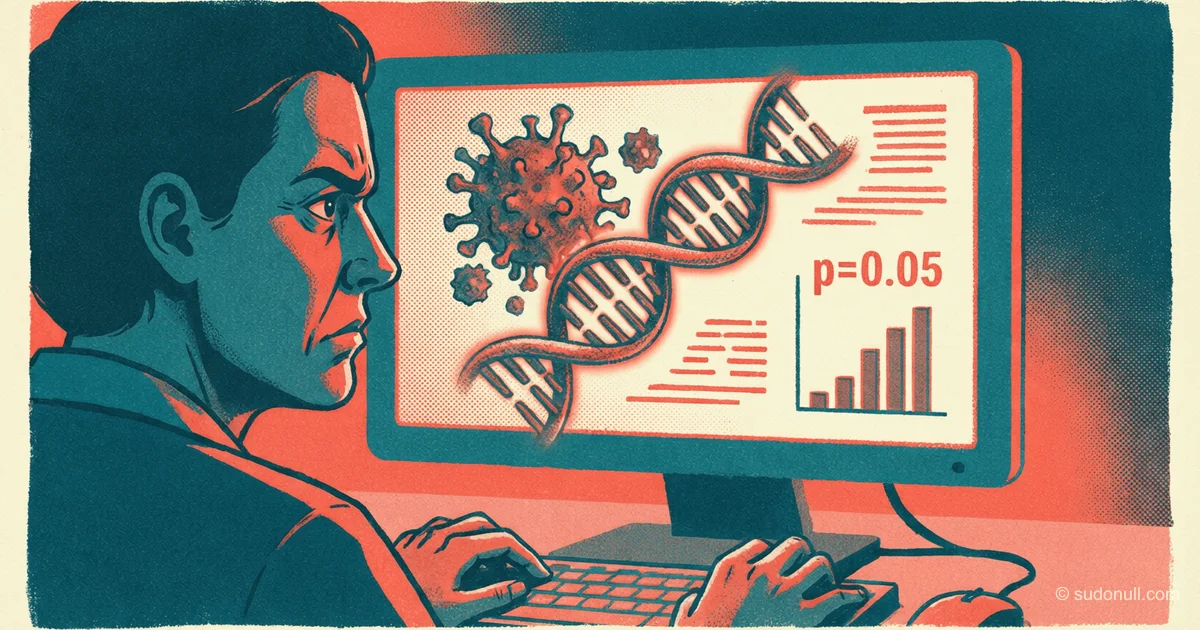
Analytical article: 18 patients, p=0.05, and a billion-dollar bet. Why Reqorsa data from ASCO 2026 is not a breakthrough but the beginning of the end for Genprex
Author: Independent analyst with an insider perspective
Date: 2026-05-28
May 26, 2026, Chicago, ASCO 2026. Genprex presents data on its main asset—Reqorsa gene therapy. Headlines: "promising results," "increase in immune markers," "reduction in tumor markers." It sounds like a promising breakthrough in lung cancer treatment.
I read the press release again. And my stomach sinks. Because I see what ordinary journalists miss: borderline statistical significance (p=0.05 and p=0.03), a sample of 18 patients, no control group. And Genprex's market capitalization, which after this news... did not rise.
Welcome to the reality of clinical development, where "promising results" often mean "we don't have money for a large study, but shareholders need something to show."
[The Gist]: What's Really Happening
What did the data show? Genprex analyzed tumor samples from 18 patients in three clinical trials: Acclaim-1 (Reqorsa + osimertinib in NSCLC), Acclaim-2 (+pembrolizumab), and Acclaim-3 (+atezolizumab in small cell lung cancer).
Result: In patients with non-small cell lung cancer, high Trop-2 protein levels (H-score above 100) correlated with increased progression-free survival (p=0.05). Low PTEN levels (H-score below 100) also correlated (p=0.03).
Sounds scientific. But let's translate from statistics into plain English.
My non-obvious insight: A p-value of 0.05 is the minimum threshold for statistical significance accepted in medicine. But with a sample of 18 patients and multiple biomarkers analyzed (Trop-2, PTEN, and others not mentioned), the probability of a false positive result is catastrophic. If you test 20 hypotheses on one sample, one of them will randomly give p<0.05. This is called "multiple testing," and no serious journal would accept such work without a Bonferroni correction.
And most importantly: this is not data on Reqorsa's efficacy. It is data on biomarkers that may predict response to Reqorsa. The company found a way to say: "Our therapy doesn't work for everyone, but now we know who it works better for." That's good for personalized medicine, but terrible for commercialization. Because it shrinks the potential market from "all NSCLC patients" to "20-30% of patients with high Trop-2 and low PTEN."
Timeline and Context
- September 2021: Start of Acclaim-1 study (NCT04486833). Expected completion: March 2029.
- April 2023: Independent researchers show that TUSC2 (the gene delivered by Reqorsa) acts as a suppressor in glioblastoma. Preclinical, nothing more.
- October 2024: Preclinical data on Reqorsa overcoming resistance to Lumakras (sotorasib). Again preclinical, again not in humans.
- May 2026: ASCO 2026. Data on 18 patients.
Note: The clinical trial started in 2021, and convincing clinical efficacy data have yet to be published. 5 years. 18 patients in the biomarker analysis. That's not just slow—it's suspiciously slow for a company trading on Nasdaq and burning millions of dollars per quarter.
Who Wins and Who Loses
Winners (obvious):
- No patients. Yet. These data do not change clinical practice. To prove that Reqorsa actually extends life, randomized trials with hundreds of patients are needed. They don't exist.
- Genprex (short-term). The press release supported the stock price (GNPX) at a time when the company is likely preparing another funding round.
Winners (non-obvious):
- Competitors in CAR-T and other gene therapies for cancer. While Genprex treads water with NSCLC, other companies (e.g., Chinese groups whose 7 studies were included in oral sessions at ASCO 2026) are moving forward with next-generation CAR-T, including "non-gene-editing" platforms and in vivo CAR-T generation.
- AstraZeneca (Tagrisso/osimertinib). Acclaim-1 is a combination of Reqorsa with Tagrisso. If Reqorsa ever reaches the market, AstraZeneca gets royalties. If not, they lose nothing. A win-win position.
Losers:
- Genprex (long-term). The company is spending resources on biomarker analyses when it needs survival data. Investors see this. Nasdaq: GNPX trades near the company's cash reserves. The market doesn't believe.
- Investors who bought into the "promising results." They will see that completing Phase 3 requires hundreds of millions of dollars, which Genprex doesn't have. Next step: a dilutive funding round or a partnership on unfavorable terms.
What the Media Isn't Saying
First omission: In SCLC data, biomarkers don't work. Trop-2 was "uniformly low and therefore not evaluable." PTEN showed no correlation with survival (p=0.53). This means that for SCLC—a separate program Acclaim-3 with FDA Fast Track Designation—Genprex has no biomarker compass. They are treating blindly.
Second omission: Sample size. 6 NSCLC patients in Acclaim-1. 1 patient in Acclaim-2. 11 SCLC patients in Acclaim-3. These are not clinical trials in the traditional sense. They are expanded case studies. You cannot build a commercialization strategy on such data.
Third, and most important: Genprex is a company on the brink. They have run out of money. Their ONCOPREX platform—a non-viral lipid nanoparticle—is a beautiful technology, but in 10 years of existence, the company has not brought a single product to market. The biomarker analysis on 18 patients is not a breakthrough. It is a cry for help: "Look, we have something that works! Give us money!"
Forecast: Next 30 Days and 90 Days
Next 30 days (by end of June 2026):
Genprex will begin a series of meetings with potential partners—large pharmaceutical companies interested in NSCLC (Merck, Bristol-Myers Squibb, AstraZeneca). They will offer rights to Reqorsa in exchange for Phase 3 funding. With 80% probability, no deal will be struck. Big pharma knows the statistics: >90% of gene therapies for cancer die in Phase 2.
GNPX stock price will likely fall 15-20% within 2-3 weeks after ASCO, when the press release enthusiasm fades and analysts ask uncomfortable questions about sample size and borderline p-values.
Next 90 days (by end of August 2026):
Two scenarios. First (30% probability): Genprex announces a strategic partnership with an Asian pharmaceutical company (Chinese or Korean) that sees TUSC2 therapy as a technology for its market. Deal size: $50-100 million upfront plus royalties. That would fund 12-18 months.
Second (70% probability): Genprex announces a public offering (follow-on) at a 20-30% discount to market. Existing shareholders will be diluted. Top management, including CEO Ryan Confer (who called the data a "substantial leap" in the press release), will receive bonuses for "successful capital raising."
But my personal forecast is pessimistic. Reqorsa is a beautiful idea: restore the lost tumor suppressor gene TUSC2, which is absent in >80% of lung cancer. But idea and therapy are different things. Ionic traps, lipid nanoparticles, intravenous administration—all work in the lab. In humans, there is still no convincing data. And after ASCO 2026, I have no reason to think that will change. Reqorsa will likely become another "promising" technology that dies in Phase 2 due to lack of funding and convincing clinical results. And 18 patients with p=0.05 will remain in memory as the moment when it became clear that the end would never come.
— Editorial Team









No comments yet.