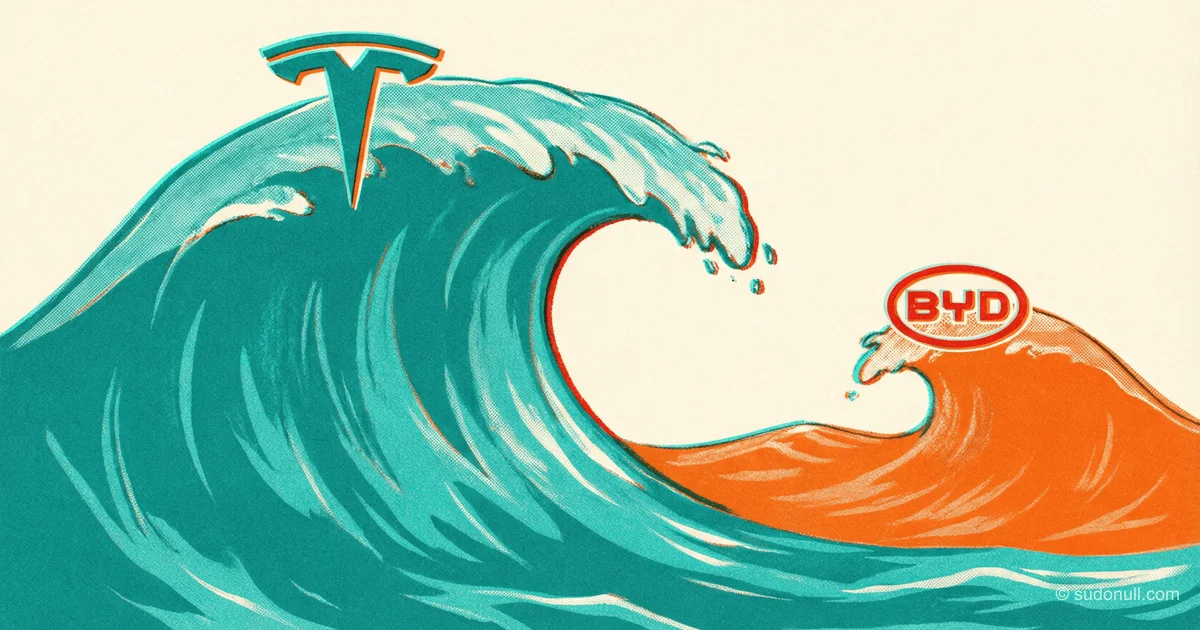
Electric Vehicle Sales in Europe Surge 40%, Led by BYD and Tesla
In April 2026, electric vehicle sales in Europe rose 40% year-on-year: BYD grew 114.5% (27,008 units), while Tesla grew 46.5% (10,654 units).
Analytical article: 27,008 vs 10,654. Why Tesla's 'comeback' in Europe is a mirage against BYD's tsunami
Author: Independent analyst with insider perspective
Date: 2026-05-28
The figures published by ACEA for April look like a celebration for everyone: the European EV market grew 40% year-on-year. Tesla posted +46.5% (10,654 units), BYD +114.5% (27,008 units). Headlines scream: 'Tesla is back!'.
But if you think Tesla and BYD are simply growing together in a growing market, you are deeply mistaken. Numbers lie, and context is everything. An analyst who doesn't look under the hood of this data will miss the tectonic shift that just happened in April 2026.
In reality, we are not witnessing a two-way race, but a 'game of elimination' where one player (Tesla) is boxing with the shadow of its own past-year failure, while the other (BYD) methodically captures territory, pushing out not only the Americans but also the Germans and French.
[The core]: what is really happening
The formal narrative is 'demand recovery' and 'Chinese expansion'. The reality is much harsher: the market is shifting from a model monopoly to an ecosystem war, and Tesla is losing this war strategically.
Note the key detail that mass media ignore: Tesla's 46.5% growth in April is almost entirely due to the 'low base effect'. April 2025 was a disaster for Tesla: a 49% drop, EU market share fell to 0.7% amid consumer boycotts over Elon Musk's political activity and the transition to the updated Model Y. Now they are simply recovering some of what was lost.
BYD, on the other hand, is not growing on a 'low base' but on real market conquest. 27,008 cars in April is more than Model 3 and Model Y combined. And this despite BYD being officially present in Europe for only about a year. Triple-digit growth in Germany in one month (to 4,705 units) is not a statistical fluke; it's an alarm signal for the entire German auto industry.
My non-obvious insight: Everyone looks at absolute sales figures, but no one looks at product mix dynamics. Tesla has two mass-market cars in Europe: Model 3 and Model Y. And the Model Y hasn't received a major update since 2020. BYD already has a full lineup: Seal U (best PHEV in Europe in 2025), Atto 3, Dolphin, the announced Dolphin G DM-i (price under £20,000 in Britain), and new models just coming out.
BYD is not capturing the market with a single 'Tesla killer' but with flanking coverage of all price segments. While Tesla defends the premium-mid segment, BYD enters from below (Dolphin) and above (new premium models), as well as through hybrids, which Tesla simply doesn't have.
Timeline and context
- 2025, full year: Tesla's decline in Europe. Half-year slump linked to Musk boycott and Model Y Juniper.
- April 2025: Tesla's bottom — 0.7% EU market share, 49% drop.
- February 2026: first signs of life — +11.8%.
- March 2026: +84% — easy because March 2025 was bad.
- April 2026 (now): +46.5% — third month of growth. But 10,654 units is still 13% less than in April 2024.
- Meanwhile, January-April 2026: BYD grows in Europe every month. Q1 2026 — 73,847 units in the region (including UK and EFTA), market share 2.1% vs 0.9% a year ago.
Why is April 2026 a turning point? Because in Germany, Europe's largest market, on April 1, 2026, EV subsidies resumed for households with income up to €80,000 (basic subsidy €3,000 plus €500 per child). This German boost lifted EV sales by 41% overall. But who captured these German subsidies? BYD, not Tesla.
Who wins and who loses
Winners (obvious):
- BYD: they are no longer just a 'Chinese competitor'. They have become the second-largest EV brand in Europe after Volkswagen Group. And the gap with Tesla is growing.
- Leapmotor: the Stellantis-controlled Chinese brand posted fivefold growth to 8,745 units. Stellantis was right to shelter the Chinese under its wing — it's their only chance to survive the EV race.
Winners (non-obvious):
- Volkswagen Group. Paradox, right? VW is losing market share, but not for long. Their new SSP platform and budget ID.2 are coming in 2026-2027. Meanwhile, BYD is forcing VW to accelerate and cut prices — this kills 'slow' competitors like Ford and Renault, leaving VW and BYD in the final two.
- Consumers in Germany and France. Subsidies are back, BYD and Tesla prices compete, and model choice is unprecedented. But this 'win' is temporary — once BYD squeezes out competitors, prices will creep up.
Losers:
- Tesla. Paradox: their sales are growing, but they are losing. Losing in market share (1.3% in EU vs 2.2% in 2024) and in growth rate compared to competitors. The EV market grows 40%, Tesla grows 46% — that's not overtaking, it's just holding position on a sinking ship. And this despite Tesla having no new mass-market product since 2020. Robotaxi? Optimus? You can't sell those at a dealership in Munich.
- Legacy automakers (Renault, Ford Europe, Stellantis without Leapmotor). They are losing market share and cannot compete on price with BYD. Their 'electric hopes' (Renault 5, Fiat 500e) are either too niche or too expensive.
What the media isn't saying
Official ACEA data for April shows 'net' sales. But there are two layers of reality that go unspoken.
First layer: Norway — a black mark for Tesla.
While all of Europe grows, Norway — historically Tesla's strongest market per capita — fell 61% in April. Why? Because from January 2026, the VAT exemption threshold was lowered from 500,000 to 300,000 Norwegian kroner. Model Y and Model 3 cost more. The Norwegian government deliberately pushed Tesla out of the market, keeping incentives only for cheaper EVs — those made by Chinese and European budget brands. This is a precedent. If other countries follow Norway's example, Tesla faces a 'tax storm'.
Second, more important omission: the EU is preparing a choking blow against the Chinese through rules of origin (RoO).
No one in the news about April sales writes that from January 2027, stricter rules of origin under the EU-UK agreement come into force. The share of non-European materials in batteries and vehicles drops sharply. BYD imports cars assembled in China into Europe. From 2027, they could face a 10% tariff if the EU does not extend the transition period (extension is under discussion but not guaranteed).
BYD knows this. Their plan is to build a factory in Hungary (announced in late 2025, launch by 2027-2028). But until the factory is ready, BYD is ramping up sales, knowing that in six months to a year, each car could face a 10% tariff. This is an aggressive market share grab 'here and now', even at the cost of future expenses.
Forecast: next 30 days and 90 days
Next 30 days (by end of June 2026):
Expect an announcement from Volkswagen about a 'price war' in the budget segment. The Volkswagen ID.2, which should cost around €25,000, will see an accelerated launch (previously expected end of 2026, now likely September). Also expect rumors that Stellantis is in talks with BYD about joint platform use — this would be a complete industry upheaval, with a European giant buying Chinese technology.
Additionally, Elon Musk will mention Europe in an upcoming interview (likely at Tesla's shareholder meeting in June). He will say something like 'we are focused on robotaxi, sales will recover'. This will be an attempt to divert attention from the Norway failure and the gap with BYD.
Next 90 days (by end of August 2026):
By August, it will become clear whether Tesla's 'recovery' is complete or just a statistical blip. My forecast: June and July will show Tesla's growth slowing to 15-20% (vs 46% in April), as the low base effect of April-May wears off.
BYD will continue to grow 70-100% month-on-month. By the end of Q3 2026, BYD could reach an EU market share of about 3.5-4%, making them the third-largest automaker in Europe by EV sales after VW and Tesla (but with a chance to overtake Tesla by December).
The main thing to watch is BYD's factory in Hungary. If in August news emerges that construction is ahead of schedule and the factory will start operating in the first half of 2027 (rather than 2028), it will signal to European regulators: imposing tariffs is pointless, the Chinese are here to stay. Then the battle for European buyers will shift from trade to technology — where BYD (their new e-Platform 3.0 Evo) and Volkswagen (SSP) have chances, while Tesla, stuck with the 2020 Model Y, does not.
— Editorial Team










No comments yet.