June 2, 2015 at 15:02
Complete Robot Station Robotics Guide
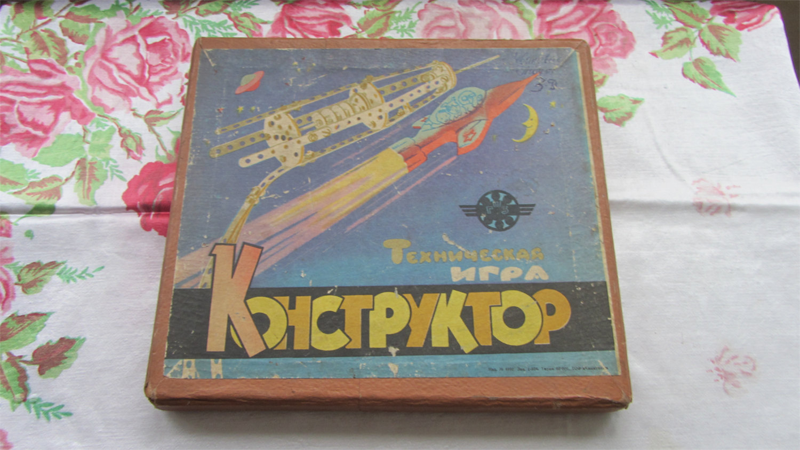
IMHO there is no better toy in the world than a constructor. Before the advent of the computer, iron beams and plastic cubes were beyond competition for me - you can create a whole world out of them without any restrictions.
Only growing up, I learned that the children's designer is the pinnacle of the evolution of toys for the invention (rather, even discovery) that European teachers spent hundreds of years, step by step, choosing the magnificence that we now have in every children's store. If there were no designers, I would not have such a craving for DIY robots.
We at the Robostation have a dozen stores with designers and a trivial robotic school where real robots are assembled from these designers. We’ll talk about this.
But first, a little theory.
Man is not distinguished from other animals by upright posture and an undeveloped brain; first of all, we are distinguished by two nuances in the structure of hands. Firstly, only in humans does the hand fold into a fist. It seems like a trifle, but it is the fist that makes a person a “super-predator” - clenching the fist, a person increases the rigidity of the metacarpophalangeal joints by four times, while reducing the impact area by increasing its strength by three times, but most importantly - a small but heavy fist with sharp Knuckle is the perfect device for breaking bones and skulls. For this reason, modern boxers wear gloves, and all found skeletons of ancient people have knuckles knocked down from constant “work”.

It is no accident that the American Indians deified the otter, considered it a "shaman of animals", because it is the only animal in America that a man cannot get with his bare hands - she is too nimble. But since the otter is the only invulnerable prey, it turns out that all other species can not oppose anything to the human hand?
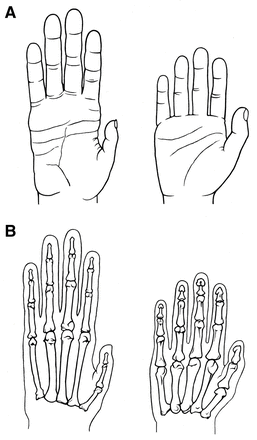
Hand of Chimpanzee and Homo sapiens.
In 2012, a large-scale study of the University of Utah (in English) confirmed the obvious: it was and exclusively thanks to the fist that our species occupied the entire planet. It seems that sexual selection was on its fists. As a result, even the design of our skulls was created primarily to withstand fist punches . That's why the fist is a symbol of a person - remember how many times it has been used in political emblems (Mouth Front ) or in the same planet of the apes.

Now you know why this scene is impossible, and what it means.
But the fist is not at all a blunt and brute force. Even if the combat function was primary. On the contrary, to assemble a fragile and thin brush into a steel cobblestone is the highest achievement of natural engineering. For a fist you need accuracy and accuracy of movements, inaccessible to any other species on earth. Philosopher I. Kant argued that "the hand is the human brain that has come out." It was the fist that gave us such universal hands, suitable for the manufacture of tools. How did you manage to achieve this?
It turns out that our hands are connected to the brain differently than all other limbs. The fingers and all muscles are directly connected to the motor centers of the brain through monosynaptic connections. Figuratively speaking, our fingers have a direct rigid coupling with the cortex of the cerebral hemispheres - this not only makes communication faster and more priority than all other muscles, but also gives feedback.
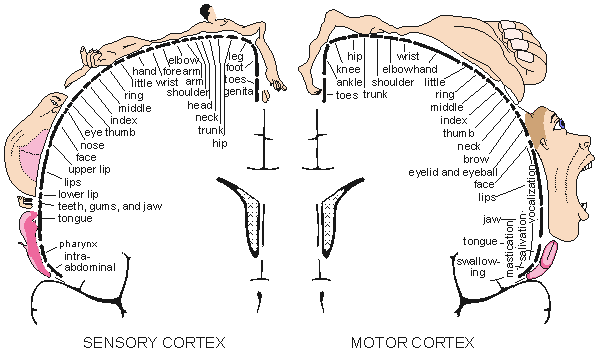
It is not difficult to see that the hands also occupy most of the cortex of the cerebral hemispheres.
It follows that the fingers and the brain are one organ. For example, if your hands are tired - the whole central nervous system will get tired, and vice versa - your brain is tired and they say that "your hands do not rise." It sounds amazing, but it is on this phenomenon that the designer’s idea is built, he consistently guides children through three stages of logical thinking.
The first stage of thinking, characteristic of young children, is called effective. Such thinking can be called “manual” - by manipulating objects, the child learns their properties. This means that a young child solves all mental tasks with his hands. The larger the stock of actions and samples the child accumulates in his experience, the faster he will go to the second stage - visual-figurative, when he will operate not with the objects themselves, but with their images.
At this stage, the child solves the problem, for example, by correctly placing the figures in the corresponding recesses immediately, because the tests are performed in the mind. The third stage is verbal-logical or abstract thinking. Here, even practical tasks are not solved by hands, but in the mind. Thus, the beginning gives the development of thinking a hand. As the physiologist I. P. Pavlov said, “hands learn the head, then a smarter head teaches hands, and skillful hands again contribute to brain development.”
That is, the designer gives the child the know-how of abstract thinking. It is through fine motor skills of the hands that the brain of a modern person receives basic thinking skills. This is the designer's trick - it consists of simple universal parts, which already provoke abstract thinking with their appearance. There are no such studies, but it is obvious that children raised with a designer will overtake their peers in their mental activity.
This concludes the theory and proceed to the history of the issue.
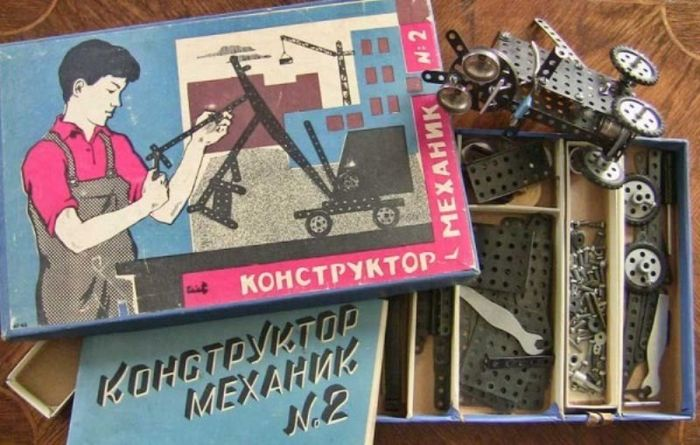
For a long time, many believed that the designers of our childhood were a Soviet invention. However, this is not quite true. The constructor in the form of “a set of metal plates with holes, screws and nuts for fastening drilled at equal distances” was invented in 1901 by the Englishman Frank Hornby.
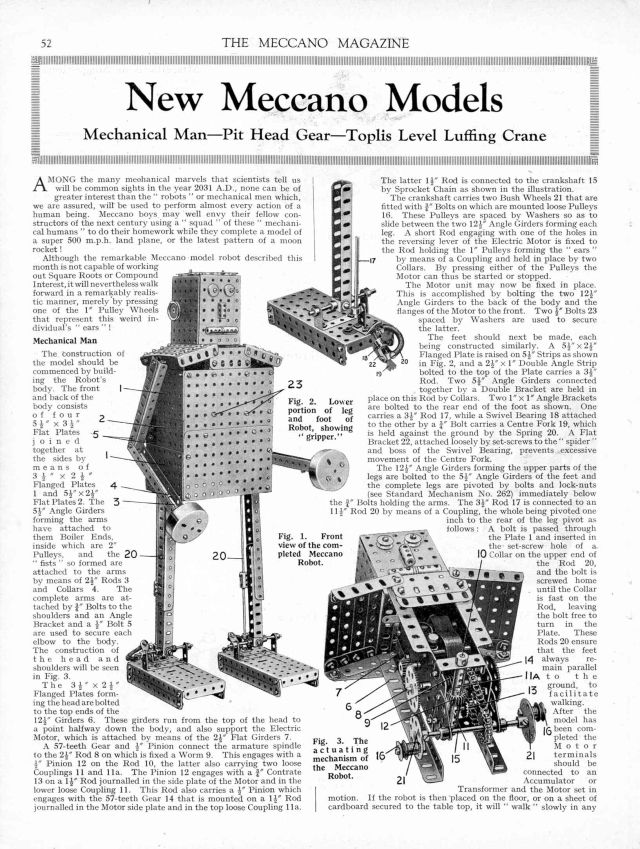
He also owns the invention of the children's railway and mini-models of cars. The successor to the first designer was Meccano . At the end of the patent protection period, they began to produce the Soviet analogue - the dream of every Soviet child - a designer called "Youth" and "Designer". It came in the form of simple to complex sets with a different set of parts.
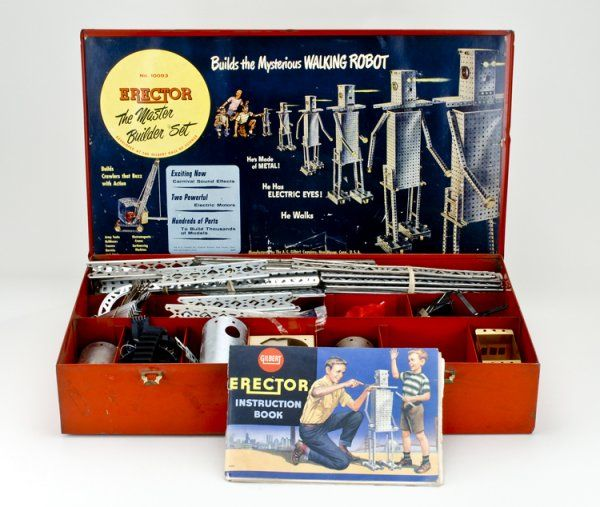
Initially, the idea of Frank Hornby to portray engineering structures in miniature was realized in the children's set of constructor for boys. It was called “mechanical aid for beginners,” it was metallic and consisted of various beams, corners, ceilings, wheels, brackets, and other details. The set also included nuts, bolts, a screwdriver and a wrench, but there were no specific schemes - each child could be imaginative and create a whole city with bridges, cars, planes and even flying saucers.
Soon, a new toy, called "Designer Meccano", gained extraordinary popularity; and its author, who quickly became a millionaire, wrote a book about himself, which he entitled: "The guy who earned $ 1,000,000 on a toy."
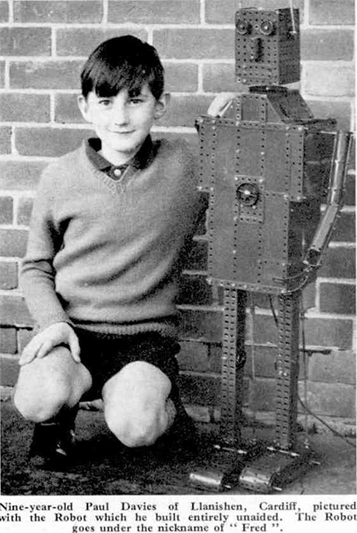
Perhaps the brilliant designer reaches the peak of world popularity by the beginning of the 1930s, becoming a household name. For the pre-war person there is no word “constructor”, there is a “meccano”.

“The island was cut by threads of roads - they converged at its northeastern rocky part, where the glass roofs sparkled. It was being completed the palace, descending three terraces to the waves of a small sandy bay. On the south side of the island, constructions resembling the confusion of a children's meccano from above were visible: farms, mounts, lattice cranes, rails, running trolleys. ”
A.N. Tolstoy "Hyperboloid engineer Garin."
The designer was the main dream until the war and was especially appreciated in the USSR - is it a joke, every pioneer can build a brave new world with his own hands.

A metal constructor made in the USSR in 1933.
On April 1, 1932, in the article “A Toy is an Instrument of Communist Education,” the Pionerskaya Pravda newspaper (No. 38) was indignant that 90% of the plan for the production of Soviet designers was frustrated: “Instead of meccano ... cans for shoe polish.”
“ ... To look at a toy as fun is an old bourgeois opinion about a toy, it must be discarded for a long time. The main feature of Soviet toys should be polytechnicism. The toy should give the child an idea of modern technology, construction ... ". Thus, from the meccano “feet grow” for all Soviet designers, and your child’s metal designer is his direct descendant.
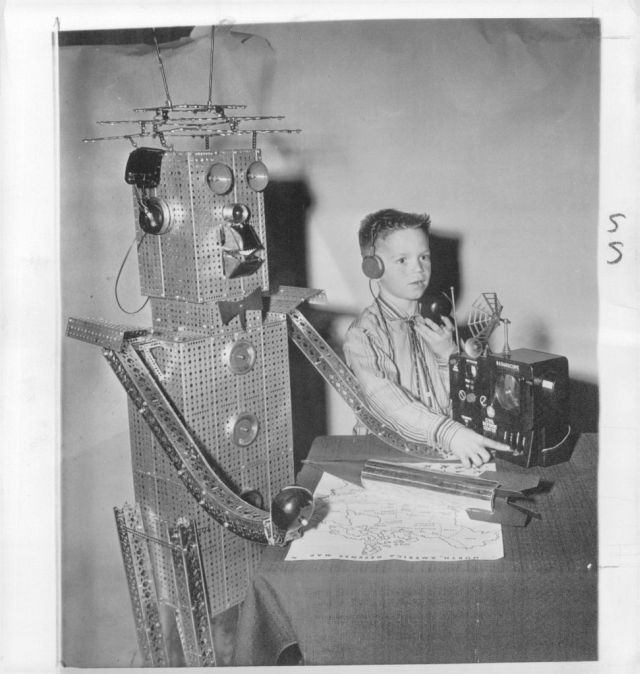
In 1925, the designer’s railroad parts were also useful - Hornby began production of electric toy railways at the current standard scale of 1:43 and direct power supply from a 110V network.
And in 1933, the company made a new revolution, starting the production of the first "serious" toy cars - a set of "Modelled Miniatures". Simple stamping made two cars, two trucks, a tractor and a tank. And then it turns out that it’s interesting to play cars not only complete with the railway, as the author intended, but also without it. That's why toy cars are made on the same scale as trains.
By the start of the war, Hornby was bringing the lineup to 300 models, including the only Soviet car model in the west. In 1958, it was this company for its cars that came up with many innovations: a spring suspension, opening doors, glazing, tire treads, etc.

So Hornby created, in fact, the entire industry of children's toys. But this does not mean that he was alone. The glory of Hornby haunted Danes Ole Kirk Christiansen, who also wanted to produce toys and founded the LEGO company for this in 1932. At first he made miniature furniture and toy cars - but things were not going very well.

Three LEGO presidents in one photo, 1951.
Ola manages to take the next step thanks to the help of Briton Hillary Fisher Page. This becomes a decisive stage in the history of the creation of Lego. As an inventor, Page also owned Kiddicraft. He became interested in creating toys when he was still a child. In the very beginning of the 40s, he began to produce plastic "building bricks", on which there were grooves and ledges for connection. The inventor believed that only by understanding the psychology of the child, you can create good toys. Therefore, he spent hours on the playgrounds, playing with their little visitors. He was interested to see how they use certain objects.
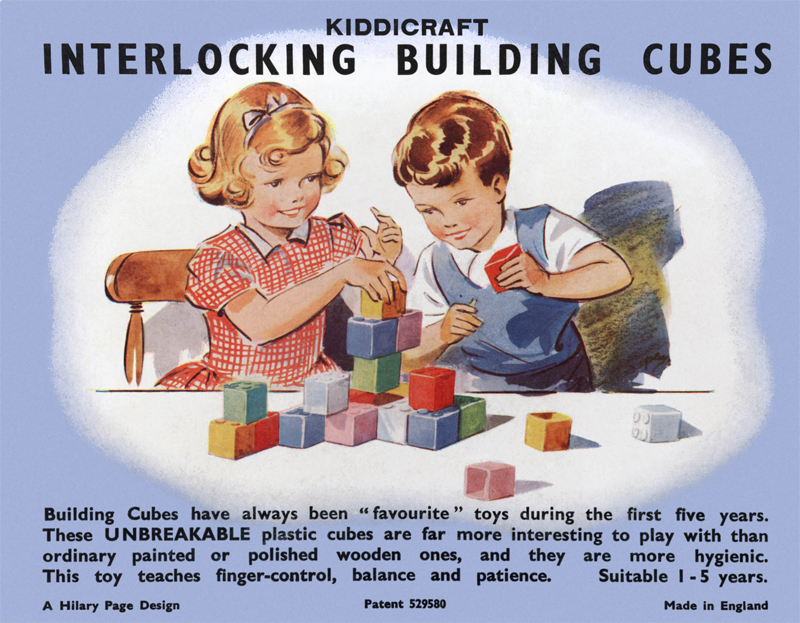
Christiansens in 1947 place an order in England for a molding machine. Suppliers send them product samples, among which there are several Page bricks. Ole immediately became interested in the idea of universal modules. Refining the design of the Briton, he rejects the rounded edges, making them straight. He translates the dimensions of the modules into the metric system.
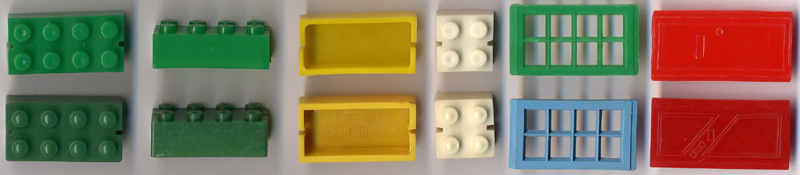
LEGO cubes on top (1949), Kiddicraft cubes on the bottom (1947).
In 195b, LEGO engineers finally solved the tenacity problem by adding hollow cylinders to them. So LEGO acquired a modern look and went to storm the American market.
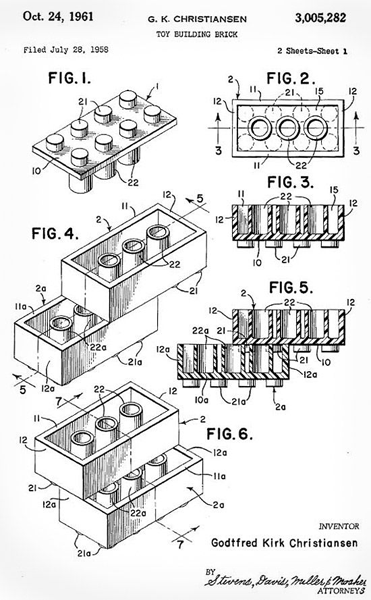
However, we know how cool LEGO is (only six blocks can be assembled in 102,981,500 in different ways!) - but parents in the late 40s were not at all happy with some strange plastic, instead of safe wood and metal in toys. The designer was simply afraid to buy.
In 1960, the company was on the verge of ruin, not only that, the fire destroyed the warehouse with all the wooden toys and LEGO just had to rely on plastic. They replaced the raw materials from cellulose acetate with non-toxic ABS plastic and spent on advertising. By this time, the Americans were already accustomed to plastic and things went.
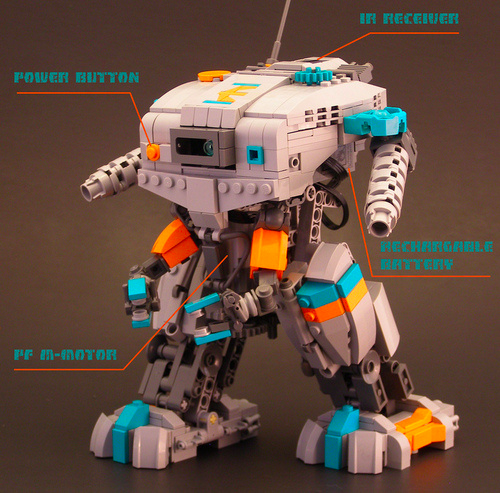
By 1990, 400 billion Lego blocks were produced. If they are simply put one on the other, then they can connect the Earth with the Moon ten times. In this case, all the cubes from 1949 to 2014 are connected to each other. This is achieved by a serious process technology of 10 microns. In addition, barium sulfate is part of the plastic. This salt does not dissolve in water, which makes it non-toxic to the body, and it is clearly visible on x-rays. Thus, if a child swallows a part, it can be easily found from these pictures.
Nothing seemed to portend trouble. But LEGO forgot that the designer is just a means to create their own reality. Better is the constructor in which you can assemble a complex device. The peak of complexity for designers is robots that Lego did not have. Therefore, in 2004, the question arose of bankruptcy.
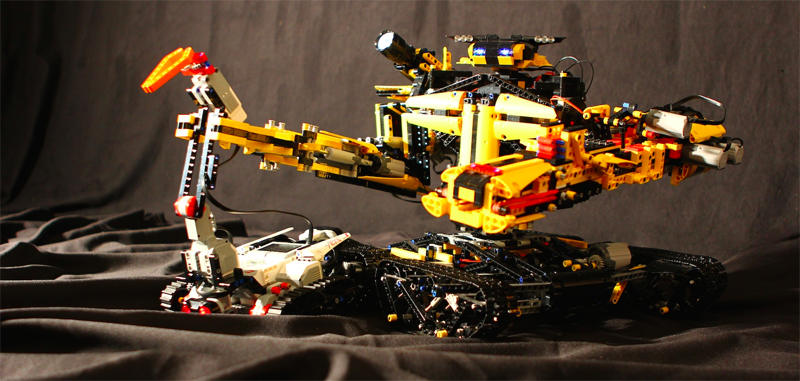
Then the Kristiansen family for the first time decided to call for the role of CEO a person who is not from the family. He became Jørgen Vig Knudstorp and his view from the outside was simple: Lego should again become the best designer - again you need to give customers the opportunity to do whatever they want. And who does not want to assemble a robot? For example, R2D2?
As a result, LEGO bought licenses for Hollywood films and invested in robotic sets. In its first year, the Star Wars kit raised sales by 32% and robots by 18%.
The LEGO Mindstorms NXT series was the first with a more or less functional designer of robots: 577 parts, three servomotors, 4 sensors (distance, sound, touch and lighting) and a central processor with its own “visual” programming language and four behavior models - Alpha-Rex ( humanoid), Tri-Bot (machine), Robo-Arm T-56 (arm), and Spike (arthropod).

In just a year, LEGO from dusty junk has again become the most desired and coolest gift. So the robots saved LEGO from ruin and began to confidently seize the toy market.
But it cannot be said that Lego is a monopolist here. The market for robotic designers is a whole world with its own ecosystem. Roughly speaking, all of them can be divided into five categories.
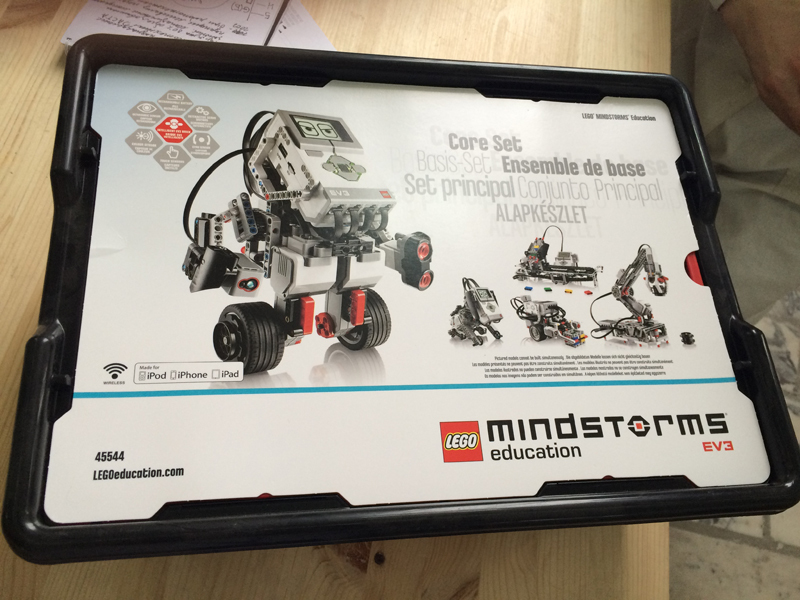
When we say a robotic constructor, we usually mean LEGO Mindstorms EV3 - this is the most massive and versatile constructor.
1. Zero level. From 2 to 6 years. For this age group, designers are developing with a minimum number of large-sized parts so that the child does not accidentally swallow one of them.
Lego Duplo
2. The level of "user". 8-9 years old. At this age, the child is already able to concentrate on creating something voluminous. There are more parts in such designers and the figures are more complicated, but still the child can assemble them independently without the help of parents.
Lego WeDo
3. Advanced user level. 8-15 years old. We begin to assemble the first robots, the details are no longer just cubes, but functional elements, electronics and complex mechanisms appear.
Lego Mindsorm , VEX IQ, German FISCHERTECHNIK , Korean Huna , Russian ScratchDuino .
4. Level Amateur. 10-20 years. We assemble complex robots with feedback and a decision-making system.
Amperka , Rasbery Pi , Galileo , Bioloid Stem , again Fishertechnik, Trick , VEX EDR and VEX PRO .
Another good idea is the optional Lego Mindstorm kits - Matrix and Tetrix .
5. Level “Profi” - the creation of serious robots that can perform tasks in the real world.
NI , FPGA .
On the diagram, all this looks more understandable:
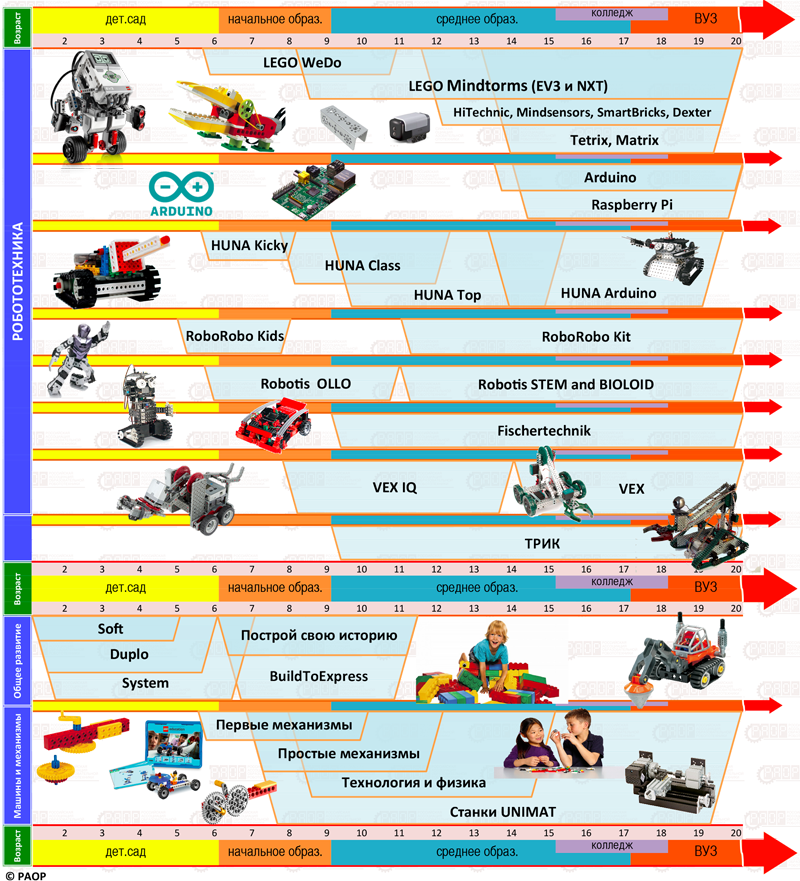
It is important to note that all designers are moving towards unification - most of them are hardware compatible and almost all software. For example, Lego NXT can be controlled by software from any other constructor. The corresponding tables can be found on the website of Andrei Guryev: www.slideshare.net/odezia
Almost all of these robots and designers can be bought directly from us at Robostations - there is no such choice as in Moscow anywhere else. We have as many as eight stores: Double Toys , Roys , Copter Express , Minecraft Toy Store, Robot and Me , Clever , MAD Robots and our own productionBall of Robots .
Soryan for the pictures, he shot on the phone:
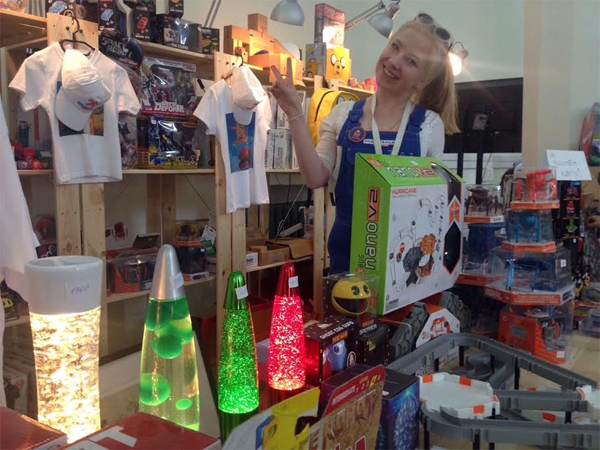
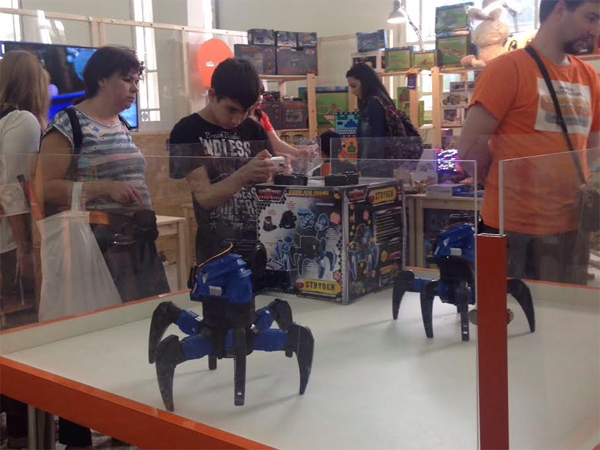
But the designer himself is only 20% of the robot, 80% of the training lies with the teacher; therefore, we cannot but mention the domestic schools of robotics.
- St. Petersburg - Filippov Sergey Alexandrovich, Presidential Physics and Mathematics Lyceum No. 239 .
- Arkhangelsk - Koposov Denis Gennadevich, Gymnasium 24 .
- Chelyabinsk - GEF-GAME .
- Novosibirsk - Nikolai Pak and his League of Robots .
- Kazan - Sergey Masyagin and his robotics course in Innopolis .
- Moscow - Sergey Mustafin, school 2017 . Lydia Kobtseva, school 2086 . Andrey Guryev School 1270 - now runs our Roboshkola .
- Russian Association of Educational Robotics - we should separately mention RAOR , which is very unsuccessfully trying to unite all the country's robot designers.
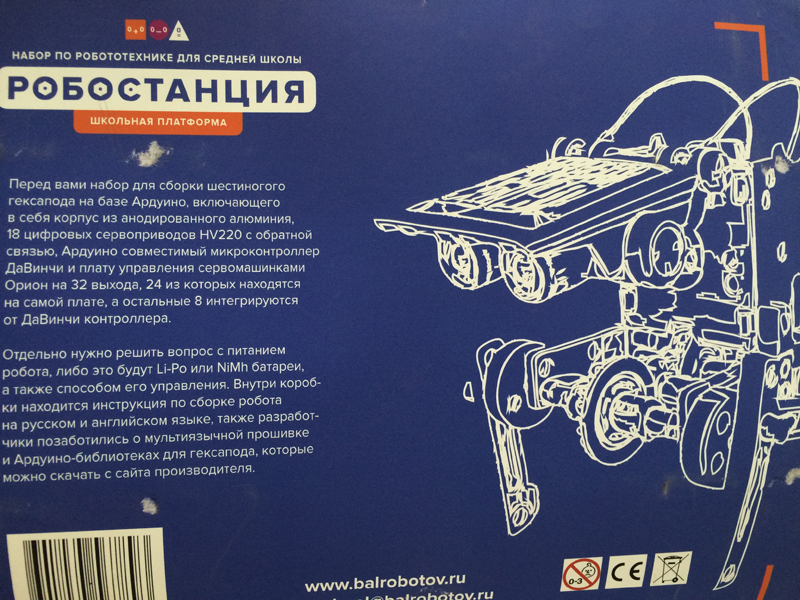
By the way, under the leadership of Guryev, in our robotic school, the creation of our own designer is in full swing. Here is a presentation to Sobyanin:

As I understand it, its difference will be versatility for all ages and tasks that the robot can perform. That is, this is the level of 15 years, already available for nine year olds. But this is still a prototype, that's why they told me not to show anything except the box - a separate post about it will see the light after the designer’s release. So far I can only show the description from the box:

Subscribe to our blog and come to the robot station to collect robots together!