
 April 10, 2015 at 12:22
Microsoft Introduces New Container Technologies for Next-Generation Cloud
- Transfer
In today's world, when cloud technology comes first, the business industry especially relies on applications that will foster innovation and productivity. With the development of the cloud, containers are becoming an attractive way for developers to quickly and efficiently create and deploy applications at the speed necessary for the business. Offering developers and IT professionals the ability to deploy applications from a workstation to a server in seconds, containers take application development to a whole new level.
Due to the desire of developers to use the capabilities of containers for a wider range of applications, new requirements arise. For example, for enterprise systems or hosted environments, increased levels of trust may be needed. In addition, developers often deploy applications in mixed environments where they may not be able to control the platform on which the application is hosted. Virtualization has historically provided a significant level of isolation, which such scenarios allowed, but now there are possibilities to combine the efficiency and density of the container model with the correct isolation level.
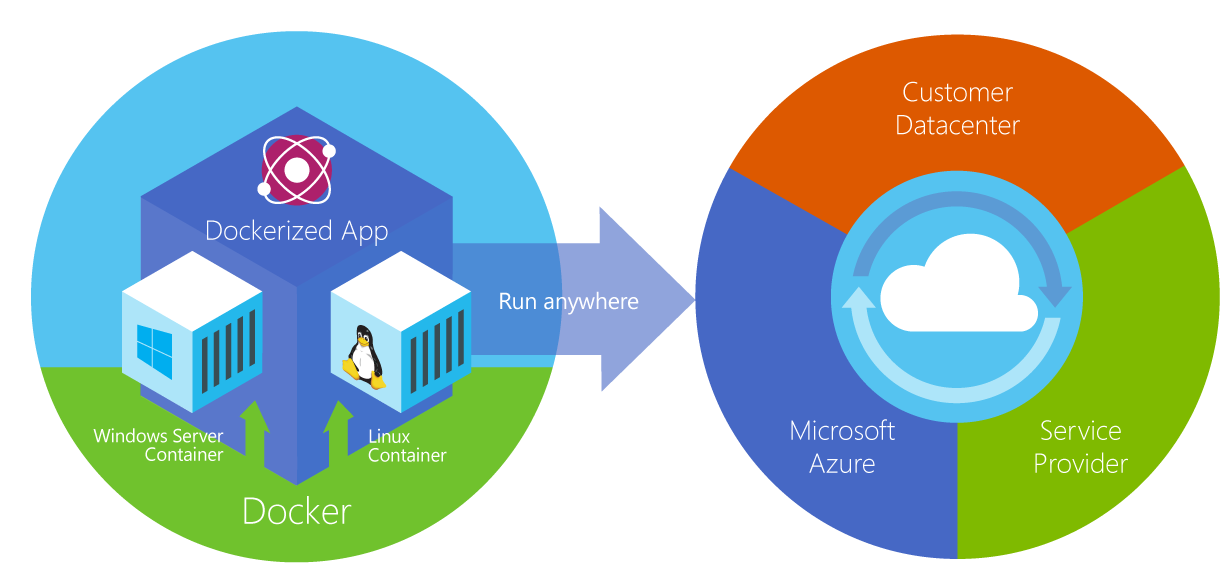
Last October, Microsoft and Docker Inc. jointly announced plansProviding containers for all developers in the Docker and Microsoft ecosystems using Windows Server containers, which will be available in the next version of Windows Server. We will hold the first open demonstration in a few weeks, starting with the BUILD conference . Today we take containerization one step further by expanding the scripts and workloads available to developers using containers:
Enhancing our deep virtualization experience, today Microsoft offers containers with a new level of isolation previously reserved only for fully dedicated physical or virtual machines, while maintaining a flexible and efficient experience with full cross-platform Docker integration. Through this first-of-a-kind proposition, Hyper-V containers ensure that code running in the same container remains isolated and cannot affect the guest operating system or other containers running on the same host.
While Hyper-V containers offer additional deployment options between Windows Server containers and Hyper-V virtual machines, you will have the opportunity to deploy them using the same development, programming, and management tools that you would use for Windows Server containers . In addition, applications designed for Windows Server containers can be deployed as Hyper-V containers without any additional modifications, providing greater flexibility for operators who need to choose the degree of density, flexibility and isolation in a multi-platform and multi-application environment.

Docker plays an important role in providing the container ecosystem on Linux, Windows, and the upcoming Hyper-V containers. We worked closely with the Docker community to evaluate and expand container innovations in Windows Server and Microsoft Azure, including introducing the development of the Docker engine for Windows Server containers by participating in the development of the Docker repository on GitHub . In addition, we have simplified the deployment of the latest Docker engine with Azure extensions to install the Docker host on Azure virtual machines running Linux and to deploy Docker -managed virtual machines directly from the Azure Marketplace . Finally, we added integration for Docker Swarm, Docker Machine, and Docker Compose in Azure and Hyper-V .
Operating systems have changed dramatically with the transition to the cloud. Today, most customers need their OS for the main purpose: launching their applications created in the cloud. Using years of experience creating and launching hyper-large data centers, Microsoft is in a unique position to create an OS designed to run modern applications and containers.
The result is Nano Server, a minimal installation option for Windows Server that is optimized for the cloud, including containers. Nano Server provides only those components that are needed - nothing more, which means a smaller server image size, which, in turn, reduces deployment time, reduces network bandwidth consumption and improves security and performance. This minimalism makes Nano Server an ideal complement for Windows Server and Hyper-V containers, as well as for other cloud-optimized scenarios. A preview version will be available in the next few weeks, and you can read more about technology on the Windows Server Blog .
In today's world of cloud technology, containers take speed and scalability to a new level. Microsoft is in a unique position to push organizations forward into the next era of containerization by offering the flexibility and choice between Windows Server containers, Linux containers, and Hyper-V containers both in the cloud and on-premises. Today’s announcement is just the beginning of what comes next, because we continue to develop both container growth in the industry and new levels of innovation in developer applications.
Stay in touch to find out more about innovation, starting with the BUILD in a few weeks.
Due to the desire of developers to use the capabilities of containers for a wider range of applications, new requirements arise. For example, for enterprise systems or hosted environments, increased levels of trust may be needed. In addition, developers often deploy applications in mixed environments where they may not be able to control the platform on which the application is hosted. Virtualization has historically provided a significant level of isolation, which such scenarios allowed, but now there are possibilities to combine the efficiency and density of the container model with the correct isolation level.
Last October, Microsoft and Docker Inc. jointly announced plansProviding containers for all developers in the Docker and Microsoft ecosystems using Windows Server containers, which will be available in the next version of Windows Server. We will hold the first open demonstration in a few weeks, starting with the BUILD conference . Today we take containerization one step further by expanding the scripts and workloads available to developers using containers:
- Hyper-V Containers is a new deployment option for a container with enhanced isolation, powered by Hyper-V virtualization.
- Nano Server is a minimal installation of Windows Server that is optimized for the cloud and ideal for containers.
First of its kind: Hyper-V containers
Enhancing our deep virtualization experience, today Microsoft offers containers with a new level of isolation previously reserved only for fully dedicated physical or virtual machines, while maintaining a flexible and efficient experience with full cross-platform Docker integration. Through this first-of-a-kind proposition, Hyper-V containers ensure that code running in the same container remains isolated and cannot affect the guest operating system or other containers running on the same host.
While Hyper-V containers offer additional deployment options between Windows Server containers and Hyper-V virtual machines, you will have the opportunity to deploy them using the same development, programming, and management tools that you would use for Windows Server containers . In addition, applications designed for Windows Server containers can be deployed as Hyper-V containers without any additional modifications, providing greater flexibility for operators who need to choose the degree of density, flexibility and isolation in a multi-platform and multi-application environment.
Our containers in the Docker ecosystem
Docker plays an important role in providing the container ecosystem on Linux, Windows, and the upcoming Hyper-V containers. We worked closely with the Docker community to evaluate and expand container innovations in Windows Server and Microsoft Azure, including introducing the development of the Docker engine for Windows Server containers by participating in the development of the Docker repository on GitHub . In addition, we have simplified the deployment of the latest Docker engine with Azure extensions to install the Docker host on Azure virtual machines running Linux and to deploy Docker -managed virtual machines directly from the Azure Marketplace . Finally, we added integration for Docker Swarm, Docker Machine, and Docker Compose in Azure and Hyper-V .
“Microsoft has been a great partner and contributor to the Docker project since the joint announcement in October 2014,” said Nick Stinemates, Head of Business Development and Technical Alliances. “They made a number of enhancements to enhance the development experience for Docker in Azure, contributing to all aspects of the Docker platform, including the Docker client for Windows and the Docker orchestration tools. Microsoft has also demonstrated its leadership in the community by providing completely new content, such as dockerized .NET for Linux. At the same time, they worked to expand the benefits of Docker containers — the ability to port applications to any infrastructure and speed up the development process — for the Windows developer community. ”
Introducing Nano Server: The Core of Modern Applications and the Cloud
Operating systems have changed dramatically with the transition to the cloud. Today, most customers need their OS for the main purpose: launching their applications created in the cloud. Using years of experience creating and launching hyper-large data centers, Microsoft is in a unique position to create an OS designed to run modern applications and containers.
The result is Nano Server, a minimal installation option for Windows Server that is optimized for the cloud, including containers. Nano Server provides only those components that are needed - nothing more, which means a smaller server image size, which, in turn, reduces deployment time, reduces network bandwidth consumption and improves security and performance. This minimalism makes Nano Server an ideal complement for Windows Server and Hyper-V containers, as well as for other cloud-optimized scenarios. A preview version will be available in the next few weeks, and you can read more about technology on the Windows Server Blog .
In today's world of cloud technology, containers take speed and scalability to a new level. Microsoft is in a unique position to push organizations forward into the next era of containerization by offering the flexibility and choice between Windows Server containers, Linux containers, and Hyper-V containers both in the cloud and on-premises. Today’s announcement is just the beginning of what comes next, because we continue to develop both container growth in the industry and new levels of innovation in developer applications.
Stay in touch to find out more about innovation, starting with the BUILD in a few weeks.