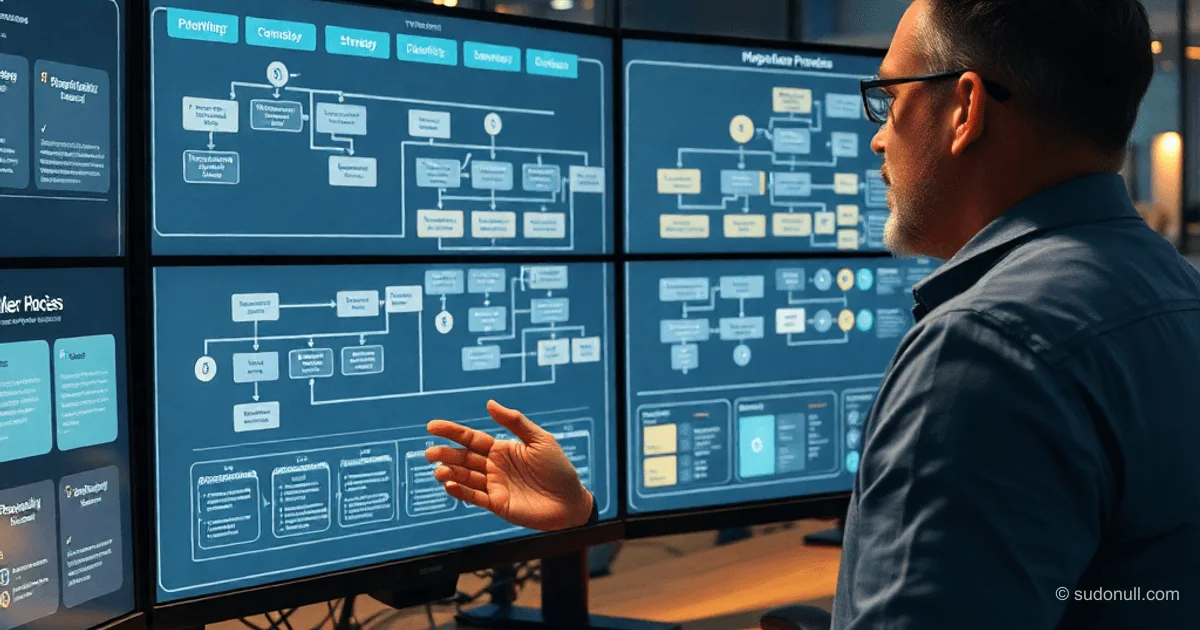
Process Architecture as the Foundation of Corporate Business Models and Automation
Process architecture serves as a hierarchical model of an organization’s business processes, facilitating the transition from strategic goals to operational actions. It integrates processes into a unified system where every element connects with roles, data, and capabilities. Unlike fragmented descriptions tailored to specific tasks, this model acts as the foundation for all IT automation projects, minimizing duplicated efforts among analysts.
Within the TOGAF framework, process architecture falls under the business architecture domain, complementing strategy, organizational structure, and business objects. Without it, business models remain declarative and incapable of practical application in development.
Components of Business Architecture and the Role of Processes
Business architecture according to TOGAF covers four domains: business, data, applications, and technology. The business domain focuses on company activities without direct ties to IT.
Key elements include:
- Strategy and Goals: KPIs, constraints, and operating principles.
- Business Capabilities: High-level company abilities critical to strategy.
- Organizational Structure: Departments, roles, and responsibilities.
- Process Architecture: End-to-end models ranging from management to instructions.
- Business Objects: Entities such as clients, orders, or contracts with defined relationships.
- Value Streams: The full cycle from request to result.
Processes act as the integrator: they realize capabilities, assign roles to actions, and manage the lifecycle of objects.
Characteristics and Structure of Process Architecture
The model is built as a process tree with decomposition from the top level (management, core, supporting) down to operational steps.
Main properties:
- Hierarchy: Full decomposition for navigation across levels.
- End-to-End: Processes cross departments, reflecting the real value flow.
- Interconnectedness: Transfer of results, shared objects, and impact of changes.
- Maintainability: Continuous updates in the repository.
- Formalization: Unified notation (ArchiMate for upper levels, BPMN for detailing).
BPMS systems (ARIS, Business Studio, Sparx EA) ensure storage, versioning, and traceability of connections.
Integration with TOGAF: From Artifacts to Management
TOGAF Phase B requires a process catalog, flow diagrams in BPMN, and connection matrices (processes-roles-objects). However, without tools, these artifacts become outdated in large organizations with thousands of processes.
Centralized management in BPMS solves key issues:
- Single storage without fragmented files.
- Hierarchical tree with navigation.
- Automatic change traceability.
- Version control and auditing.
- Traceability to application architecture.
This transforms process architecture into a living tool for analysts.
Benefits for Business Process Automation
With a model, analysts use existing processes as the basis for requirements, avoiding reactive analysis from scratch. Time saved on approvals is achieved through unified terminology and traceability.
Problems without architecture:
- Isolated processes.
- Inconsistent terminology across projects.
- Lack of a single source of truth.
- Duplication of work.
- Chaotic changes.
Proactive approach: search for the current process, adjust it, and generate requirements considering related models.
Key Takeaways:
- Process architecture is the core of business architecture, linking strategy with operations.
- It provides an end-to-end model for IT automation, reducing analysis time.
- It requires BPMS to maintain relevance in large-scale organizations.
- It integrates with TOGAF through mandatory Phase B artifacts.
- The role of a process architect is equivalent to a business analyst during the design phase.
— Editorial Team










No comments yet.