How Software Was Developed for the Soviet Missile Shield: Technical Details Straight from the Developer
In 2014, an archival interview with Anatoly Stepanovich Glushko—the key developer of the software for the USSR's anti-missile defense system—was discovered. His account reveals unique technical solutions that are still in use today in modernized forms. This isn't about theoretical developments, but real systems that processed radar data in real time through temperature swings from -50°C to +50°C.
Architecture of Super-Scale Computers
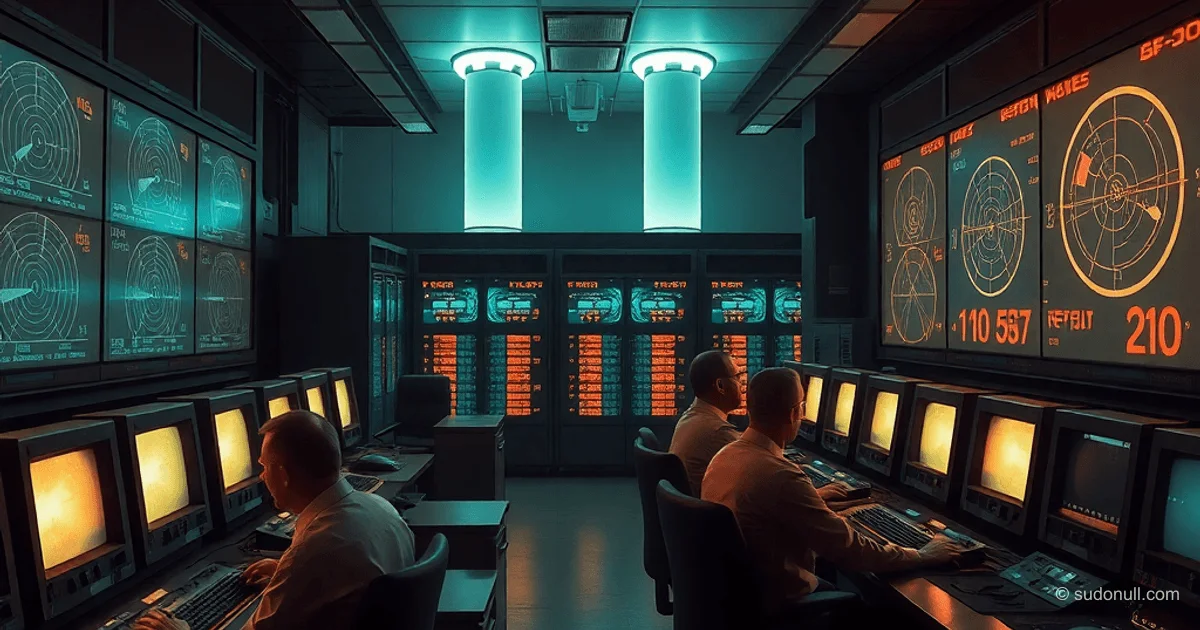
The M10 computer (index 5E66), which became the foundation of the system, occupied three floors totaling 1500 m². Its element base—K217 series microchips on diode-transistor logic—was the first domestic mass-produced solution in integrated circuit technology. The system consumed record-breaking power for the era: the commissioning report (1975–1976) proudly noted it as "the most powerful in the world in terms of electricity consumption."
Cooling was handled by a water cooling tower and a three-story blower system. Data transmission relied on 512-wire cables with control lines, routed through the taiga along different paths—duplication was critical for fault tolerance. This architecture enabled the system to keep running even if one of the three communication channels failed.
Memory: From Beryllium Foil to Ferrite Cores
The M10's RAM totaled 256 KB (128K 16-bit words), which was standard for the time. But the permanent memory (ROM), protected against electromagnetic pulses, is especially intriguing:
- First version: capacitive memory on metal foil made of beryllium bronze
- Perforation was performed by a special device that created mechanical holes
- Information was stored physically—it could only be erased by dismantling the structure
- Later versions used ferrite core memory that could be rewritten via an external device
This approach ensured radiation hardness: a nuclear blast wouldn't affect the data, unlike magnetic media. This architecture fundamentally differed from Western counterparts, which relied on EMP-vulnerable semiconductor chips.
Real-Time Data Processing
The system received coordinate data (latitude, longitude, altitude) from radar stations in a unified reference frame. Each radar station independently tracked targets, detecting them upon entering and leaving the visibility zone. Interpolation algorithms plotted trajectories from multiple measurements, classifying objects as satellites or ballistic missiles.
A standout feature was tracking all near-Earth objects—by the 1980s, the system monitored around 5000 satellites. For each one, it calculated the probability of crossing USSR or Warsaw Pact borders. Processing occurred on specialized computers at the radar sites, which digitized analog signals into sequences before sending them to the central hub.
Evolution of Programming: From Binary Codes to Operating Systems
Before the M10, programs were hand-coded in octal or even binary. Glushko created the USSR's first assemblers for the 5E50/5E73/5E79 series, complete with debuggers and editors for fixing punch cards. Key milestones:
- Introduction of mnemonics instead of direct coding
- Development of compilers supporting absolute addressing
- Creation of the first code structuring tools in the USSR
- Implementation of multitasking via a hardware interpreter
- Introduction of dynamic module loading
This shift enabled moving from monolithic programs to modular architecture. The operating system, developed in 1972, formed the basis for real-time data processing with guaranteed response times.
Key Takeaways
- Hardware Resilience: The physical foil-based ROM provided protection against nuclear pulses
- Three-Level Fault Tolerance: Duplicated communication lines, redundant computers, and data redundancy
- Tool Evolution: Switching from manual coding to assemblers cut errors by 70%
- Geodetic Precision: A unified coordinate system for integrating data from distributed radar stations
- Power Consumption as a Strength: Massive cooling capacity offset limitations in the element base
— Editorial Team






No comments yet.