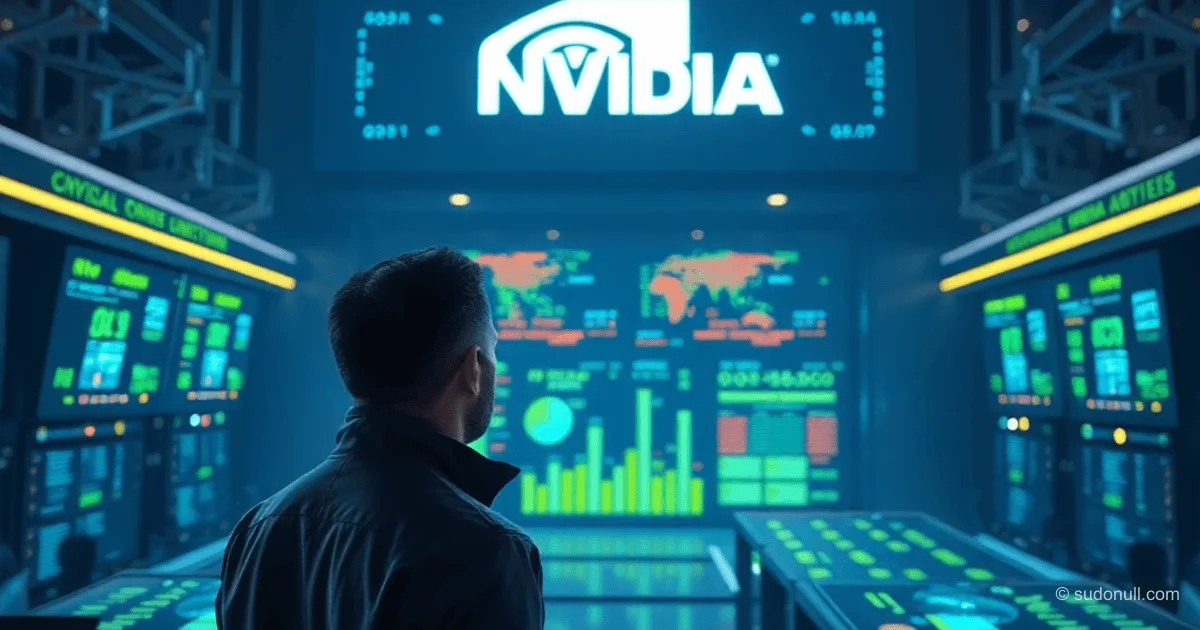
Tokens as AI Currency: How NVIDIA is Reinventing Software Development Economics
Jensen Huang, CEO of NVIDIA, has outlined a fundamental shift in the IT industry: software is becoming token-driven. Computing power is no longer a supporting resource—it's directly shaping the economic performance of companies and countries. The key efficiency metric is tokens per watt, and data centers are transforming into AI factories producing the digital currency of the future.
How NVIDIA Built the Foundation for the AI Revolution
NVIDIA's success isn't based on individual chips but on a complete technology stack. Since its IPO in 1999, the company has consistently integrated algorithms, architecture, and ecosystem. In the era of computer graphics, this approach enabled deep integration into game engines, and later became the foundation for AI supercomputers. Owning all stack levels—from low-level components to system architecture—has been critically important. This control allows annual technology updates without delays from supplier coordination.
Full integration gives NVIDIA an edge in innovation speed. Unlike companies reliant on external components, NVIDIA can upgrade its entire supply chain at once—from processors to interconnects. This creates a closed system where improving one element automatically boosts the entire platform's efficiency. This approach is especially critical amid the exponential growth in AI compute demand.
Three Inflection Points in AI Evolution
Huang highlights three key inflection points that radically changed AI's development trajectory:
- Generative AI: The ability to transform information between formats and generate tokens. The breakthrough came with the user-friendly ChatGPT interface for GPT-3. However, systems suffer from hallucinations due to a lack of up-to-date context.
- Reasoning AI: Models like O1, using RAG and fact-checking. AI gained conditional generation based on ground truth, self-analysis, and real-time corrections. This boosted utility hundreds of times over, while compute consumption increased a thousandfold.
- Agentic AI: Systems that can work with files, tools, and handle complex tasks. Prompts shifted from questions to commands ("create," "do"). A single agent consumes a million times more tokens than a chatbot and operates continuously. OpenClaw became the most downloaded open-source project, surpassing Linux in three weeks.
Each inflection point multiplied the volume of generated tokens and compute costs. Agentic AI is especially revolutionary: it turns AI from a question-answer tool into an autonomous task executor. This requires constant background compute resources and fundamentally changes AI usage models.
Token Economics: Data Centers as Manufacturing Factories
Huang proposes rethinking data centers—they're no longer data storage but AI factories whose output is tokens. Compute capacity directly correlates with company revenues and countries' GDP. The key metric here is tokens per watt. At a factory capped at 1–2 gigawatts, architecture efficiency determines annual revenue.
This shift changes decision-making: computer architecture choices are now CEO-level discussions, not just for tech specialists. The IT industry is transforming from tool rental to creating "digital workers." Software companies will combine open and closed models, hire agents, and monetize specialized tokens. The trillion-dollar market that barely used tokens before will become their biggest consumer.
For developers, this means optimizing for token efficiency. Algorithms must minimize redundant compute, and architecture must maximize output per unit of energy. Traditional metrics like FLOPS are giving way to those directly tied to economic outcomes.
Physical AI: The Next Technology Frontier
Agentic AI is just an intermediate stage. The next major challenge is physical AI, which requires understanding physics laws, causality, and object persistence. NVIDIA is actively advancing areas from physical process simulation to robotics and digital biology.
Key components of physical AI:
- Modeling gravity and inertia
- Understanding object persistence (existence outside the field of view)
- Integrating real-time sensor data
- Predicting physical interactions
These technologies will take AI beyond data centers. In 2–3 years, physical AI will dominate, enabling applications in autonomous transport, manufacturing robots, and biomedical systems. Developers will need new skills in physical modeling and multimodal data processing.
The Future of the Token-Driven Industry
Huang predicts irreversible growth in compute demand. Every company will use AI to generate revenue, and countries to maintain economic competitiveness. The internet industry has already shifted all CapEx to AI systems, and software development will become fully token-driven.
This creates new challenges for engineers:
- Optimizing energy efficiency at the microcode level
- Developing token economics for SaaS products
- Integrating agentic systems into existing workflows
- Monitoring tokens per watt as a project KPI
The key takeaway: compute is no longer a cost center. It's become a revenue driver, where every watt directly impacts financial results. For IT professionals, this means deeply understanding the links between architecture, power consumption, and economic value.
Key Takeaways
- Tokens are becoming the primary currency of the AI economy, with efficiency per watt as the key success metric
- Agentic AI consumes a million times more resources than classic chatbots, demanding new system architectures
- Physical AI will bring artificial intelligence into the real world, creating demand for physical modeling
- IT infrastructure decisions are now made at the CEO level due to their direct impact on revenue
- Developers must rethink optimization: the focus has shifted from performance to token efficiency
— Editorial Team








No comments yet.