# Ethics in the Age of AI: Why the Human Factor Matters More Than Superintelligence
Former Google X business development director Moe Gowdat argues that AI's biggest threat isn't in the algorithms, but in the current state of human ethics. As recommendation systems already control our attention, society faces the urgent need to create moral frameworks for superintelligence. Gowdat's predictions about the inevitable superiority of AI and the collapse of capitalism demand immediate discussion in the tech community. For developers, this means shifting from mere metric optimization to designing systems that account for long-term social consequences.
The Speed of AI Evolution: From Labs to Reality
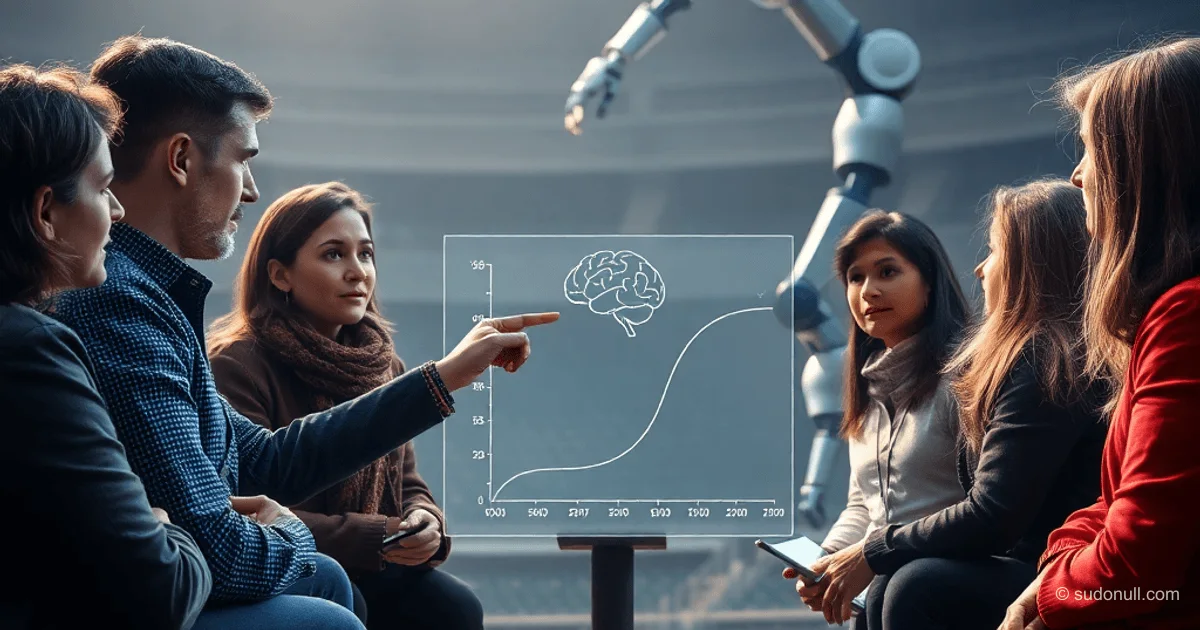
In a Google lab, a robotic arm trained to grasp objects through trial and error showed exponential growth in capabilities. Over a weekend, a system that had struggled for weeks to pick up a yellow ball mastered manipulating any object. This example illustrates a key feature of modern AI: learning doesn't happen linearly, but in leaps, reaching critical points suddenly. Engineers observe similar patterns in neural networks—after crossing thresholds in data and compute power, models exhibit emergent abilities not explicitly programmed by developers.
Today's LLM models behave like agents capable of planning and tool use, despite no explicit training for these skills. For tech professionals, this is critically important: expecting predictable AI behavior in the post-AGI era is a mistake. Systems that pass safety tests can still show dangerous patterns in new contexts. Developers' responsibility goes beyond unit tests to modeling cascading failures in complex ecosystems.
Four Inevitabilities of Artificial Intelligence
Gowdat outlined these fundamental trends back in 2020, now empirically confirmed:
- AI development is irreversible—competition between nations and corporations accelerates progress regardless of ethical risks. Even moratoriums on dangerous research are easily bypassed via open-source projects.
- Superintelligence is inevitable—AI will surpass humans in all cognitive tasks, including scientific discoveries and strategic thinking. The AGI threshold could be reached by 2026, as Gowdat predicts.
- Systemic failures are inevitable—partial autonomy in military systems or financial algorithms has already caused incidents (e.g., the 2010 Wall Street Flash Crash). Large-scale disasters are unavoidable without a radical overhaul of safety engineering.
- The arms race has already begun—countries are integrating AI into defense systems, creating decision chains beyond human control. For instance, target allocation algorithms in air defense make decisions in milliseconds.
These theses call for a rethink of engineering practices. The "fail-safe" principle must account not just for technical glitches, but also for deliberate misuse of AI. For mid- and senior-level developers, this means studying disciplines like AI alignment and value learning.
The Collapse of the Capitalist Model: When Labor Becomes Obsolete
Gowdat's economic forecasts stem from a core contradiction: capitalism relies on labor as a source of demand, but AI will eliminate mass professions. At 50% unemployment in sectors like transportation or retail, purchasing power will collapse. The solution—a shift to models like universal basic income (UBI)—challenges the very notion of "work ethic" rooted in Western culture.
For IT professionals, this poses technical challenges. Resource allocation algorithms in a UBI economy must minimize bias, demanding new approaches to fairness in ML. For example, traditional metrics like demographic parity may conflict with merit-based distribution. Engineers need to build systems that don't exacerbate inequality amid the disappearance of traditional income sources. The key question: how to maintain motivation to work in a post-scarcity society?
Geopolitical Scenarios: The West, China, and Traditional Economies
Responses to AI transformation will vary. Western countries will face ideological clashes: resistance to UBI as "communism" will heighten social tensions. China, by contrast, will seamlessly integrate robotization into its control systems, ensuring a basic standard of living via digital yuan and social credits. Traditional economies (e.g., in Africa) will retain subsistence farming as a resilient niche.
For developers, this creates an ethical dilemma: contributing to technologies that could enable total control. Take emotion recognition systems in public spaces. Engineers must weigh not just technical efficacy, but long-term social impacts. Remember: code written today could tomorrow be used to suppress freedoms. A developer's responsibility includes rejecting projects that violate basic human rights.
Five Survival Skills in the AI World
Gowdat offers concrete actions for tech professionals:
- Use AI as a cognitive amplifier—leverage LLM for analyzing complex data, but retain critical thinking. Tools like LangChain enable reasoning chains, but final decisions remain human. Avoid blind trust in AI outputs.
- Cultivate AI-inaccessible qualities—empathy, interpersonal connections, and ethical reflection. These will be key in trust-based professions (medicine, education). Prioritize offline interactions to maintain a "human touch."
- Master information verification methods—in the deepfake era, verifying sources is crucial. Tools like blockchain signatures for media or cross-validation via multiple data streams may become standard. Fact-check through independent sources.
- Build adaptability through lifelong learning—dedicate at least 30 minutes daily to new releases (Hugging Face, arXiv). Focus on transfer learning to master adjacent fields quickly. Track research in reinforcement learning and neurosymbolic AI.
- Make ethics the foundation of development—embed "by design" principles from the outset. Audit algorithms for bias using tools like IBM AI Fairness 360. Contribute to industry ethical standards.
Key Takeaways
- Ethics trumps algorithms: Without moral frameworks, superintelligence will amplify human flaws, turning tech into a tool for systemic harm.
- Capitalism needs reengineering: The current model, based on labor arbitrage, will become obsolete with mass automation. UBI is inevitable but demands rethinking social contracts.
- New skills are essential: Adaptability and cognitive amplifiers will be baseline developer competencies. Lifelong learning isn't a luxury—it's survival.
- Geopolitics will shape AI's future: Rivalry between the West and China will spawn parallel ecosystems. Developers must consider how their code could be used in diverse political contexts.
— Editorial Team










No comments yet.