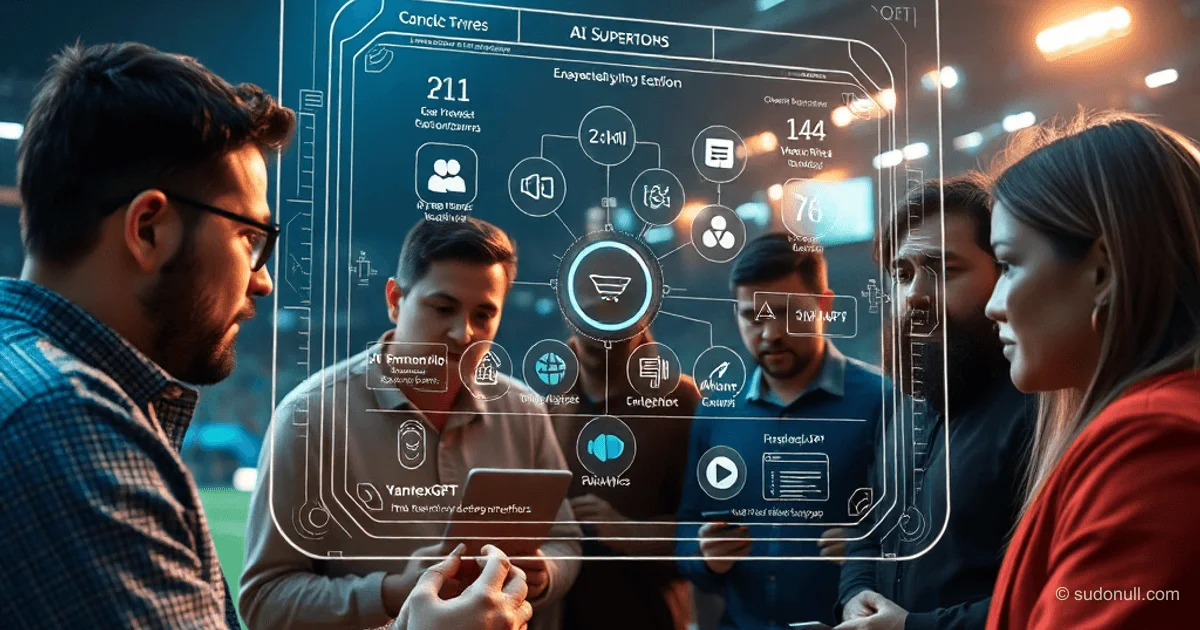
AI Superapp: How Global Trends Are Shaping the Future of AI Platforms
In 2026, Forbes named the AI superapp the top trend. Analyzing data from 2 million GPTunneL users, we see that this trend has already become operational reality: traffic to creative and multimodal tools has tripled, and users have shifted from simple queries to task-setting. The AI market is evolving from model aggregation to product solutions.
Global Contours of the AI Superapp: China, USA, and Turkey
China, the birthplace of superapps, has moved to the next stage: integrating AI into existing platforms. Alibaba updated Qwen, allowing users to order food, book tickets, and compare products on Taobao right in the chat. In January 2026, Alipay AI Pay became the first AI-native payment product with 120 million transactions in a week during Chinese New Year. ByteDance integrated Doubao into Douyin, while Tencent integrated Yuanbao into WeChat. Alibaba also launched Wukong for the enterprise segment, providing a single interface for managing multiple AI agents.
Underpinning these solutions is powerful infrastructure policy. China banned foreign AI chips in state data centers and invested over $100 billion in AI infrastructure over two years. Huawei's vertically integrated stack—from Ascend chips to clouds and models—enables true sovereignty.
In the USA, where the market has traditionally favored specialized apps, Big Tech is building its own AI superapps. Apple is integrating AI at the device and cloud levels, creating a unified environment. Google is developing Gemini as a cross-platform interface combining search and services. Microsoft positions Copilot as a single AI layer across all products. Each company is shaping its own ecosystem encompassing all services.
Turkey shows that an AI superapp can be built from scratch. In February 2026, Yandex launched Yandex AI—a superapp combining search, AI assistant, and browser. It runs 20 AI agents tailored to the Turkish market. In 2025, Yandex's search audience in Turkey grew 75%, with over 40% of queries handled by AI. This proves: the AI superapp is no longer just for China or Big Tech, but a universal model for any market.
Russian AI Market: Between Sovereignty and Infrastructure Challenges
The Russian generative AI market grew sixfold in 2025, reaching 58 billion rubles. AI chat traffic shares: ChatGPT (39.9%), DeepSeek (27.8%), GigaChat (7.3%), Alice AI (5.7%). Sber is investing 350 billion rubles in AI in 2026.
Key takeaway: value is created not at the model level, but on the product layer. Businesses need solutions, not raw models. Sber confirms the trend with GigaChat Enterprise—a platform for building AI agents that connect to CRM, ERP, and knowledge bases.
A regulatory framework is also taking shape. The Ministry of Digital Development published a draft law introducing "sovereign," "national," and "trusted" AI models, requiring development and training on Russian soil. Infrastructure challenges persist, though: GPU shortages (H100/H200, B100/B200) due to sanctions and global demand. Sber requested 450 billion rubles for a data center but was turned down, highlighting resource constraints even for big players.
GROM: Our Own Model as the Foundation for Orchestration
GROM is GPTunneL's proprietary LLM (second version), free and already popular with tens of thousands of users. The goal: transform GROM into an intelligent orchestrator that decides how to handle requests—respond itself, route to Claude or GigaChat, generate via Nana Banana, pull data via RAG, or chain multiple models.
Currently, GROM operates as a standalone LLM and is beginning to orchestrate external models. For quality assessment, we've launched our own benchmark testing on MMLU, ARC, GSM8K, TruthfulQA, and HellaSwag. The third version is in development.
Product Layer: From Aggregation to Superapp
GPTunneL is evolving from a token aggregator to a platform with a full product layer. Key components:
- 100+ models with integration features: connect your own knowledge bases, reasoning modes, powerful search (matching OpenAI's direct agents), data obfuscation for privacy protection. All integrable into Telegram bots and client services via API.
- Creative Lab: creator environment with moodboards and content generation pipelines—photo creation, editing, video generation in one interface.
- Presentation generation: tool for building presentations right on the platform.
- Vibe-coding: proprietary development tool used in-house.
- GraphRAG and AI agents: solutions for document indexing, knowledge graph building, and business process automation, integrated into the platform.
These products consume tokens as fuel but are sold as turnkey solutions. This lays the groundwork for an AI superapp.
Key Takeaways
- 2026 Trend: AI superapp is now operational reality, not hype. Traffic to creative and multimodal tools has tripled.
- Sovereignty vs. Infrastructure: Russia's market grows amid regulation but grapples with hardware shortages from sanctions.
- Product Layer Wins: Businesses want ready solutions atop models, not models alone. Orchestrating platforms deliver real value.
- Global Accessibility: AI superapps aren't just for China or Big Tech—buildable anywhere with tech and local savvy.
— Editorial Team







No comments yet.