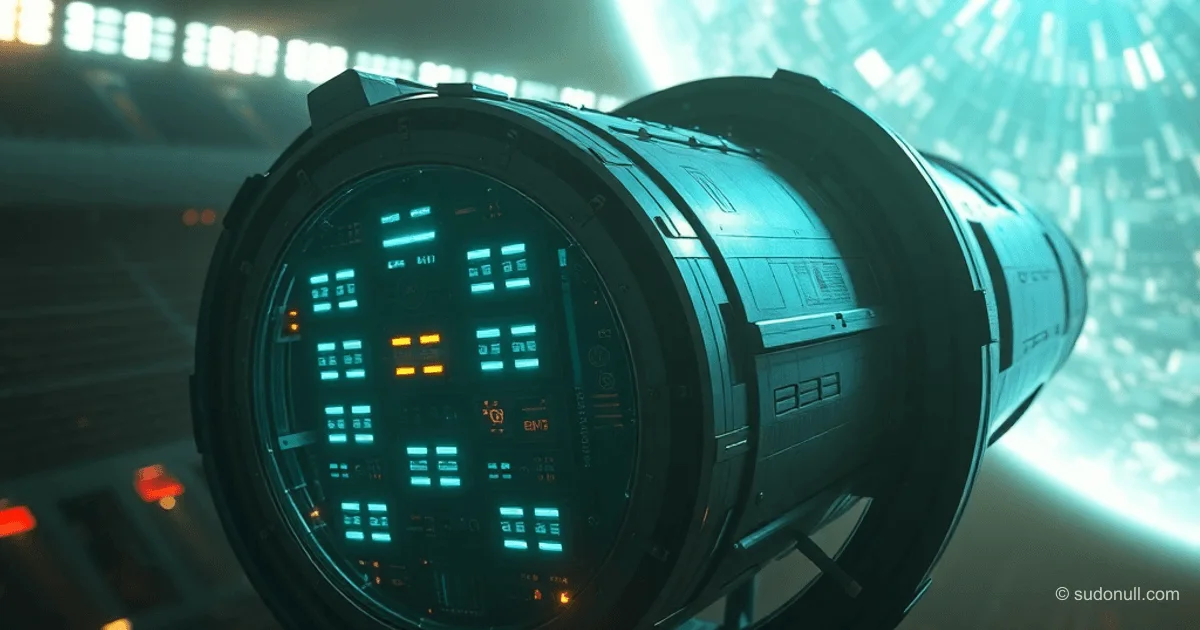
# Fault-Tolerant Architecture: How NASA Ensures Reliability of Orion's Onboard Systems for the Artemis-2 Mission
To ensure crew safety in deep space, NASA has developed a multi-level fault-tolerant system onboard the Orion spacecraft. Unlike the simplified solutions from the Apollo era, the modern architecture combines hardware redundancy, deterministic algorithms, and backup software capable of withstanding radiation glitches and full processor failures. Critical functions—from life support to navigation—are managed through a system where every component has at least three layers of protection.
Eight-Channel Redundancy: The "Fail-Silent" Principle
The heart of the system consists of two onboard computers, each containing two flight management modules (FMMs). Inside each FMM, paired processors run, cross-checking each other's computations in real time. The resulting setup integrates eight processors, all executing the same code in parallel. If a discrepancy is detected in calculations (for example, due to radiation), the faulty processor is instantly switched to a "fail-silent" state, preventing erroneous data from reaching the control system.
This approach differs fundamentally from traditional triple-redundant systems that rely on voting to determine the correct result. Orion implements prioritized source selection: the system sequentially checks available FMMs, starting with the highest priority. Even if three out of four modules fail, the spacecraft can still safely complete the mission. A key innovation is dynamic reconfiguration—modules in fail-silent mode automatically reboot, synchronize with operational units, and return to service without crew intervention.
Key protection components:
- Paired processors with hardware result comparison
- Triple modular redundancy memory (TMR) for single-bit error correction
- Duplicate network interfaces with continuous data verification
- Prioritized source selection scheme instead of voting
- In-flight dynamic reconfiguration
Deterministic Synchronization: Overcoming Asynchrony
Synchronous operation of eight processors requires eliminating timing discrepancies that can arise from even minor clock frequency variations. NASA employed a time-triggered architecture (TTEthernet), where all operations are synchronized via a centralized time domain. Flight software operates within a strict temporal framework:
- Major frames (1 second) are divided into minor frames (millisecond intervals)
- A scheduler compliant with the ARINC 653 standard allocates tasks with guaranteed timing constraints
- Each FMM receives identical input data at precisely defined moments
This model ensures spatial and temporal isolation of processes, preventing one component from affecting another. Critical applications that exceed their allotted time slot are automatically deactivated and restarted. To maintain synchronization, the system corrects each FMM's local clocks against the network's "true" time every second, measuring deviations with nanosecond precision.
Michael Riley from Carnegie Mellon University notes that such determinism is rare in modern development: "Agile methodologies often sacrifice architectural discipline for iteration speed, leading to technical debt. In mission-critical systems, this is unacceptable—every line of code must meet strict timing and functional specifications."
Redundancy via Heterogeneity
Even with eight-channel redundancy, there's a risk of system-wide failures—for instance, bugs in the primary flight software. To mitigate this, Orion is equipped with an independent redundant flight software system (RFS), which:
- Runs on a separate hardware stack
- Uses an alternative operating system
- Features a simplified control algorithm
- Operates in parallel with the primary system
The RFS was specifically designed to be as dissimilar as possible from the main system, eliminating correlated errors. In case of total primary channel failure, the backup system automatically assumes control, placing the spacecraft in safe mode. Its algorithms can perform all critical operations to stabilize the vehicle, including orienting solar arrays and thermal control.
Special attention is given to total power loss scenarios ("dead bus"). After power restoration, Orion sequentially:
- Stabilizes attitude in space
- Orients solar panels toward the energy source
- Ensures thermal stability
- Initiates communication recovery attempts
The crew can also intervene manually by activating emergency protocols via mechanical interfaces.
Key Takeaways
- Eight-channel redundancy with fail-silent mechanisms maintains operability even after losing 75% of compute modules.
- Deterministic architecture based on TTEthernet and ARINC 653 ensures operational synchrony with nanosecond precision.
- Heterogeneous redundancy via RFS eliminates error correlation between primary and backup systems.
- Monte Carlo stress-testing simulates catastrophic scenarios to verify recovery algorithms.
- Radiation-hardened hardware includes TMR memory and duplicate network interfaces with continuous data integrity checks.
Verification in Space-Like Conditions
To validate the architecture's reliability, NASA uses a multi-level testing strategy. During development, simulators recreate the radiation environment of the Van Allen belts. The key method involves injecting artificial faults via supercomputer models, introducing:
- Synchronous failures across multiple FMMs
- Asynchronous timing discrepancies
- Network packet losses
- Hardware failures at specified intervals
Special focus is on mode transition testing. For example, when simulating the loss of three FMMs within 22 seconds, the system must seamlessly switch to the remaining module while maintaining attitude control. All tests exceed expected mission loads, with a safety margin of at least 30%.
These procedures uncovered and fixed hidden vulnerabilities, such as timing windows during system reconfiguration after module reboot. As Nate Wittenbrock from Johnson Space Center notes: "Our goal isn't just to detect a failure, but to ensure the system returns to full functionality without human intervention."
The shift from Apollo to Artemis illustrates the evolution of reliability approaches: in the 1960s, mechanical backups compensated for limited onboard computing power; today, software is the last line of defense. Orion's architecture sets standards for future systems—from autonomous vehicles to critical infrastructure, where a single bit flip can spell disaster.
— Editorial Team

No comments yet.