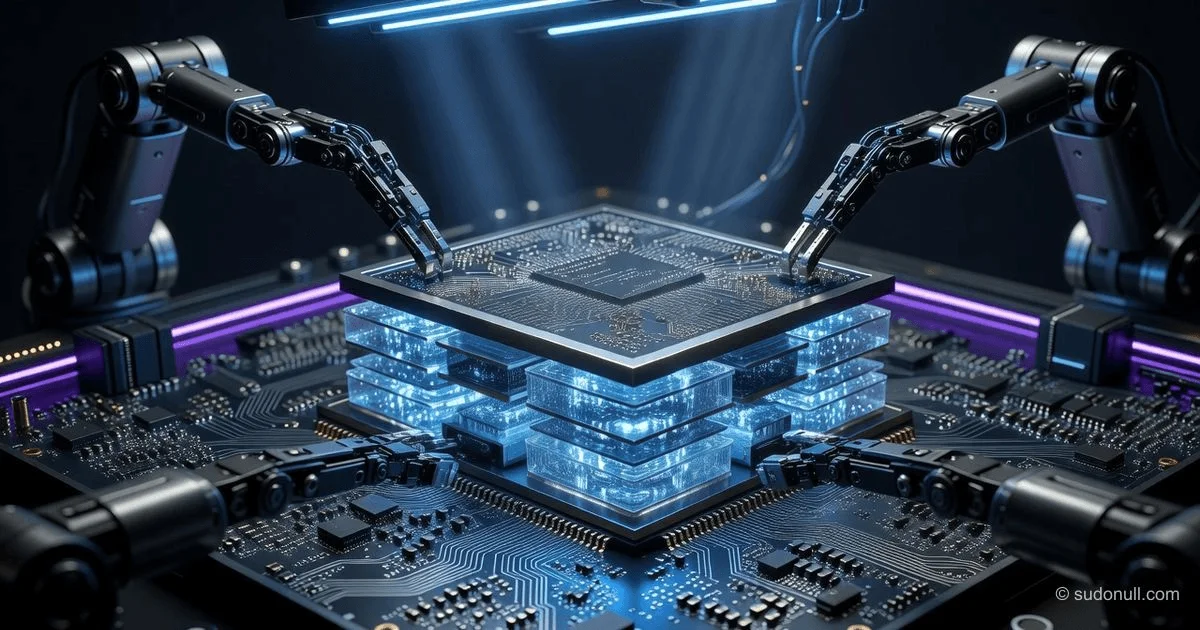
Nvidia and SK hynix Enter Multi-Year Partnership to Develop Memory for Physical AI
South Korean memory maker SK hynix has signed a multi-year agreement with Nvidia to jointly develop memory technologies for AI infrastructure and 'physical AI.' The deal aims to strengthen leadership in next-generation AI chips.
Insider Analysis: Why the Nvidia-SK Hynix Deal Is Not About Memory, but About Control Over 'Physical AI'
Independent analysis from a semiconductor industry veteran
[The Gist]: What's Really Happening
On June 8, 2026, Jensen Huang and Choi Tae-won announced a 'multi-year technology partnership' between Nvidia and SK hynix. All the formal signs are there—supplies of HBM4 for the Vera Rubin platform, use of CUDA in design, digital twins of factories. But behind these words lies a fundamental shift that will upend the entire hierarchy of AI component suppliers.
This is not a memory supply deal. It is SK hynix's absorption into the Nvidia ecosystem at the architectural planning level. Note SK Group's wording: 'a shift in relationship from supplier-contractor to alliance.' Translated from diplomatic to insider speak: SK hynix has just voluntarily given up its status as an independent memory maker to become Nvidia's 'strategic railway.'
Why is this critically important? Because 'physical AI' (robots, drones, factory systems) imposes completely different demands on memory than cloud-based LLMs. As a recent study (arXiv, May 2026) shows, on real physical AI workloads with batch-1 decoding, the H100 uses only 27% of its peak memory bandwidth. That means 73% of the chip's potential is idle—not because of memory, but due to kernel launch overhead.
This means classic HBM, optimized for huge batches in the cloud, is fundamentally unsuited for physical AI. And here Nvidia and SK hynix are striking a deal that changes the rules: they will design memory not for existing GPUs, but for specific physical AI scenarios, starting at the memory controller level. This is not HBM4—it's HBM for real-time with predictable latency, where usage is not 27% but 80%. Competitors (Samsung and Micron) are still measuring gigabytes per second, while Nvidia and SK hynix have already moved into a different physical dimension.
Timeline and Context
To understand the depth of this move, we need to trace the evolution of Nvidia's relationships with memory makers. SK hynix historically was the first to supply HBM3 for the H100, and that gave them an edge they haven't let slip. But the June 2026 deal is not a continuation—it's a quantum leap.
| Date | Event | Participants | Strategic Significance |
|---|---|---|---|
| 2013 | SK hynix pioneers HBM | SK hynix | Technology was niche—now critical for AI |
| 2022-2023 | HBM3 for H100 | SK hynix exclusively (Samsung had issues) | SK hynix gains a 12-18 month lead |
| February 2026 | Samsung and Micron begin HBM4 shipments | Samsung, Micron | Competition in HBM4 officially opens |
| May 2026 | arXiv publication on memory problem in physical AI | Researchers | Industry gets quantitative confirmation of the problem |
| June 2026 | Multi-year technology partnership Nvidia-SK hynix | Nvidia, SK hynix, SK Group | Shift from supply to co-design at the architecture level |
| Q3 2026 (planned) | Start of Vera Rubin shipments | Nvidia, SK hynix, Samsung | First deployment of HBM4 in production |
| 2027+ | HBM4E and beyond | All three makers | Standardization vs. customization |
Key takeaway from the timeline: February 2026 was the moment when all three memory makers got the 'green light' for HBM4. Samsung even announced it was first to start mass production. But the June deal shows that 'supplier qualification' and 'strategic partnership' are completely different levels. Samsung and Micron will supply HBM4 to Nvidia's specs. SK hynix will design HBM5 together with Nvidia before the specs are even written.
Who Wins and Who Loses
Winner #1: SK hynix. They just got something more valuable than a contract—they got early access to Nvidia's next-generation architecture. In the semiconductor world, where memory development cycles are 3-4 years and GPU cycles are 2 years, such access means SK hynix can start HBM5 production 12-18 months ahead of competitors. This is not just an advantage—it's the right to set market prices.
Winner #2: Nvidia. They just hedged against their biggest risk—memory shortages. In 2024-2025, HBM3 was the bottleneck limiting H100 production. Now Nvidia gets guaranteed volumes from SK hynix plus leverage over Samsung and Micron through the threat of losing share. But most importantly, Nvidia gets to dictate memory architecture for its physical AI tasks. This is vertical integration without buying fabs.
Loser #1: Samsung. The Korean giant just officially became the 'third wheel.' They have HBM4, they started mass production first. But it doesn't matter, because Nvidia chose a partner for the next generation. Samsung can supply memory, but they will never be part of setting standards. Their vertical integration (memory + foundry) becomes a burden, not an advantage—SK hynix can now use 'neutrality' against Samsung.
Loser #2: Micron. The American maker has historically been third in the HBM race. The Nvidia-SK hynix deal cements that status. Micron can hope for American patriotism (CHIPS Act, local production requirements), but Nvidia is a global company, and technology compatibility matters more than geography. Plus, their $20 billion CAPEX for capacity expansion now looks like trying to catch a departing train.
What the Media Isn't Saying
Insight #1: The deal is not really about HBM4, but about near-memory compute. In SK hynix's press release, they mention using CUDA-X and NVIDIA PhysicsNeMo to 'accelerate TCAD simulations and computational lithography.' This is not marketing. It means the HBM4 logic base die will be manufactured on a 5nm or 4nm process and will be able to perform part of the data processing right inside the memory stack. For physical AI, where every microsecond of latency is critical, the ability to do basic sensor data filtering in memory before sending to the GPU is revolutionary. SK hynix becomes not just a memory maker, but a maker of 'intelligent buffers.'
Insight #2: The four-pillar structure of the deal. Most analysts see only 'memory for Vera Rubin.' In reality, the deal has four pillars, three of which are not about HBM:
- Stable memory supply for Nvidia's roadmap
- Joint development of memory for robotics (Jetson Thor)
- Using Nvidia software to accelerate SK hynix chip simulation
- Digital twins of factories for autonomous manufacturing
Points two and four are game-changers. Developing memory for Jetson Thor means SK hynix will design chips for robots that will work in the fields and factories of Samsung, Hyundai, and other Korean industrial giants. This creates a closed loop: SK hynix makes memory for Nvidia's robots, and those robots automate SK hynix's memory production. This is not a deal—it's an industrial symbiotic ecosystem.
Insight #3: The geopolitical dimension. In an interview with Arirang TV, Huang stated: 'No country is better prepared for robotics than Korea.' This is not just a compliment. It's a signal to the Biden/Trump administration (choose depending on election date) that the US needs Korean manufacturing capacity for physical AI, just as it needs Taiwanese capacity for advanced logic. SK hynix becomes a 'second Taiwan'—a critical link the US cannot afford to lose. And the Koreans know it, which is why they enter such an alliance: they now have leverage over Washington.
Forecast: Next 30 Days and 90 Days
Next 30 Days (by mid-July 2026)
Within a month, we will see Samsung's official reaction. The Korean giant cannot afford to stay silent when a competitor effectively gains 'privileged partner' status with Nvidia. Expect one of two things: either an announcement of accelerated HBM4E to 2027, or—more likely—a lawsuit for unfair competition in Korean courts. Samsung will argue the deal violates principles of equal access to Nvidia's specs. It won't succeed, but it will create noise.
Also expect the first public mentions of 'physical AI' in Microsoft and Amazon reports. Both hyperscalers are already building AI factories, and now they will need chips optimized not just for training but for inference on real physical systems (warehouse robots, autonomous forklifts). If either announces a pilot project using Vera Rubin and SK hynix memory for factory automation, the deal's value will jump another 15-20%.
Key indicator: SK hynix's stock price on KOSPI. If it rises more than 8% in two weeks after the deal, the market has bought into the 'physical AI narrative.' If the rise is less than 3%, investors see no difference between this deal and a regular contract.
90-Day Horizon (by September 2026)
By September, as Q3 reports are prepared, we will see technical details of HBM for physical AI. Most likely, SK hynix will announce a separate memory line (tentatively HBM-P or HBM-R for real-time) that will feature not maximum peak bandwidth, but guaranteed latency and predictable power consumption. These specs will be 2-3 times better than standard Samsung HBM4, and that will be the moment the market grasps the scale of SK hynix's advantage.
Geopolitical scenario: The US will announce the inclusion of SK hynix in the list of 'approved suppliers' for CHIPS Act projects related to defense applications of physical AI (drone systems, automated Pentagon logistics). This will not be a subsidy, but a political endorsement that allows SK hynix to bid for contracts previously closed to non-US companies. Ironically, a Korean company will get access to US military orders before American Micron.
What could go wrong: If Samsung can demonstrate a working prototype of HBM with a logic base die that matches SK hynix's latency, the race continues. But given the pace (Samsung was 12 months late with HBM3), this scenario is unlikely before 2027.
Final assessment: This is not the deal of the decade in semiconductors. It is a deal that redefines the category of 'memory.' SK hynix has just ceased to be a component supplier and become Nvidia's architectural partner. Samsung and Micron are now competing not for contracts, but for survival in a market where standardized memory will become a commodity, and customized memory will be the only source of high margins. Within 18 months, we will see a market split: 60% volume—standard HBM at low prices (Chinese makers will enter here by 2028) and 40%—customized solutions for physical AI with 70%+ margins. SK hynix has just secured its place in that top segment. The only question is whether they can maintain technological leadership when US and Chinese startups with radically new memory approaches (e.g., based on resistive RAM or magnetic memory) enter the game. Over a 3-5 year horizon, the battle is just beginning, but the first round has been decisively won by the Koreans.
— Editorial Team








No comments yet.