August 19, 2014 at 10:46
Conversion Optimization: 7 tips for using predictive analytics
- Tutorial
- Recovery mode
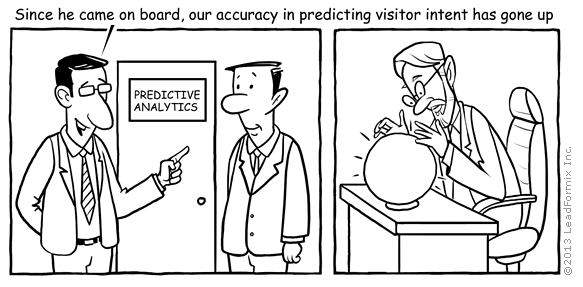 Predictive analytics is a technology that relies on Big Data, data on people's behavior, to predict how they will behave in the future, and to optimize business processes using this knowledge. Have you ever wanted to know in advance which products your customers are most likely to buy? It would be great if you could predict the maximum price that the customer is willing to pay for the product. But what if you could optimize the customer service and solve all the problems even before they would arise in the user? Most likely, this knowledge would help you increase your profits in the field of e-Commerce and increase conversion.
Predictive analytics offers solutions not only in the above areas, but also in many others. Below are 7 tips for optimizing your conversion using predictive analytics.
1. Increase customer interest and increase revenue.
There are different types of customers, and their perception of sites in the e-commerce segment is significantly different from each other, each needs its own approach, each can be attracted in some specific way. Predictive analytics considers all possible perceptual options in order to arouse the desired interest of each buyer. This may be an offer to subscribe to the newsletter, click on the "share" button or some other way to attract customers.
There are several products that help retailers create models for tracking and analyzing user behavior - for example, Alteryx , Attivio , Lattice , SAS . Such models can subsequently serve as landmarks in business, helping to develop in the right direction.
Lattice examined how leading Amazon and Netflix companies used predictive analytics to better understand user behavior and come up with a solution that would help sales people better identify leads.

The venture capitalists invested more than $ 160 million in 2014 in forecasting tools that help marketers figure out how best to make online and offline sales.
Investors in this area understand the potential of the market - they see that forecasting tools such as Lattice help sales managers better calculate leads using publicly available information about them, rather than simply qualitatively comparing them with an existing customer base of the company. Below is an illustration of the amount of investment in various predictive analytics programs.

A source
Forrester calls the combination of predictive analytics and customer engagement predictive analysis applications, considering them to be part of an era in which the entire Internet segment approaches its expected extreme: the world of hyper-individualized experience. Thanks to such tools, Dell managed to achieve an almost twofold improvement in sales performance, although the number of leads that the marketing department sent to the sales department was reduced by 50%, only the most promising ones were selected using predictive analytics.
In this example, at PredictiveAnalyticsWorld.comThe unnamed educational portal, which is used by every third senior high school student, uses a predictive advertising system that helps to better match advertising offers to existing traffic. As a result, user response increased by 25%, which equals approximately $ 1 million in advertising revenue for 19 months.
2. Launch advertising campaigns targeted at your customers.

An example of a personalized advertising company.
Advertising in retail is a must-have, but it’s not so easy to direct your advertising campaign in the right direction.
According to an Oracle study, 98% of fast-growing trading companies understand that segmentation and targeting are an essential part of their online merchandising strategy, but more than half are not satisfied with the tools they use to conduct promotions.

source
Predictive analytics can change this by comparing data from several sources, which helps to create personalized advertising offers that will be most effective for a particular client or segment.
Macy's already managed to see the benefits of predictive analytics using the solution proposed by SAP, which led to more effective targeting of users already registered on the site. For three months Macy’sobserved an increase in online sales of 8-12%, this was achieved by analyzing user clicks by product category and sending targeted e-mails to each segment of potential customers.
StitchFix is another retailer using a unique sales model. Users are encouraged to take a survey on clothing style, and then using predictive analytics, they determine which clothes each client will like best. If the buyer does not like the clothes, he can return it back without paying shipping.

source
Another example: Turkcell, the largest mobile operator in Turkey, uses more than 150 parameters characterizing its users, such as the nature of use, preferred device parameters, and location data. All this information is used to send customers the most suitable advertising offers for them in real time and thereby reduce the outflow of users.
It is important that you understand that the predictive analytics tools do not work on the principle of Plug & Play: flooded the data and received instant revenue growth. According to a study conducted by Ventana, only 13% of 2600 enterprises consider predictive analytics to be the most important element of their business strategy.

A source
David Menninger, a former director of research at Ventana, argues this as follows:
 “Predictive analytics remains a tool for professionals. Personally, it seems to me that it’s very difficult to do this, and the complexity of the calculations in this area is beyond the capabilities and knowledge of most people . ”
 Robert T. Mitchell found out during an interview with expert analysts of consulting firms that the most common mistakes in implementing predictive analytics programs are because entrepreneurs cannot formulate the ultimate goals of their activities, do not delete outdated data (due to lack of understanding) and their company has a spirit of conservatism and rejection of change.
For example, Dean Abbot from Abbot Analyticsshared a story about a collection agency that wanted to develop the most effective sequence of actions for debt collection, but adhered to strict rules, because of which collectors had to perform the same actions each time.
 “Data analysis is the art of making comparisons, and for that you need examples from history. Fortunately, most experts are of the opinion that although even defective forecasting models are rarely fatal and can always be improved, the general opinion is that building high-quality models takes a lot of effort and can take a really long time. For the client, this means that he spends money and time and does not receive instant returns, or worse, he spends resources in general. "John Elder says that it can take a year to bring the forecasting model to mind, and for this reason, even if technically 90% of the models created for customers are successful, only 65% of them really work . "
 3. Price optimization for maximizing profit.

Example of testing different price tags
Traditionally, retailers have used A / B or Multivariate testing to set prices for different categories of products and determine the optimal cost, which will maximize profits. The problem is that each price is set manually and is very dependent on the human factor, which means that there is a high probability of error.
Predictive analytics uses a different approach to developing a real-time pricing model, which is formed on the basis of information from sources such as:
• Historically accepted product price;
• customer activity;
• history of orders, customer preferences in the past;
• prices of similar products from competitors;
• desired mark-up;
• available stock of product;
• other.
This video shows how Uber & AirBnB got rid of the difficulties associated with setting prices for different categories of goods by equalizing supply and demand, and how predictive analytics helped them in this.
You need to constantly monitor the pricing process in order to avoid automatic price changes, which will cause questions among retailers.
Accenture has been emphasizing the benefits of predictive analytics for pricing management for a long time. Their report states that it is never too early for a retailer to start experimenting with pricing using predictive analytics, the sooner a company begins to do this, the sooner it will be able to achieve successful analytical forecasts. This is unlikely to be somehow connected, but after the publication of the report in 2011, the demand for the work of analysts has grown significantly.

4. Warehouse management: replenish them on time, but avoid oversupply
Walmart revolutionized inventory management by asking suppliers to provide real-time support in this area, the system was called VMI (vendor managed inventory - vendor-managed inventory).
Predictive analytics improves this solution by decreasing the required / critical level of stock of goods, if large orders are not expected for the near future according to the forecasting model. This helps retailers distribute their funds so as to buy products that are in high demand and potentially more profitable.
A useful study was published last year on how big data (Big Data) and predictive analytics can change inventory management strategies.
Researchers from Sam M. Walton College of Business and Weber State University have determined that the lack of technical skills to use such technologies is the biggest obstacle to the wider implementation of predictive analytics analysis, but this situation is changing with the help of suppliers who offer easily implemented comprehensive solutions for inventory management using predictive analytics.
The graph below shows how often over the past years they began to search the phrase “predictive analytics” on Google - this indicates that knowledge gaps are decreasing every day.

source
One of similar examplesSouthern States was cited - it tells how agricultural cooperatives used Alteryx to maintain sales at the same level, while storing 31% of the goods in warehouses.

For farmers, this meant 31% less spoiled products, but for the business owner in the e-Commerce segment, this means less money spent on storage, less goods at customs and other unnecessary expenses.
5. Reduce the risk of fraud by actively identifying it
. Unfortunately, fraud is a common story in modern retail, including online, annual losses from it are estimated in billions of dollars.
Any technology that can reduce the losses from fraud is like a breath of fresh air for any retailer. The solutions offered by predictive analytics, such as those found in IBM's SPSS suite , allow the entrepreneur to analyze user behavior patterns, methods of payment and purchase of goods in order to detect and prevent possible fraud. Some retailers even experiment using self-learning predictive analytics programs to automatically identify patterns by which fraud can be detected and prevented.
This is really necessary because fraudsters are becoming more and more inventive every day.
Aberdeen's work analyzed various types of fraud, as well as their willingness to deal with them. Below is a graph showing the degree of readiness to deal with different types of fraud, in vertical percent - the degree of readiness of retailers to protect themselves from each type of fraud, horizontally - the prevalence of this type over the past year.

Source
The report also emphasizes that predictive analytics as a method of dealing with fraudsters still have to develop for a long time: only 16% of respondents said that they used analytical tools primarily to detect fraud.

Walmart showed a serious attitude to predictive analytics as a way to combat fraud detection when they acquired Inkiru, a promising predictive analytics startup, last year.
Other retailers have also used various scam computing algorithms over the past few years. But now these models are expanding and improving, starting to use predictive analytics to recognize and prevent fraud before it even happens.
6. Offer better customer service for less.
Customer service is one of the areas that retailers have a lot of questions to answer, here are some of them:
• Should there be customer support only in electronic form, or is a call center also needed?
• If telephone support is also needed, how many managers do you need?
• Maybe, besides a call center, you need an online consultant on the site?
• What should be the optimal waiting time for a response when a customer calls support?
• How to prioritize issues between loyal and valuable customers?
You can find answers to these and other questions by building a model, a unique customer service for each specific retailer. Over time, this model will improve and will provide the most accurate forecasts to help improve customer service.
Linux distributor Red Hat uses predictive analytics to improve customer service by increasing the dimension they call “subscriber stickiness.” According to the study, the company managed to anticipate users' questions and solve their problems before they even appeared.
Hotel chains, such as Marriott, are another great example of a business that places great emphasis on predictive analytics, which helps exceed customer expectations before, during, and after a hotel stay.
Premium hotel chains such as Four Seasons and Ritz Carlton are always trying to predict the wishes of customers - and all this is due to predictive analytics! Here is just one example where Ritz Carlton got out of his way to exceed customer expectations using some predictive analytics. The son of one of the hotel guests forgot there his favorite toy - the giraffe Josie, his father came up with a funny story about the giraffe staying at the hotel and taking sun baths. On the same day, the hotel staff called, saying that they had found a giraffe, and when their father asked them to take one funny photo of a giraffe in a deck chair to demonstrate the veracity of their fiction, the hotel staff arranged a real photo shoot of Josie's vacation, a couple of photos below.


7. Analyze information and make decisions in real time.
Stream analytics is the ability to generate ideas in real time, which helps retailers make decisions here and now.
The retail segment is developing very quickly, so it makes no sense to use predictive analytics, relying on outdated data. Real-time decisions help you choose the best day to launch your promotion, identify products that will sell best, popular products that will sell well, target specific campaigns correctly, etc.
Netflix is a well-known example of effective streaming analytics: they record and analyze each element of customer interaction, including at what point the client was delayed, how many times she did it, fix it, the name of the movie of which color attracts more attention of customers, etc. . All this helps them to give useful recommendations in real time.
The Granify technology platform delivers predictive analytics of the same level, using accumulated data to adjust the website in real time. For example, if the behavior of a site visitor matches the behavior of someone from past customers who were worried about clothing sizes, their attention will be paid to the size chart, and as soon as it becomes clear that the customer wants to know about delivery, the system will immediately turn his attention to delivery terms in any way.
Source - http://conversionxl.com/predictive-analytics-changing-world-retail/?hvid=352IDw# .
Only registered users can participate in the survey. Please come in.
Do you use predictive analytics tools in your work?
- 27.5% Yes, I think they are effective 8
- 3.4% Yes, used, but did not notice much effect 1
- 58.6% No, but I want to try 17
- 10.3% No, I consider them useless 3