Runet performance week
Some time ago, in one of the boarding houses of the Leningrad Region in a narrow circle of hosting providers, co-owner of Openstat Leonid Filatov presented a report, which became a kind of feast of meta-analysis. We managed to combine a lot of heterogeneous data on an example of a topic that most webmasters and hosters care about - the performance (speed) of returning web site pages to different hosting services and depending on various engines.
An example of such a report.
As you can see, there is so much data that I want to decompress them.
But first, a couple of paragraphs on how they are obtained.
One of their sources is the special developer interface adopted on December 17, 2012 - the Navigation Timing API. It provides access to a set of parameters characterizing the speed of loading and preparing the page for work - the time in milliseconds that has elapsed from the beginning of an era to a specific event. Based on it, Openstat provided a new standard report for a little over a month, which allows one to find out the performance of page returns in real time and evaluate the speed of page assembly for various users.
In addition to Openstat, there are several more web analytics in the world with similar functionality: New Relic, Google Analytics, Yandex. Metric, Piwik. They allow you to work with the performance of sites, as with traces of people in the virtual space, in other words, with Big Data. Other tests, for example, the well-known WebPagetest, measure page loading speed not for live visitors, but for programs that communicate with the server.
Another data source is the Openstat crawler, which since last summer has been indexing the entire Runet, as well as Bynet, Uanet and sites of other domain zones, where Russian users go in large numbers. The main purpose of this "spider" is to collect signatures of counters, advertising systems, online consultants and similar systems. But along the way, he fixes available site technometrics.
The crawler works with all second-level domains that give a “200” response, and the counter works with all the sites where it is installed. Therefore, a meta-analysis using both tools was often carried out only for second-level domains.
However, the simplest report was received for one, but very large RuNet site.
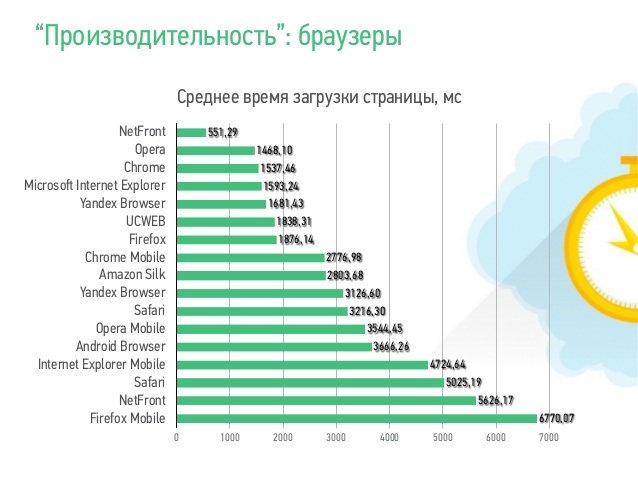
It’s easy to guess that desktop browsers turned out to be faster than mobile browsers (so this is not specifically marked on the histogram).
And if you think about this picture, then the first immature thoughts are:
1. Yandex Browser should have been done with the goal (apart from the competition in the search market) of optimizing page loading speed, but it still does not exceed competitors!
2. The first three include browsers for geeks, and they already provided themselves and the last mile with good bandwidth.
But such conclusions are not rich in meaning, and Crome has long become a browser for everyone, since every fifth Internet provider has it.
So here it is more appropriate to draw conclusions for analysts of a specific Internet resource.
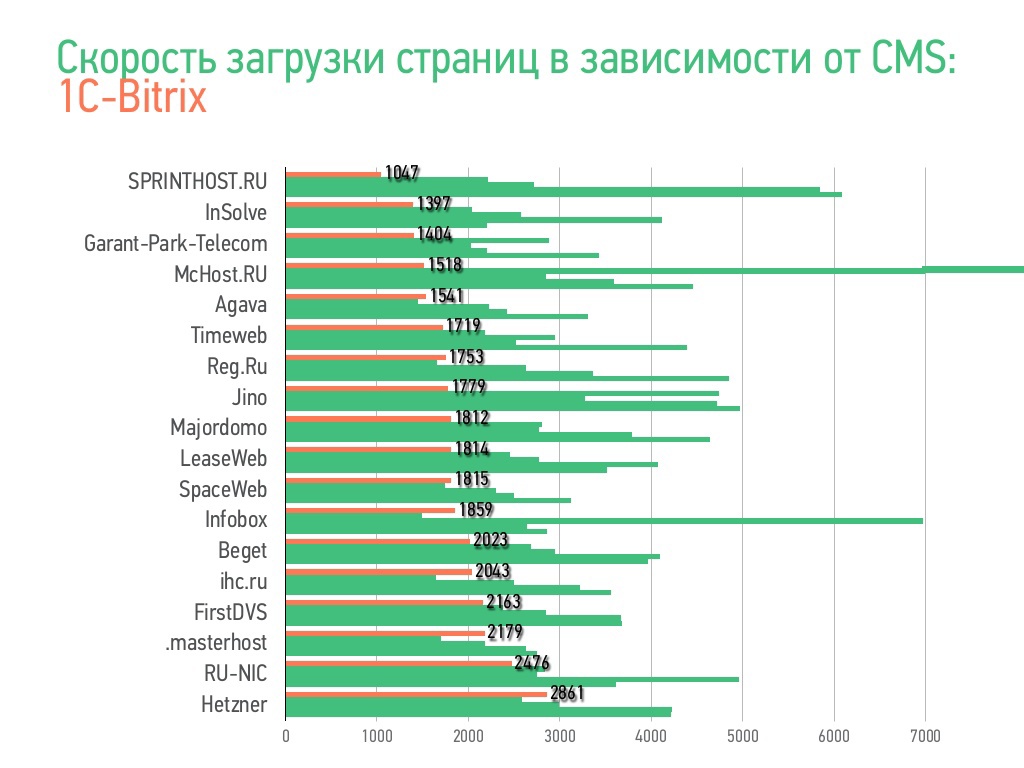
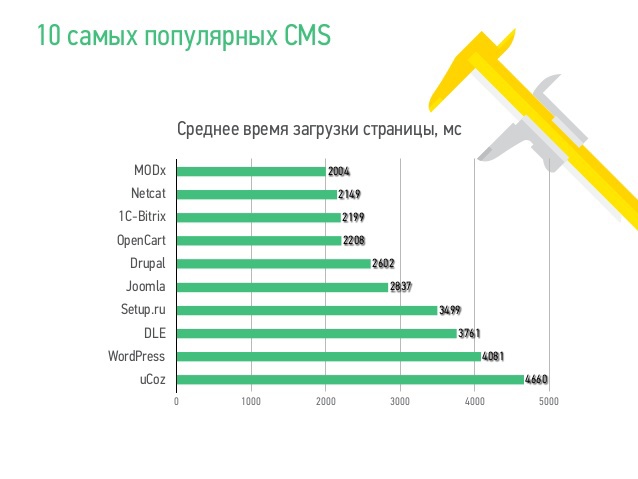
And here is the first special study, “Performance Dependence for 57 Popular CMS”. A selection of 24 thousand sites. Results for May 2014. In April, 38 CMS were tested and the first five were exactly the same, although with different values.

In the case of Bitrix, the speed depends on whether the website acceleration (CDN) service was used, as well as the Composite Site technology. Such nuances were not tracked.
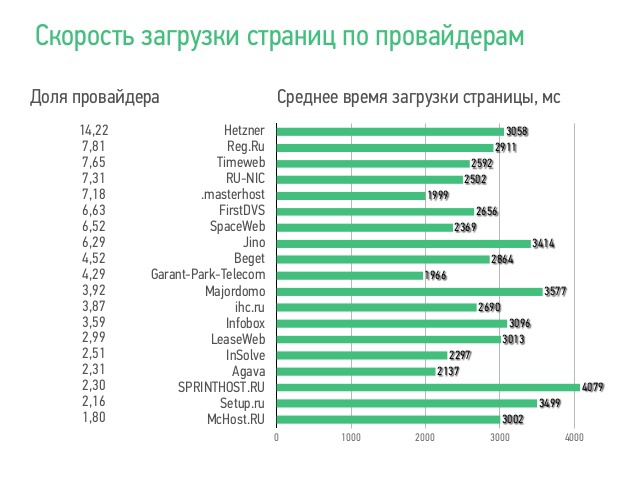
One of the central reports was in search of itself for a long time. Five times refined (in the sense of grouping) data on hosting providers. The selection criteria for the central slide twice changed.
In the end, when choosing the defendants, we stopped at the statistics of the hosting providers StatOnline.ru (from there the shares in the group were taken). And after approximate calculations using Excel, the final report was generated using SQL.
Although there is no limit to perfection, the following diagram should be regarded as data related to the real situation in May 2014.
And a little bit about the vulnerability of hosting providers using SSL certificates as an example, which were collected by the same Openstat crawler for second-level domains on port 443.
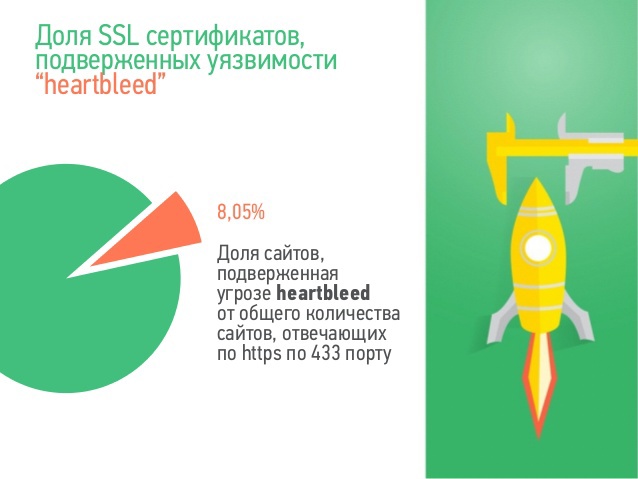
This completely separate study was conducted on the whole Runet (4.93 million domains). 1.6 million certificates were discovered, of which 760 thousand were self-signed; fully normal (status 200) - 4 thousand; vulnerable to Heartbleed (vulnerable version of OpenSSL) - 133 thousand (8%).
HeartBleed could become, if not already, the biggest information vulnerability in general.
According to Habrahabr analysts, approximately примерно Runet websites were vulnerable to this day. An accurate calculation showed that this is not the case, to put it mildly.
"Runet Performance Week" turned out to be non-calendar. It began on Friday, May 23, when Andrei Travin (Openstat) and Sergey Ryzhikov (1C-Bitrix) spoke about website performance at the Failover conference - the first two reports. The first of these included the dependence of site performance on CMS in April. And Sergey had about his “Composite site”.
On May 27, they managed to report the same thing to Petersburgers at the SPIK conference.
And on May 30, Leonid Filatov at the "Host Review" showed the dependence of site speed on the largest providers and at the same time on the CMS used by them.
Almost simultaneously, a Bitrix study appeared on the performance of 100 domestic online stores, as if in response to a similarSurvey of 500 stores from Radware.
It will be necessary to rake the results obtained not only in June, but also generally before the fall conferences.
An example of such a report.
As you can see, there is so much data that I want to decompress them.
But first, a couple of paragraphs on how they are obtained.
One of their sources is the special developer interface adopted on December 17, 2012 - the Navigation Timing API. It provides access to a set of parameters characterizing the speed of loading and preparing the page for work - the time in milliseconds that has elapsed from the beginning of an era to a specific event. Based on it, Openstat provided a new standard report for a little over a month, which allows one to find out the performance of page returns in real time and evaluate the speed of page assembly for various users.
In addition to Openstat, there are several more web analytics in the world with similar functionality: New Relic, Google Analytics, Yandex. Metric, Piwik. They allow you to work with the performance of sites, as with traces of people in the virtual space, in other words, with Big Data. Other tests, for example, the well-known WebPagetest, measure page loading speed not for live visitors, but for programs that communicate with the server.
Another data source is the Openstat crawler, which since last summer has been indexing the entire Runet, as well as Bynet, Uanet and sites of other domain zones, where Russian users go in large numbers. The main purpose of this "spider" is to collect signatures of counters, advertising systems, online consultants and similar systems. But along the way, he fixes available site technometrics.
The crawler works with all second-level domains that give a “200” response, and the counter works with all the sites where it is installed. Therefore, a meta-analysis using both tools was often carried out only for second-level domains.
However, the simplest report was received for one, but very large RuNet site.
It’s easy to guess that desktop browsers turned out to be faster than mobile browsers (so this is not specifically marked on the histogram).
And if you think about this picture, then the first immature thoughts are:
1. Yandex Browser should have been done with the goal (apart from the competition in the search market) of optimizing page loading speed, but it still does not exceed competitors!
2. The first three include browsers for geeks, and they already provided themselves and the last mile with good bandwidth.
But such conclusions are not rich in meaning, and Crome has long become a browser for everyone, since every fifth Internet provider has it.
So here it is more appropriate to draw conclusions for analysts of a specific Internet resource.
And here is the first special study, “Performance Dependence for 57 Popular CMS”. A selection of 24 thousand sites. Results for May 2014. In April, 38 CMS were tested and the first five were exactly the same, although with different values.
| Name CMS | Average ms | Min., Ms | Max. Ms | Sites |
| A5 | 491 | 175 | 1213 | 7 |
| Melbis shop | 898 | 632 | 1462 | 7 |
| RBC Contents | 961 | 463 | 1377 | 8 |
| ImageCMS | 980 | 437 | 1748 | 5 |
| Abo | 996 | 457 | 1834 | 12 |
| Djem | 1130 | 901 | 1425 | 7 |
| Aquilon | 1183 | 961 | 1405 | 2 |
| Twilight | 1189 | 1024 | 1359 | 3 |
| TYPO3 | 1453 | 426 | 3708 | 19 |
| S. Builder | 1474 | 281 | 3475 | 8 |
| Taberna eCommerce | 1505 | 784 | 2482 | 3 |
In the case of Bitrix, the speed depends on whether the website acceleration (CDN) service was used, as well as the Composite Site technology. Such nuances were not tracked.
One of the central reports was in search of itself for a long time. Five times refined (in the sense of grouping) data on hosting providers. The selection criteria for the central slide twice changed.
In the end, when choosing the defendants, we stopped at the statistics of the hosting providers StatOnline.ru (from there the shares in the group were taken). And after approximate calculations using Excel, the final report was generated using SQL.
Although there is no limit to perfection, the following diagram should be regarded as data related to the real situation in May 2014.
| organization | bitrix | drupal | joomla | setup_ru | dle | wordpress | ucoz |
| Agava | 1541 | 1444 | 2230 | 2422 | 3313 | ||
| Beget | 2023 | 2684 | 2949 | 4093 | 3967 | ||
| Compubyte limited | 4662 | ||||||
| Firstvds | 2163 | 2384 | 2846 | 3667 | 3679 | ||
| Garant-park-telecom | 1404 | 2885 | 2030 | 2203 | 3430 | ||
| Hetzner | 2861 | 2591 | 2990 | 4228 | 4213 | ||
| Hosting telesystems network | 2245 | 3918 | 2681 | 4865 | 2636 | ||
| Insolve | 1397 | 2036 | 2576 | 4116 | 2205 | ||
| Infobox | 1859 | 1493 | 6970 | 2636 | 2857 | ||
| Jino avguro | 1779 | 4746 | 3271 | 4714 | 4966 | ||
| Leaseweb | 1814 | 2459 | 2775 | 4075 | 3512 | ||
| Majordomo | 1812 | 2806 | 2776 | 3788 | 4640 | ||
| McHost.RU | 1518 | 13923 | 2846 | 3598 | 4456 | ||
| RU-CENTER | 980 | ||||||
| RU-NIC | 2476 | 2836 | 2747 | 4964 | 3615 | ||
| Reg.Ru | 1753 | 1658 | 2633 | 3359 | 4855 | ||
| Sedo parking | |||||||
| SPRINTHOST.RU | 1047 | 2210 | 2723 | 5847 | 6091 | ||
| Setup.ru | 3499 | ||||||
| Spaceweb | 1815 | 1740 | 2301 | 2494 | 3126 | ||
| Timeweb | 1719 | 2183 | 2949 | 2520 | 4390 | ||
| ihc.ru | 2043 | 1649 | 2502 | 3217 | 3562 | ||
| masterhost | 2179 | 1702 | 2178 | 2631 | 2751 |
And a little bit about the vulnerability of hosting providers using SSL certificates as an example, which were collected by the same Openstat crawler for second-level domains on port 443.
This completely separate study was conducted on the whole Runet (4.93 million domains). 1.6 million certificates were discovered, of which 760 thousand were self-signed; fully normal (status 200) - 4 thousand; vulnerable to Heartbleed (vulnerable version of OpenSSL) - 133 thousand (8%).
HeartBleed could become, if not already, the biggest information vulnerability in general.
According to Habrahabr analysts, approximately примерно Runet websites were vulnerable to this day. An accurate calculation showed that this is not the case, to put it mildly.
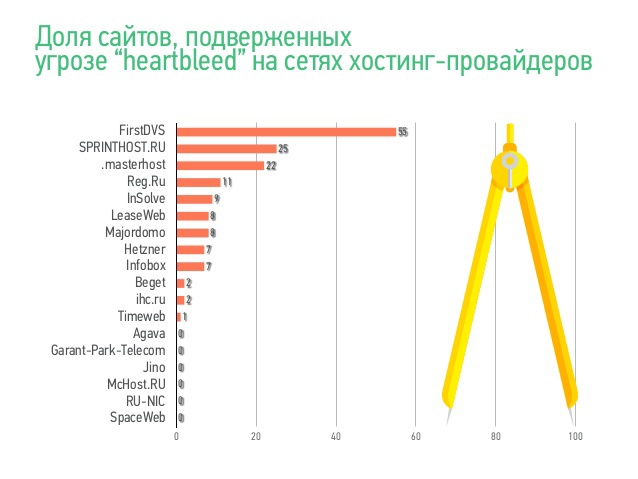
| org | cnt |
| Firstvds | 49248 |
| Reg.Ru | 14838 |
| Hetzner | 12279 |
| Not determined | 9231 |
| Majordomo | 6220 |
| Leaseweb | 3359 |
| Closed Joint Stock Company RuWeb | 3274 |
| OOO “Network of data-centers“ Selectel ” | 2027 |
| Timeweb | 2016 |
| E-PLANET Hosting Provider | 1651 |
| masterhost | 1614 |
"Runet Performance Week" turned out to be non-calendar. It began on Friday, May 23, when Andrei Travin (Openstat) and Sergey Ryzhikov (1C-Bitrix) spoke about website performance at the Failover conference - the first two reports. The first of these included the dependence of site performance on CMS in April. And Sergey had about his “Composite site”.
On May 27, they managed to report the same thing to Petersburgers at the SPIK conference.
And on May 30, Leonid Filatov at the "Host Review" showed the dependence of site speed on the largest providers and at the same time on the CMS used by them.
Almost simultaneously, a Bitrix study appeared on the performance of 100 domestic online stores, as if in response to a similarSurvey of 500 stores from Radware.
It will be necessary to rake the results obtained not only in June, but also generally before the fall conferences.