Synthesis-2 - domestic clone ZX-Spectrum
While cleaning the village on a recent weekend, I found in the attic deposits a proud creation of Soviet electronics engineers - “Gaming Computer Synthesis 2”.

Without unnecessary thoughts, it was decided to immediately take him out of this wild place and see what he is capable of at work. Who is interested in the process of launching such antiquity and additional clickable photos - please, under cat.
A series of Synthesis computers (yes, there were several, but more on that later) - nothing more than another clone of ZX Spectrum computers based on the Z80A chip with a clock frequency of 3.5 MHz . It was produced, depending on the version, with 128 or, as was the case in our case, 48 KB of RAM and 16 KB of ROM . It supported a color image in RGB format, displaying 8 colors with a resolution of 256x192. It was completed, in addition to the operating instructions and a small guide to the integrated Basic power supply, which converted 220V AC to 5V 1A DC, a set of cables for connecting to a tape recorder and TV, and, depending on the configuration, joysticks.
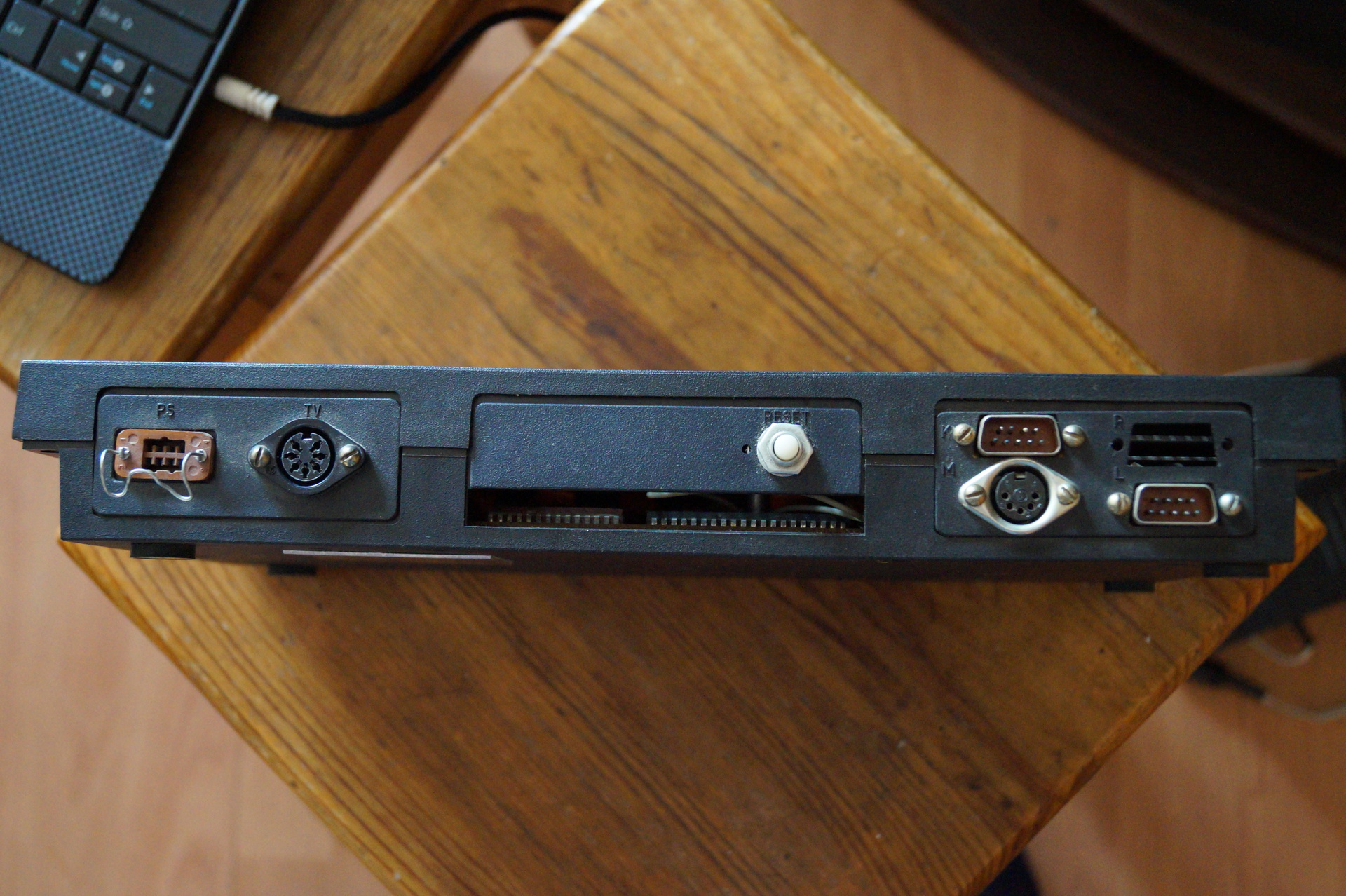
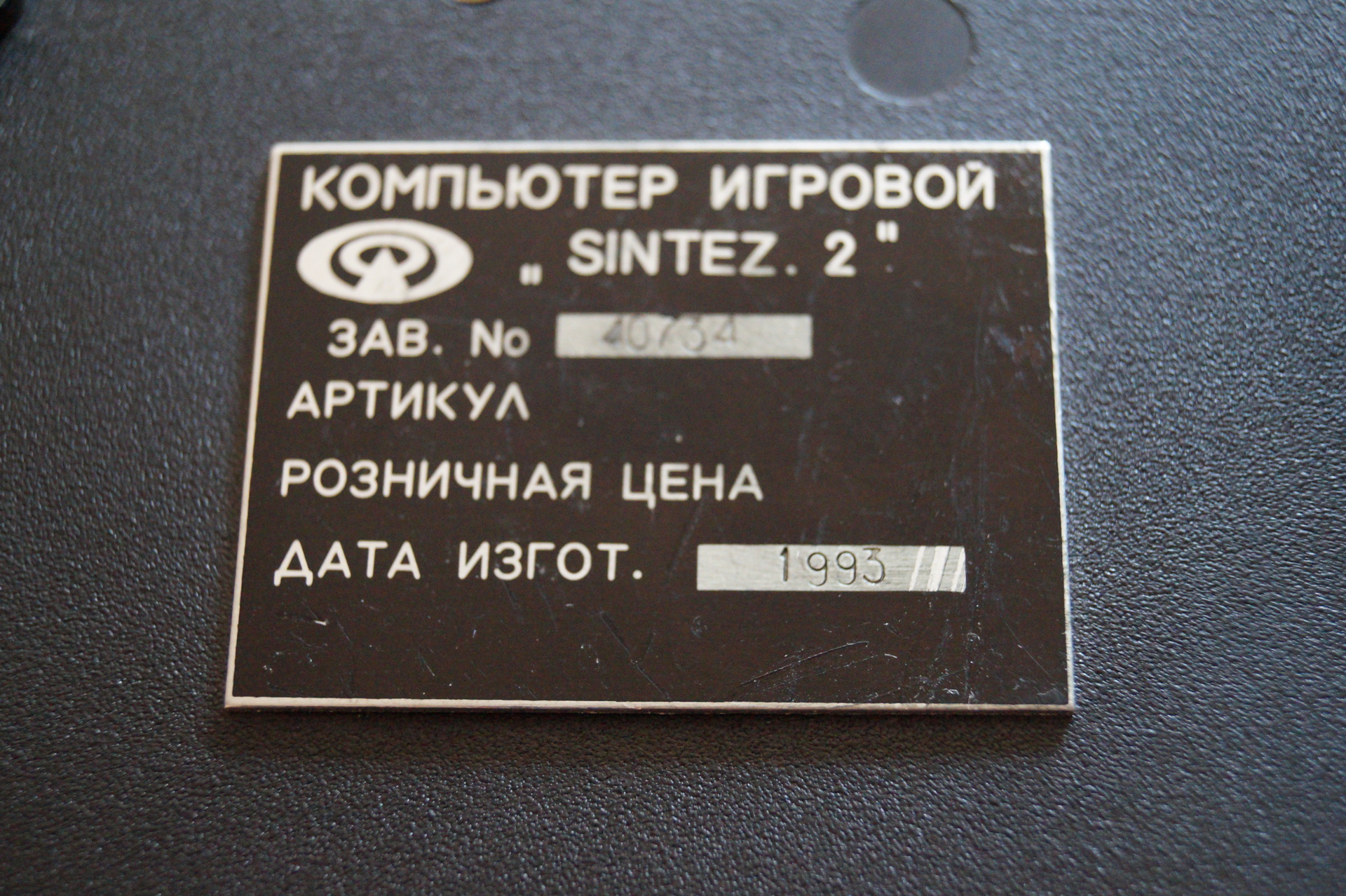
Rear panel. From left to right: Power supply socket, TV socket, “Reset” button, jacks for connecting a tape recorder and joysticks. The label on the bottom panel: "Under the hood":
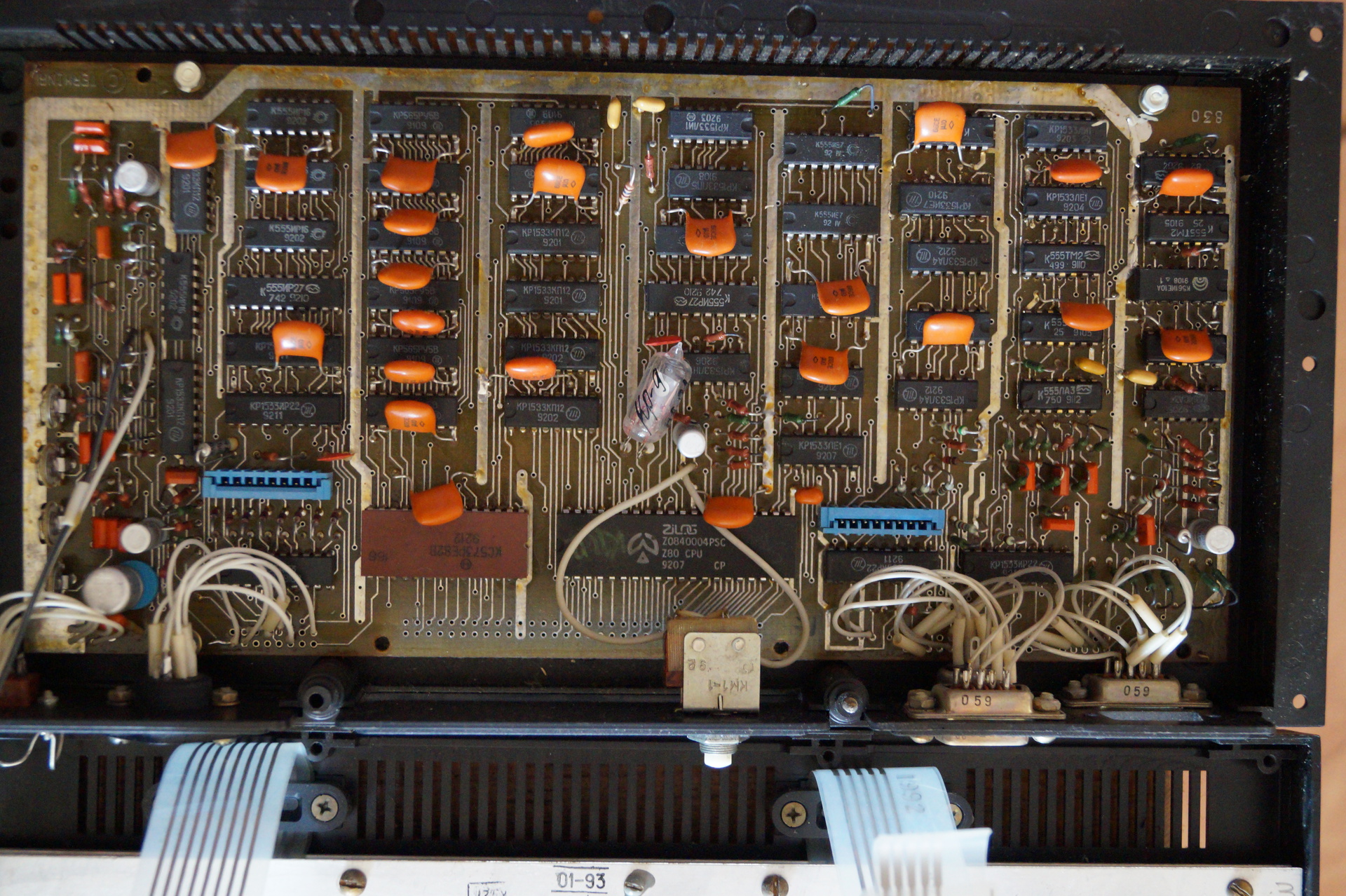
But, nevertheless, back to the main goal - to start the computer.
We turn on the power supply in the socket, we connect the power supply to the computer. The LED on the front panel lights up. Power is - gives hope that the PC is working. However, to be sure, one would have to connect it at least to the TV. There is practically nowhere to plug the wires with the five-pin (for tape recorder) and seven-pin (for TV) plugs, so in Google we found a page where the diagrams for wiring the video cable to SCART and the audio cable to two ordinary 3.5 Jacks were given.
Immediately make a reservation - when I soldered everything according to the instructions from there, nothing worked: the image was white stripes along the screen, and unpleasant wheezing came from the TV speakers. Without losing hope, we are looking for the original computer circuit, looking at which it can be seen that the pin assignments for the TV sockets and the tape recorder are different from those on the site. Well, apparently we have a different modification.
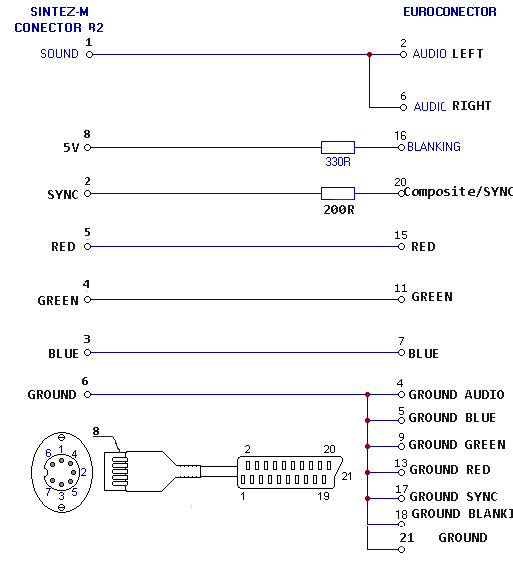
Schematic diagram of the Synthesis computer Without going into details, I will give a modified soldering scheme for SCART and Jack cables for this particular modification: I want to pay attention to the resistance of 200 Ohms on the synchronization channel, a deviation of even 100 Ohms from this value led to a loss of image color .


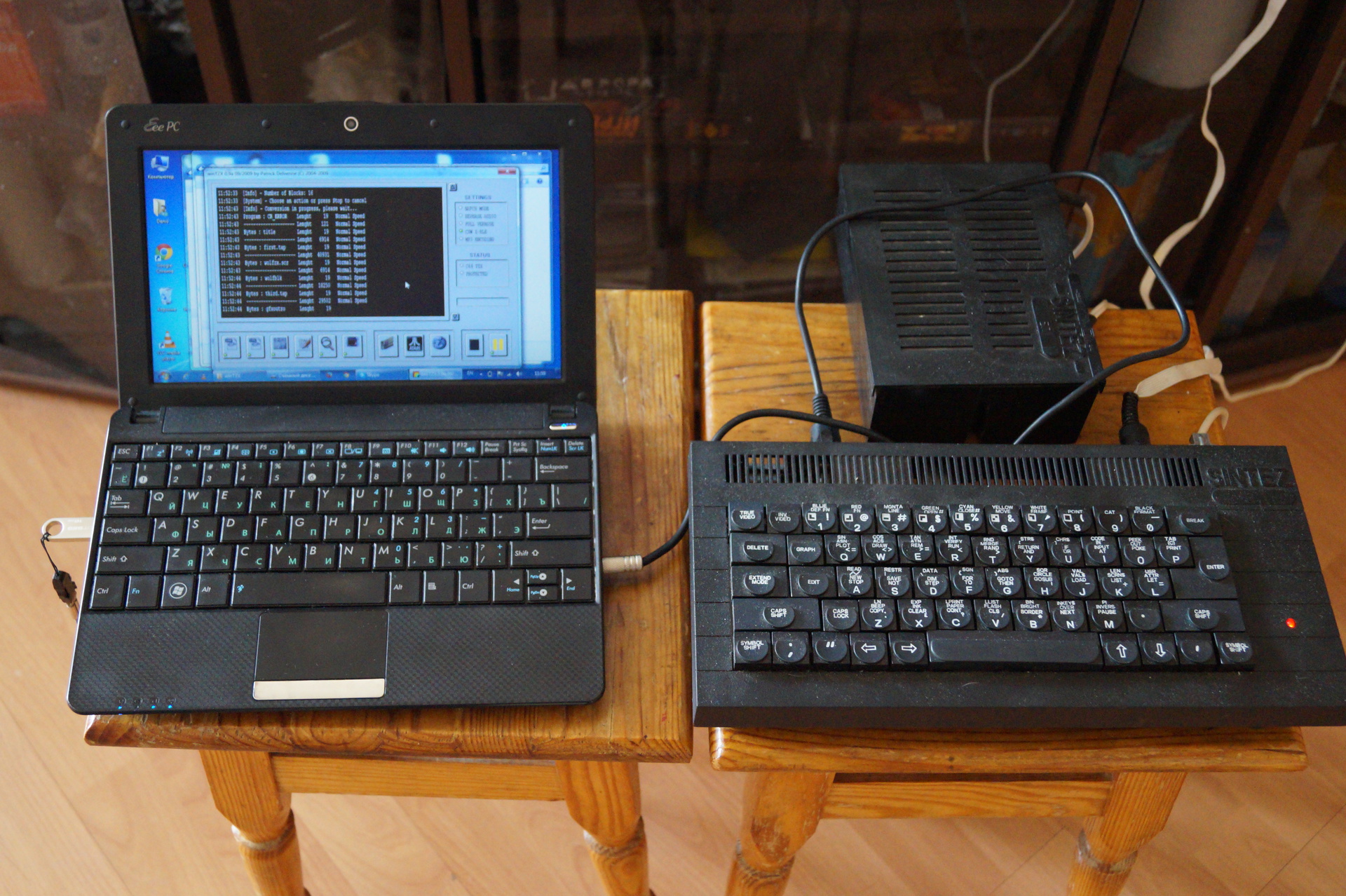
After making sure that everything works, try to load some classic toy. Since the cassette player, and even more so the cassettes with programs for the Spectrum was not available - as a sound source with the game we took a netbook and software for playing * .tap files - winTZX. It looked very ironic - a 1993 computer downloads software from a computer, thousands of times more powerful than it. We introduce the familiar LOAD “” to everyone, press “Enter”, turn on the playback ... but whoever is interested in the process - here is a video with loading and a small let’s play in the good old Space Raiders:
Surprisingly, the computer maintains a fully operational state to this day. The keyboard is quite worn out, the keys are pressed almost effortlessly, but it works!
Having launched some more toys, we finished our work with this PC. Now his place is in the museum.
Finally - another photo of the loading screen: So here it is - domestic Spectrum. Thank you for attention.

Without unnecessary thoughts, it was decided to immediately take him out of this wild place and see what he is capable of at work. Who is interested in the process of launching such antiquity and additional clickable photos - please, under cat.
Bit of theory
A series of Synthesis computers (yes, there were several, but more on that later) - nothing more than another clone of ZX Spectrum computers based on the Z80A chip with a clock frequency of 3.5 MHz . It was produced, depending on the version, with 128 or, as was the case in our case, 48 KB of RAM and 16 KB of ROM . It supported a color image in RGB format, displaying 8 colors with a resolution of 256x192. It was completed, in addition to the operating instructions and a small guide to the integrated Basic power supply, which converted 220V AC to 5V 1A DC, a set of cables for connecting to a tape recorder and TV, and, depending on the configuration, joysticks.
We examine the computer from all sides
Rear panel. From left to right: Power supply socket, TV socket, “Reset” button, jacks for connecting a tape recorder and joysticks. The label on the bottom panel: "Under the hood":


Preparation for launch
But, nevertheless, back to the main goal - to start the computer.
We turn on the power supply in the socket, we connect the power supply to the computer. The LED on the front panel lights up. Power is - gives hope that the PC is working. However, to be sure, one would have to connect it at least to the TV. There is practically nowhere to plug the wires with the five-pin (for tape recorder) and seven-pin (for TV) plugs, so in Google we found a page where the diagrams for wiring the video cable to SCART and the audio cable to two ordinary 3.5 Jacks were given.
Immediately make a reservation - when I soldered everything according to the instructions from there, nothing worked: the image was white stripes along the screen, and unpleasant wheezing came from the TV speakers. Without losing hope, we are looking for the original computer circuit, looking at which it can be seen that the pin assignments for the TV sockets and the tape recorder are different from those on the site. Well, apparently we have a different modification.
Schematic diagram of the Synthesis computer Without going into details, I will give a modified soldering scheme for SCART and Jack cables for this particular modification: I want to pay attention to the resistance of 200 Ohms on the synchronization channel, a deviation of even 100 Ohms from this value led to a loss of image color .

Let's run it!
After making sure that everything works, try to load some classic toy. Since the cassette player, and even more so the cassettes with programs for the Spectrum was not available - as a sound source with the game we took a netbook and software for playing * .tap files - winTZX. It looked very ironic - a 1993 computer downloads software from a computer, thousands of times more powerful than it. We introduce the familiar LOAD “” to everyone, press “Enter”, turn on the playback ... but whoever is interested in the process - here is a video with loading and a small let’s play in the good old Space Raiders:

Conclusion
Surprisingly, the computer maintains a fully operational state to this day. The keyboard is quite worn out, the keys are pressed almost effortlessly, but it works!
Having launched some more toys, we finished our work with this PC. Now his place is in the museum.
Finally - another photo of the loading screen: So here it is - domestic Spectrum. Thank you for attention.