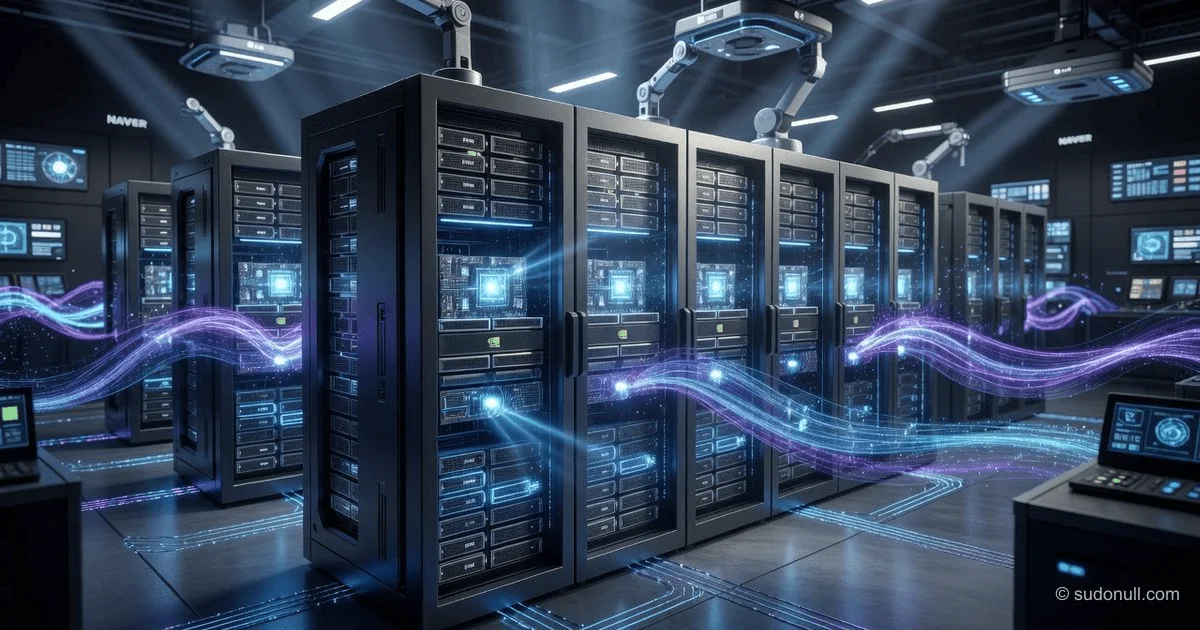
Nvidia strengthens cooperation with South Korea's LG and Naver to build AI factories
During Nvidia CEO Jensen Huang's visit to South Korea, strategic agreements were signed with LG Group and Naver aimed at developing infrastructure for AI factories. These partnerships focus on integrating artificial intelligence technologies into industrial automation and creating new computing power.
Insight beyond the hype: Analysis of Jensen Huang's visit to Korea and deals with LG and Naver
When the CEO of Nvidia flies into a country for four days and finds time not only for the heads of the largest conglomerates but also for a meeting with esports star Faker at an internet cafe — that's not PR. It's a signal. The market is used to seeing South Korea as a "memory warehouse": a place where HBM is made for Nvidia chips. What happened on June 7-8, 2026, finally transforms Korea from a component supplier into a strategic architect of global AI infrastructure. And you know what? That's not an exaggeration.
The essence: what's really happening
Huang is not selling Koreans chips or software. He is selling dependency, packaged in the beautiful concept of an "AI factory." The difference between an ordinary data center and a gigawatt-scale AI factory is like the difference between a library and a printing press. The former stores data on demand. The latter consumes raw materials and produces tokens — the digital currency of the AI economy.
Why Korea? Because it has three things that no one else in the world has in such combination: leadership in memory production (SK hynix, Samsung), industrial experience in robotics and automation (LG, Doosan), and digital infrastructure with one of the densest network coverages (Naver, SK Telecom). Nvidia does not build these factories alone — it provides the DSX reference architecture, and Koreans supply everything else: from power supply (LG Energy Solution, 800V DC) to cooling systems and land.
But there is an insight that almost everyone misses: Huang's real goal is to push hyperscalers (AWS, Google, Microsoft) out of the sovereign AI segment.
Look. Previously, the largest AI clouds were controlled by American hyperscalers. Now Nvidia is offering sovereign players (like Naver) to build their own gigawatt infrastructure on its platform — and gain full control over data and models. Naver gets technology and global market access. Nvidia gets a loyal operator that won't develop competitive chips (as Google does with TPU or Amazon with Trainium). A brilliant move to fragment the market? Definitely.
Timeline and context
Huang's visit to Korea on June 5-9, 2026, was no coincidence. It fits into a series of steps that began back in October 2025 at the APEC summit in Gyeongju, where the first major partnership with SK Group for 50,000 GPUs was announced. But it was June 2026 that marked the moment when Nvidia moved from point agreements to forming a cohesive AI alliance.
| Date | Event |
|---|---|
| June 5 | Huang arrives in Seoul, meets with SK Group Chairman Chey Tae-won and LG CEO Koo Kwang-mo |
| June 6 | Meeting with esports legend Faker from T1 — a symbolic gesture to Korean gaming culture |
| June 7 | Meeting with heads of Krafton (creators of PUBG) and NCSOFT; discussions on RTX Spark and physical AI |
| June 8 | Public announcements with Naver, LG Group, and SK hynix: Naver builds a 55 MW AI factory in Sejong |
| June 9 | News about Nvidia's R&D center in Korea and meeting with the Minister of Science and ICT |
Why is this important right now? Nvidia has a window of about 18-24 months before competitors (AMD with Instinct, startups like Groq and Cerebras) catch up on the CUDA software stack. Huang is laying anchors in Korea to make a mass transition to alternative architectures in the Asia-Pacific region impossible.
Who wins and who loses
Winners:
Naver. This is the most underestimated winner. Naver gets access to the DSX reference architecture and a chance to become the operator of a gigawatt AI cloud for all of Asia. Their "Seoul World Model" — a digital twin of streets based on 1.2 million panoramic images — integrates with Nvidia Cosmos for training physical AI. A local search engine turns into a global infrastructure player.
LG Group. LG signed the broadest contract in scope. LG Electronics will make cooling systems for AI factories (CDU, cold plates) and robots based on Isaac GR00T. LG Innotek — sensors and optics. LG Energy Solution — 800V DC power systems. LG Uplus — telecom infrastructure. LG AI Research gained access to Blackwell GPUs for developing the sovereign EXAONE model. LG becomes the supplier of "everything but the GPU" for Nvidia's AI factories.
SK Telecom and SK hynix. SK Telecom is building an industrial AI cloud on RTX PRO 6000 Blackwell — the first in Asia. SK hynix will continue to supply HBM, but now also gets access to digital twins on Nvidia Omniverse for automating its own factories. A closed loop: SK hynix chips go into Nvidia GPUs, and Nvidia GPUs manage SK hynix chip production. Beautiful, isn't it?
Losers:
Amazon Web Services and Google Cloud in Asia. Their positions as the "natural choice" for AI workloads are weakening. Sovereign players now have an alternative — build their own factory on the Nvidia stack without being tied to American hyperscalers.
Chinese AI companies (Baidu, Alibaba, Tencent), cut off from the latest Nvidia GPUs due to US export restrictions. While Korea builds gigawatt factories on Blackwell, China is forced to catch up on outdated or homemade hardware.
Samsung Electronics — a notable absence from the list of key partners. SK hynix and LG signed exclusive agreements, while Samsung remained an observer. Despite Samsung also producing HBM (competing with SK hynix) and having its own AI ambitions, this is a strategic loss.
What the media isn't saying
But here's where it gets really interesting — the non-obvious insight.
"AI factory" is a euphemism for "monopoly on tokens." Huang said: "An AI factory produces tokens just like a factory produces products." What is a token? A unit of information on which LLMs are trained and operate. By controlling the largest AI factories, Nvidia controls not only chip production but also the production of the very data on which competing models are trained. If all major AI models in Asia are trained on Nvidia GPUs in data centers designed by Nvidia DSX and managed by Nvidia partners, then Nvidia will have full telemetry of exactly how competitors are training. This is not just equipment supply — it's strategic intelligence.
The second nuance that goes unmentioned: energy consumption. One gigawatt is the power of a small nuclear power plant. Korea Electric Power Corporation (KEPCO) has already warned of possible disruptions. LG Energy Solution offers a solution with 800V DC, but that requires a complete reconstruction of power grids. Who will pay? Korean taxpayers — so that Nvidia can sell more chips.
The third nuance: existential risk for Naver. Yes, they got access to Nemotron and Cosmos. But they also became hostage to DSX. If in three years Naver wants to switch to open architectures or competitor chips, migration will cost billions. Classic vendor lock-in strategy on steroids.
Forecast: next 30 days and 90 days
30 days:
- Finalization of terms for Nvidia's R&D center in Korea. It has been announced that the center is being built — expect specifics on location, investment volume (estimated: $200-300 million), and number of engineers (at least 500).
- Announcements from SK Telecom on launch timelines for the industrial AI cloud on RTX PRO 6000 Blackwell. The first phase will likely be operational by the end of 2026.
- Regulatory response. Korea's Fair Trade Commission and the US Department of Commerce may begin informal consultations on antitrust risks: Nvidia is becoming the "single window" for AI infrastructure in Korea.
90 days (summer-fall 2026):
- M&A deal. LG or SK Telecom will acquire a small Korean robotics developer (likely a startup in logistics robotics) and integrate it into the Isaac GR00T ecosystem. The goal is to show a "live example" of physical AI on the LG production line.
- Launch of Naver's "Seoul World Model" into commercial operation for training autonomous robots. This will become the world's first urban digital environment for physical AI, accessible through the Nvidia cloud.
- Escalation of trade war: The US will expand export restrictions on advanced chips to China. Korea, as a strategic Nvidia partner, will gain additional privileges in technology access but will also come under pressure from Beijing. Taiwan and South Korea will become the main arenas of the chip cold war.
Conclusion for strategists
Huang's visit to Korea is not about technology. It's about geopolitics and the redistribution of the AI infrastructure market. Nvidia is no longer just selling chips. It is selling a license to participate in the AI revolution — and the price of that license is rising with every signed memorandum.
By 2027, when the first gigawatt factories of Naver and SK become operational, we will see two types of countries: those with sovereign AI infrastructure on the Nvidia platform, and those renting capacity from hyperscalers. Korea has bet on the first option. Will it remain the owner of this infrastructure or become just a tenant of Nvidia? Without its own software stack and chips alternative to CUDA, this bet will turn into a golden cage in 5 years.
— Editorial Team






No comments yet.