
 April 15, 2014 at 12:23
Newton MIPS - Intel's Edison rival for use on laptop computers
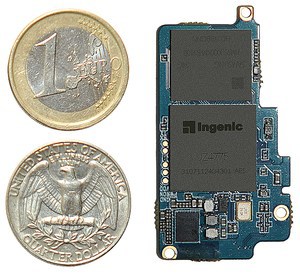
Ingenic introduced the tiny MIPS-based Newton COM for wearable computers and IoT devices running Android or Linux under Xburst SoC, and with built-in WiFi and other sensors.
The Newton computer-on-module platform was reported by both Chinese semiconductor company Ingenic Semiconductor and Imagination Technologies, which licenses MIPS intellectual property for Ingenic. The Imagination message related only to wearable computers, and Ingenic only mentioned them as the first in a series of Internet of Things (IoT) applications.
In addition, Newton can be used in healthcare, household appliances, security, biometrics, industrial control and consumer electronics. Imagination also expects to use Newton as the platform for Google’s new Android Wear, although Ingenic has not mentioned it.
Close-up photo of Ingenic Newton:
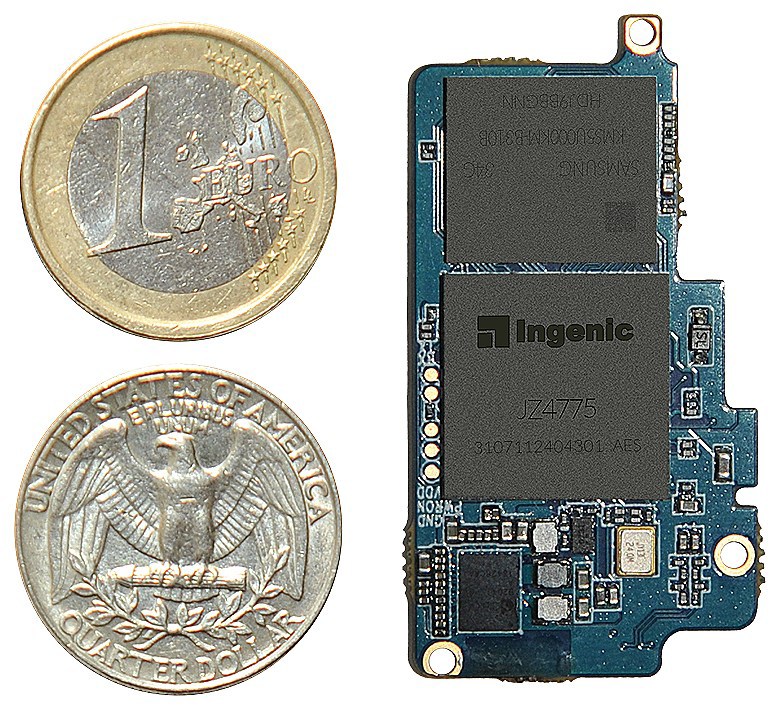
Newton COM can compete with the Edison module, which Intel announced in January. Like Edison, Newton, whose size is 39x22 mm, supports Linux as well as Android - unlike Edision. In size, it is approximately equal to the SD-card. On March 28, Intel talked in more detail about its plans, saying that prior to the release of the Quark-based product, it will introduce a version of Edison on a dual-core Intel Atom SoC, resulting in a slightly larger SD card.
Newton implements Ingenic's 32-bit MIPS-based “system on a chip” XBurst, which is used in over 40 million devices, including tablets, e-book readers, multimedia players, and laptop computers. Newton uses the relatively new JZ4775 XBurst SoC. This is a stripped-down version of the 1 GHz JZ4770 found in products such as the Linux-based GWC Zero game console. It is even more similar to the JZ4774 used in the Geak Watch on Android.
Block diagram Ingenic JZ4774:
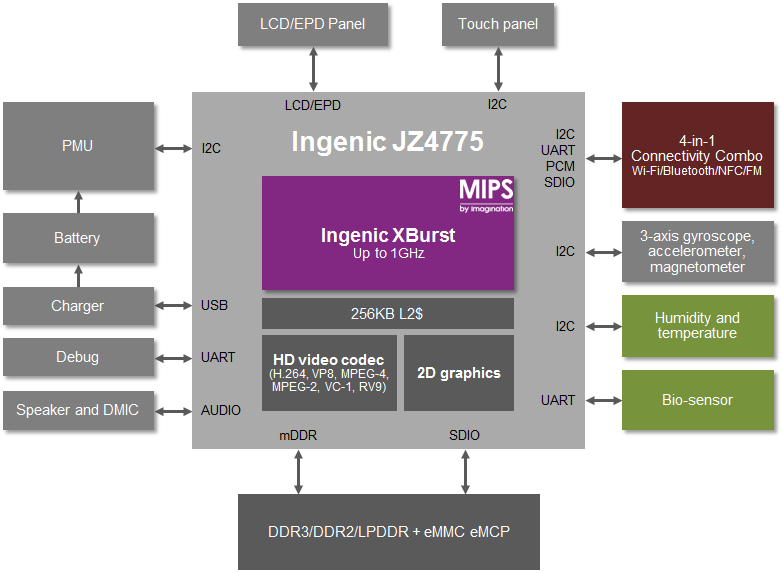
In JZ4775, instead of the Vivante GC860 GPU, which is used in the JZ4770, a much simpler 2D GPU is used, the video accelerator of which only supports 720p resolution, not 1080p. The camera resolution is half as small as that of the JZ4770 - 2048x2048 pixels. On the other hand, the JZ4775 has more advanced memory support, including DDR3 RAM at speeds up to 800 Mbps, Toggle NAND and NAND, as well as 64-bit ECC memory.
The JZ4775 is also more energy efficient than the JZ4770. According to the company, Newton COM consumes from 80 to 260 mW during operation, and in standby mode - less than 4 mW. According to Imagination, the “smart watches” created on the basis of Newton can work more than 30 hours on a single charge.
Front and rear view of Newton COM (clickable):

Newton is equipped with 3 GB DDR1 RAM and 32GB eMMC flash memory. The module is equipped with an LCD interface with touch input support and backlight, as well as an E Ink EPD controller for monochrome electrophoretic displays. There is a WiFi and Bluetooth 4.0 connection, as well as NFC and FM radio through a common 4-in-1 module.
For use in wearable devices, the module integrates a 3-plane gyroscope, accelerometer and magnetometer, temperature, humidity and pressure sensors. Health and fitness apps can use the integrated ECG biosensor. The I / O interfaces are for USB 2.0, I2C, UART, GPIO, and “motor control,” although the latter may be for UART or GPIO interfaces.
Newton can be powered by USB or battery and is equipped with a microcontroller power management (PMU). Imagination emphasized that the PMU is not integrated into the processor itself, which is consistent with the Ingenic modular approach. “Users can remove unnecessary components from the module to reduce the cost of the BOM,” the Imagination noted.
Supported operating systems are Linux 3.0.8, Android 4.4 (KitKat) and several RTOSe (open-source rial-time operating systems). Ingenic also provides specialized software suites for developing voice or gesture-driven interfaces.
Specifications for Newton include:
- Processor - Ingenic JZ4775 (1x XBurst core up to 1 GHz); 256 KB L2 cache
- Memory - 3GB LPDDR1; 32GB eMCP eMMC flash
- Display - supports LCD or EPD (electronic paper) displays with sensor and backlight
- Audio - DMIC; speakers
Wireless Options:
- 802.11 a / b / g / n (2.4GHz and 5 GHz)
- Bluetooth 4.0 + EDR and BLE
- FM
- Nfc
Sensors:
- 3-plane gyroscope
- 3-plane accelerometer
- 3-plane magnetometer
- ECG sensor
- Pressure sensor
- Humidity sensor
- Temperature sensor
Other I / O:
- USB 2.0
- I2C
- UART
- GPIO
- "Motor support"
Other features are Power and Home buttons.
Power - USB or battery, with PMU and charger
Power Consumption:
- <4 mW standby
- <80 mW minimum load
- <100 mW in MP3 playback mode
- <260 mW maximum load
Dimensions - 38x22x3 mm
Operating System - Linux 3.0.8, Android 4.4 (KitKat), several RTOSe.
Platform for Android Wear?
Google did not specifically mention Ingenic in its recent announcement of the Android Wear platform for Android-based wearable computers, but Imagination Technologies is on the list, as are semiconductor manufacturers Broadcom, Intel, Qualcomm, Mediatek, and Samsung. Imagination emphasizes that it is the only IP provider on the list and not the manufacturer of SoC.
“This means that MIPS, PowerVR, and Ensigma licensees will be the first to get access to the latest resources from Google and the chance to better optimize their platforms for the next generation of wearable devices,” said Alexandru Voica of Imagination on his blog. “In the coming months, we will focus on several full-featured, high-performance platforms that use Imagination's hardware IP to create innovative solutions for the new wave of mobile devices.”
All this gives the impression that Newton is a platform ready for Android Wear, although this has never been claimed for sure, and Ingenic does not mention it. At the end of January, Imagination’s Vojka published on the blog that Ingenic’s XBurst is used in a number of smart watches, including those using Android - Geak Watch, YiFang Digital NextOne and Tomoon T-Fire.
Imagination acquired MIPS a little over a year ago for $ 100 million, and since then its shares have fallen in price by half, according to a recent Forbes report. But wearable computers can become a lifesaver for MIPS and Imagination. MIPS also relies on its Warrior processor platform for Android, including the MIPS Series5 Warrior-P “system on a chip” equipped with six 32-bit MIPS P5600 cores, which are twice as productive as previously used.
MIPS was also the first non-ARM architecture ported to Android, but its use with partners like tablet maker Velocity Micro has not been particularly successful. MIPS even announced the creation of MIPS-based Android phones, but so far nothing is known about them.
Further information
Ingenic did not disclose what Newton's price will be and when it will be available. For more information, see the Ingenic Newton product page and the Imagination Technologies Newton ad.
Source:
MIPS-based Newton module takes on Intel's Edison in wearables
Ingenic Newton - Ultra Low Power and Small Size Smart Connected Devices Platform
Newton Hardware Manual
From the Ingenic Semiconductor wiki