January 13, 2014 at 19:09
Invisible difficulties of rocket technology
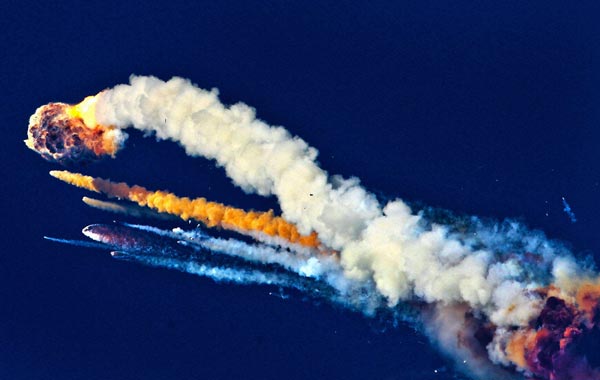
The construction and operation of launch vehicles is a kind of “black team” of astronautics. The large and complex work is done quietly, and most of the laurels go to the payload developers. We forgot about the complexity of the tasks that are solved in the design and manufacture of launch vehicles. This article is intended to show the importance of the topic and introduce a small educational program to those who would like to know "how it flies."
Introduction
Even a small company can make their own satellite, but only eleven countries were able to assemble rockets that delivered the payload to orbit. And then, for example, South Korea bought the first step from Russia and received it as a "black box". Why so few? The fact is that launch vehicle technologies require a very high level of development of science and technology and a lot of money. You should probably start here with this video:
For seventy years, the countdown of which began with the first launches of the V-2, missiles are striving to fall. Of course, now it’s more difficult for them to do this, and the number of accidents is measured in percentages, not tens of percent, but the complexity of the industry plays along with them.
Engine
Even on a simple popular science circuit, a booster engine looks rather complicated. What can we say about real schemes?

Where does this complexity come from? The fact is that all sorts of cunning turbopumps, regenerative cooling, closed cycle, etc. are used to increase engine efficiency. The simplest liquid propellant rocket engine can be made practically in garage conditions (a one-component MosGIRD or using a 3D printer ), but such an engine will not fly away from a hobby.
Turbopump unit
The main task of the turbopump unit is to supply fuel and oxidizer. It is necessary to spend part of the energy of the fuel, burning it in a small combustion chamber of the gas generator.
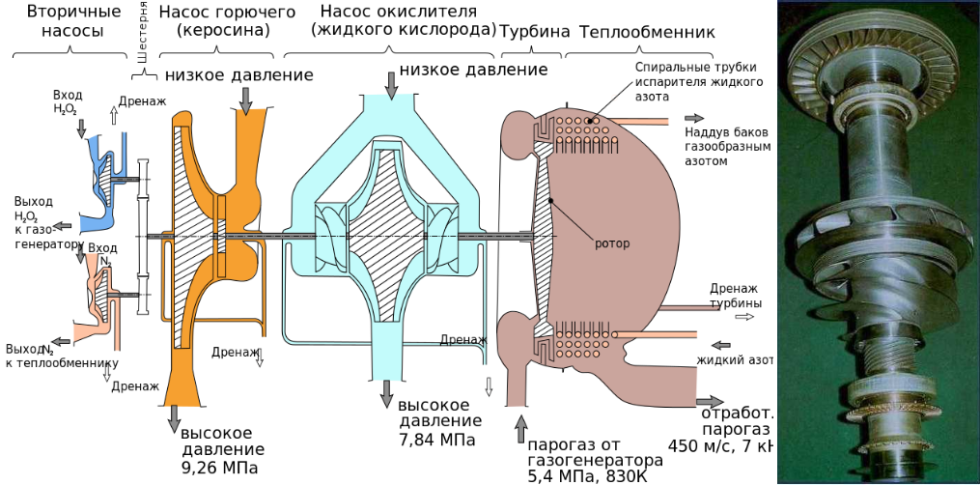
On the left is the TNA diagram RD-107/108 for the R-7 family, on the right is the TNA diagram for the RD-180 (Atlas-V)
Turbopump unit operates in very harsh conditions. For example, the explosive destruction of TNA led to two accidents of the Soviet "lunar" missile N-1.
The combustion chamber
In the combustion chamber are nozzles through which fuel and oxidizer are injected. One of the main problems that engineers have encountered is combustion instability. Any accidental change in the flow through the nozzles can give rise to a pressure jump, which will cause the detonation of the components instead of uniform combustion and create problems up to the destruction of the engine. The only working solution was the separation of the combustion chamber into compartments isolated from each other by extended nozzles or partitions: on the
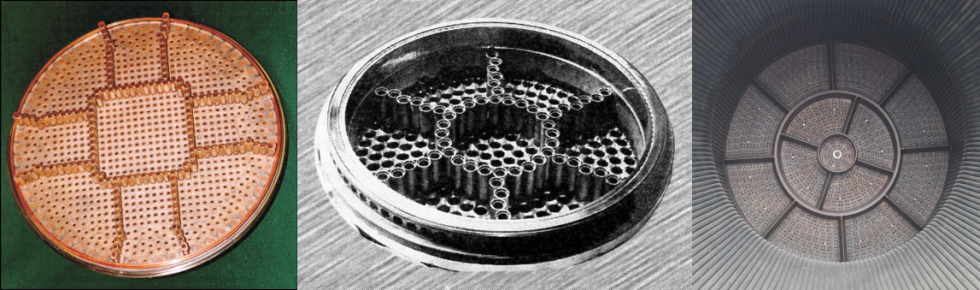
left is RD-107/108, in the center is RD-180, on the right is F-1 (the first stage of Saturn-V)
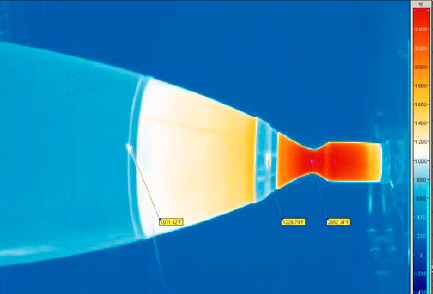
Nozzle
And here the main problem is heat removal. The temperature in the combustion chamber can reach 2000 degrees Celsius, and the heat flux density is 1-20 MW / m ^ 2, which is comparable to the annual energy from the Sun per m ^ 2 in the region of the equator.
The most effective solution was the so-called. regenerative cooling. A fuel component (usually fuel) is pumped in a cooling jacket from the outside of the nozzle. To do this, the United States came up with a tube system, and in the USSR - a corrugated spacer and milled ribs:
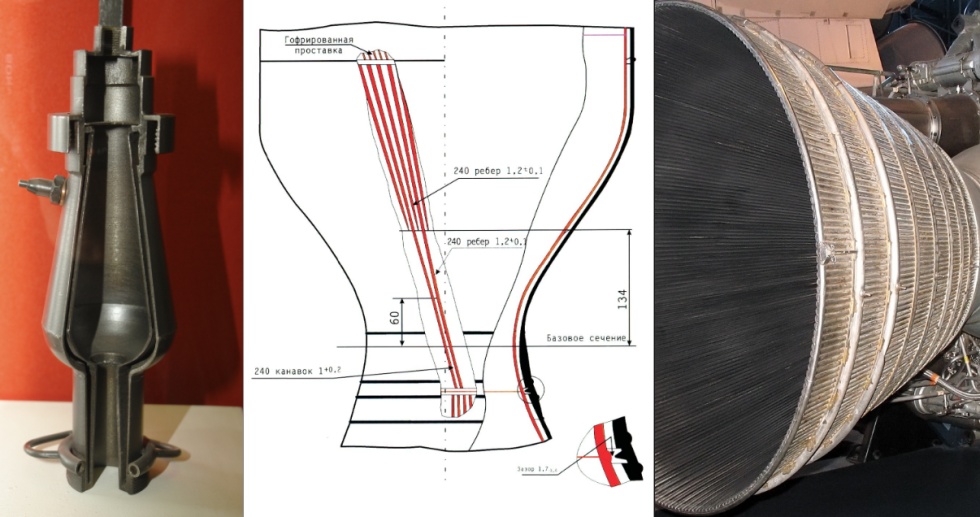
Left - RD-10, 1933, the first experiments, in the center - a diagram of the ribs on RD-107/108, on the right - LR-87, “Titanium -2 "
In addition, nozzles are placed near the walls that emit fuel, creating a curtain of flame. There can be many such curtains (for example, the V-2 engine had four curtain belts). Here is an example of a curtain on an engine diagram - three curtain belts on an RD-170:

Efficiency
Talking about engine efficiency as an integral parameter is virtually impossible. Because the engine and the stage on which it stands is a complex compromise of many parameters: the technical complexity of the creation / refinement / production, the cost of the creation / refinement / production, thrust, specific impulse, the pressure in the combustion chamber, the reliability that has been put into operation, and many others. And these parameters are in conflict with each other. An easy-to-manufacture and cheap unloaded engine will have mediocre thrust or specific impulse, and an engine with a very high specific impulse will be difficult, unreliable or too expensive, it is quite common to put an existing engine with non-optimal parameters, because it already exists and does not require investment in the development of a new one. For instance,
The situation is complicated by the fact that today technologies have approached the physical limit of fuel efficiency, and a new engine based on well-known principles will not be qualitatively better than the old ones.
Control system
The control system solves two complex tasks: maintaining a stable flight and removing the payload to the desired point in space.
Sustainable Flight
Almost all launch vehicles are aerodynamically unstable in flight:
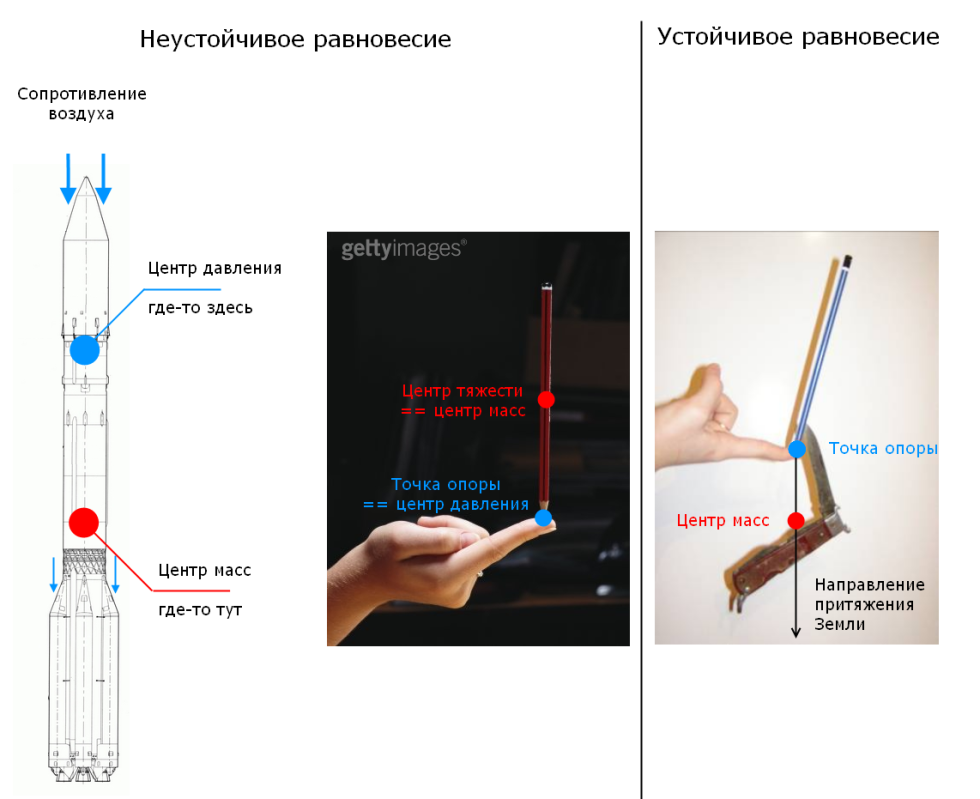
Another name for this problem is the “reverse pendulum”. And the control system maintains an unstable balance, ensuring a normal flight, fending off various disturbing influences.
Breeding accuracy
Modern digital "Proton-M" has the following parameters for the accuracy of output:
- Perigee ± 2 km
- Apogee ± 4 km
- Inclination ± 1.8 arcmin
- Excretion time ± 3 s
If you have not played Orbiter or Kerbal Space Program, it is very difficult to explain how high accuracy it is. Try to imagine that you are nine minutes old, with your eyes closed, driving in a car, and with an accuracy of ± 3 seconds you drive into a garage that is 8 centimeters longer and 2 centimeters wider than your car.
How does it work?
Why did you have to close your eyes in the car example from the previous paragraph? Because there is no road marking in space, and modern systems do not use any external sources, but work autonomously. An inertial navigation system captures changes in the position of the rocket and acceleration that occur with it, generating control signals for actuators. In the control system there is a so-called gyro-stabilized platform on which gyroscopes are located, which fix the position, and accelerometers, which fix accelerations. The platform itself is suspended in such a way as to maintain its position:
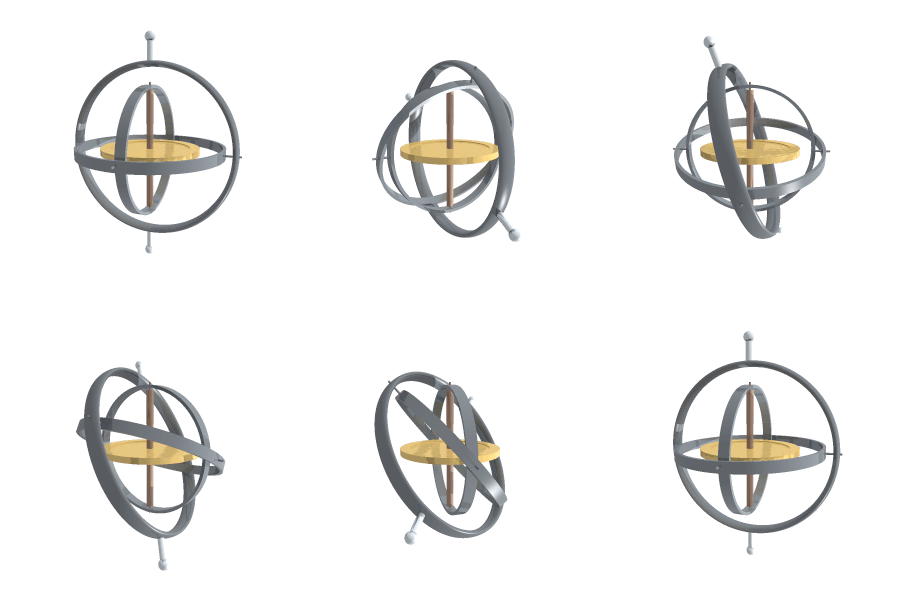
And they look something like this:
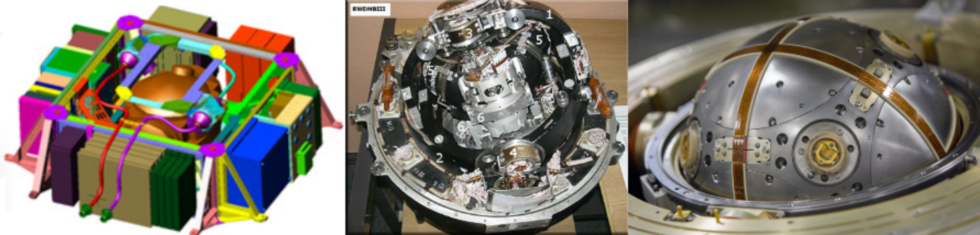
On the left is the computer model of the platform that the center makes to them. Pilyugina , in the center the platform of the Oka missile system, on the right - the platform of the American Peacekeeper ICBM with an air suspension
Now, thanks to the development of computers and equipment based on new principles, gyro-stabilized platforms are gradually becoming a thing of the past. Traditional gyroscopes have almost been replaced by laser gyroscopes , and rotating platforms are being replaced by strap-on systems where gyroscopes and accelerometers are rigidly fixed to the case, and their data is processed by a computer. By the way, gyroscopes in consumer electronics are not rotating and not laser - they are vibrational . Accuracy is so-so, but small and cheap.
Reliability Measures
In our imperfect world, failure is striving not only for a complex engine, but also for a simple wire, sensor or valve. Therefore, special measures are taken:
- Actuators are duplicated whenever possible: in case of failure of one element, a spare one is triggered. The space shuttle mission STS-112 almost ended in disaster at launch, when the main pyro bolt detonators holding the side solid fuel boosters failed. Fortunately, back-up detonators worked, and the pyro-bolts exploded at the right time.
- Measuring instruments are tripled: three sets of sensors are installed, they “vote” and, in the event of a failure of one of the sensors, two “healthy” ones continue to provide correct information. In aviation, there was an accident when two out of three gyro-horizons failed, and the autopilot started the car at a peak. Fortunately, the pilots intervened, and no disaster happened. With the proliferation of computers, a fourth “voice” is sometimes added (or a third instead of one of the sensors) - a mathematical model of “how it should be”.
Conclusion
I hope that the familiar and inconspicuous complexity of rocket technology has become more familiar to you, so that, after successfully removing the payload, you can be glad not only for it, but also for the rocket.