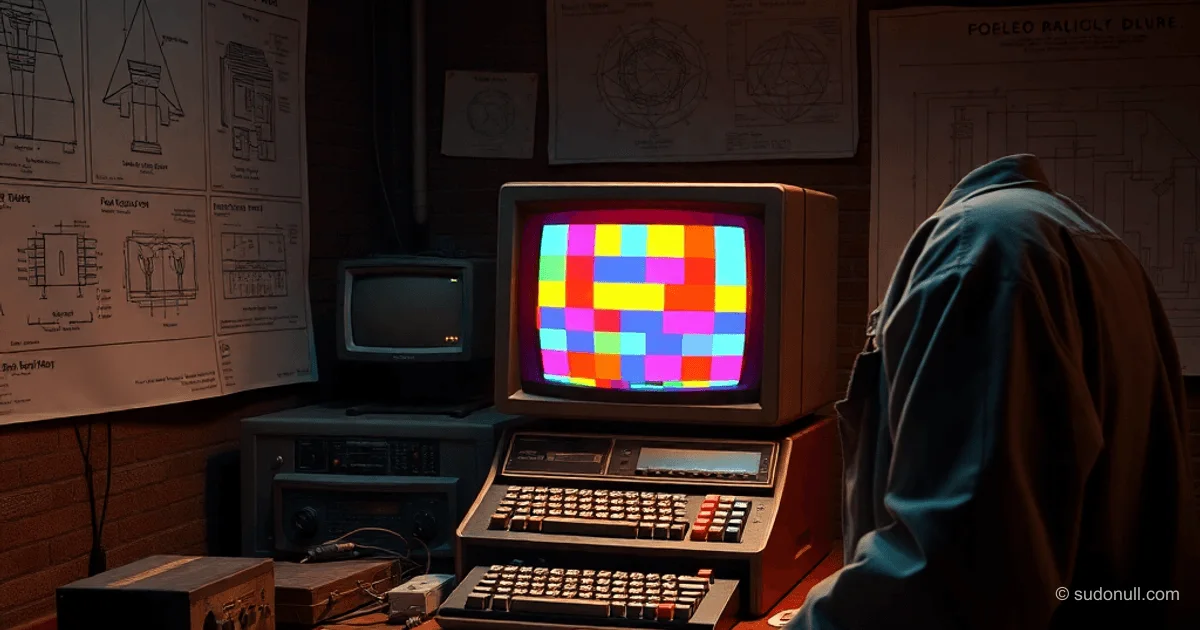
# Graphics and Audio Modes of 1980s Soviet Home PCs
Soviet home computers of the 1980s supported over 70 text and graphics modes—from 10×24 to 1024×256 pixels. Audio capabilities ranged from simple buzzers to 3-channel synthesizers. GOST 21552-84 regulated general computing equipment parameters but ignored video and audio specifics, leading to a fragmented product lineup.
Audio Subsystems: From Binary Beeps to DAC
Audio in Soviet computers was implemented through several types of devices:
- Electromechanical buzzers—for secure equipment.
- Piezoelectric emitters—fixed-frequency tone generation.
- Electrodynamic speakers—1-bit mono/stereo, with PWM up to 6-bit sampling.
- Covox-type DAC—8-bit sound.
- Specialized chips—3 channels + noise + envelope, without burdening the CPU.
Lack of standardization complicated software development but enabled homebrew upgrades.
Text Modes: Standards Table
| Name | Resolution | Display | Notes |
|------|------------|---------|-------|
| Elektronika 0202, UK NC | 10×24 | text | - |
| Elektronika MS 0511 | 10×26 | text | - |
| Korvet | 32×16 | text, B&W | - |
| PK8000, PK8002 | 32×24 | text | - |
| BK-0010/0011 | 32×25 | text | - |
| Agat | 32×32 | text | 8 colors symbol/background + blink |
| Radio-86RK and others | 32×24 | text, 15 colors | graphics emulation |
| YuT-88 | 64×28 | text, mono | - |
| Poisk | 80×50 | text | VGA |
| Vector-06C | 80×25 | text | - |
The full range spanned from low-res B&W text to EGA/VGA-like modes.
Graphics Modes: From Monochrome to 256 Colors
Graphics varied by resolution and palette. Key examples:
| Name | Resolution | Colors | Notes |
|------|------------|--------|-------|
| Radio-86RK | 128×60 | mono | - |
| Agat | 256×256 | 4/6 | - |
| Vector-06C | 256×256 | 2-16 | palette 256 |
| ATM Turbo and others | 320×200 | 16 | EGA, palette 64 |
| Poisk, ES PEVM | 640×350 | 64 | EGA with >64KB VRAM |
| Korvet | 512×256 | 8 | palette 16, no artifacts |
| DVK | 400×480 | 16 | progressive scan |
| Soyuz-Neon PC-11/16 | 128×96 | 256 | - |
Some models copied Western standards: CGA (320×200, 4 colors), EGA (640×350, 16), Hercules (720×348 mono).
Cloning and Licenses: Ties to Foreign Counterparts
Many PCs were licensed or homemade copies: Pravets-8—ZX Spectrum, Agat—Apple II, Vector-06C—unique design with 256-color palette. Specs often lagged behind originals, but engineers refined the hardware while programmers exploited undocumented features for new modes.
Key Takeaways
- GOST 21552-84 did not cover video/audio, resulting in >100 models without standardization.
- Graphics modes: 70+ variants, max 1024×256 or 640×480 VGA-like.
- Audio options: from 1-bit to 8-bit DAC and 3-channel synthesis.
- Clones of Western PCs (CGA/EGA) formed the core, with local enhancements.
- Homebrew mods expanded capabilities via code tricks.
— Editorial Team










No comments yet.