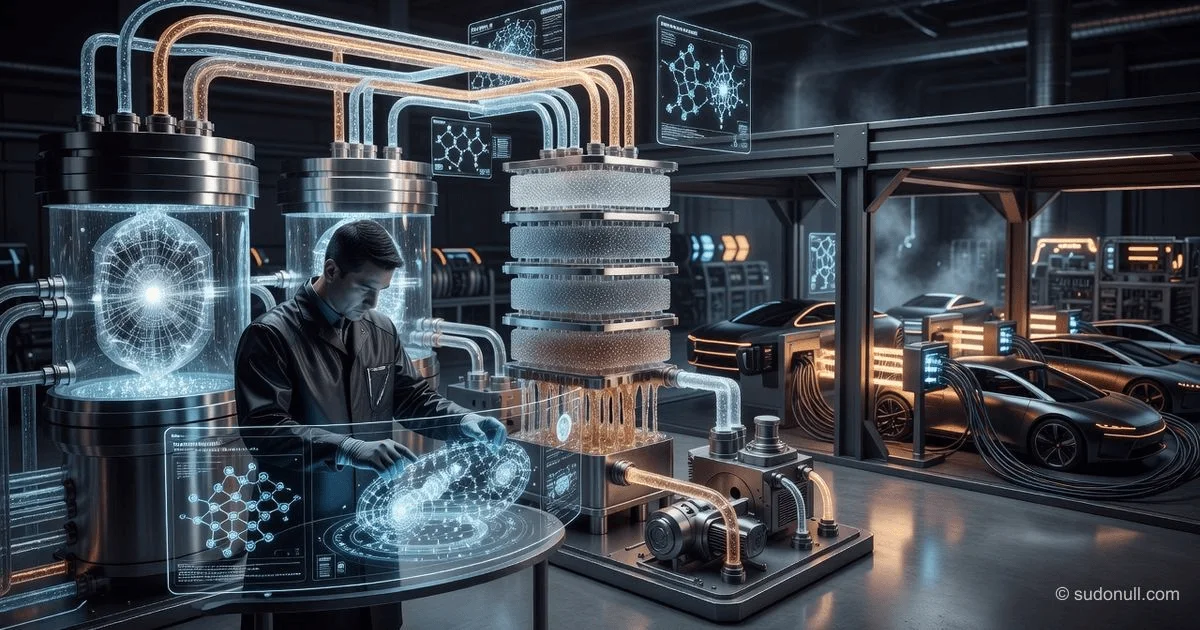
World Economic Forum Unveils Top 10 Breakthrough Technologies for 2026
The WEF report, published on June 23, highlights advances in biotech, energy, and computing, including direct lithium extraction, personalized mRNA cancer vaccines, quantum simulation for drug discovery, and lattice-based cryptography to defend against quantum threats.
Analytical Review: Behind the Scenes of the Top 10 Emerging Technologies 2026
Author: Independent Industry Analyst
[The Core]: What's Really Happening
The World Economic Forum's report on breakthrough technologies for 2026 isn't just a hype list for the media. It's a battle map. When I read this list, I don't just see "cool ideas" — I see a systemic response to three existential crises: resource scarcity, collapsing energy infrastructure, and the dead end of traditional pharmaceuticals.
Notice the wording: the WEF selects technologies that have reached a "tipping point" between science and real-world deployment. This means investments here are no longer speculative. There's no nuclear fusion or general-purpose quantum computer on the list — that's the distant future. What's gathered here are mature solutions that will start generating trillions of dollars in revenue within the next 2-3 years, reshaping global supply chains.
The key trend the report articulates but doesn't emphasize is industrial decentralization. We're moving from the era of centralized mega-factories to "micro-manufacturing" and distributed networks. Whether it's on-site lithium extraction or protein production in fermentation tanks — this is a blow to monopolies and long logistics chains.
Timeline and Context
Imagine the world of 2026. Europe is choking on gas prices, China controls 75% of the lithium market, and California's power grids are shutting down due to air conditioning. In this chaos, WEF experts gathered in Dalian, China, for the "Summer Davos" and released a list of 10 technologies meant to break this reality.
But there's context the official releases stay silent on. At the same time, the European Innovation Council (EIC) published its Tech Report 2026 with 25 technological signals. This is no coincidence. While the WEF beats the media drums, the EIC is quietly but aggressively reallocating a €10 billion budget toward "strategic autonomy": quantum communication, bionic AI, semiconductors.
Timeline of Recent Events:
- June 22-25, 2026: WEF report presentation in Dalian.
- June 25, 2026: Publication of the EIC Tech Report 2026, focusing on deep-tech to strengthen Europe's defense capabilities and independence.
- Background: Against the backdrop of these "future" technologies, a reassessment of the "present" is underway — Nvidia's market cap reaches $5.4 trillion, more than the top 10 European companies combined.
Who Wins and Who Loses
Here's where it gets interesting. The WEF talks about technologies, but the fates of entire nations are at stake.
Winners:
- USA and Israel: The report mentions pilots in California, Michigan, and South Carolina. "Everything-to-grid" technologies and personalized vaccines are strengths of the American biotech ecosystem and startups like Moderna (partnering with IBM on quantum simulation). Israel is traditionally strong in exosome delivery and cybersecurity (lattice cryptography) — these niches are theirs.
- China: Paradoxically, the report is presented in China, yet direct lithium extraction (DLE) technology aims to break China's monopoly on this metal. However, China is already integrating passive radiative cooling into its "green" building standards. Beijing is playing the long game: if they can't hold onto lithium, they'll capture the construction materials and energy efficiency markets.
Losers:
- Europe (as a producer): The EU is losing the capitalization battle. Europe's largest company, ASML ($628 billion), is a supplier to American and Asian chipmakers. Europe has no giants in this list of "breakthrough technologies" beyond niche players like Daikin (PFAS destruction). Its role is relegated to "regulator" and "technology buyer," not owner.
- Traditional Mining Industry: DLE kills the geopolitical value of the high-altitude deserts of Chile and Bolivia. Instead of waiting two years for water evaporation, lithium is extracted in hours, and the water is returned. This devalues the infrastructure of old production facilities.
Table 1: Balance of Power by Key Technology
| Technology | Deployment Leaders (Country/Region) | Who Loses Influence |
|---|---|---|
| Direct Lithium Extraction | USA, Argentina, Australia | China (as processing monopolist), Chile |
| Lattice-Based Cryptography | Apple (USA), Google (USA) | China (attempts to build quantum decryption) |
| Passive Cooling | USA (California), China (standards) | Compressor manufacturers (Japan, Germany) |
| mRNA Vaccines | USA (South Carolina) | Traditional pharma giants (Roche, Novartis) |
What the Media Isn't Saying
Everyone writes about "breakthroughs," but no one talks about the "quantum deception." The item on "Quantum Simulation for Drug Discovery" is a time bomb for investors. IBM and Moderna ran major simulations in 2025, but the result is still raw data.
The media sells the idea that quantum computers are already saving lives. That's not true. We're in the "noisy intermediate-scale quantum" (NISQ) phase. Current simulations are no more accurate than classical supercomputers for real molecular problems. But that doesn't matter! The entire biopharma market is overheating on expectations. Until a quantum computer actually works, startup stocks rise on promises. This item on the WEF list is a goldmine for venture capital funds to exit deals before the "winter" of disappointment hits the industry.
The second hidden point: "Everything-to-grid." The WEF cites an example of 16,000 homes in California generating 51 MW. Sounds impressive, but this technology makes power systems cyber-vulnerable. Every electric vehicle connected to the grid is an entry point for hackers. If an aggregation system is breached, it could collapse a state's power supply by issuing a "draw energy back" command during peak hours. That's exactly why lattice-based cryptography was included in the list — to protect this distributed infrastructure. It's an interconnected "arms race": first, we create the vulnerability, then we create the defense.
Forecast: Next 30 Days and 90 Days
Next 30 Days (July-August 2026): The market will start "digesting" this list. Stocks of companies mentioned in the report will get a short-term boost (IBM, Moderna, DLE membrane manufacturers). However, expect a correction in the PFAS sector. EU regulators will begin aggressively enforcing laws mandating the destruction of "forever chemicals," hitting chemical giants like BASF but boosting engineering solutions from the US mentioned in the report.
Next 90 Days (September-October 2026): Real contracts for "Passive Radiative Cooling" will begin. New building codes take effect in California and China. This will lead to a shortage of raw materials for producing these materials, driving up prices for certain rare earth elements. Electric vehicle manufacturers will realize that "Everything-to-grid" technology allows them to monetize their vehicle fleets as virtual power plants — expect announcements from Tesla and China's BYD about new "charging + selling energy back" tariff plans.
Table 2: Technology Maturity Dynamics (2024-2026)
| Technology | Stage in 2024 | Stage in 2026 (per WEF) | Next Step |
|---|---|---|---|
| Direct Lithium Extraction | Pilot plants | Commercial operation (Argentina, USA) | Scaling to oil fields |
| PFAS Destruction | Lab experiments | Industrial plant (Michigan, 2023) | Standardizing tap water treatment |
| Exosome Delivery | Preclinical trials | Phase 1 (pancreatic cancer) | Moving to Phase 2 (Alzheimer's) |
| mRNA Vaccines (personalized) | Clinical trials | 40-50% reduction in death risk | First-line therapy registration |
Conclusion: We live in an era where the technological bet is not on space, but on basic survival needs (water, energy, food, and cancer). The WEF has given us the blueprint for shaping the economy over the next five years. Keep an eye on quantum simulations — in the next 90 days, reports from IBM will either confirm a breakthrough or tank the market.
— Editorial Team





No comments yet.