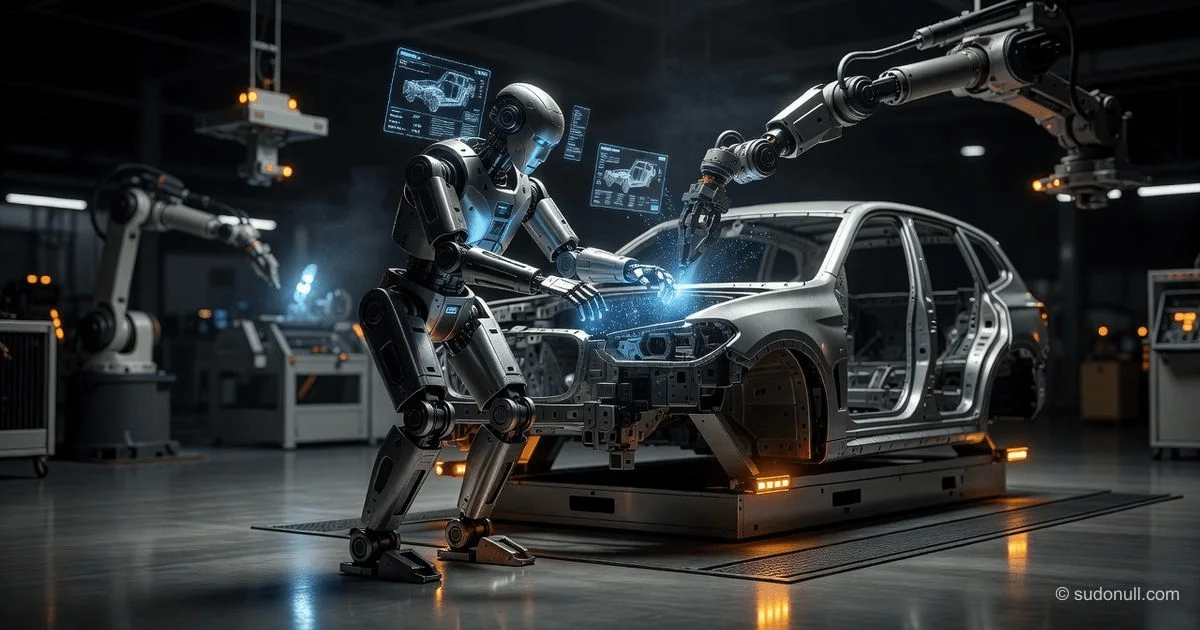
Introducing the Next Generation of Humanoid Robots: Figure 02 with AI Interface
Figure AI has unveiled the second generation of its bipedal robot, equipped with an advanced neural network for understanding natural language and performing tasks autonomously on the production line. Prototypes are already being tested at BMW plants in the USA.
"Physical AI" Has Arrived: Why Figure 02 Is Not Just a Robot, But the End of the "Crippled Robot" Era
Insider Analysis of the Hidden Bets by BMW, OpenAI, and the Man Who Raised $39 Billion on "Hardware"
[The Gist]: What's Really Happening
On June 22, 2026, the humanoid revolution ceased to be a futuristic concept. Figure AI didn't just unveil the second generation of its robot, Figure 02 — it proved its industrial viability. Ten months at the BMW plant in Spartanburg, 30,000 assembled BMW X3 crossovers, 1.2 million steps, and 1,250 hours of operation — these aren't lab tests; this is deployment on a real production line.
But here's the first non-obvious point that the media stubbornly ignores: Figure 02 didn't replace a single worker. It integrated into the existing process as an additional tool. BMW called it a "valuable addition to existing automation systems," not a labor replacement. And that's a fundamental point. The labor market in the US and German automotive industry is a zone of strong unions. Any attempt to "replace humans" would spark a political scandal. Figure and BMW took the path of "labor relief" — the robot handles monotonous, repetitive operations with millimeter precision (installing body components for welding), while humans shift to quality control and non-standard tasks.
The second hidden layer: Figure 02 is not just "hardware." It's the first mass-produced product that combines OpenAI's large language models with a physical body. The robot isn't rigidly programmed for a specific operation — it understands natural speech and can adapt to a new task on the fly. This is "Physical AI" — a term BMW introduced into its digitalization strategy. And Figure 02 became the first commercial embodiment of that term.
What's really happening: we are witnessing the birth of a new industrial paradigm where AI doesn't just "think" in the cloud but "acts" in the physical world. And the stakes here are trillions of dollars in potential market value.
Timeline and Context
To understand why now, we need to look at the roadmap of Figure AI and BMW. This isn't a random pilot; it's a systematic expansion:
| Date | Event | Significance |
|---|---|---|
| 2022 | Figure AI founded by Brett Adcock | Start with the ambition of "billions of humanoids in homes and factories" |
| January 2024 | Agreement with BMW for pilot in Spartanburg | First industrial contract — validation from an auto giant |
| March 2024 | Partnership with OpenAI + $675M from Bezos, Microsoft, Nvidia, Intel | AI brain for the robot and strategic investors |
| 2025 | Figure 02 at BMW Spartanburg plant (10 months) | 30,000 BMW X3, 1.2M steps, 90,000 components — proof of reliability |
| September 2025 | Series C > $1B, valuation $39B | Figure becomes the most valuable robotics startup in history |
| December 2025 | First test of Hexagon AEON in Leipzig | BMW secures a second supplier to avoid dependence on Figure |
| February 2026 | BMW announces deployment in Europe (Leipzig) | US success transferred to Germany — Physical AI competence center |
| May 2026 | Hark (new project by Adcock) — $700M at $6B valuation | Figure founder simultaneously builds "personal AI" with former Apple engineers |
| June 2026 | Figure 02 officially recognized as successful pilot | Transition from "test" to "standard solution" for the automotive industry |
Note a key nuance: BMW is simultaneously testing two suppliers — Figure (US startup) and Hexagon Robotics (Swiss company). This is a classic "don't put all eggs in one basket" strategy. If Figure becomes too expensive or delays deliveries, BMW already has an alternative. And this is a fact the market somehow ignores when talking about a "Figure monopoly."
Who Wins and Who Loses
Winner #1: BMW Group. They got ten months of real-world data on humanoid operation in mass production conditions. Without risk, without capital expenditure (they simply rented the robot as a service). Now they know: robots work, integration via standard interfaces is possible, safety is ensured. They created a Competence Center for Physical AI to replicate this experience at other plants. Milan Nedeljković, who became CEO of BMW in May 2026, has already made Physical AI part of his strategy.
Winner #2: Figure AI. Their market valuation of $39 billion is no longer "paper" but confirmed by a real-world case. They proved they can manufacture robots (the BotQ plant produces one robot every 90 minutes) and, crucially, that their AI works in the real world. The partnership with OpenAI gave them an advantage competitors can't match: a language model that can control physical actions.
Winner #3: Nvidia and Microsoft. They invested in Figure early ($675M in the 2024 round). Their stake is now growing in value. Nvidia also supplies GPUs for training Figure's models and Adcock's new project Hark. This is a classic "sell shovels during a gold rush" strategy.
Loser: Tesla Optimus. Yes, Elon Musk promised humanoid robots back in 2021. But Tesla has yet to show an industrial pilot comparable to 30,000 BMW cars. Their robots are mostly "dancing demonstrations," not production tools. And while Tesla tries to do everything itself (its own AI, its own hardware), Figure uses the best market components: OpenAI for the brain, Nvidia for computing, BMW for validation.
Neutral: Chinese manufacturers (UBTECH, Xiaomi, Fourier Intelligence). They are actively developing humanoids, but the Western market is closed to them due to geopolitics. Their success will be measured by the domestic Chinese market, not globally.
What the Media Isn't Saying
Insight #1: Figure 02 is a "Trojan horse" for data collection.
Every hour of Figure 02's operation at the BMW plant generates terabytes of data: how the robot moves, how it interacts with parts, what errors occur. This data is invaluable for training the next generation of models. Figure AI isn't just making money from robot rentals — they are building the world's largest dataset of physical interactions. That's why their valuation is $39 billion with revenue likely still under $100 million per year. Investors are paying for data, not robots.
Insight #2: Brett Adcock is playing two games simultaneously.
In May 2026, Adcock launched Hark — a new project to create "personal AI" with its own hardware. He invested $1 billion of his own funds, hired former Apple designers (including those who worked on the iPhone Air), and signed a contract with Nvidia for thousands of GPUs. Why does Figure's CEO need another startup? Answer: Figure is "Physical AI for factories," and Hark is "Physical AI for the home." And most likely, Hark's technologies will be used in Figure 03 and beyond. This is vertical integration through two legal entities, allowing separate capital raising and risk reduction.
Insight #3: Europe is not a testing ground; it's a bet.
BMW chose Leipzig for a reason. It's one of their most advanced plants for electric vehicle production. High-voltage batteries require precision assembly and absolute safety — ideal conditions for robots. But there's also a political subtext: Germany is losing the EV race to China, and they need a competitive edge. "Physical AI" is what could bring German manufacturing back to the forefront. It's no coincidence that Milan Nedeljković speaks of "digitalization as a factor of competitiveness in Europe and the world."
Forecast: Next 30 Days and 90 Days
Next 30 Days (through end of July 2026):
Expect an official announcement from Figure AI about commercial rollout of Figure 02. They have the BotQ production line (one robot every 90 minutes), and they need to fill it with orders. Likely contracts with one or two more automakers (possibly Mercedes or Ford). Also, Figure will probably unveil an updated AI model for robots that leverages Hark's developments — this will be direct proof of synergy between Adcock's two companies.
Next 90 Days (through September 2026):
In Leipzig, the full pilot phase with Hexagon AEON will begin. This will be the first comparison of two platforms at the same plant. Figure and Hexagon will compete on efficiency, and the results could influence BMW's choice for global scaling. Also likely: competitor Tesla will show its Optimus Gen 3, but without an industrial pilot, it will look like a "catch-up" presentation.
And most importantly: watch for news on Figure's next funding round. The $39 billion valuation could rise to $50 billion+ if they confirm new contracts. This means Figure's IPO (which everyone is waiting for) could become the largest in robotics history — possibly as early as 2027.
Summary Table: Key Players in the Humanoid Robotics Market (2026)
| Company | Model | Status | Key Pilot | Valuation / Investment | AI Partner |
|---|---|---|---|---|---|
| Figure AI | Figure 02 (Figure 03 in production) | Commercial deliveries | BMW Spartanburg (30,000 cars) + Leipzig (planned) | $39B (Series C 2025) | OpenAI, Hark (in-house) |
| Tesla | Optimus Gen 2 | Prototype, demonstrations | No industrial pilots | ~$3-5B (estimated investment) | Tesla AI |
| Hexagon Robotics | AEON | Pilot project | BMW Leipzig (from summer 2026) | Not disclosed | In-house |
| Boston Dynamics (Hyundai) | Atlas (electric) | Research | No commercial contracts | Part of Hyundai | In-house |
| UBTECH (China) | Walker X | Pilots at Geely plants | Domestic Chinese market | ~$1.5B (public company) | In-house + Baidu |
Data based on public company reports and industry sources from 2025-2026
— Editorial Team









No comments yet.