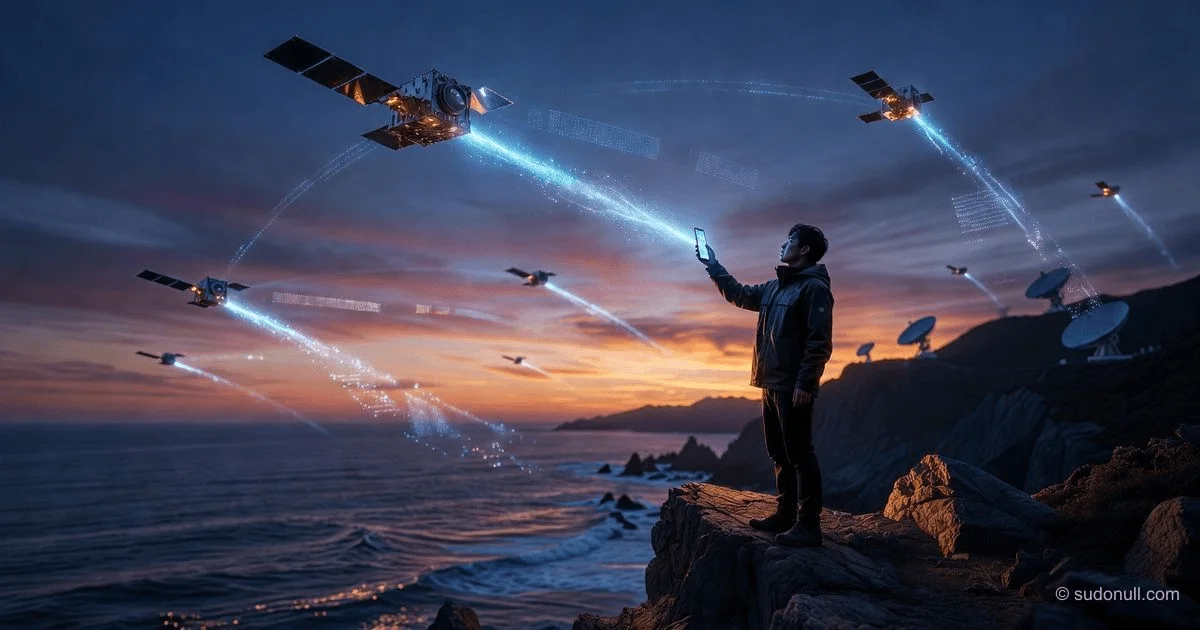
Starlink Satellite Constellation Launch for Direct-to-Smartphone Signal in Japan
SpaceX, together with Japanese operator KDDI, has begun deploying an orbital network providing cellular coverage in remote areas of the country. The service allows sending messages via satellite without additional equipment.
Pacific Rift: Why Free Starlink in Japan Is Not Charity, But a Geopolitical Maneuver
Insider Analysis of KDDI's Hidden Stakes, Japanese Regulation, and the D2D Standards War
[The Gist]: What's Really Happening
On June 22, 2026, Japan became the first country in the world where all three major mobile operators — NTT Docomo, KDDI, and SoftBank — simultaneously offer direct satellite communication on regular smartphones via Starlink. KDDI launched its "au Starlink Direct" back in April 2025, and within a year, 3.5 million people used it — mostly tourists, climbers, and residents of remote islands. NTT Docomo and SoftBank followed in April 2026, making the service free for most subscribers. At first glance, this is simply a victory for convenience and technology.
But there's a hidden layer here that the media ignores. Japanese operators are making D2D free not out of altruism. They are protecting their subscriber base from competitors. In Japan, smartphone penetration is 94%, the market is saturated, and every operator fights for each user. If KDDI offers free satellite access and NTT Docomo does not, tourists and residents of mountainous areas will switch to KDDI. So they are forced to respond with free access — this is not a strategy, it's a price arms race.
And the second hidden fact: Japanese coverage. According to KDDI, their terrestrial networks cover 99.9% of the population, but only 60% of the country's territory. The remaining 40% are mountains, forests, small islands, and coastal waters. Satellite communication for Japan is not a "nice bonus" but an infrastructural necessity. Without it, the country cannot provide communication in disaster zones (and earthquakes and tsunamis are regular here). And the Japanese government understands this — so it silently supports Starlink's expansion, despite concerns about dependence on an American company.
Timeline and Context
To understand the scale and pace of deployment, let's look at the timeline of Direct-to-Cell in Japan and the world. This is not a random launch but a systematic expansion by SpaceX that began back in 2022.
| Date | Event | Significance |
|---|---|---|
| August 2022 | SpaceX and T-Mobile announced D2D partnership | First public promise of "connectivity everywhere" |
| January 2024 | SpaceX sent first SMS via satellite to a regular phone | Technology proven in practice |
| April 2025 | KDDI launches "au Starlink Direct" in Japan | First Asian country with commercial D2D |
| November 2025 | KDDI expands roaming to the US (T-Mobile) | Japanese tourists get connectivity in the Grand Canyon and other "dead zones" |
| April 2026 | NTT Docomo and SoftBank launch their Starlink Direct | All three operators on one platform |
| April 2026 | FCC rejects SpaceX's request for new spectrum in the US | Regulatory blow, but Japan is not dependent on the FCC |
| May 2026 | Rakuten announces D2D with competitor AST SpaceMobile | An alternative to Starlink emerges, but only in 2026 |
| June 2026 | Starlink Direct in Japan covers 47 prefectures and territorial waters | Full country coverage, including maritime zones |
Importantly: SpaceX has already launched over 650 Direct-to-Cell satellites as part of the first generation, and they operate in eight countries across five continents. In 2026, the UK (Virgin Media O2) and 14 African countries (Airtel) will join the network. Japan is not an exception but a testing ground for the Asian region. And judging by the numbers, the test succeeded — 12 million people worldwide have already used emergency communication via D2D.
Who Wins and Who Loses
Winner #1: SpaceX and Starlink. Japan is a market "anchor" in Asia. Without Japanese operators, Starlink Direct would be an "American-European" toy. Now SpaceX has a reference case in a country with the most demanding consumers in the world. And more importantly, KDDI pays SpaceX for access to its infrastructure, generating recurring revenue. Estimates suggest that by the end of 2026, about 10 million users per month will be served via Direct-to-Cell worldwide.
Winner #2: Japanese tourists and residents of remote areas. This is obvious, but the numbers speak for themselves: 3.5 million people used KDDI Starlink Direct in the first year. For a country with a population of 125 million, that's 2.8% — and it's just the beginning. Free access to emergency messages, tsunami and earthquake alerts saves lives.
Loser #1: Starlink competitors in Japan. Rakuten plans to launch D2D via AST SpaceMobile, but only in 2026. By then, Starlink will have captured the market and user habits. Switching a customer from a free, working service to a paid one is nearly impossible.
Loser #2: South Korean operators. While Japan makes D2D free for the mass market, Korea focuses on the B2B segment (ships, aircraft) through its satellite subsidiaries SK Telink and KT SAT. SpaceX has already called this "a battle of three Goliaths against David" — and bet on David. South Korea may lose the race for the consumer market in the region.
Neutral: Chinese operators. They have their own satellite constellations (e.g., Guowang), but they do not use Starlink. The Chinese market is closed to SpaceX, so Japan and Korea will remain the main battlegrounds for D2D in East Asia.
What the Media Leaves Out
Insight #1: "Free" only applies to text, not data.
All three operators offer free SMS and emergency alerts. But KDDI, for example, charges 1,650 yen (about $11) per month for satellite internet access if you are not on their premium plans. And speed, as Elon Musk reminds us, is limited — roughly 7 Mbps per beam, and the beam is very wide, so it won't compete with terrestrial 5G. So "free communication" is only text messages and emergency alerts; full internet is paid and slow.
Insight #2: The spectrum war is just beginning.
In April 2026, the US Federal Communications Commission (FCC) rejected SpaceX's request for access to new spectrum for D2D. This means Starlink may face capacity limitations in the US. But in Japan, the regulator is more lenient — and that's a strategic advantage. SpaceX can use Japan as a testing ground for technologies not yet approved in the US. Then, they can return to the States with a "proven solution."
Insight #3: Rakuten and AST SpaceMobile — a sleeping giant.
Japan's fourth operator, Rakuten, did not join Starlink. Instead, they signed an agreement with AST SpaceMobile, a SpaceX competitor. AST uses satellites with larger antennas (65 sq. meters vs. 5 sq. meters for Starlink) and promises speeds up to 120 Mbps on the first generation. If they launch commercial service in Japan in 2026, it could upend the market. But for now, it's just plans.
Forecast: Next 30 Days and 90 Days
Next 30 days (through end of July 2026):
Expect official statistics from KDDI on user growth for the second year. They will likely announce 4.5–5 million users. Also watch for news from NTT Docomo — they may expand the free zone to more plans to keep up with KDDI. And possibly, Rakuten will confirm the exact launch date for its D2D with AST SpaceMobile to capture market attention.
Next 90 days (through September 2026):
Expect announcements about expanding Starlink Direct roaming. KDDI has already promised to connect Canada, the Philippines, and New Zealand by the end of 2026. If this happens in the coming quarters, Japanese tourists will get global coverage. Also likely are news about the second generation of Direct-to-Cell satellites — SpaceX plans to launch 15,000 new, more powerful satellites with 5G support.
And most importantly: watch regulatory actions in the US. If the FCC changes its stance and approves new spectrum, it will sharply accelerate D2D development in North America — and Japan will become the benchmark that lobbyists reference. If not, Japan will remain a "safe harbor" for Starlink, where the technology can develop without political obstacles.
Summary Table: Comparison of D2D Services in Japan
| Operator | Service Name | Launch Date | Price (Basic Plan) | Speed (Claimed) | Coverage | Competing Provider |
|---|---|---|---|---|---|---|
| KDDI | au Starlink Direct | April 2025 | Free (SMS); 1,650 yen/month (data) | ~7 Mbps per beam | 47 prefectures + territorial waters | Starlink (SpaceX) |
| NTT Docomo | docomo Starlink Direct | April 2026 | Free for all | Not disclosed | All of Japan (outside coverage area) | Starlink (SpaceX) |
| SoftBank | Starlink Direct | April 2026 | Free (except cheap plans — 1,650 yen/month) | Not disclosed | All of Japan | Starlink (SpaceX) |
| Rakuten | D2D Planned | 2026 (unspecified) | Not disclosed | Expected higher (AST SpaceMobile) | Planned for all of Japan | AST SpaceMobile |
Data based on official operator statements and reports from April–June 2026
— Editorial Team







No comments yet.