November 21, 2013 at 08:59
Interview with the founder of the company with an estimate of 2'000'000'000 $. Stepan Pachikov about his unsuccessful experience in high-tech business: “Don’t put a premium on your own business”
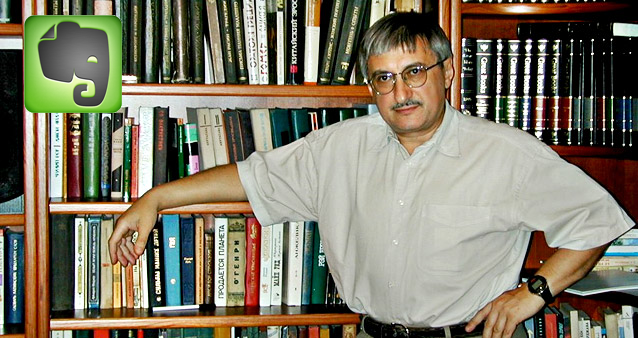
AmBAR and SiliconNews.ru interviewed the founder of Evernote (also the legendary ParaGraph and Parascript), whose valuation has already exceeded $ 2 billion. A very interesting person with an interesting story who has a lot to learn. An exclusive interview where, among other facts, Stepan Pachikov for the first time shares his failures in business.
Stepan Pachikov: Russian innovator, co-founder of ParaGraph Intl., Parascript, Evernote, which have made a great contribution to the development of handwriting recognition and VRML technology (virtual reality modeling language, a standardized file format for demonstrating three-dimensional interactive vector graphics, most often used in WWW). The first businessman of the USSR, whose firm [ParaGraph] received a contract with Apple.
Ivan Tsybaev: First, let's talk about Silicon Valley. You have a wonderful inspirational article, Silicon Fever, from the 95th year in The Twinkle . How was it written? What is your impression? Was there any special stage in getting to know the Valley?
Stepan Pachikov: I have known the Valley since June 90, when I first arrived there. Then, in '91, we began working with Apple, opened the ParaGraph office in Cupertino, next to them (this was one of the terms of the contract) - and a dozen key handwriting recognition developers moved to the Valley. They [Apple] were very worried about the project. They tried to keep abreast of all the details, but did not tell us why they needed a handwriting recognizer. And this was one of Apple’s fundamental mistakes - we worked blindly, only according to specifications, it’s wrong - when you are engaged in artificial intelligence, there are a lot of nuances that are of great importance, and the knowledge that recognition will be done with a handheld device modifies the way the algorithm is developed and affects development.

I began to spend more time in the Valley, so in the 92nd I moved my wife and children there. Sasha was 12, Ksyusha - 8. In Moscow, of course, I spent a lot of time, but about the same in the Valley and the same in traveling.
At that time, I began to keep a weekly column “Looking from California” in the magazine “Computer Press”, an article for “Spark” - this was my understanding of what the Valley was at that time. This article occurred to me again when they started organizing Skolkovo, and when they tried to declare Skolkovo Silicon Valley, Medvedev continues to call her Siliconova.
ITS: How did the attitude towards the Valley change over time?
SP: You know, the Valley has always been my favorite place, and I especially loved the 280th road, always talked about it and drove guests to the airport along it. Attitude to the Valley, as to another Homeland. True and some claims arose at the end of the last century. It seemed to me that with so much money and capital, and with so many interesting, intelligent and educated people, educational institutions, the cultural life in the Valley could be more intense: theaters, conservatories and other museums. And it seemed unfair to me that there was such a concentration of smart, educated and rich people, and such a low intensity of cultural life. But now the situation is changing, I hear from my friends and acquaintances that, in general, everything is changing for the better, but, again, everything revolves around San Francisco. I do not consider San Francisco to be part of Silicon Valley. San Francisco is a separate big phenomenon. Although, probably, now SF can be included in the Valley. I have a generally good relationship with the Valley, but there is no desire to move to the Valley from New York.
IZ: So, you have claims from a cultural point of view, I myself lived in New York, and I understand that in New York the cultural life is more eventful. Tell us more about why you moved to New York from the Valley. What affected the move?
SP: There are 2 reasons. The first is pretty funny. In 97, Silicon Graphics bought my first company, ParaGraph, and it so happened that I earned a certain amount of money - more than what I used to spend. In an attempt to learn how to spend money on toys, I became interested in Hi-End equipment (tube amplifiers, electrostatic speakers, etc.) - all this is very expensive, tens of thousands of dollars. It so happened that until then I was not a fan of opera, but since we had very good equipment and very good, wonderful transport for laser discs, my wife began to buy opera on laser discs, and so we started listening to operas and other things classics, quickly fell in love with opera and began to look around. We started going to opera houses, in San Francisco, to Seattle, we really liked New York and its opera, and I half-jokingly told my wife in 2000 that instead of constantly flying to New York, let's move there. And, pretty quickly, we did it. Bought an apartment a 15-minute walk from the Metropolitan Opera, in western Manhattan. In general, we just fell in love with the city when we began to constantly fly to opera performances. So, the reason for our move to New York was the player for laser video discs.

The second reason I do not like to tell. It so happened that I organized a rather successful Pen and Internet division in Silicon Graphics, it began to develop rapidly, but by this time Silicon Graphics began to have financial difficulties, problems with management, they began to get rid of non-core businesses, and branch6 which I headed, along with the team, continued to develop handwriting recognition technology. SGI decided to sell our division to Vadem. I worked at Vadem for almost a year, but one “fine” day, the CEO of the company John Jao called me and said that “now you will work for Microsoft, we will transfer your department to Microsoft with all your patents, all the technology , team, with everything. " It was not a big shock for me because I didn’t treat Microsoft badly, I had great respect for Bill Gates and his company, but the fact that this was done in a slightly dishonest manner, behind me, I was confronted with a fact. Therefore, I refused to participate in the transaction, slammed the door, left the company and was depressed for a year and a half.
Moving to New York was partly a way out of this state. Microsoft bought the Paragraph patents and for many years I entertained the public with the fact that when they showed me handwriting recognition on Microsoft phones, I asked: “Here write Pachikov with any degree of recognition, as you like, as fast as you like Further". It always recognized, because my last name was in the dictionary, and the technology was sharpened for recognizing my last name, because during the demonstration I often wrote my last name - it was like the “Easter egg” that our programmers made. In general, recognition technology was transferred to Microsoft, and I moved to New York.
IZ: It is clear, that is, New York has become a kind of outlet for you after some not very pleasant events. And how often do you go to the Valley now and for what purpose?
SP: I’m a member of the Evernote board that I started in 2002 - it was a New York company, but the main team (these were the people from my Para team), everyone lived in California, and I started flying to New York on weekends. And then, when Phil [Libin] headed the company in 2007, I already stopped flying to California and flew only to Board meetings.
ITS: When you lived in the Valley, what kind of Russian-speaking communities were there, and how did they communicate then?
SP: from 92 to the end of the century, the main Russian-speaking company that was available to me was the former ParaGraph employees, of whom there were a lot, we moved more than 25 families to Silicon Valley, so the majority of Russian-speaking people, friends and acquaintances were linked to ParaGraph. Of course, other Russian-speaking communities appeared, but I was not very involved in them. It is clear that at that time there was nothing like AmBAR (the American Business Association of Russian- Speaking Professionals with headquarters in Palo Alto - ed.).
IZ: You re-registered the company in California and at the same time participated in the SVOD (Silicon Valley Open Doors) conference - how did you get there? You were invited by Alexei Fedoseev , who previously presented therehis startup , which he later sold to Motorola?
SP: Alexey Andreev invited me and introduced people around this conference, and I met Fedoseev much later. It so happened that I invested in 4HomeMedia and even made money on it when they sold to Motorola.
IZ: How did you personally develop after the registration of Evernote?
SP: After we released a beta version for Evernote for Windows in 2004, the business needed to be developed, it was necessary to meet with partners, with the press, and investors. I was a CEO of the company and was engaged in the business of the company 24 hours a day. And, of course, I spun more or less in all areas, I met with investors, gave interviews, met the press, newspapers, magazines, radio. I did the usual job of SEO. In no special way did the Russian “party” occupy a special place in my life then, but most of the Evernote team was Russian-speaking. This has its pros and cons. The downside is that, voluntarily, it was necessary to communicate in Russian - in the company it is much more convenient to brainstorm in the native language. And this left a mark, it seemed that it was a Russian company. But this is not so Evernote was originally an American company, although a large number of Russian speakers gave it a certain aura. Now this is not. Now it is clear to everyone that this is a 100% American company. But CEO (Phil Libin ) speaks good Russian.
EC: I know that Round A attracted Evernote investments, including from Troika Dialog, from Russian investors.
SP: It was already with Phil. Troika offered the most favorable conditions for providing money at that time.
ITS: You started to raise such a company, and now it is one of the leading ones. And why in one of the previous interviews you evaluated yourself as an entrepreneur of the middle hand?
SP: Natural modesty :-) You understand, when you spend so much time in business, when you meet with a large number of entrepreneurs of the highest level, you quickly realize that your place is far from the first thousand. For example, Phil, a brilliant entrepreneur, businessman, and I think that if I was lucky to meet such a person earlier in my life, I would learn a lot. Phil is not just a brilliant entrepreneur, but also a brilliant teacher. You can just see how his employees learn a lot, he makes them first-class specialists. Generally, he is a born teacher. He is a really talented teacher. And, I think that over the years we have learned a lot from him.
IZ: Tell us what you did before Evernote - what were the important stages in your history as an entrepreneur?
SP: The first stage happened in the year 67-68. Being a 1-2 year student of mechmath of Novosibirsk University, I organized the first rock band Black Lines in Siberia. Until now, I consider it to be one of the most successful events that I was able to “knock out” 5000 rubles from the rector Spartak Timofeevich Belyaev for a drum kit (of the Trollo company), and I managed to buy it by bank transfer, although it was sold only for cash. The first month I “knocked” on drums, then I found a more talented guy, and then I became just the manager of this group. We gave concerts, performed at weddings, at dances, in a hostel. I still remember all this with pleasure and believe that this is my first entrepreneurial success.
The next milestone in my organizational activities was a home scientific seminar, which was organized in my apartment, and where a wide range of issues was discussed. First, Kolya Yatsenko (“Kolyaba”) for several months told a non-trivial concept of the history of the Civil War, about how graduates of the Tsar’s Academy General Staff helped the Bolsheviks to win the Civil War. Then for several months we were engaged in the analysis of Fomenko's theory of violations in the dating of history. Zhenya Paletsky fairly accurately and critically analyzed the approaches of Anatoly Fomenko. It so happened that at the seminar, it took place on Sundays, about 25-30 people gathered. It was a purely male company, even his wife left. There were various rumors that men were gathering, and they didn’t drink vodka. There were many interesting topics: Sasha Semenov talked about music and what logic is the basis of musical perception. And for the first time at the seminar, I felt like a leader and manager.
The next stage is the computer club for children. In '84, I became very interested in personal computers. I was able to get and read various foreign computer magazines. I quickly became a specialist in personal computers, and I was invited to the group “Temporary staff of the school under the President of the USSR Academy of Sciences.” Velikhov led him, but the team leader was Lesha Semyonov. I learned a lot there.

In the 86th year, we organized the Moscow Children's Computer Club. And Garry Kasparov then greatly helped in this matter, since he handed over to the club a batch of Atari computers - about 50 pieces. It was the largest concentration of personal computers in the entire USSR. Harry signed a contract with Atari, but instead of the money he took them with "greyhound puppies" - computers. Harry co-founded the club. And the club was a bright page in the life of Moscow in the 80s. They taught children programming - for free. Becoming a member of the club could only be the one who taught classes with children.
Around the club, a noticeable community of enthusiasts in the USSR was created. Quite a lot of bright people were there. And we began to think how to organize our own company. So ParaGraph company appeared - a joint venture, then registered in the USA as ParaGraph International with an office in Moscow. It so happened that of the various kinds of projects that we wanted to do, we decided to do text recognition. And there were several reasons for this, one of them was the minimum necessary equipment: a computer and a scanner. We were lucky, and the team of guys I attracted very quickly made a very good version, which showed that we could read the handwritten text without training. Of course, we could only read legible texts. With this we went to COMDEX (then it was the largest IT conference) in May-June of the 90th year. The airline lost our luggage and we had neither computers at the stand, nor scanners, but the people helped and gathered together "with a thread." They gave computers, scanners, printers, we hung the flag of the USSR. We were lined up. Then CNN made a report from our booth and our demo. This coincided with the arrival of Gorbachev, the interest was huge.
By the fall, we were already the most famous Soviet company. They showed not only scanning, but also demonstrated technology, using a tablet with digital pens. And one of the people then famous - the founder of Lotus, after watching our demo, called GO (the firm of Jerry Kaplan, who came up with the idea of "pen oriented OS", he really came up with tablet computers) and told them: "It really works!" . In the fall of 1990, we again came to California, met with Apple, began to show them our technology, they began to write words, but nothing worked. We explained that we simply didn’t have a digital English dictionary, and that we did the dictionary ourselves, taking as a basis the Beetles diskette, which was presented to me by a friend from England. Then people with Apple started writing different words from Beatles songs, and it worked. The condition for the contract was the relocation of key engineers to the Valley. Apple paid us 6 million. The essence of the contract was to develop a technology for handwriting, as it later became clear for Apple Newton (tablet computer of the early 90s, the "great-grandfather" of the modern iPad - ed. ) And I still have a nostalgic love for Apple Newton, although this product has failed in the market. All due to the fact that the notorious marketing Apple has made several mistakes that can be cited in the marketing textbook. One of them was that they too much lifted the standby bar from the device. People really believed that a machine would recognize a language better than they themselves did.
I remember how we were at the same conference, and someone loudly swore in the hall for our recognition. I told him that "if you do not like it, turn it off, do not use it." But he said that he could not make out his own text and therefore bought Newton. He really believed that a computer should do this better than him. And this was one of Apple's major punctures. And the second mistake is that Newton was very ahead of his time. The processor power of the taxonomy was really not enough. The iPhone arrived on the market on time when needed, and all other premature devices paved the way. Apple Newton is a very significant step.
ITS: So you and this conference were at the right time in the right place?
SP: In business, luck is very important. A lot of people find themselves in the right place and time, but they don’t notice it. Therefore, luck is important, but it is equally important not to miss this chance.
IZ: After 92 years when you moved, were there any important points?
SP: The most important moment happened on January 15, 1993, when I suddenly realized for real what WWW was when it was still in its infancy. I clearly foresaw that my children would live in a different era, and what role virtual reality would play, and then I decided that it was impossible to deal with it. There is a saying: “If you don’t know how to deal with this, you need to head it” - then I had a certain picture of a virtual time machine for children in my head that would allow us not only to travel in time, but also to meet people, live there, make friends, meet, for example, Archimedes. And then the concept of the Alter Ego project was formed - this project very much excited the entire company [ParaGraph]. I like to tell the theory that very often the principle of “soup from the ax” - “stone soup” works well in business. If you cook from the ax for a long time and hard, you get a good soup. The Alter Ego project is a radiant dream, and people had the feeling that we could do something brighter than text recognition. The project greatly changed the company, the company began to engage in three-dimensional technology, which really then did not exist for a personal computer.
We created everything from scratch. They made their own three-dimensional engine, a new team of people appeared, new specialists appeared - for example, Misha Lyapunov, Edik Talnykin, who wrote their own language for describing three-dimensional objects. Then ParaGraph became one of the founders of VRML. We tried to show how three-dimensional graphics work on a personal computer. Launched on the market a product that allows you to build houses, interiors using three-dimensional graphics.
And at that moment, Silicon Graphics was looking for a new platform, a new direction, they also decided to move in the field of virtual reality of personal computers. They had a project whose goal was virtual reality in the user market, and they were looking for the most powerful team in this area, and ParaGraph seemed to them such a team, and the co-owners of the company decided to sell the company. I did not want to sell the company, although it is difficult to say what would have happened if this had not happened. Silicon Graphics bought the company in '97, it was headed by another person, I was removed from virtual reality, I was allowed to create my own branch, I was allowed to take a dozen engineers, we developed a new, more advanced version of the text recognition program compared to Newton. Silicon Graphics was already downhill at that time,
IZ: So, the idea came on January 15, 93, and 4 years passed before the sale of ParaGraph Silicon Graphics. How did the idea come about?
SP: I realized from observing my son. The son spent a lot of time at the computer and read little (in my opinion). He often helped me do demos at conferences when he was 12-14 years old (now he is vice president of Evernote). Then, in '93, it was already clear that this is a new generation of children for whom a computer is a vital condition, for example, in terms of correspondence, communication, mail. And I wanted the child to read books, palm off good books to him, but he was sitting more and more on the computer. And I understood that something needs to be done. As I said, if I can’t interfere with this process, then we must head it.

ITS: The son was mainly engaged in games or what?
SP: Games too. Bybeskami. By email. She was new then. He helped me a lot at work. He accompanied me to many conferences that we attended.
ITS: What happened next of interesting things?
SP: in the 96th year, my partner and I [from ParaGraph] singled out all the technology for recognizing scanned images, scanned text, handwritten, printed — everything related to handwritten text. We created Parascript - this system is still functioning and practically dominates the market for sorting letters and receipts. Each time you drop a letter in a box, it doesn’t matter how it is written: by hand or printed - it is still sorted using Parascript technology. USPS ( United States Postal Service - US Postal Service) has been using our technology since 2001. Then - other countries: Canada, France, Australia. Then we captured the check recognition market. And we still own it with the same partner with whom we owned ParaGraph.
IC: i.e. do you still get income from this?
SP: Yes, of course, every year.
ITS: And your customers are banks and postal services?
SP: Now the project is expanding, the company has made great strides in the ability to recognize any form and, most likely, will be dominant in recognizing forms, handwritten, printed, any other specialized forms. We read mixed texts very well.
IZ: Please tell us about your failures. Everyone usually talks about success, but, in my opinion, failure stories are more instructive for others.
You know, I, initially, did not want to tell you about this story, since an entrepreneur should look like a successful person, everyone wants to be close to successful, successful - to be like them, imitate them, and therefore did not really want to talk about failures would. The reason for this failure is that I violated the golden rule that Knysh (a well-known KVN worker) voiced: “Don’t put a premium on your own business.”
I tried to get into a business that was not my business. This company, which was organized in 2001, was called "Hyperboloid." The idea was to make the light beam so precise that it was almost like a laser, but, unlike a laser, it was not monochrome, but included the entire color gamut.
We began to make searchlights with which we could write on the clouds everything we needed: any advertising, texts directly on the clouds. We still have some amazing quality demos where we could write texts on trees, roofs, on the surface of the lake for several hundred meters. [The project failed not so much in technical terms as in commercial ones] This is a completely different business in which I did not succeed in having my own laws, my own rules.
IZ: Was this project instructive for you, and did Evernote bring any benefit?
SP: I don’t think, it’s more likely the opposite. The Evernote idea came in 2000, that is, almost simultaneously. Evernote just fascinated me, I realized that I like him, that I loved him, and the Hyperboloid was more like a stepson.
ITS: What are you doing now?
SP: I occasionally get some ideas, discuss them. Including with Phil [Libin]. In 2006, I came up with the idea of a universal translator, and I figured out how to do it, how to translate from any language to any other, using the phone. It would be very useful for tourists when traveling. There would be a personal guide and a translator - all in one phone. I had a dream: to assemble a team and understand what language the Creator is programming. How, for example, is the program that controls the spider.
Then the idea came up how to save the press from degeneration - I caught fire with this project, now I'm thinking about its implementation. I don’t tell the details in public yet. In general, I often thought that I should write an article “My unrealized projects”
IZ: Stepan, thanks for the interview. What is your parting word to entrepreneurs?
You don’t have to follow the rules, but you have to follow them.
Thank you for your attention and for the positive feedback. Subscribe to our blog on Habré , Twitter , Facebook , YouTube channel to stay tuned. Previous posts can be viewed here .
Worked on the interview:
Yaroslav Bosenko (transcript) - a startup from Ukraine.
Alexander Protsyuk (edition) - blogger and Internet entrepreneur.
Ivan Tsybaev (interview itself).
Only registered users can participate in the survey. Please come in.
Are you interested in such interviews from Silicon Valley?
- 92.9% Yes 1257
- 7% No 96