November 11, 2013 at 07:39
Open source and 2d printing
I would like to discuss, for many sore, the topic of the good old 2d-printing and the current market situation. Who cares about the topic, please, under the cat.
I understand that this hour is not in the trend and I’m not talking about the next merits of 3d printers, which are finding more and more applications and are gradually becoming familiar, but I would not like to hush up the problem of the obvious crisis in 2d printing.
The situation in this area is another example of what copyright and the patent system are not doing well: manufacturers sell printers at the lowest prices and expect to maximize their profits by selling supplies. In the case of laser printing, it looks very sad. The cost of the original cartridge can easily reach 70% or more of the cost of the printer itself. As for refueling, the manufacturer is trying to make life as difficult for its customers as possible by incorporating page counters into the cartridges, hard-wired with chips, and the refueling process itself cannot be called hygienic at home.
With inkjet printing, the first artificially manufactured CISS played a huge role. It came to the point that some manufacturers surrendered and began to produce printers with a factory-installed CISS. I myself am (do not consider it for advertising) the proud owner of the Epson L100. Over the past 2 years in my city, I began to notice much more often such printers in store windows. It is worth recognizing that printers from the factory CISS got rid of many childhood diseases: after a long period of inactivity, it’s enough to clean the print head and the printer is ready to print, it’s quite leakproof, if nozzles are cleaned, the nozzles can be cleaned, but the manufacturer installs page counters and forces you to enter serial numbers from the original ink bottles to reset the counter. All this is easily done with special software, but nevertheless, the manufacturer does not strive to make life easier for those who plan to use third-party ink. Further, the setup from the manufacturers is manifested in the choice of models where the factory CISS goes: as a rule, these are outdated models with mediocre print speed and quality indicators, and if the indicators are in order, then there is a significantly higher price, as well as the almost complete absence of MFP options, even in the upper price range (if anyone is aware of such options at reasonable prices - please indicate in the comments).
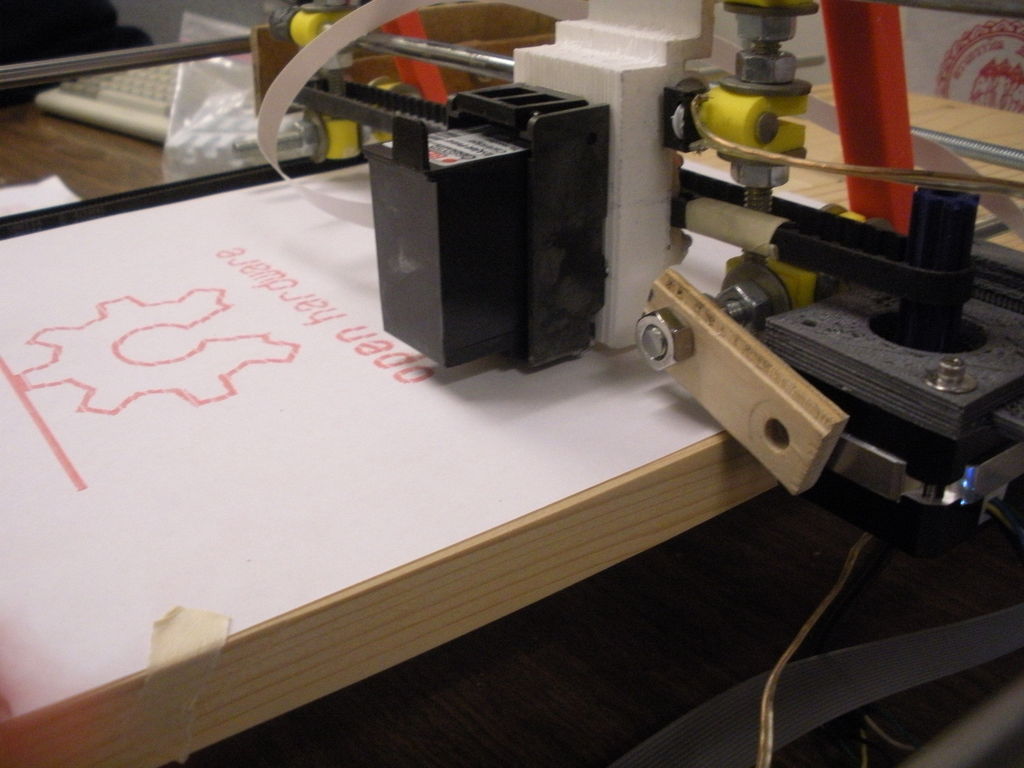
There are quite few interesting projects in this direction and they cannot be called competitive. The option that is presented in the photo above is interesting not so much as a printer, but as another device that can be made from arduino mega, adhesive tape and a print head from an old printer.
Several quite complex hardware projects have already been implemented on kickstarter, so it is quite possible that a commercially targeted Open Hardware printer will appear. Such a project should represent a line of devices with a single ideology aimed at increased maintainability, easy refueling, open specifications, compactness and parameters that allow you to compete with modern printer models. It will take some redesign to simplify printing the maximum possible number of parts on 3d printers of the lower price segment. For laser printers, change the design of the cartridge in order to simplify the refueling process for an unprepared person. With inkjet printers, the attitude is simpler: in the end, the CISS has shown itself well just get rid of the binding to ink from specific manufacturers and open the specifications. It would not be bad for inkjetters to modify the software, which would be easier to calibrate to work with the most famous ink manufacturers.
As one of the most likely obstacles to such a project, I see the threat of a patent lawsuit from the main vendors who are satisfied with the current situation. Further possible difficulties in the production of the printheads themselves, however, I think this is surmountable. I look forward to the appearance of such a project, which will make 2d printing truly affordable and simple.
PS if you have information about the hardware projects of 2d printers, then please unsubscribe in the comments. Please inform me about errors and inaccuracies in PM.
About the situation with laser and inkjet printing
I understand that this hour is not in the trend and I’m not talking about the next merits of 3d printers, which are finding more and more applications and are gradually becoming familiar, but I would not like to hush up the problem of the obvious crisis in 2d printing.
The situation in this area is another example of what copyright and the patent system are not doing well: manufacturers sell printers at the lowest prices and expect to maximize their profits by selling supplies. In the case of laser printing, it looks very sad. The cost of the original cartridge can easily reach 70% or more of the cost of the printer itself. As for refueling, the manufacturer is trying to make life as difficult for its customers as possible by incorporating page counters into the cartridges, hard-wired with chips, and the refueling process itself cannot be called hygienic at home.
With inkjet printing, the first artificially manufactured CISS played a huge role. It came to the point that some manufacturers surrendered and began to produce printers with a factory-installed CISS. I myself am (do not consider it for advertising) the proud owner of the Epson L100. Over the past 2 years in my city, I began to notice much more often such printers in store windows. It is worth recognizing that printers from the factory CISS got rid of many childhood diseases: after a long period of inactivity, it’s enough to clean the print head and the printer is ready to print, it’s quite leakproof, if nozzles are cleaned, the nozzles can be cleaned, but the manufacturer installs page counters and forces you to enter serial numbers from the original ink bottles to reset the counter. All this is easily done with special software, but nevertheless, the manufacturer does not strive to make life easier for those who plan to use third-party ink. Further, the setup from the manufacturers is manifested in the choice of models where the factory CISS goes: as a rule, these are outdated models with mediocre print speed and quality indicators, and if the indicators are in order, then there is a significantly higher price, as well as the almost complete absence of MFP options, even in the upper price range (if anyone is aware of such options at reasonable prices - please indicate in the comments).
What can open source offer
There are quite few interesting projects in this direction and they cannot be called competitive. The option that is presented in the photo above is interesting not so much as a printer, but as another device that can be made from arduino mega, adhesive tape and a print head from an old printer.
Several quite complex hardware projects have already been implemented on kickstarter, so it is quite possible that a commercially targeted Open Hardware printer will appear. Such a project should represent a line of devices with a single ideology aimed at increased maintainability, easy refueling, open specifications, compactness and parameters that allow you to compete with modern printer models. It will take some redesign to simplify printing the maximum possible number of parts on 3d printers of the lower price segment. For laser printers, change the design of the cartridge in order to simplify the refueling process for an unprepared person. With inkjet printers, the attitude is simpler: in the end, the CISS has shown itself well just get rid of the binding to ink from specific manufacturers and open the specifications. It would not be bad for inkjetters to modify the software, which would be easier to calibrate to work with the most famous ink manufacturers.
As one of the most likely obstacles to such a project, I see the threat of a patent lawsuit from the main vendors who are satisfied with the current situation. Further possible difficulties in the production of the printheads themselves, however, I think this is surmountable. I look forward to the appearance of such a project, which will make 2d printing truly affordable and simple.
PS if you have information about the hardware projects of 2d printers, then please unsubscribe in the comments. Please inform me about errors and inaccuracies in PM.