July 31, 2013 at 13:26
UXtra Show - Issue 1: Dream Interfaces
- Transfer
The other day in iTunes there was a new show from the creators of Metrica - UXtra. UXtra - English-language podcast about user experiences and interfaces, service design and business, created with the participation of UIDG and usability of the alliance companies UXalliance (world leader in the field of user experience and interface). Especially for the audience of Habr, the creators of the podcast prepared his transcript in Russian. Author’s remark: We decided to remove the opening words, advertising inserts and slightly edited the original text for the best receptivity in Russian.
In the first episode, I would like to welcome all those who are not indifferent to the themes of UI and UX. I will gladly take into account your comments, suggestions and reviews on the show. So, after we have finished with the introductory part, we can proceed to the main topic of today's release. Preparing for the show, I thought about what thoughts are visited by everyone who starts the implementation of a new project - you decide which way it will develop, you try to look into the future and understand what this or that aspect of your work will result in, ask yourself new goals. In my opinion, it is very important not to lose the overall picture of what is happening, a picture that extends far into the future and allows you to combine your knowledge, as well as the experience of colleagues and predecessors, in order to set the right goals for the project, clear and doable.
Therefore, in this issue of the show, I decided to talk about futuristic interfaces (FUI, Futuristic User Interface). I mean the interfaces that we see in the movies, which we read about and that we come up with. I am convinced that, despite the groundless talk about the practical applicability of futuristic interfaces, it is they that inspire us, if we consider the issue not from the point of view of a specific story or its characters, but from the point of view of elements that support the plot, determine its kind of technological appeal and conquer our imagination is the imagination of today's users.
No, I will not make a selection of all Wikipedia-style materials that are relevant to the topic. On the contrary, I will ask introductory topics in order to arouse your interest in this issue and draw some necessary conclusions. I am going to share my own, maybe amateurish opinion and look at the industry of futuristic interfaces. I call it industry, since a huge number of user interface options were created not only during the development of information technology, but also during the development of film production. An indirect confirmation of this can be the fact that when you try to find information about futuristic interfaces on the Internet, you will most likely come across a lot of collections of video clips, screenshots and UI mockups from various blockbusters.
One of these collections is Access Main Computer File , a blog with endless scrolling of screenshots from the films Alien (1979), Moon 2112 (2009), Me, Robot (2004), Minority Report (2002) and a series films about Iron Man. The creators of the blog talk about their selection as a study of computer user interfaces in the cinema.
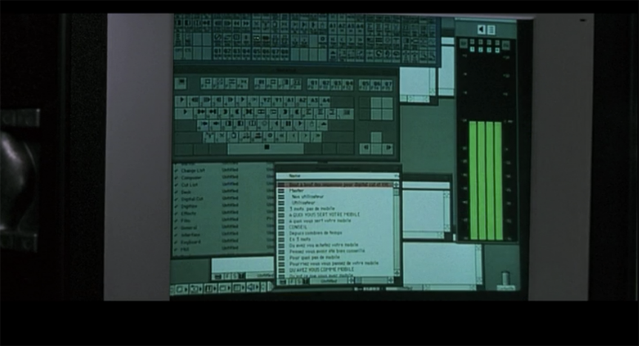
Ronin (1998)
A similar collection of images is available on the Barnorama blog .
However, it’s interesting to follow the evolutionary steps of futuristic interfaces, and the Noteloop website can help ., the creators of which have collected, in my opinion, one of the best libraries of what can be called fantastic / fictional / nonexistent interfaces from popular films and television shows. Most of them are not real programs, but animations that are played on screens at the right time of shooting or added later during installation. Typically, this kind of animation is created in Adobe Illustrator, Adobe After Effects, and Maxon Cinema 4D. So Noteloop's Kit FUI is a database of interfaces like IMDb. However, the guys who made it included not only popular films and TV shows, but also ads, video concepts, short films, as well as information about the designers who came up with all this.
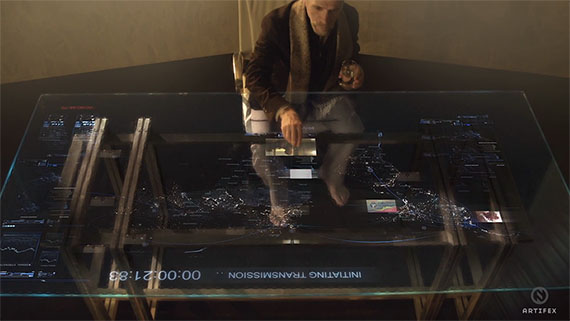
Continuum (TV series 2012)
These kinds of blogs can help keep track of the history of the development of futuristic interfaces, freshen up memories of a particular concept, or even decide on the closest movie for evening viewing. They are good for exploring the topic, although the creators of such resources prefer not to delve into a detailed analysis of an interface. But what attracts people to futuristic interfaces, what makes people invent them? What allows them to overcome all difficulties and at an enviable speed create new interfaces for a growing number of high-tech blockbusters?
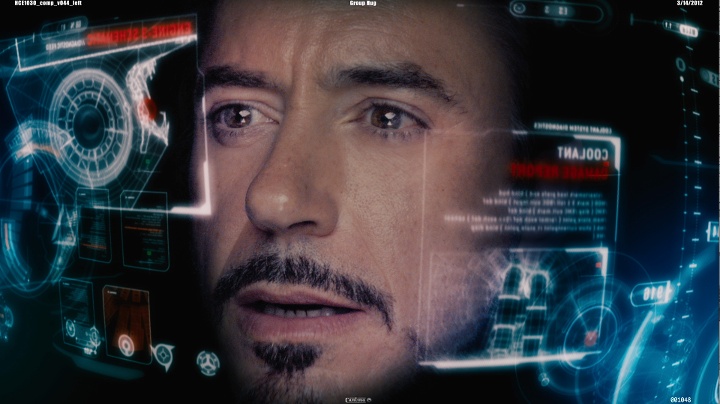
In the journal Pushing Pixels, I found an interesting interview with Jace Hansen(Jayse Hansen), who talks about the work of the creator of graphics for screens and user interfaces in movies. The article dates back to the first of June 2012, but has not lost its relevance and now - from the designer who came up with the interface for the Iron Man helmet, you can find out a lot of interesting things. I like these articles because they make it possible to understand what drives a person and how Jace, whose childhood imagination was struck by episodes from Star Wars and Back to the Future, eventually became an expert in such large-scale projects as Iron Man.
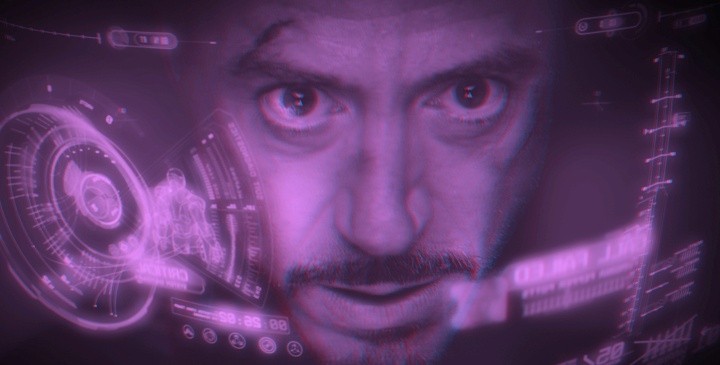
Iron Man 2 (2010)
The interview allows you to take a deeper look at the process of creating FUI - after all, Jace took part in the work on many interfaces for the heroes of high-tech blockbusters, starting with ideas and sketches and ending with stunning graphics. He should be trusted, if only because there are relatively few specialists of this kind and level in the cinema. It is he who conducts basic research before starting work, which are based on a general description of the picture or part of the script. In particular, work on the painting “Rise of the Planet of the Apes” required Jace to create a PDF portfolio for about 20 different script items. So in the profession of creating futuristic interfaces, there is time for serious paper work.
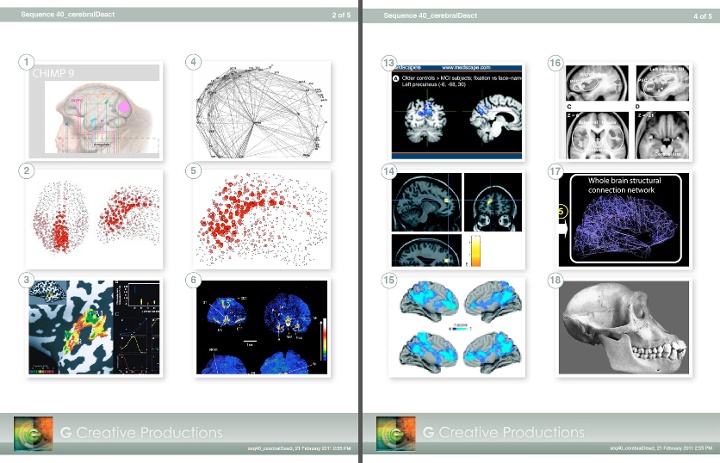
Materials for the preparation of "Rise of the Planet of the Apes" (2011)
However, the development of futuristic interfaces is closely involved not only in the film industry, but also in the largest IT companies. Among these concepts: Apple's iLens , the EEG of brainwaves , the future productivity of the vision (Productivity Future Vision) from Microsoft, the future of shopping from Cisco and offers from Mobile "oldies" - experiment TAT the Open Innovation, the OmniTouch , the Samsung Flexible AMOLED , the BlackBerry Empathy , the Mozilla Seabird Mobile Phone , as well as several recent (July 2013) Interactive Air Screen demos:
Returning to the films: there is one picture among the high-tech blockbusters that cannot be ignored in the conversation about futuristic interfaces. This, of course, is a “dissenting opinion”. I found a good article by Christian Brown on February 25, 2013 about her , where the author criticizes the user interface from the movie.
The film “Special Opinion” was released in 2002, when the technology of touchscreens already existed, but the main task was to create practical, user-friendly products for this technology. In his article, Christian talks to readers about a galaxy of technical experts and futurists who developed the world of 2054 for Spielberg’s film, based on what was new breakthrough technology in 2002. So what? Was this knowledge used in UI design? Most likely not, since Christian calls many of the interfaces ridiculous. He talks about those moments when, for example, to enlarge an object, you need to place one hand in front of the other, or about a situation where, when shaking hands, all files fall into a corner. Christian calls it absurd.
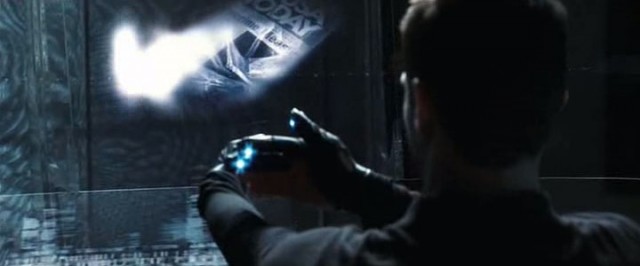
Dissenting Opinion (2002)
Even more unnatural seems to him the idea of changing the position of a three-dimensional object by clicking on it with one hand and turning with the other - Christian points to Microsoft's vision of Productivity Future Vision as a much more logical example of working with objects in space, and hopes that one day the day will come, when the filmmakers cease to confuse work with a computer and conducting an orchestra.
The next related article is material from Smashing Magazine dated March 1, 2013. Its author, Christopher Noessel, analyzed the “Minute Opinion Interface” and made two important conclusions that are worth mentioning:
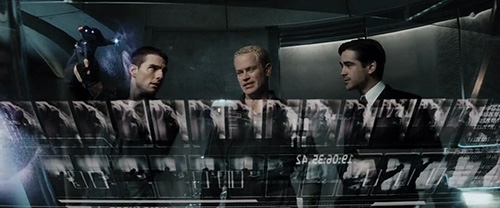
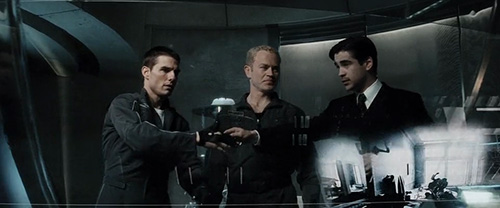
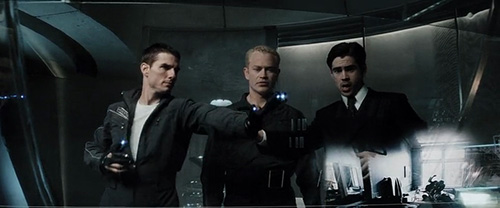
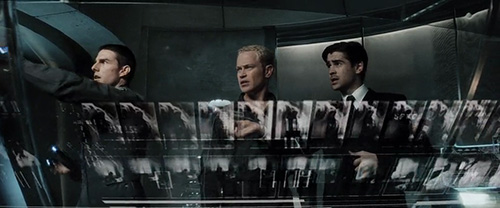
4 fragments from the film “Minority Opinion” (2002)
This moment makes Christopher note that such a system should definitely provide for various operating modes: a mode where user actions are significant for the system and when they are insignificant.
In addition, Christopher chose the seven most widespread gestures used in various futuristic movie interfaces.
Christopher emphasizes that this list is incomplete, which presents great prospects for further analysis of other examples. And he notes that one of the most important things here is the following: “Interfaces using gestures are attractive and allow you to quickly interact with virtual objects in a“ real ”format, but outside the framework of basic examples of manipulating objects, gestures are complex, ineffective and difficult to remember. For more abstract requests, designers should offer alternative ways of interacting, such as voice input. ”
That's all. In addition to all the materials mentioned above, I will add a link to the latest works of Joseph Kosinski and Crater Lake Productions for the film Oblivion, an interview with Sean Yue(Shaun Yue), who participated in the creation of interfaces for Prometheus and 007: Skyfall coordinates, and even more interfaces from Iron Man.
In the first episode, I would like to welcome all those who are not indifferent to the themes of UI and UX. I will gladly take into account your comments, suggestions and reviews on the show. So, after we have finished with the introductory part, we can proceed to the main topic of today's release. Preparing for the show, I thought about what thoughts are visited by everyone who starts the implementation of a new project - you decide which way it will develop, you try to look into the future and understand what this or that aspect of your work will result in, ask yourself new goals. In my opinion, it is very important not to lose the overall picture of what is happening, a picture that extends far into the future and allows you to combine your knowledge, as well as the experience of colleagues and predecessors, in order to set the right goals for the project, clear and doable.
Therefore, in this issue of the show, I decided to talk about futuristic interfaces (FUI, Futuristic User Interface). I mean the interfaces that we see in the movies, which we read about and that we come up with. I am convinced that, despite the groundless talk about the practical applicability of futuristic interfaces, it is they that inspire us, if we consider the issue not from the point of view of a specific story or its characters, but from the point of view of elements that support the plot, determine its kind of technological appeal and conquer our imagination is the imagination of today's users.
No, I will not make a selection of all Wikipedia-style materials that are relevant to the topic. On the contrary, I will ask introductory topics in order to arouse your interest in this issue and draw some necessary conclusions. I am going to share my own, maybe amateurish opinion and look at the industry of futuristic interfaces. I call it industry, since a huge number of user interface options were created not only during the development of information technology, but also during the development of film production. An indirect confirmation of this can be the fact that when you try to find information about futuristic interfaces on the Internet, you will most likely come across a lot of collections of video clips, screenshots and UI mockups from various blockbusters.
One of these collections is Access Main Computer File , a blog with endless scrolling of screenshots from the films Alien (1979), Moon 2112 (2009), Me, Robot (2004), Minority Report (2002) and a series films about Iron Man. The creators of the blog talk about their selection as a study of computer user interfaces in the cinema.
Ronin (1998)
A similar collection of images is available on the Barnorama blog .
However, it’s interesting to follow the evolutionary steps of futuristic interfaces, and the Noteloop website can help ., the creators of which have collected, in my opinion, one of the best libraries of what can be called fantastic / fictional / nonexistent interfaces from popular films and television shows. Most of them are not real programs, but animations that are played on screens at the right time of shooting or added later during installation. Typically, this kind of animation is created in Adobe Illustrator, Adobe After Effects, and Maxon Cinema 4D. So Noteloop's Kit FUI is a database of interfaces like IMDb. However, the guys who made it included not only popular films and TV shows, but also ads, video concepts, short films, as well as information about the designers who came up with all this.
Continuum (TV series 2012)
These kinds of blogs can help keep track of the history of the development of futuristic interfaces, freshen up memories of a particular concept, or even decide on the closest movie for evening viewing. They are good for exploring the topic, although the creators of such resources prefer not to delve into a detailed analysis of an interface. But what attracts people to futuristic interfaces, what makes people invent them? What allows them to overcome all difficulties and at an enviable speed create new interfaces for a growing number of high-tech blockbusters?
In the journal Pushing Pixels, I found an interesting interview with Jace Hansen(Jayse Hansen), who talks about the work of the creator of graphics for screens and user interfaces in movies. The article dates back to the first of June 2012, but has not lost its relevance and now - from the designer who came up with the interface for the Iron Man helmet, you can find out a lot of interesting things. I like these articles because they make it possible to understand what drives a person and how Jace, whose childhood imagination was struck by episodes from Star Wars and Back to the Future, eventually became an expert in such large-scale projects as Iron Man.
Iron Man 2 (2010)
The interview allows you to take a deeper look at the process of creating FUI - after all, Jace took part in the work on many interfaces for the heroes of high-tech blockbusters, starting with ideas and sketches and ending with stunning graphics. He should be trusted, if only because there are relatively few specialists of this kind and level in the cinema. It is he who conducts basic research before starting work, which are based on a general description of the picture or part of the script. In particular, work on the painting “Rise of the Planet of the Apes” required Jace to create a PDF portfolio for about 20 different script items. So in the profession of creating futuristic interfaces, there is time for serious paper work.
Materials for the preparation of "Rise of the Planet of the Apes" (2011)
However, the development of futuristic interfaces is closely involved not only in the film industry, but also in the largest IT companies. Among these concepts: Apple's iLens , the EEG of brainwaves , the future productivity of the vision (Productivity Future Vision) from Microsoft, the future of shopping from Cisco and offers from Mobile "oldies" - experiment TAT the Open Innovation, the OmniTouch , the Samsung Flexible AMOLED , the BlackBerry Empathy , the Mozilla Seabird Mobile Phone , as well as several recent (July 2013) Interactive Air Screen demos:
Returning to the films: there is one picture among the high-tech blockbusters that cannot be ignored in the conversation about futuristic interfaces. This, of course, is a “dissenting opinion”. I found a good article by Christian Brown on February 25, 2013 about her , where the author criticizes the user interface from the movie.
The film “Special Opinion” was released in 2002, when the technology of touchscreens already existed, but the main task was to create practical, user-friendly products for this technology. In his article, Christian talks to readers about a galaxy of technical experts and futurists who developed the world of 2054 for Spielberg’s film, based on what was new breakthrough technology in 2002. So what? Was this knowledge used in UI design? Most likely not, since Christian calls many of the interfaces ridiculous. He talks about those moments when, for example, to enlarge an object, you need to place one hand in front of the other, or about a situation where, when shaking hands, all files fall into a corner. Christian calls it absurd.
Dissenting Opinion (2002)
Even more unnatural seems to him the idea of changing the position of a three-dimensional object by clicking on it with one hand and turning with the other - Christian points to Microsoft's vision of Productivity Future Vision as a much more logical example of working with objects in space, and hopes that one day the day will come, when the filmmakers cease to confuse work with a computer and conducting an orchestra.
The next related article is material from Smashing Magazine dated March 1, 2013. Its author, Christopher Noessel, analyzed the “Minute Opinion Interface” and made two important conclusions that are worth mentioning:
- Conclusion 1. A good demonstration can hide many shortcomings. Of course, everyone knows that Tom Cruise needed long breaks between filming scenes with a computer interface, since they were physically exhausting. Such breaks were extremely useful, although they did not reflect the real state of things - which shows how an ineffective solution can be successfully demonstrated by omitting some details.
- Conclusion 2. An interface using gestures should take into account the user's goals. This again refers to the very moment when Anderton breaks away from work to shake hands with Whitver. The computer perceives the gesture of Anderton, as a team, and almost destroys all his work.
4 fragments from the film “Minority Opinion” (2002)
This moment makes Christopher note that such a system should definitely provide for various operating modes: a mode where user actions are significant for the system and when they are insignificant.
In addition, Christopher chose the seven most widespread gestures used in various futuristic movie interfaces.
- Swipe to activate. In the film “The day the Earth stopped”, to activate the spacecraft’s interface, you just had to hold your palm in front of the translucent activation panel, and in “Johnny Mnemonic” to open the water in the bathroom, you had to hold your hand.

Johnny Mnemonic (1995) - Push to move. We saw this in “Separate Opinion” and again noticed in “Iron Man 2”, for example, at the moment where Tony moves his father’s theme park projection.
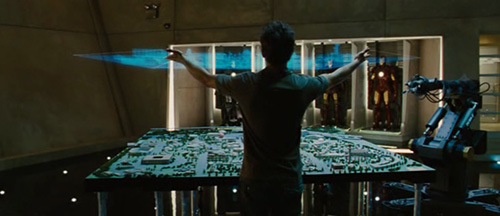
Iron Man 2 (2010) - Turn to turn. We saw this in the episode “Ariel” from the series “Firefly” in 2002.
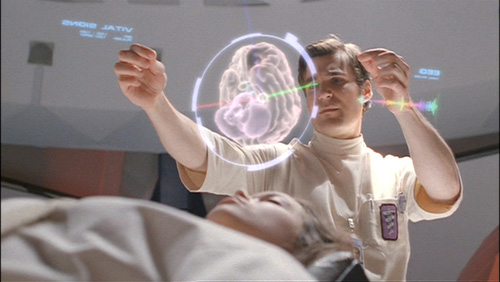
“Firefly” (TV series, 2002) - Swipe to cancel. In “Johnny Mnemonics”, by energetically waving the back of the hand up, the video call could be canceled, and in “Iron Man 2”, the movement “swiping from right to left”, Tony eliminated uninteresting images.

Johnny Mnemonic (1995) - Point or touch to select. In District 9, Christopher Johnson selected items on the volumetric display by touching them.
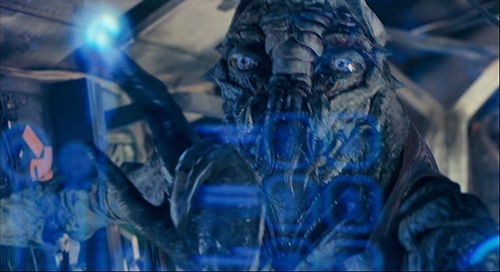
"District No. 9" (2009) - Open your palm to shoot. So there was an energy bundle from the palms of the Syndrome from the Incredibles and similar bundles of energy from the palms of Iron Man.
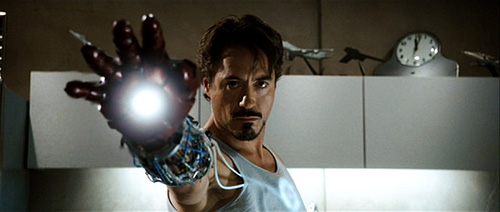
Iron Man 2 (2010) - Squeeze or spread your fingers to scale. Both of these are used by Tony Stark, examining the models in the second Iron Man.
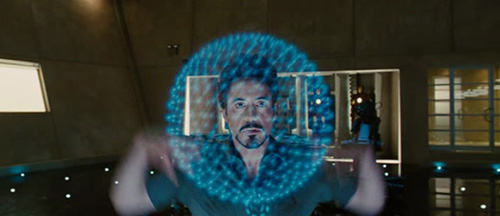
Iron Man 2 (2010)
Christopher emphasizes that this list is incomplete, which presents great prospects for further analysis of other examples. And he notes that one of the most important things here is the following: “Interfaces using gestures are attractive and allow you to quickly interact with virtual objects in a“ real ”format, but outside the framework of basic examples of manipulating objects, gestures are complex, ineffective and difficult to remember. For more abstract requests, designers should offer alternative ways of interacting, such as voice input. ”
That's all. In addition to all the materials mentioned above, I will add a link to the latest works of Joseph Kosinski and Crater Lake Productions for the film Oblivion, an interview with Sean Yue(Shaun Yue), who participated in the creation of interfaces for Prometheus and 007: Skyfall coordinates, and even more interfaces from Iron Man.