July 26, 2013 at 19:21
Slingatron Project: Launching Cargo into Space Without Rocket Engines
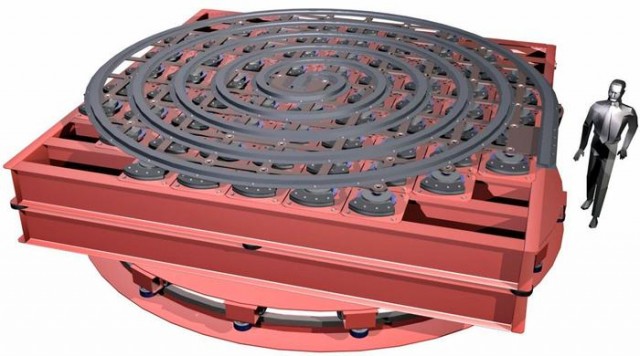
From the beginning of space exploration, rocket engines were the basis of the space program, but they were not the only way that was tried along the way. Since the 50s of the last century, the American government has tested several ideas in this direction, from the space gun, tests of which took place in the 1960s, to the ideas of using a launch loop and a space elevator. When trying to implement most of these ideas encountered significant technical difficulties or were postponed for political reasons. But one team of scientists, hoping for the help of Kickstarter, expects to achieve those goals that turned out to be too tough for government structures.
The idea of the Slingatron project, like many other ideas, is theoretically workable. The idea is simple: rotating an object around a fixed point is the easiest way to achieve high speed without excessive energy consumption. There are two ways to build a classic slingatron: you can vary the speed of rotation, keeping the path length unchanged, or you can change the length of the path, but keep the speed of rotation constant. In both cases, the “thread” for launching will be broken long before the projectile reaches its first space velocity.
The idea of a slingatron is simple - do not spin the “thread” itself, but rotate the entire launch pad. It is hard enough to explain, but an analogy can help us in this case. Imagine you want to stir a cup of coffee. You can do this with a spoon or rotate the cup itself also quickly. Centrifugal force will rotate the fluid around the walls of the cup, thoroughly mixing coffee with minimal energy use.
Company HyperV Technologies' Corp , which wants to raise money for the project through a Kickstarter, has already built a prototype, which they claim has launched about 200 gram projectile at a speed of 100 meters per second. The purpose of the study is not to create a full-sized model of a slingatron, but to demonstrate a model that can launch a projectile weighing 400 grams at a speed of 1 km per second. Although this speed is not enough to launch a projectile into Earth orbit, it will be a significant step forward to future research.
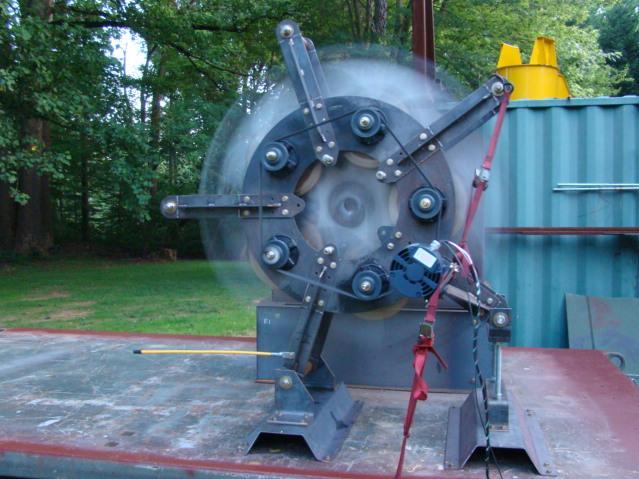
You should not expect too much from this project, even if it is successfully implemented. Unlike rocket ships, a slingatron cannot be used to launch people into orbit or to launch large loads. But this method could be used to put into orbit small cargoes for astronauts - water, food or equipment that will not fail due to increased load at launch. But when using missiles, a significant part of them is lost. The Slingatron would not have such losses and could throw loads of 10 kg into orbit literally every day.
The team hopes to raise $ 250,000 and build a prototype that can reach speeds of 2 km / s in the future. Prototype ( if money is collected), will be in the form of a horizontal model with a diameter of 5 meters. It will allow you to test the idea in practice and give an answer whether it is possible to use such a system in real conditions with a payload.
Transfer.
Source code - http://www.extremetech.com/extreme/162252-slingatron-project-aims-to-prototype-new-space-launch-system
Slingatron project on Kickstarter .