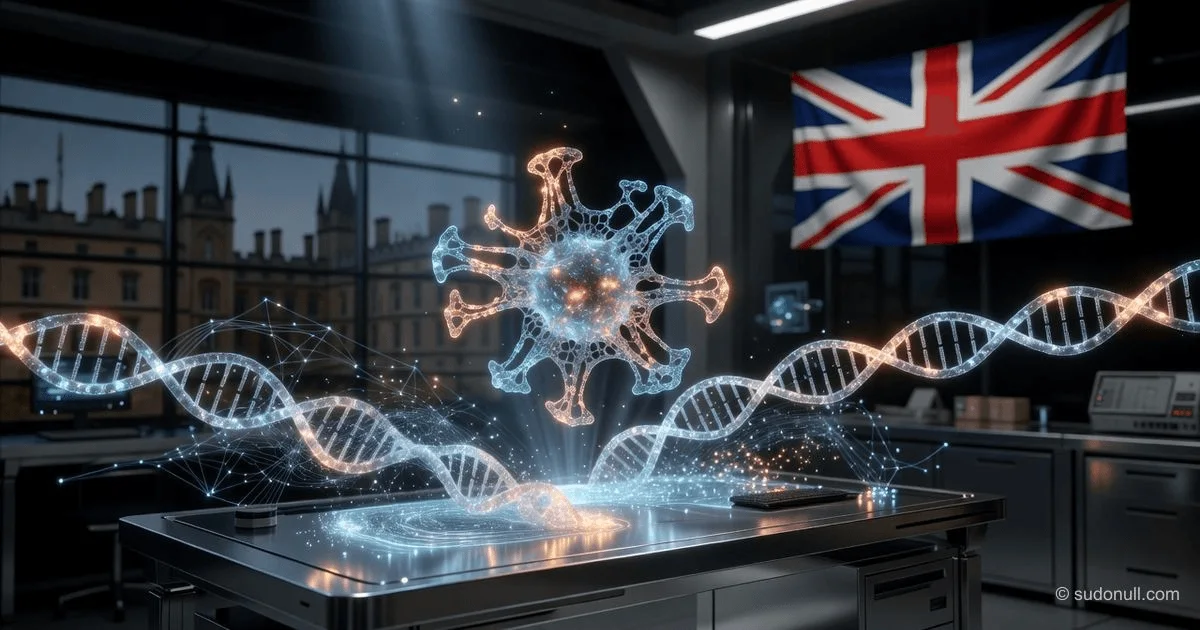
UK and Cambridge create AI-designed next-generation coronavirus vaccine
British scientists from the University of Cambridge and its spin-off company DIOSynVax have presented a vaccine developed using artificial intelligence technologies. Results from the first phase of clinical trials, published in the Journal of Infection, showed good tolerability and no significant side effects for the new drug.
Insight beyond the hype: Analysis of the DIOSynVax vaccine — $42 million for 15 years of silence
While everyone is discussing the $32 billion valuation of Safe Superintelligence and Nvidia CEO's visits to Korea, something far more threatening to viruses than any antiseptic has happened in Cambridge. On June 5, 2026, the results of the first phase of trials for the pEVAC-PS vaccine were published in the Journal of Infection. This is the world's first vaccine whose active component was designed by artificial intelligence — and it has already been tested on humans.
The result on paper looks modest: "safe and tolerable" in 39 volunteers aged 18 to 50. The immune response was called "modest." But behind this modesty lies a tectonic shift in vaccinology. And the fact that mainstream media missed it only proves that real breakthroughs happen where there is neither RGB lighting nor Elon Musk's TikTok lifestyle.
The essence: what is really happening
Professor Jonathan Heeney's team at the University of Cambridge didn't just "create a vaccine." They broke a fundamental principle of vaccinology that had held for 200 years — the principle of "reactivity," i.e., chasing an existing virus.
Traditional vaccination is a game of cat and mouse. You take a circulating strain, inactivate it or its spike protein, and inject it into a person. By the time you've done that, the virus has already mutated. The result: annual boosters, constant reformulation, and a vaccine that is always slightly outdated. You know that feeling when you buy a smartphone and a new model comes out a month later? Same here, only the stakes are lives.
What did Heeney and his spin-off DIOSynVax do? They fed the AI genetic sequences not of one virus, but of an entire family of Sarbecoviruses — SARS-CoV-2, the 2003 SARS virus, plus dozens of bat coronaviruses that haven't yet jumped to humans but could at any moment. Machine learning analyzed the genomes and found common conserved regions — those parts of the virus that cannot mutate without fatal consequences for itself. From these regions, the AI constructed a synthetic "superantigen" pEVAC-PS, which trains the immune system to attack not a specific spike, but the unkillable foundation of the entire family.
The difference between a traditional vaccine and this one? It's like the difference between a guard who memorizes one criminal's face and a detective who collects indelible DNA traces — even after the tenth plastic surgery.
Timeline and context
This story began long before COVID. And that's what almost all sensational headlines miss.
| Year/Period | Event |
|---|---|
| 2017 | Heeney founds DIOSynVax (Digital Immune Optimised Synthetic Vaccines) with support from Cambridge Enterprise. Goal: hemorrhagic fevers and a universal flu vaccine funded by the Bill & Melinda Gates Foundation |
| January 2020 | On January 12, China publishes the genetic sequence of SARS-CoV-2. "It was a Sunday, but I started work immediately," Heeney recalls |
| March 2022 | CEPI awards DIOSynVax $42 million for a universal beta-coronavirus vaccine |
| December 2021 – September 2023 | Phase 1 in 39 volunteers in Southampton and Cambridge |
| June 2026 | Publication of results in the Journal of Infection |
Why is this important right now? Because the world has been distracted from pandemics. Everyone is looking at AI and quantum computers. Meanwhile, H5N1 (bird flu) is quietly mutating. Heeney and his team are already working on a universal flu vaccine that could make annual shots unnecessary, and an Ebola vaccine — including strains for which no commercial drugs currently exist.
Who wins and who loses
The UK wins. This is not just science — it's national branding. Science Minister Lord Vallance has already called it "another British success story." Unlike the mRNA vaccines from Pfizer/BioNTech and Moderna, where patent wars are still ongoing, DIOSynVax's technology is British-owned. Cambridge is becoming the global center of AI vaccinology, attracting talent and investment from the US.
CEPI and the Bill Gates Foundation win. They invested tens of millions when almost no one believed in "universal vaccines." Now they have proof of concept: AI can create antigens for entire virus families.
Developers of needle-free systems win. The vaccine was administered using the PharmaJet Tropis device — a micro-jet injector without a needle. Faster, safer, no needle phobia.
Producers of "seasonal" vaccines lose (Sanofi, Seqirus). Their business is annual flu vaccine updates. If DIOSynVax's technology reaches flu (and Heeney is already working on it with Gates' support), the "annual booster" model will collapse. Instead of a billion doses a year — one dose every 3-5 years. That's tens of billions of dollars in lost revenue.
What the media isn't telling you
Here's the main point. What is completely ignored in the public sphere.
The media is silent about the fact that the regulatory system is not ready for such a vaccine. Classic regulators (FDA, EMA, MHRA) are set up for the old scheme: you show the composition, you show how it works on a specific strain. But what do you show when your vaccine is designed for viruses that don't yet exist? How do you prove efficacy against a non-existent threat?
That's why the Phase 1 results were only published now, even though the trials ended in September 2023. Two and a half years were spent on regulatory approvals — to prove that the "modest immune response" against existing strains is sufficient for extrapolation to future ones. This isn't "bureaucracy," as newspapers write. It's a legal system struggling to keep up with technology.
Second nuance: price. DIOSynVax received tens of millions from CEPI and Innovate UK — public money. But when the technology is commercialized, who will set the price for a universal vaccine? Under CEPI's terms, DIOSynVax committed to ensuring equitable access. But what does that mean in practice? Free for poor countries? $10 per dose for the US? The battle over price will begin in Phase 3.
Third nuance: the "modest" immune response. The researchers honestly admit: the response is modest. The vaccine works, but not as strongly as desired. For a universal antigen, this is expected — you pay for breadth of coverage with reduced response strength against each specific strain. The question: will this "modest" response be enough to protect the elderly and immunocompromised? Phase 2 with 200 participants will provide the answer.
Forecast: next 30 days and 90 days
30 days:
- Investment interest in DIOSynVax. The company, which since 2017 has lived on grants with a staff of 1-2 dozen people, will receive venture round offers. Valuation? Based on AI-bio analogs — $500 million to $1 billion. Main contenders: Andreessen Horowitz (US) and aMoon (Israel).
- Negotiations with MHRA and EMA on Phase 2 design. Main dispute: which endpoints to choose? Regulators will demand demonstration of neutralizing response against real SARS-CoV-2 strains. DIOSynVax will insist on tests against lab-created "future" strains. A compromise will prevail.
- Announcement on a universal flu vaccine. Heeney, capitalizing on the moment, will announce the status of his "flu" program. Most likely — the start of preclinical trials in ferrets (the gold standard for flu).
90 days (September 2026):
- Launch of Phase 2. Expected enrollment of 150-300 volunteers in the UK and possibly one African country. Phase 2 will take 12-18 months. Approval by 2028-2029, just in time for the next possible pandemic peak.
- Partnership with a major manufacturer. DIOSynVax lacks capacity for hundreds of millions of doses. They will sign an agreement with someone from "big pharma" — most likely GSK (British choice) or the Serum Institute of India (world's largest by volume). Amount: $200-500 million for technology licensing in Asia and Africa.
- Political reaction in the US. HHS will announce $100-150 million for similar AI-designed universal vaccine programs domestically through BARDA. Americans cannot afford to let a key pandemic preparedness technology remain exclusively British. An AI vaccine race between Cambridge and Boston will begin.
Conclusion for a strategist
pEVAC-PS is not "just another COVID vaccine." The pandemic is over, the booster market is shrinking. This is a technology platform that changes the paradigm itself: from "responding to a threat" to "preemptive protection."
For an investor: betting on DIOSynVax is betting that the next pandemic will happen. And it will come from a virus family for which we already have a vaccine prototype. This is insurance, not "quick money." But if a pandemic starts (and with H5N1 and climate change, it's a matter of "when," not "if"), Cambridge's technology will become the most valuable intellectual property on the planet. And you know what? It works.
For competitors (Pfizer, Moderna): you have 2-3 years to build your own AI platforms for universal antigen design. Otherwise, you'll become generic manufacturers for DIOSynVax's technology. The war for the next pandemic has already begun. And the first shots were fired on June 5, 2026, in the Journal of Infection. Quiet, modest, almost unnoticed against the noise around LLMs. But they were fired.
— Editorial Team








No comments yet.