July 30, 2013 at 10:20
Colossus on feet of clay. Principles of managing a fast-paced gaming studio

It often happens, it would seem: a close-knit team of professionals, a strong and high-quality product on the way, a thick investment pillow of financial security, and something is wrong. Moreover, with each week of these "something" is becoming more and more. Employees are nervous, a huge amount of work takes place in overtime mode, constant failures in internal communications, the search for responsible and guilty - victory has many fathers, defeat is always an orphan. Such a destructive scenario for the development of the studio is a slow but sure path to the completion of its activities. But we didn’t just get together a few months ago?
A large number of start-ups "go out of the way" precisely because of the fact that at some point they cannot correctly plan and control their scaling. Any organization is like a living organism. The lack of development directly indicates a slow but sure dying. The paradox is that rapid and uncontrolled growth can lead to the opposite of the desired result. After a while, the company becomes a colossus on clay feet. The feeling that everything can collapse from the slightest blow of the breeze, changes in market conditions or any other global processes of optimism does not add. Nervousness, stress, squabbles, a drop in productivity as a result.
In this article we will try to describe our experience in overcoming this kind of situation. It was damn difficult, but we did it.
History
Room 8 appeared in the spring of 2012. Classics of the genre. A huge desire to create games for mobile devices rallied several like-minded people, each of whom had absolutely no experience related to the industry in which the newly created company was going to carry out its activities.
The business model involved the construction of a full-fledged game development studio. The plans were to produce 5-6 high-quality games a year. The rapid growth of the mobile games industry inspired hope that the main risks are balanced, and the potential for further growth and development is high. Together, both of these factors attracted the attention of VostokVentures venture company and Room 8 studio agreed on investment support.
After receiving the investment, the studio begins to grow rapidly. The departments of development, testing, design, game design and marketing are significantly strengthened. In just two months, the staff grows from 7 to 30 people. After another three months, the studio has 60 employees. Five months after its founding, the company was a motley bouquet of a motley team with a huge number of newly identified problems.
Fires
As we mentioned above, rapid growth has led to a number of global problems, each of which one or another employee tried in vain to solve alone. In addition to the (solvable) problems with development, management issues also “burned”. Historically, the project management function was assigned to GameDesigner, who had to combine it with his main activity - product development in terms of game design. The coordinating actions of the group of founders were hindered by coherence, lack of experience and inability to manage each other's expectations. All this was aggravated by congestion in overtime and communication problems. At that time, the organizational structure looked something like this:
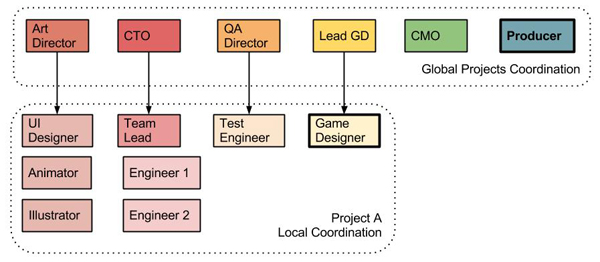
A typical picture for one project
Let's try to figure out the shortcomings of such a structure:
- Authority and responsibility. On the one hand, the game designer has a personal responsibility for the game being created. On the other hand, directors also have the authority to manage project team members. In practice, it turns out that the freedom of decision-making in a gamediz is limited. This state of affairs leads to a blur of responsibility - sooner or later one of the directors was involved in any “heated” discussions.
- Availability and communication. The scheme is also complicated because a large number of people are involved in project management, many of whom are involved in several projects at once.
- Conflict of interest. The game designer combined product responsibility (you need to create the best product!) And project responsibility (constantly searching for optimal ways to create a product). Thus, the game designer was in a permanent state of internal contradiction. On the one hand, quality and a sense of beauty, and on the other - terms, deadlines and profitability.
- Mistakes in prioritization. A rapidly growing structure is difficult to manage. Often, multidirectional pressure on the game designer gradually led him to conflicting decisions. The way the game designer imagined the product often differed from the worldview of other project participants. Hence communication failures, conflicts and a huge amount of negative feedback.
It should be noted that one characteristic feature of the (albeit rapidly growing) startup did play on our side. We mean flexibility. Yes, it took almost six months to repair and update the company’s structure. Yes, I had to overcome the problems of its participants. Negotiate, compromise, and negotiate again. But at the moment we are much more like a streamlined and holistic mechanism working on agile principles than a couple of hundred days ago. I would like to believe that all the perturbations of the last six months will allow us to produce even better products. But first things first.
How we put out the fire
As a participant in a process, it is extremely difficult to influence its principles and its logic. The risk of self-management changes is very great. If from the very beginning the management of the company made mistakes in the organization of the management system, then where is the guarantee that having done a great and serious work on the errors, we will not get a similar result?
To reduce this risk, we took a step atypical for many domestic startups. Namely, a man from outside was invited. The knowledge of the principles of building a control system in conjunction with the position of this specialist “above” processes inspired certain hopes. We were completely open to any ideas and suggestions, and these ideas were voiced. In fact, we invested in strengthening our own organization, and after utilizing the startup enthusiasm, the studio opened its second wind.
Who is this person from the outside?
There is a misconception that venture companies do not give startups anything but money. This is not at all true, if only because money does not “give” but “invest”. Our "business angels", of course, were completely not interested in us bending over after some time. Expert advice, contact details of possible business consultants, moral support - all this we received in full from our venture investor.
What have we done?
We started from above - with the Board of Directors. Priorities were identified in the importance of a project, the volumes of resources that we are ready to direct were reviewed. In the picture it looks something like this:
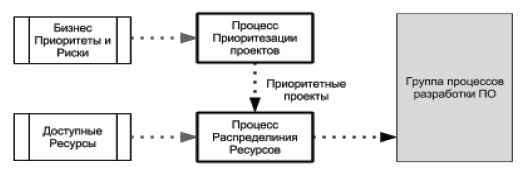
Priorities of projects were determined depending on the prospects. Naturally, everything may not be the most important. Occam’s razor is a simple question: “if we have the ability to make only one game, which one will we choose for development?” The choice, it should be noted, is so-so. Which of my children will have dinner tonight? Tough, not comfortable, but necessary.
Resource allocation.After a complex arrangement of emphasis among existing projects, there was a distribution of resources. It is clear that more important projects should receive the strongest people in the team and, of course, more attention. After the introduction of this simple principle, the constant practice of daily redistribution of personnel ended. Everyone clutched not for the most important project, but for the one that burned brighter than everyone.
After putting the order “above”, the next step was the introduction of SCRUM . As part of the first wave, we introduced only some elements of this system. Those elements that should have led to the desired result as quickly as possible. These are daily standups and iteration demo.
Daily Standups.Every day the project team gathered, and each answered three simple questions: What did you do yesterday? (pride) What problems did you encounter? (request for help) What will you do today? (promise) This simple innovation helped teams increase communication efficiency. The Scrum Board may not have taken root right away, but stand-ups have significantly increased coordination and understanding of the project. For example, suddenly it came to the realization that you could find out about the time lag not on Friday evening, but on Tuesday morning.
Iteration democlearly demonstrates the state of the stages and components of the product being developed. The introduction of this element allowed us to establish communication at the level of team - leadership. Involvement in the project and awareness of its condition significantly increased transparency and, thereby, reduced overall nervousness.
Why do problems arise again?
After the first three months of the studio, we found that often already resolved problems reappear. Moreover, similar problems could arise both for the same people and for different projects. The reason turned out to be quite trivial: torn attention to a particular project hindered the development of each of them. Although a small but unplanned pause in the development of the project is a clear step back.
Finding a tool that would support the process of continuous development did not take much time. First of all, we wanted to go to a different level of planning. We decided to test the practice of iterative quality assurance of the functioning of the company. It looks like this:
1.The group of directors develops a set of quality criteria for each department (engineering, testing, art, game design), compliance with which, by default, determines the whole process of work quality and effective. The criteria might look something like this:
Engineering: Coding Style, Code Review, Refactoring
Testing: Co-Location with Engineering team, Test Cases, Defect Metrics, Feature Metrics
Art: design repository ... etc.
2. Then, once a month, the process of evaluating each project according to the developed criteria passes. Qualitatively numerical metrics look something like this:

Or like this, if you are interested in the details:

3.Further, the department heads analyze the resulting picture of reality. First of all, red zones in problematic projects. The analysis should provide answers to two main questions: why this happened and what needs to be done to change the picture for the next meeting.
4. After 1-2 months, the picture describing what is happening stabilizes. That is, almost all project components are gradually moving into the green zone. This does not mean that everything will be fine now (the project is developing!), It’s just the time to develop new criteria and repeat steps 1-3, actually driving the projects into the red zone.
The meaning of this tool is not that the schedule is always green, but that the company develops without any “kicks” from the side, using only internal resources.
How not to overdo it with business analysis
There was an attempt to improve the situation with project management by implementing the SCRUM system. But the more we “pressed” on this system, the worse it became with game design. And vice versa, when the game design turned out, the compliance with SCRUM principles sagged. As a result of a small analysis, the main reason for the SCRUM vs GameDesign conflict was revealed - it turned out to be the same internal conflict of interest for an employee who combined the functions of a project manager and a game designer. The only way, as we decided, is to change the organizational structure. In particular, all managerial functions were removed from game designers by a strong-willed decision - let them do what they do best, we thought. But should someone manage the project? For management, a new role has been introduced into each project - the project coordinator.
As a result, we got this structure:

Conclusion We invented Lean Management
Having overcome the path of SCRUM implementation, we found solutions to all those problems that the company faced a year ago. Moreover, difficulties arose not only in the process of overcoming, but also in questions of choosing the direction of movement. Naturally, we are fully aware that the development of the company is a continuous thing. You can’t wake up once, say: “That's it. My company has developed. ” We understand that we have to go countless ways and forks, but, as they say, "The road will be overpowered by the one walking." We will continue to search for new problems, formulate their descriptions, look for methods to solve them and improve everything that is not improved.
The answer to the question in what condition the company is, lies not in assessing the ideality of the processes, but in the ability to quickly change them in the context of the changing situation in the industry and the market as a whole. It will not work otherwise. You need to constantly search and find something that helps not only startups survive, but also turn them into a modern, young in spirit and effective business.