April 20, 2013 at 09:19
A gadget that uses brain waves to block phone calls
I would like to have such a “mentally activated” gadget that, knowing that I am very busy, will ask you to call me back later, and not distract me in moments of concentration.
I’m in a hurry to share the news that such a gadget will appear soon! Here's a translation of a recent Business Week article on a prototype created during the AT&T Hackathon and won a top prize of $ 30,000.
Neurologist and former software engineer Ruggiero Scorzioni was often distracted by incoming calls when he worked. “If I code or ponder scientific research, then distracting phone calls make it difficult to move to a concentrated state of the brain,” says 42-year-old Skorzioni. "Maybe you have a great idea, but it can slip away."
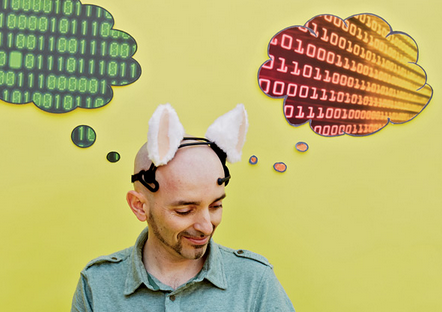
In January 2013, Skorzioni took part in the hackathon for the development of mobile applications from AT&T. His idea was born after a gift was given to the contestants: a headset with cat ears created by Neuro-wear with sensors that monitor the owner’s brain activity and raise motorized fluffy ears during periods of high brain activity. Skorzioni, who had just completed an internship at the Neuroscience Institute in La Hoya, California, decided to hack this headset by creating a gadget to block incoming calls when the user is in a high degree of concentration.
The result was a working prototype of the Good Times gadget, which analyzes, in real time, the data of brain waves coming from the headset, and then sends commands to the AT&T telephone network to allow or block phone calls. Blocked calls are redirected to an automatic message asking them to call later. After spending 26 hours, he worked until the last minute of the hackathon, leaving himself only two hours to sleep and shower. Skorzioni describes the application as a “MENTALLY ACTIVATED” sign “DO NOT DISTURB.
A well-made prototype won the AT&T Hackathon's top prize of $ 30,000. “It looks simple, but what he did is actually quite complicated,” says Abi Ingle, vice president of ecosystem and innovation at AT&T, noting that the project requires the integration of several interfaces. The neurologist used his prize money to create a personal startup, Brainyno, and in the past few months has coded a beta version of the Good Times app. “There is a big potential market for this kind of application,” says Chris Bregler, professor at New York University of Computer Science, although he claims the brain-computer interface technology is still in its infancy.
Skorzioni, who grew up in the small town of Serramazzoni in Italy, spent several years programming for companies such as IBM before starting to study neurology at the age of 29. He became obsessed with brain secrets after his grandmother was diagnosed with Alzheimer's. While working on his degree at George Mason University, he helped develop a computer program that shows how brain cells change shape as a result of injuries or illnesses.
Skorzioni plans to sell the Good Times application to corporate clients, but has not yet decided on a market entry date. At the moment, he is looking for investors and is completing the application. He added a feature that allows users to see a representation of their brain waves. By the time it enters the market, he said, the application will recognize levels of brain concentration at which users would like to block incoming phone calls. He says email filtering is the next logical step. “I think that in the end everyone will wear such a gadget,” says Scorzioni, holding a headset with cat ears, “but of course it won’t look as stupid as this headset.”
Problem : Unwanted phone calls can be distracting at crucial moments.
Solution : Brainwave headset and call filtering software
Funding : AT&T Hackathon $ 30,000 top prize.
I’m in a hurry to share the news that such a gadget will appear soon! Here's a translation of a recent Business Week article on a prototype created during the AT&T Hackathon and won a top prize of $ 30,000.
Neurologist and former software engineer Ruggiero Scorzioni was often distracted by incoming calls when he worked. “If I code or ponder scientific research, then distracting phone calls make it difficult to move to a concentrated state of the brain,” says 42-year-old Skorzioni. "Maybe you have a great idea, but it can slip away."
In January 2013, Skorzioni took part in the hackathon for the development of mobile applications from AT&T. His idea was born after a gift was given to the contestants: a headset with cat ears created by Neuro-wear with sensors that monitor the owner’s brain activity and raise motorized fluffy ears during periods of high brain activity. Skorzioni, who had just completed an internship at the Neuroscience Institute in La Hoya, California, decided to hack this headset by creating a gadget to block incoming calls when the user is in a high degree of concentration.
The result was a working prototype of the Good Times gadget, which analyzes, in real time, the data of brain waves coming from the headset, and then sends commands to the AT&T telephone network to allow or block phone calls. Blocked calls are redirected to an automatic message asking them to call later. After spending 26 hours, he worked until the last minute of the hackathon, leaving himself only two hours to sleep and shower. Skorzioni describes the application as a “MENTALLY ACTIVATED” sign “DO NOT DISTURB.
A well-made prototype won the AT&T Hackathon's top prize of $ 30,000. “It looks simple, but what he did is actually quite complicated,” says Abi Ingle, vice president of ecosystem and innovation at AT&T, noting that the project requires the integration of several interfaces. The neurologist used his prize money to create a personal startup, Brainyno, and in the past few months has coded a beta version of the Good Times app. “There is a big potential market for this kind of application,” says Chris Bregler, professor at New York University of Computer Science, although he claims the brain-computer interface technology is still in its infancy.
Skorzioni, who grew up in the small town of Serramazzoni in Italy, spent several years programming for companies such as IBM before starting to study neurology at the age of 29. He became obsessed with brain secrets after his grandmother was diagnosed with Alzheimer's. While working on his degree at George Mason University, he helped develop a computer program that shows how brain cells change shape as a result of injuries or illnesses.
Skorzioni plans to sell the Good Times application to corporate clients, but has not yet decided on a market entry date. At the moment, he is looking for investors and is completing the application. He added a feature that allows users to see a representation of their brain waves. By the time it enters the market, he said, the application will recognize levels of brain concentration at which users would like to block incoming phone calls. He says email filtering is the next logical step. “I think that in the end everyone will wear such a gadget,” says Scorzioni, holding a headset with cat ears, “but of course it won’t look as stupid as this headset.”
Problem : Unwanted phone calls can be distracting at crucial moments.
Solution : Brainwave headset and call filtering software
Funding : AT&T Hackathon $ 30,000 top prize.