November 28, 2012 at 19:07
Localization of VN on the example of Hoshizora no Memoria
- Tutorial
Just don’t say that geeks don’t read VN. So, there is one visual card (profile on vndb) .
Very good, by the way, a rating of 8.06, I advise you to read to those who do not mind a certain amount of hentai.
Well, in general, not about this article.
There is an English patch, there is Chinese. There is no Russian. Not fair. Let's try to fix it.
You will need:
Let's start a new game, see the first sentence - "俺 は 彼女 が 好 き だ っ た" . In the English version - "I liked her . " Remember, this is still useful to us. Close the game, go to the folder. We see there a couple of suspicious files - “Memoria.hcb” and “MemoriaEN.hcb”, respectively. Let's start with the first one. We open with the hex editor, we see the first 4 bytes. On something very similar. We check with ..En.hcb , and make sure that this is nothing but the file size minus 2029 bytes in Big Endian. The last 2029 bytes is occupied by the code that is called when the game is closed (smoothly shading the image and displaying farewell text). In principle, it might be necessary to change this, but in such an option localization is not required.
Now we are looking for the phrase"I liked her."
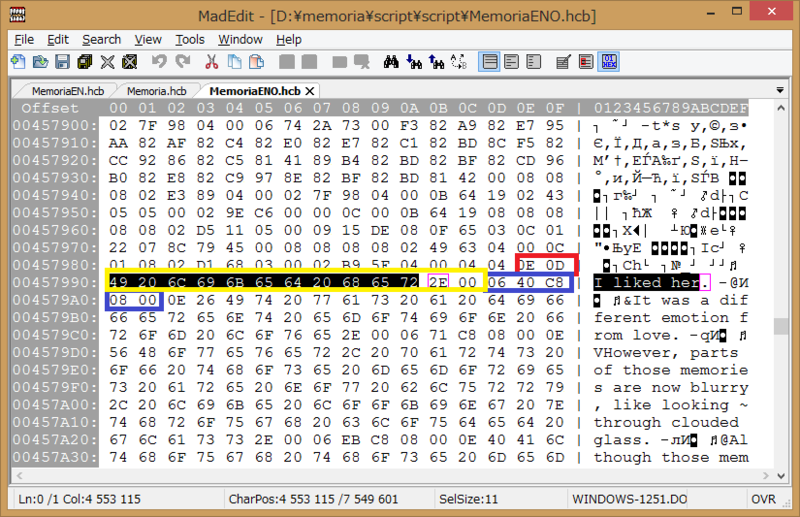
If you write several lines in a row, a certain pattern becomes visible:
Suppose this is again some kind of offset. Well, let's follow it. We find ourselves immediately after the phrase "俺 は 彼女 が 好 き だ っ た". Almost. The first couple of characters turned into some kind of mess.

The first 5 bytes are replaced with the same 06 XX XX XX XX! The beginning of “I liked her” , or rather, 0E, is just hiding at this address . After the line, some kind of magic begins. It was experimentally established that the sequence 08 08 08 02 E3 89 04 00 02 7F 98 04 00 waits for a mouse click or keystroke - confirmation of the transition to the next line. This is still useful.
To summarize, the following structure is obtained:
In the original script:
0E<Text, size bytes, encoded in Shift-JIS > <13 bytes, confirmation that the player has read the text>
<some checks, depending on them <06 transition to the next line or to another storyline >>
The classic patch was used trick - if you need to paste the code in a specific place, but you can not knock down the addressing, then put jump at the end of the file, there we do our job, go back.
Thus, 5 bytes of the original line are changed to <06> <address a bit further than the original end of the file>
and there is <0E>
In haste, a utility was written that rips the text from the script
The code is completely suboptimal, however, it copes with its work, generating 2.5 megabytes (or Mibibytes?) Of text in a few seconds. If you uncomment 2 lines in the middle, the text is collected - Japanese - English bilingual.
Here I cheated a little, because I did not begin to study in detail the format of checks after the text, and I get the address of the beginning of the next line by comparing the English and Japanese script.
Suppose we somehow translated the text, now it would be nice to push it back.
Another softinka, the code has already been fixed, the error description is described below.
Another “masterpiece” of code, of course, but it does what it needs, and also in a couple of seconds.
Run, going. Trying to play with the translation. The first few sentences are fine,
and suddenly - Runtime Error!
Again we take a hex editor, we are looking for a problem proposal. That's it. 1 byte is allocated for the length of the line, the translation is longer, as a result, the size overflows, and the game considers that the text is not 300 bytes, but 45. Accordingly, the engine tries to “execute” some symbol in the middle of the sentence as an instruction, with an understandable result.
Recall about those 13 bytes. So, if the size is exceeded, we break the text into pieces, give the first one,
wait for the click, give the second one until the text is over. You can, of course, rephrase the translation, but it is better to play it safe.
We install the font Segoe UI in the game ...
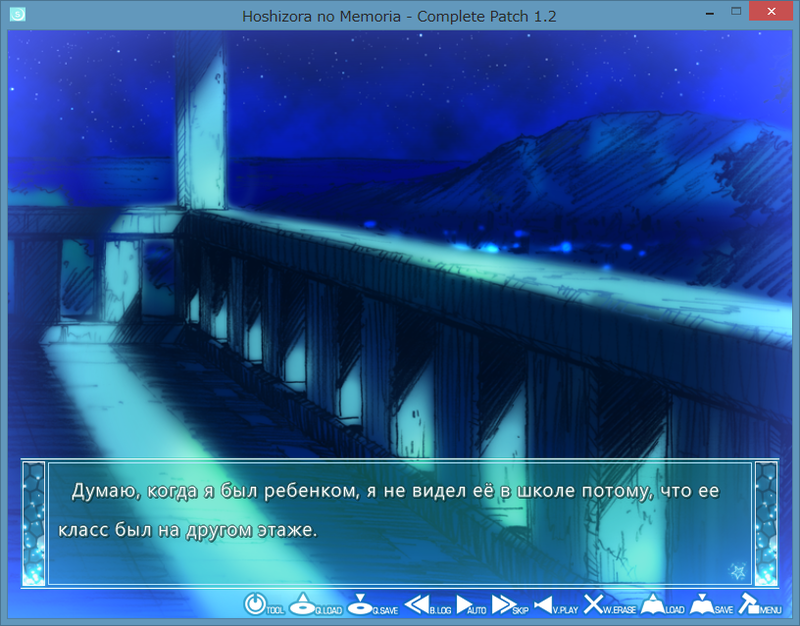
True, line breaks are far from always optimal, sometimes the phrase breaks right in the middle of the word.
The game supports manual indication of the gap, for this you need to place the tilde in the desired location. It would be necessary to modify the “stuffer” so that he would arrange the tildes. Also, the names of heroes and menus have not yet been translated. It’s easy to change the names directly in the script, but I’m not sure about the menu yet. It seems that you need to dig more resources and redraw part of the graphics.
I created a translation project on Notabenoid, whoever wants to can participate, you can’t do it alone in a year.
Notabenoid .
Very good, by the way, a rating of 8.06, I advise you to read to those who do not mind a certain amount of hentai.
Well, in general, not about this article.
There is an English patch, there is Chinese. There is no Russian. Not fair. Let's try to fix it.
You will need:
- Winhex. Where without him.
- MadEdit. An open source alternative to Vinhex, which I still couldn’t get to display Shift-JIS normally. In general, according to Wiki, in mad the richest support for languages and encodings.
- To collect localization, the program is in C, so some kind of IDE. I used Visual Studio , although there aren’t very specific things there, probably, any will do.
Study
Let's start a new game, see the first sentence - "俺 は 彼女 が 好 き だ っ た" . In the English version - "I liked her . " Remember, this is still useful to us. Close the game, go to the folder. We see there a couple of suspicious files - “Memoria.hcb” and “MemoriaEN.hcb”, respectively. Let's start with the first one. We open with the hex editor, we see the first 4 bytes. On something very similar. We check with ..En.hcb , and make sure that this is nothing but the file size minus 2029 bytes in Big Endian. The last 2029 bytes is occupied by the code that is called when the game is closed (smoothly shading the image and displaying farewell text). In principle, it might be necessary to change this, but in such an option localization is not required.
Now we are looking for the phrase"I liked her."
If you write several lines in a row, a certain pattern becomes visible:
- All lines start at 0EXX, where XX is the size of the line in bytes, including the null character
- After the line - 06 XX XX XX XX. These 4 bytes obviously increase from line to line.
Suppose this is again some kind of offset. Well, let's follow it. We find ourselves immediately after the phrase "俺 は 彼女 が 好 き だ っ た". Almost. The first couple of characters turned into some kind of mess.
The first 5 bytes are replaced with the same 06 XX XX XX XX! The beginning of “I liked her” , or rather, 0E, is just hiding at this address . After the line, some kind of magic begins. It was experimentally established that the sequence 08 08 08 02 E3 89 04 00 02 7F 98 04 00 waits for a mouse click or keystroke - confirmation of the transition to the next line. This is still useful.
To summarize, the following structure is obtained:
In the original script:
0E
<some checks, depending on them <06 transition to the next line or to another storyline >>
The classic patch was used trick - if you need to paste the code in a specific place, but you can not knock down the addressing, then put jump at the end of the file, there we do our job, go back.
Thus, 5 bytes of the original line are changed to <06> <address a bit further than the original end of the file>
and there is <0E>
Ripping text
In haste, a utility was written that rips the text from the script
radiator
#include
#include
void main()
{
	FILE *en;
	FILE *jp;
	FILE *out;
	en = fopen("MemoriaEN.hcb", "rb");
	jp = fopen("Memoria.hcb", "rb");
	out = fopen("out.txt", "w");
	fseek(en, 0x8c827, SEEK_SET);
	fseek(jp, 0x8c827, SEEK_SET);
	unsigned char todo_en[50];
	unsigned char todo_jp[50];
	unsigned char size_en;
	unsigned char size_jp;
	char str_en[255];
	char str_jp[255];
	unsigned int off_en;
	unsigned int off_en2;
	unsigned int off_en3;
	bool r = true;
	do
	{
		fread(&todo_en, 1, 1, en);
		fread(&todo_jp, 1, 1, jp);
		if ((todo_en[0] )  != 6 || (todo_jp[0] ) != 14) break;
		fread(&size_jp, 1, 1, jp);
		fread(str_jp, size_jp, 1, jp);
		fread(&off_en, 1, 4, en);
		fseek(en, off_en, SEEK_SET);
		fread(&todo_en, 1, 1, en);
		if ((todo_en[0] )  != 14) break;
		fread(&size_en, 1, 1, en);
		fread(str_en, size_en, 1, en);
		//fwrite(str_jp, size_jp, 1, out);
		//fwrite((const char *) "\n", 1, 1, out);
		fwrite(str_en, size_en, 1, out);
		fwrite((const char *) "\n", 1, 1, out);
		fwrite((const char *) "\n", 1, 1, out);
		fread(&todo_en, 1, 1, en);
		if ((todo_en[0] )  != 6) break;
		fread(&off_en, 1, 4, en);
		if (off_en == 0x0045793e)
			break;
		off_en2 = ftell(en);
		fseek(en, off_en, SEEK_SET);
		fseek(jp, ftell(en), SEEK_SET);
		do
		{
			fread(&todo_jp, 1, 1, jp);
			fread(&todo_en, 1, 1, en);
			if (todo_en[0] == 6 &&  todo_jp[0] == 14)
				break;
		} while (!feof(en));
		fseek(en, -1, SEEK_CUR);
		fseek(jp , ftell(en), SEEK_SET);
	} while (true);
	fclose(jp);
	fclose(en);
	fclose(out);
}
The code is completely suboptimal, however, it copes with its work, generating 2.5 megabytes (or Mibibytes?) Of text in a few seconds. If you uncomment 2 lines in the middle, the text is collected - Japanese - English bilingual.
Here I cheated a little, because I did not begin to study in detail the format of checks after the text, and I get the address of the beginning of the next line by comparing the English and Japanese script.
Putting text back
Suppose we somehow translated the text, now it would be nice to push it back.
Another softinka, the code has already been fixed, the error description is described below.
stuffer
#include
#include
unsigned char buff[0x7fffff];
unsigned int end;					//offset of russian strings
unsigned char s[1024];
unsigned int retpos;				//return here after russian
unsigned char cl[13] = {0x08, 0x08,  0x08, 0x02 , 0xE3 , 0x89 , 0x04, 0x00, 0x02, 0x7F, 0x98, 0x04, 0x00};	//prompt for click
unsigned char ro = 250;				//max len of string
unsigned char todo_en;				//must be 0x06 or 0x14
unsigned char size_en;				//size of engish string
unsigned char jmp = 0x06;			//jumps to xx xx xx xx in LE
unsigned char stl = 0x0E;			//indicates new sring
int ts;
int k;
unsigned char d;
int parts;
FILE *en;
FILE *trans;
FILE *text;
char str1[255];
void main()
{
	en = fopen("MemoriaENO.hcb", "rb");	//non-modifed english script
	text = fopen("text.txt", "r");		//translated strings
	trans = fopen("MemoriaEN.hcb", "wb");	//translated script
	rewind(trans);
	rewind(text);
	fseek(en, 0, SEEK_END);
	end = ftell(en);			//begin writing localization here
	rewind(en);
	fread(buff, end, 1, en);
	fwrite(buff, end, 1, trans);
	fseek(en, 0x45798e, SEEK_SET);
	do
	{
		s[0] = '\0';
		ts = 0;
		do
		{
			fscanf(text, "%c", &s[ts]);
			ts++;
		} while (s[ts-1] != 0);
		fseek(text, 4, SEEK_CUR);
		//get new string, terminated with \0
		fseek(trans, ftell(en), SEEK_SET);
		fread(&todo_en, 1, 1, en);
		//if ((todo_en) != 14) break;
		fread(&size_en, 1, 1, en);
		fseek(en, size_en, SEEK_CUR);
		retpos = ftell(en);
		//english string begin + len = return here after russian
		fwrite(&jmp, 1, 1, trans);
		fwrite(&end, 4, 1, trans);
		//jump to the russian line
		fseek(trans, end, SEEK_SET);
		if (ts <= ro)
		{
			//if length of line < byte, just write it
			fwrite(&stl, 1, 1, trans);
			fwrite(&ts, 1, 1, trans);
			fwrite(s, ts, 1, trans);
			end += (ts + 2 + 5);
		}
		else
		{
			//get maximum amount of words, which does not exceed byte
			//and write it
			end += (ts + 2 + 5);
			do
			{
				str1[0] = '\0';
				memcpy(str1, &s, ro);
				strrev(str1);
				d = strcspn(str1, " ");
				strrev(str1);
				str1[ro-d] = '\0';
				d = strlen(str1);
				memcpy(s, &s[d], ts - d);
				ts -= (d + 1);
				str1[d-1] = 0x00;
				fwrite(&stl, 1, 1, trans);
				fwrite(&d, 1, 1, trans);
				fwrite(&str1, d, 1, trans);
				fwrite(cl, 13, 1, trans);
				end += 15;
			} while (ts > ro);
			//write the remaining part of line
			s[ts] = 0x00;
			fwrite(&stl, 1, 1, trans);
			fwrite(&ts, 1, 1, trans);
			fwrite(&s, ts+1, 1, trans);
		}
		fwrite(&jmp, 1, 1, trans);
		fwrite(&retpos, 4, 1, trans);
		//jump back to english
		fseek(en, 5, SEEK_CUR);
		if (retpos == 0x732aaf)
			break;
		//exit in case of last line
	} while (true);
	fclose(en);
	fclose(trans);
	fclose(text);
}
Another “masterpiece” of code, of course, but it does what it needs, and also in a couple of seconds.
Run, going. Trying to play with the translation. The first few sentences are fine,
and suddenly - Runtime Error!
Again we take a hex editor, we are looking for a problem proposal. That's it. 1 byte is allocated for the length of the line, the translation is longer, as a result, the size overflows, and the game considers that the text is not 300 bytes, but 45. Accordingly, the engine tries to “execute” some symbol in the middle of the sentence as an instruction, with an understandable result.
Recall about those 13 bytes. So, if the size is exceeded, we break the text into pieces, give the first one,
wait for the click, give the second one until the text is over. You can, of course, rephrase the translation, but it is better to play it safe.
Total
We install the font Segoe UI in the game ...
True, line breaks are far from always optimal, sometimes the phrase breaks right in the middle of the word.
The game supports manual indication of the gap, for this you need to place the tilde in the desired location. It would be necessary to modify the “stuffer” so that he would arrange the tildes. Also, the names of heroes and menus have not yet been translated. It’s easy to change the names directly in the script, but I’m not sure about the menu yet. It seems that you need to dig more resources and redraw part of the graphics.
I created a translation project on Notabenoid, whoever wants to can participate, you can’t do it alone in a year.
Notabenoid .