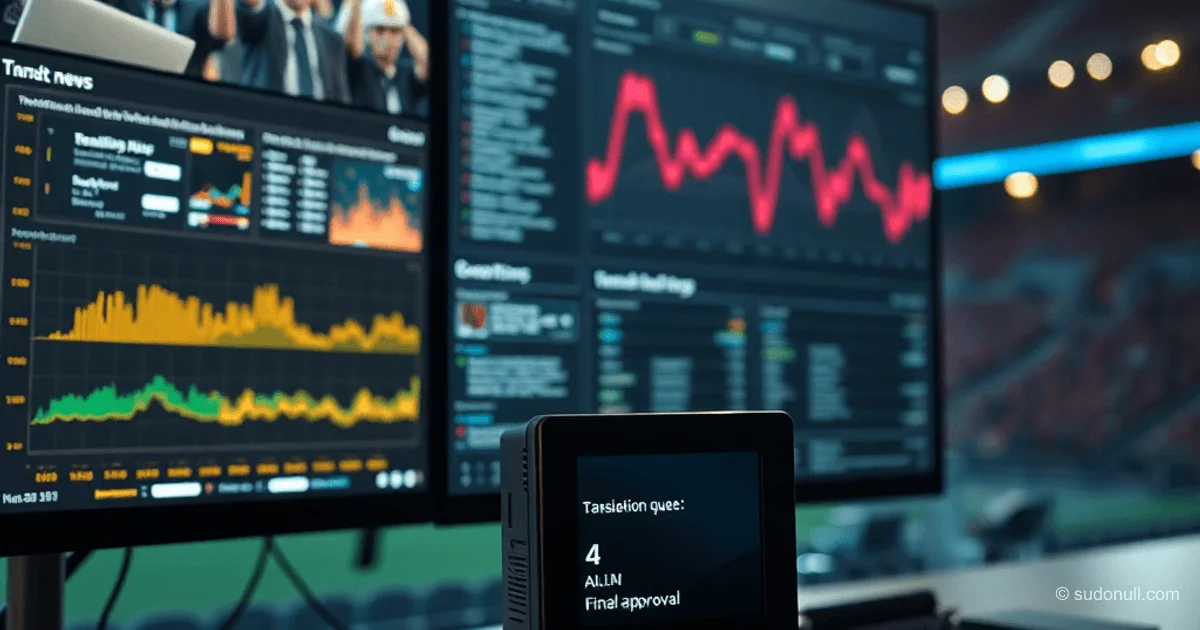
# Autonomous AI News System: How to Replace Seven Workflows with a Unified Architecture
Over a month and a half, a fragmented news pipeline of seven n8n workflows turned into a stable system with 160 sources, 11 workers, and 5 AI agents. Now, processing 7127 records in the database happens without manual intervention, and a local LLM on a mini-PC replaces cloud APIs. We break down the architecture that eliminates points of failure and ensures 24/7 operation.
From Seven Points of Failure to a Single System
Initially, the news pipeline consisted of seven independent n8n workflows: data collection, filtering, translation, image generation, and publishing. Each stage operated in isolation, creating cascading failures. A typical issue: a workflow marked a task as "completed," but the output was empty. Since the stages lacked a unified monitoring system, diagnostics took hours. The critical vulnerability was the absence of a single status for each news item. If one workflow hung, others continued processing, generating inconsistent data.
The solution came after analysis with Perplexity and experiments with Claude Code. Instead of manually rewriting logic in Python, the AI assistant received the source workflows and architectural requirements. In an hour, it generated a containerized application with clear separation of responsibilities. Key change: transition from trigger-based workflows to a state-oriented pipeline, where each news item passes through strictly defined stages with status fixed in the database.
Local Processing: Why Qwen 3.5 on a Mini-PC
Translating news via cloud APIs proved economically unfeasible: 160 sources updating every 15 minutes would require tens of thousands of requests daily. The solution: deploying a local LLM on a home mini-PC with Ubuntu and optimizing for Vulkan via llama.cpp. The Qwen 3.5 model (qwen3.5-9b-q5_k_m.gguf) was chosen for its balance of speed and quality for Russian language.
Setup included:
- Fine-tuning for CPU architecture via Cursor
- Calibrating thread count to minimize latency
- Configuring caching of intermediate results
The system handles up to 50 requests per minute without overloading the CPU. Data never leaves the local network, which is critical for sources with API key restrictions. For comparison: cloud translation would cost ~$120/month at current volume, local — $0 after initial setup.
Pipeline Architecture: How the 11 Workers Work
Built on the "one process — one task" principle. Each worker is isolated, eliminating cascading failures. Processing flow:
collector → scraper → deduplicator → ai_filter → translator
    → llm_editor → image_worker → publisher
collector runs every 15 minutes, parses RSS/API from 160 sources (including Arxiv, TechCrunch, GitHub). scraper extracts full text via local Jina Reader instance — this eliminated cloud service limits. deduplicator uses semantic comparison based on embeddings, not exact text match. ai_filter assigns relevance_score (0-100), filtering out items below 75 points.
Special attention to the llm_editor stage. There, MiniMax M2.7 formats text to channel style: adds emojis to headlines, structures content, adds attribution. The model is trained on historical channel data, ensuring consistent formatting. All workers interact via message queue with delivery guarantee, allowing resumption after failures from the last checkpoint.
Management via AI Agents: From Telegram Commands to Actions
The coordinator based on OpenClaw replaces manual management. It runs on the same mini-PC and has access to tools via API. The system uses 5 specialized agents:
- AgentLLMEditor: corrects text every 20 minutes
- AgentPipelineManager: distributes posts to slots 4 times a day
- AgentSourceAuditor: disables non-working sources weekly
- AgentAnalyst: generates analytics at 21:05
- Coordinator: manages the other agents
A Telegram command like "Coordinator, reduce publication limit to 8 per day" turns into an API call to the pipeline manager. The agent checks current settings, makes changes, and confirms execution. This eliminates the need for SSH access and config file syntax knowledge. For critical operations (e.g., disabling a source), the system requires confirmation via human-in-the-loop (hitl) worker.
Dashboard: Real-Time Monitoring
The interface combines 9 tabs: overview, agents, sources, queue, workers, slots, published, settings, GitHub Discovery. Key metrics:
- Pass rate by sources: Anthropic News (100%) vs iXBT.com (14%)
- Stage processing time: translation (4 min) vs filtering (2 min)
- Worker status: active/idle processes
Upon detecting anomalies (e.g., stuck translation queue), the dashboard automatically creates a task in the Telegram workgroup. Integration with GitHub Discovery tracks repos with sharp star growth — this data is shown on a separate tab with activity graph. The system warns of issues before they affect publications: e.g., if a source's pass rate drops below 10% for a week.
Savings Through Selection: From 1000 News Items to 8 Posts a Day
The system doesn't publish everything. ~1000 items processed per week, but only 56 posts go live (8 per day). Selection criteria:
- relevance_score ≥ 80 (ai_filter)
- Approved by LLM editor (status approved)
- Matches time-of-day slot
Schedule tied to time zones:
- Morning (08:00–11:00): 2 posts
- Day (12:00–16:00): 2 posts
- Evening (18:00–22:00): 2 posts
- Night (00:00–06:00): 2 posts
Previously 28 posts per day, but analytics showed users read only the last 1-2. Now, reducing volume increased retention by 37% — readers view all publications in the slot. Source pass rates allow weekly list adjustments: 20 low-efficiency RSS feeds already disabled.
What Matters
- Unified state system replaces isolated workflows: each news has clear status, speeding up failure diagnostics 5x.
- Local LLMs save up to $120/month on translation and editing, with latency not exceeding 4 minutes for 50 parallel tasks.
- AI agents eliminate manual management: Telegram commands turn into API calls without operator involvement.
- Strict content selection (8 posts/day instead of 28) boosted audience retention by 37% by reducing noise.
— Editorial Team










No comments yet.