November 8, 2012 at 19:59
How to "open" the chip and what is inside it?
 Microcircuits - are closest to being called a "black box" - they are really black, and their insides - remain a mystery to many.
 Today we will lift this veil of secrecy, and sulfuric and nitric acid will help us in this.
Attention! Any operations with concentrated (and even more boiling) acids are extremely dangerous, and you can only work with them using appropriate protective equipment (gloves, glasses, an apron, an exhaust hood). Remember, we have only 2 eyes, and one drop is enough for everyone: because everything that is written here is not worth repeating.
Open
We take the microcircuits that interest us, add concentrated sulfuric acid. Bring to a boil (~ 300 degrees), do not stir :-) Soda is poured on the bottom - to neutralize spilled acid and its vapors.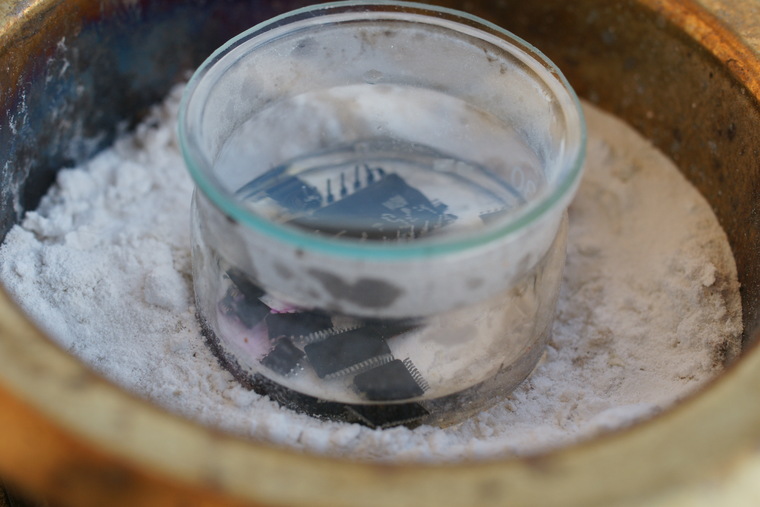
After 30-40 minutes carbon remains from the plastic:
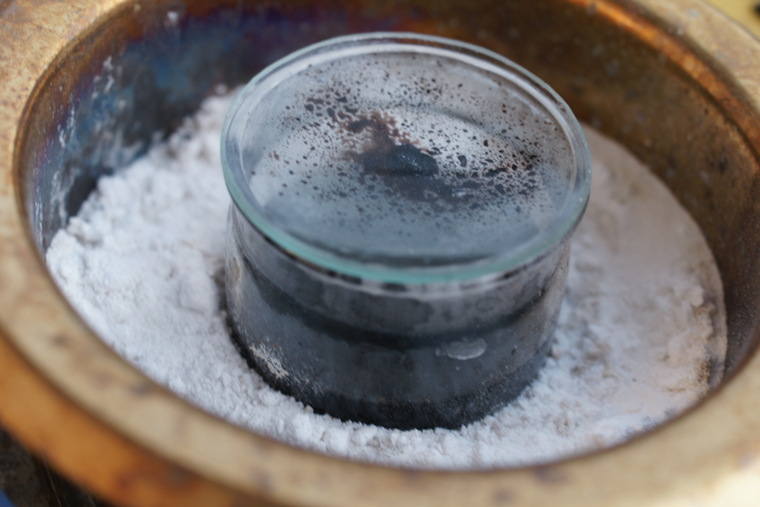
We get out and choose what will go for another life-giving acid bath, and what is ready:

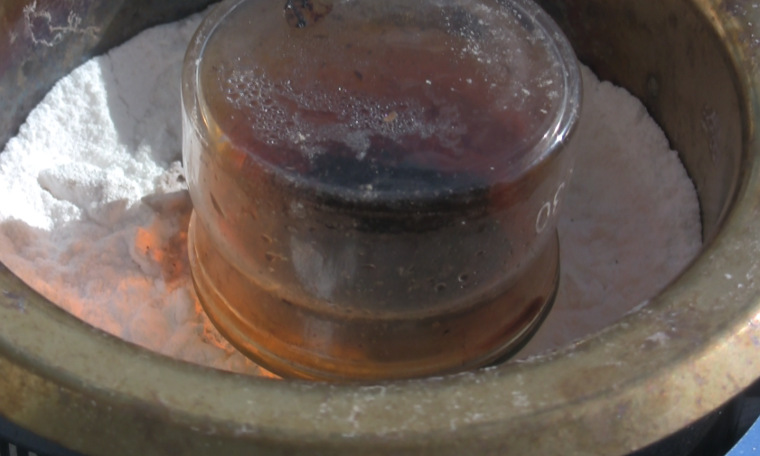
If the pieces of carbon are firmly stuck to the crystal, they can be removed with boiling concentrated nitric acid (but the temperature here is already much lower , ~ 110-120C). Diluted acid will eat metallization, therefore it needs concentrated:
Watching
Pictures are clickable (5-25Mb JPEG). Some of you could already see some photos with me.Colors are traditionally “enhanced” to the maximum - in reality, the riot of colors is much less.
PL2303HX - USB converter <> RS232, such are used in all Arduino and others like them: LM1117 - linear power controller: 74HC595 - 8-bit shift register: NXP 74AHC00 74AHC00 - 4 NAND (2AND) elements. Looking at the gigantic crystal size (944x854 µm), it becomes obvious that the “old” micron technologies are still used. The abundance of “backup” via is interesting to increase the yield. Micron MT4C1024 - dynamic memory chip, 1 mebibit (2 20


bit). It was used at the time of 286 and 386. The crystal size is 8662x3969µm. AMD Palce16V8h GAL (Generic array logic) chips are the predecessors of FPGA and CPLD. AMD Palce16V8h is a 32x64 array of AND elements. The crystal size is 2434x2079µm, technology 1µm. ATtiny13A is one of Atmel's smallest microcontrollers: 1kb of flash memory and 32 bytes of SRAM. The crystal size is 1620x1640 µm. Technological standards - 500nm. ATmega8 is one of the most popular 8-bit microcontrollers. The crystal size is 2855x2795µm, technological standards are 500nm. KR580IK80A (later renamed KR580VM80A) is one of the most popular Soviet processors.


It turned out that contrary to popular belief, it is not a layered copy of the Intel 8080 / 8080A (some units are similar, but the layout and location of the contact pads are significantly different).
The thinnest lines are 6µm. STM32F100C4T6B is the smallest microcontroller based on the ARM Cortex-M3 core manufactured by STMicroelectronics. The crystal size is 2854x3123µm. Altera EPM7032 - CPLD has seen a lot, and one of the few who worked on 5V power. The crystal size is 3446x2252µm, technological standards are 1µm. The black box is now open :-) PS. If you have chips that have historical significance (for example, T34BM1, Soviet 286, foreign chips old and unique for their time), send them - we’ll see what they have inside.


Photos are licensed under a Creative Commons Attribution 3.0 Unported license.