August 7, 2012 at 23:13
Half empty glass
- Transfer
On Habré the new column What if Rendela Munroe ( xkcd ) was already mentioned . Every Tuesday, he answers various stupid questions from readers in terms of the laws of physics. Below is a translation of one of the issues.
What if suddenly the glass becomes literally half empty?
—Victorio Jacovella
As it turns out later, the pessimist will be right in this case. When they say "the glass is half empty" they usually mean that the glass contains equally water and air.

It is believed that the glass seems half full to the optimist, while the pessimist finds it half empty. This parable gave rise to a whole bunch of humorous variations (the engineer sees a glass that is designed with a double supply of capacity; the surrealist sees a giraffe chewing a tie, etc.)
But what if the empty half of the glass really became empty - i.e. containing vacuum? (They say that even the vacuum is not empty, but we will leave this question to quantum physicists).
Vacuum, of course, will not last long. But what will happen to him depends on the answer to the question that they usually forget to ask: which half of the glass is empty?
For our study, we will present three half-empty glasses and trace what will happen to them, nanosecond after nanosecond.
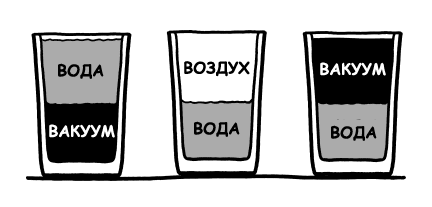
In the center is a classic glass with water and air. On the right is an option similar to the first, but instead of air in a glass is a vacuum. In the glass, which is on the left, the lower half is empty .
Suppose a vacuum is formed at time t = 0.

The first few nanoseconds, nothing happens. In such a period of time, even air molecules are almost motionless.
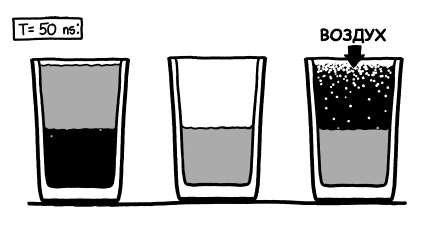
Most of the time, air molecules rush around at a speed of several hundred meters per second. But at any given time, some of them can move faster than others. A couple of the fastest speeds up to 1000 m / s. It is these molecules that are the first to fly into the vacuum of the glass on the right.
The vacuum in the glass on the left is surrounded on all sides by obstacles, so it is not so easy for air molecules to get there. Water, being a liquid, does not expand to fill the resulting void, as air does. However, at the border with the vacuum, the water begins to boil, gradually releasing steam into the lower part of the glass.

While the water in both glasses begins to boil, in the right glass, the air penetrating inside prevents the water from walking properly. The glass on the left continues to fill with a light mist of boiling water.
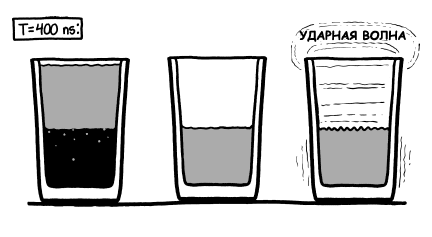
After a few hundred nanoseconds, air bursting into the glass on the right completely fills the vacuum and crashes into the surface of the water, sending a shock wave through the liquid. The walls of the glass shake slightly, but withstand pressure and do not break. The shock wave is reflected from the water back into the air, contributing to the turbulence that has already arisen there.
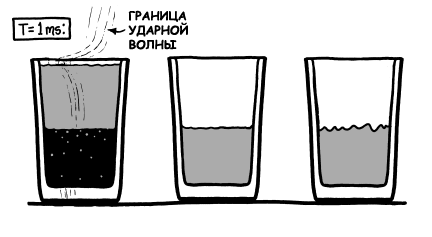
The shock wave generated by the collapse of the vacuum takes about 1 ms to reach the other two glasses. The glass and water bend slightly as the wave passes through them. After a few milliseconds, the wave reaches the human ear in the form of a loud pop.

Around the same time, the glass on the left begins to rise noticeably.
Air pressure is trying to squeeze a glass and water. This is a force that we are used to perceiving as absorption. The vacuum in the glass on the right did not last long enough for the suction to raise the glass, but since air cannot penetrate the vacuum on the left, the glass and water begin to move towards each other.

Boiling water filled the vacuum with a very small amount of water vapor. As the empty space contracts, the mass of water vapor gradually increases the pressure on the surface of the water. Over time, this process will weaken the boiling, as would happen if the atmospheric pressure increased.

However, by this time the glass and water are moving towards each other too quickly for the steam to have any meaning. Less than 10 ms after the start of the countdown, they rush towards each other at a speed of several meters per second. In the absence of a softening layer of air between them - only miserable remnants of steam - water crashes into the bottom of the glass, like a sledgehammer.

Water practically does not know how to compress, so the collision is not stretched in time - it occurs as one sharp blow. Glass does not withstand tremendous pressure and bursts.
This “water hammer” effect (also leading to a thud in the old water supply when closing the tap) can be seen in the well-known rally (played by the Destroyers of Legends, studied in physics classes, demonstrated at countless parties), when a sharp blow to the neck of a bottle knocks out her bottom .
When they hit a bottle, it is pushed down sharply. The liquid inside cannot react to the increased air pressure instantly - as in our case - and a gap occurs for a short time. This is a very thin gap - only a centimeter thick - but when it collapses, the blow knocks the bottom off the bottle.
In our case, the strength will be enough to break even the most durable glass.

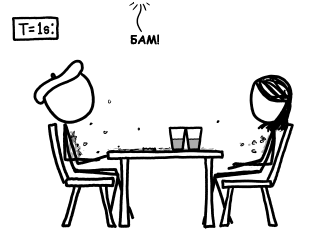
Water pulls the bottom of the glass down and imprints it on the surface of the table. Water spills on the table, spraying drops and pieces of glass in all directions.
Meanwhile, the lonely upper part of the glass continues to take off.
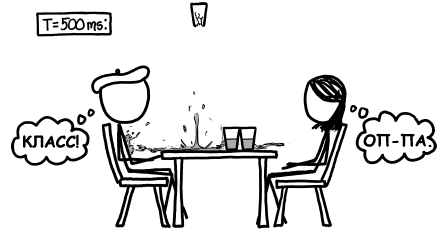
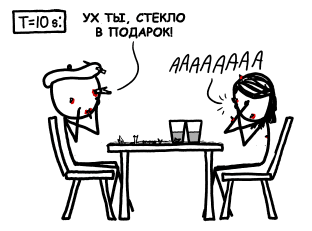
After half a second, the observers, hearing a pop, startle. Their heads rise involuntarily, following the soaring glass.
The glass has enough speed to crash onto the ceiling, shattering into fragments ...

... which are now returning to the table.
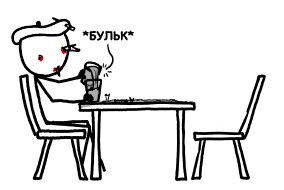
Conclusion: if the optimist claims that the glass is half full and the pessimist says that it is half empty, the physicist hides under the table.
What if suddenly the glass becomes literally half empty?
—Victorio Jacovella
As it turns out later, the pessimist will be right in this case. When they say "the glass is half empty" they usually mean that the glass contains equally water and air.
It is believed that the glass seems half full to the optimist, while the pessimist finds it half empty. This parable gave rise to a whole bunch of humorous variations (the engineer sees a glass that is designed with a double supply of capacity; the surrealist sees a giraffe chewing a tie, etc.)
But what if the empty half of the glass really became empty - i.e. containing vacuum? (They say that even the vacuum is not empty, but we will leave this question to quantum physicists).
Vacuum, of course, will not last long. But what will happen to him depends on the answer to the question that they usually forget to ask: which half of the glass is empty?
For our study, we will present three half-empty glasses and trace what will happen to them, nanosecond after nanosecond.
In the center is a classic glass with water and air. On the right is an option similar to the first, but instead of air in a glass is a vacuum. In the glass, which is on the left, the lower half is empty .
Suppose a vacuum is formed at time t = 0.
The first few nanoseconds, nothing happens. In such a period of time, even air molecules are almost motionless.
Most of the time, air molecules rush around at a speed of several hundred meters per second. But at any given time, some of them can move faster than others. A couple of the fastest speeds up to 1000 m / s. It is these molecules that are the first to fly into the vacuum of the glass on the right.
The vacuum in the glass on the left is surrounded on all sides by obstacles, so it is not so easy for air molecules to get there. Water, being a liquid, does not expand to fill the resulting void, as air does. However, at the border with the vacuum, the water begins to boil, gradually releasing steam into the lower part of the glass.
While the water in both glasses begins to boil, in the right glass, the air penetrating inside prevents the water from walking properly. The glass on the left continues to fill with a light mist of boiling water.
After a few hundred nanoseconds, air bursting into the glass on the right completely fills the vacuum and crashes into the surface of the water, sending a shock wave through the liquid. The walls of the glass shake slightly, but withstand pressure and do not break. The shock wave is reflected from the water back into the air, contributing to the turbulence that has already arisen there.
The shock wave generated by the collapse of the vacuum takes about 1 ms to reach the other two glasses. The glass and water bend slightly as the wave passes through them. After a few milliseconds, the wave reaches the human ear in the form of a loud pop.
Around the same time, the glass on the left begins to rise noticeably.
Air pressure is trying to squeeze a glass and water. This is a force that we are used to perceiving as absorption. The vacuum in the glass on the right did not last long enough for the suction to raise the glass, but since air cannot penetrate the vacuum on the left, the glass and water begin to move towards each other.
Boiling water filled the vacuum with a very small amount of water vapor. As the empty space contracts, the mass of water vapor gradually increases the pressure on the surface of the water. Over time, this process will weaken the boiling, as would happen if the atmospheric pressure increased.
However, by this time the glass and water are moving towards each other too quickly for the steam to have any meaning. Less than 10 ms after the start of the countdown, they rush towards each other at a speed of several meters per second. In the absence of a softening layer of air between them - only miserable remnants of steam - water crashes into the bottom of the glass, like a sledgehammer.
Water practically does not know how to compress, so the collision is not stretched in time - it occurs as one sharp blow. Glass does not withstand tremendous pressure and bursts.
This “water hammer” effect (also leading to a thud in the old water supply when closing the tap) can be seen in the well-known rally (played by the Destroyers of Legends, studied in physics classes, demonstrated at countless parties), when a sharp blow to the neck of a bottle knocks out her bottom .
When they hit a bottle, it is pushed down sharply. The liquid inside cannot react to the increased air pressure instantly - as in our case - and a gap occurs for a short time. This is a very thin gap - only a centimeter thick - but when it collapses, the blow knocks the bottom off the bottle.
In our case, the strength will be enough to break even the most durable glass.
Water pulls the bottom of the glass down and imprints it on the surface of the table. Water spills on the table, spraying drops and pieces of glass in all directions.
Meanwhile, the lonely upper part of the glass continues to take off.
After half a second, the observers, hearing a pop, startle. Their heads rise involuntarily, following the soaring glass.
The glass has enough speed to crash onto the ceiling, shattering into fragments ...
... which are now returning to the table.
Conclusion: if the optimist claims that the glass is half full and the pessimist says that it is half empty, the physicist hides under the table.