July 20, 2012 at 14:46
The future of cloud computing: 9 key trends in 2012
Translation of the article “ The future of cloud computing: 9 trends for 2012 ”
At the moment, cloud technologies look mixed: they bring convenience to the company, but they force them to take a certain risk. In this article, we present to you the results of a survey of 39 firms that are somehow related to cloud technology. This data should shed light on which direction the "clouds" will develop in the near future.

Our main occupation here at ZDNet is “peeking around the corner”, keeping abreast of the technology industry to understand what lies ahead.
Venture capitalists are no less interested in predicting a “technological future,” because for them the price of one unsuccessful investment is measured in millions of dollars.
North Bridge Venture Partners recently published a study focusing on the future of cloud technology. Representatives of the company interviewed 785 people in 39 major technology enterprises, including Akamai, AWS, Citrix, Microsoft, Red Hat, SAP and VMware, to understand how their leadership sees the future of cloud computing.
Since North Bridge is a company that is ready to support what it believes in with serious financial investments, the details of their research really matter. The following are its main results:
1. Some consider the clouds to be perfect.Half of the respondents are convinced that cloud solutions are quite viable as a tool for implementing the most important business processes.
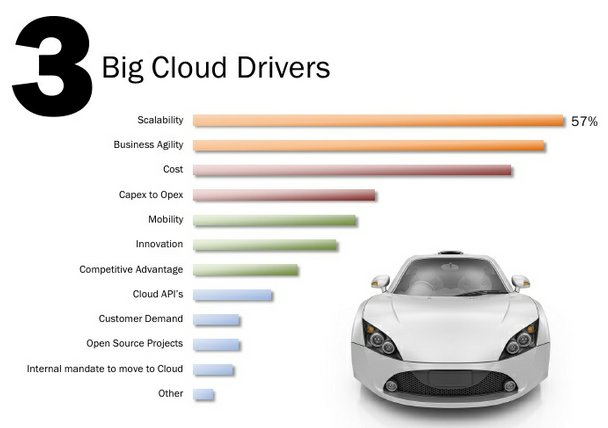
2. Scalability is a major success factor. Fifty-seven percent of companies said that this is the main reason why they switched to the use of "clouds" (in second place is the acceleration of business processes).
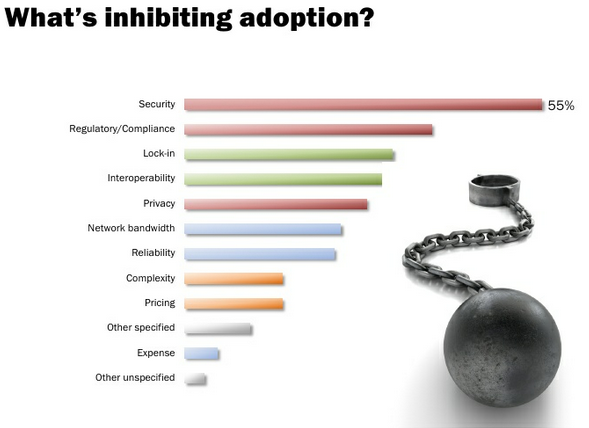
3. Security remains a major hurdle. Perhaps the “clouds” are gaining momentum, but the security problem is still unresolved: 55% of respondents noted it as a factor hindering the widespread adoption of cloud technologies (closing the top three is compliance with established standards and closed vendors).
4. Companies are willing to pay for SaaS.As many as 82 percent of respondents said they use software-as-a-service today. Another six percent intend to implement SaaS in the next five years.
5. PaaS and Iaas are not far behind. There is also widespread interest in the platform-as-a-service and infrastructure-as-a-service: forty percent of respondents use PaaS today, and 72 percent intend to start using it in the next 5 years. The same figures for IaaS are 51% and 66%, respectively.
6. Efficiency - the name of the game. The most important and resource-consuming processes were backup and archiving (43 percent), continuity (25 percent), collaboration tools (22 percent), processing of large amounts of information (19 percent).
7.Noticeable cost savings. Fifty-three percent of those surveyed said that cloud leads to lower total cost of ownership or TCO, and a less complex IT process.
8. Public or private “clouds”? Actually, both of them. Forty percent of respondents use public “clouds,” 36 percent follow a hybrid approach, and 52 percent intend to use a hybrid approach over the next 5 years.
9. Information in large volumes is an elephant in a china shop. Eighty percent of respondents believe that information storage should completely go into the field of cloud computing. Analysts also think.
Michael Skok, a spokesman for North Bridge, said: “We, as weather forecasters, predict that precipitation will soon fall from the cloudy sky, which will finally reveal key trends.”
Comment by Askar Rakhimberdiev, founder and developer of the My Warehouse service , expert at CloudsNN-2012:
 As a comment, I can say that our small business rarely chooses SaaS for reasons of scalability or cost reduction.
The main reasons are the unique capabilities of the clouds (for example, collaboration from different offices) and, most importantly, the fact that Internet services are often simpler and more understandable than their traditional counterparts.
And how would you comment on the results of a survey conducted by North Bridge?
At the moment, cloud technologies look mixed: they bring convenience to the company, but they force them to take a certain risk. In this article, we present to you the results of a survey of 39 firms that are somehow related to cloud technology. This data should shed light on which direction the "clouds" will develop in the near future.
Our main occupation here at ZDNet is “peeking around the corner”, keeping abreast of the technology industry to understand what lies ahead.
Venture capitalists are no less interested in predicting a “technological future,” because for them the price of one unsuccessful investment is measured in millions of dollars.
North Bridge Venture Partners recently published a study focusing on the future of cloud technology. Representatives of the company interviewed 785 people in 39 major technology enterprises, including Akamai, AWS, Citrix, Microsoft, Red Hat, SAP and VMware, to understand how their leadership sees the future of cloud computing.
Since North Bridge is a company that is ready to support what it believes in with serious financial investments, the details of their research really matter. The following are its main results:
1. Some consider the clouds to be perfect.Half of the respondents are convinced that cloud solutions are quite viable as a tool for implementing the most important business processes.
2. Scalability is a major success factor. Fifty-seven percent of companies said that this is the main reason why they switched to the use of "clouds" (in second place is the acceleration of business processes).
3. Security remains a major hurdle. Perhaps the “clouds” are gaining momentum, but the security problem is still unresolved: 55% of respondents noted it as a factor hindering the widespread adoption of cloud technologies (closing the top three is compliance with established standards and closed vendors).
4. Companies are willing to pay for SaaS.As many as 82 percent of respondents said they use software-as-a-service today. Another six percent intend to implement SaaS in the next five years.
5. PaaS and Iaas are not far behind. There is also widespread interest in the platform-as-a-service and infrastructure-as-a-service: forty percent of respondents use PaaS today, and 72 percent intend to start using it in the next 5 years. The same figures for IaaS are 51% and 66%, respectively.
6. Efficiency - the name of the game. The most important and resource-consuming processes were backup and archiving (43 percent), continuity (25 percent), collaboration tools (22 percent), processing of large amounts of information (19 percent).
7.Noticeable cost savings. Fifty-three percent of those surveyed said that cloud leads to lower total cost of ownership or TCO, and a less complex IT process.
8. Public or private “clouds”? Actually, both of them. Forty percent of respondents use public “clouds,” 36 percent follow a hybrid approach, and 52 percent intend to use a hybrid approach over the next 5 years.
9. Information in large volumes is an elephant in a china shop. Eighty percent of respondents believe that information storage should completely go into the field of cloud computing. Analysts also think.
Michael Skok, a spokesman for North Bridge, said: “We, as weather forecasters, predict that precipitation will soon fall from the cloudy sky, which will finally reveal key trends.”
Comment by Askar Rakhimberdiev, founder and developer of the My Warehouse service , expert at CloudsNN-2012:
As a comment, I can say that our small business rarely chooses SaaS for reasons of scalability or cost reduction. The main reasons are the unique capabilities of the clouds (for example, collaboration from different offices) and, most importantly, the fact that Internet services are often simpler and more understandable than their traditional counterparts.
And how would you comment on the results of a survey conducted by North Bridge?