July 18, 2012 at 14:39
Review GPS tracker BCE FM Blue
Previously, there were only a few pieces of trackers in the CIS market, and it was very easy to choose, but now dozens of manufacturers release many versions. At the same time, naturally, each new version has more and more advanced functionality, which makes the manufacturer more competitive in the market, and at the same time provides customers with more opportunities.
It’s becoming more and more difficult to sort out these products of the competitive race of manufacturers. I’m reviewing BCE FM Blue, a controller from Baltic car equipment (BCE), a Lithuanian manufacturer of electronic equipment for cars.

FM blue- This is a GPS / GSM device that allows monitoring of mobile and stationary objects. The package includes a central unit, wires for connection, external GPS and GSM antennas and a 1A fuse.
It is quite convenient to determine the operation mode of the device thanks to the LED indication. Another unique advantage of BCE Blue is the complete absence of configuration connectors, as parameter programming is done via GPRS. If you work with a large number of such controllers, on each of them, in addition to the IMEI number, there is also a bar code that allows you to quickly and easily record devices, which saves a lot of time.
From myself, I note that when placing the central unit during the installation process, one should take into account the short length of the GPS cable and GSM antennas.
If it’s absolutely prosaic to list the technical characteristics of the device:
Initially disappointed by the lack of a built-in battery. But later it turned out that this model was provided for by manufacturers, since Li-Ion or NiMh batteries, widely used in most devices on the market, have a very narrow temperature range, which is especially noticeable at temperatures below zero. Also, these batteries have a limited number of charge / discharge cycles. Thus, the use of acidic external batteries is a deliberate choice of manufacturers, primarily because of their affordable price, lack of capacity limitations, as well as a wide temperature range.
The GSM module is one of the smallest modules in the world, the quad-band GSM / GPRS module Telit GE 865-QUAD. Despite its size, the module has an extended temperature range - from -40 ° C to + 85 ° C and is known for its reliability and stability. GPS-receiver is a module from the Swiss company U-Blox, which has also proven itself in the market.

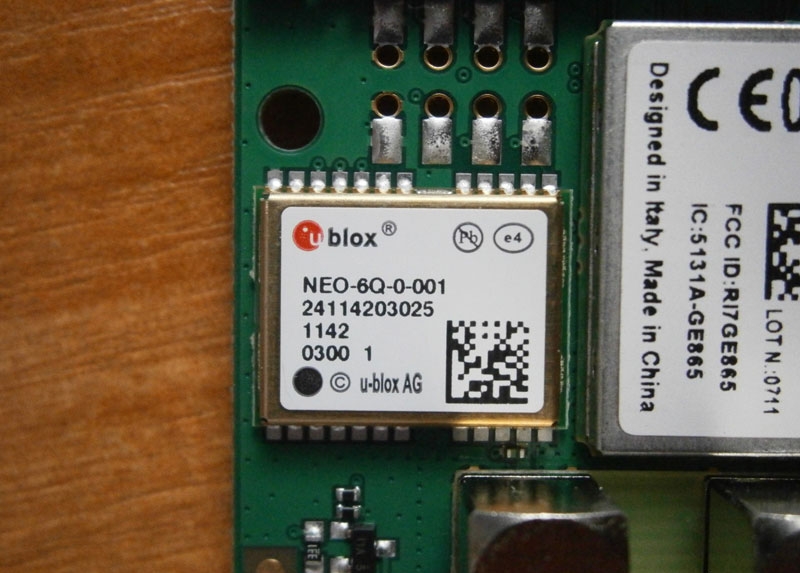
GPS-modules NEO-6x , made by u-blox 6 technology, are small in size and low in power consumption, so that these characteristics are important, I think, everyone who works with m2m technologies. The built-in low-noise amplifier LNA is designed for use with both active and passive antennas. Also very interesting was the Kick Start mode, which makes it possible to carry out a “cold start” with a weak signal. The best result when testing about 30 seconds - the device showed in an open area.
I also liked the ability to configure the device so that every 20-30 minutes it would automatically connect to the satellite to download the latest data.
An obvious plus is the presence of the ATxmega256A3 microcontroller , which acts as a link between the GPS receiver, modem and peripheral devices, as well as the presence of a SIM card holder - Amphenol with gold-plated contacts.


We were pleased with the FAKRA antenna connectors . Connectors of different colors and with locks, so it is very difficult to get confused when connected. The main Molex Micro-Fit connector provides both electrical and mechanical connections and seems to be very reliable.
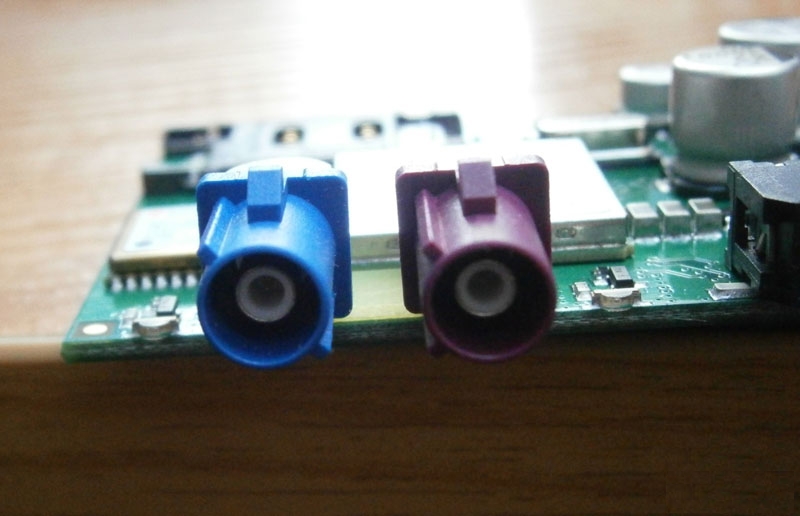
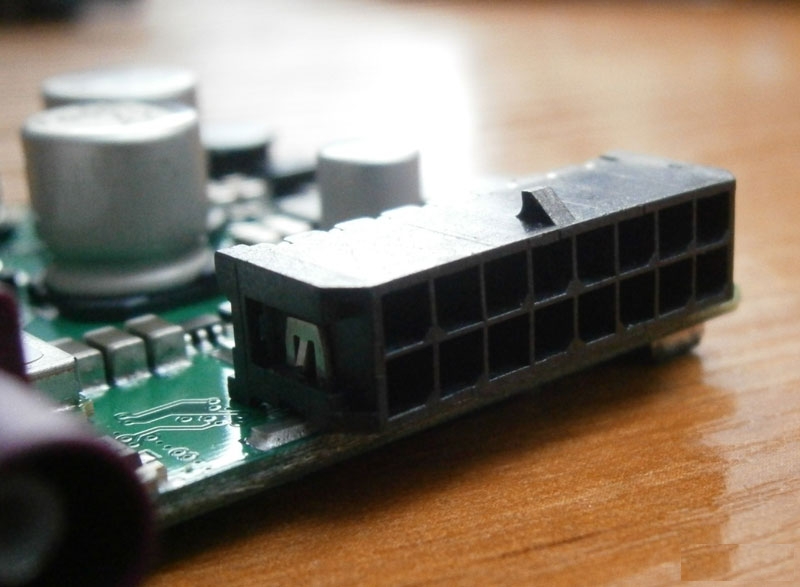
Micro-Fit and FAKRA are very convenient to seal, which means installers will not lose much time on this operation, which seems to me to be a plus too.
The device has 4 digital inputs. Each of them can be used as a pulse counter, as well as as a frequency meter. And although the measured frequency should not exceed 3 kHz, manufacturers say that, if necessary, it can be increased to 12-15 kHz. So far I have not had the opportunity to believe so.
There are 3 analog inputs in the device (1 input up to 16 V and 2 inputs up to 36 V). ADC gives an error of the order of 1.5%. The device has 2 outputs (closing minus) and one output with a stable positive voltage. It may be useful to power an additional device, but the same pin is used to connect a backup power source, so it will not work two functions at the same time, but it would be a pity it would be convenient. All outputs are controlled via SMS or GPRS.
It is also possible to connect fuel level sensors to the device (at the moment - up to 2 sensors via RS-232 or up to 4 sensors via RS-485).
Here are the protocols that BCE FM Blue supports:
As well as a 1-Wire interface (driver identification, the ability to connect temperature and humidity sensors). Of course, the number of supported protocols was impressive, you will not often find this on the market.
Convenient sleep mode settings turned out to be very relevant. Firstly, you can independently specify the criteria for entering sleep mode and waking up (vibration, external voltage, ignition, or any other digital input). And secondly, you can control the operation of GPS and GSM modules in sleep mode.
In addition to GPS data, the device also gives information received from GSM towers, including the distance to the tower. So the fact of moving the car can be fixed even if GPS does not work. And if you accumulate the base of towers, then it will be possible in this way even to determine the location of the device, with a discount on the error, of course.
The device transmits about 50 diagnostic codes (information about external voltage and current; state changes and errors when connecting to a GSM network, GPRS or server, GSM modem status, etc.), which can be very useful in different situations.
The manufacturer also provided XML settings for exporting already configured sensors to Wialon monitoring system objects . Everyone will be able to choose a sensor according to the needs of their business solution.
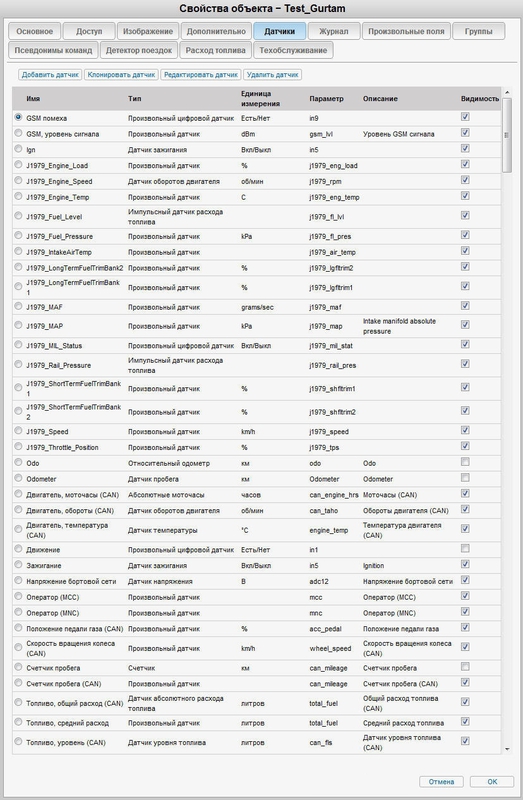
Well, of course, the data turned out to be pleasant that, compared with devices such as Teltonika FM4200 or Ruptela FM Pro3A, the device provides 50 percent savings on traffic, almost getting tired of the settings and the number of parameters transferred.
It turned out to be very convenient BCE Configuration Manager - a web-server for accounting and configuration of ALL controllers. With it, you can add new devices, change firmware, parameters and settings for each tracker, as well as create and edit lists of operators, relay data, and so on.
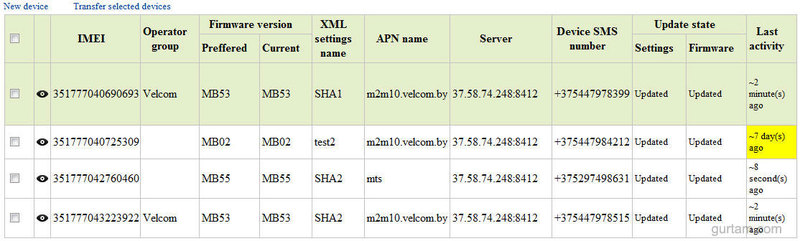
The idea is that all settings are changed using GPRS, which allows you to simply insert a SIM card into the module and connect it in the car, the service will automatically implement all other settings. BCE Configuration Manager also allows you to create groups of objects and change settings for them automatically, as well as create other users and delegate part of the rights to them.
All configurations can be edited independently in two modes: Simple mode and Advance mode.
It's nice to use Simple mode, which is obviously intended for visuals used to rearrange ticks and move sliders. And in this mode, of course, you can change only 20% of the parameters, but they are used in 80% of the solutions, this is enough to implement all standard functions, monitor inputs and CAN.
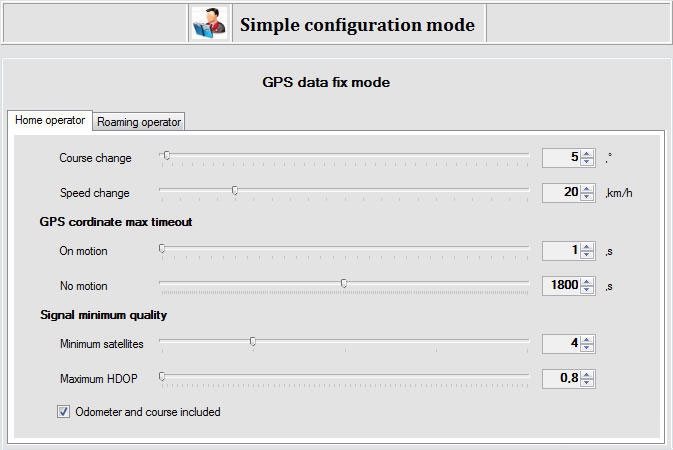
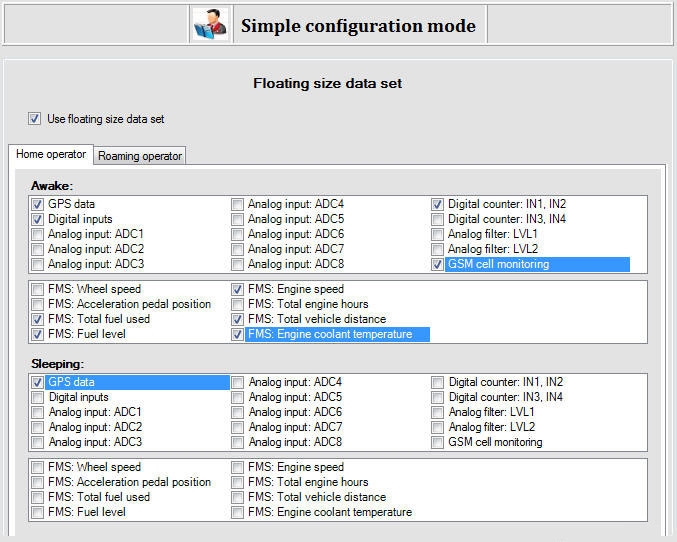
Advance Mode is more suitable for programmers or for very advanced users, quite difficult to use, but it can provide full access to tracker settings.
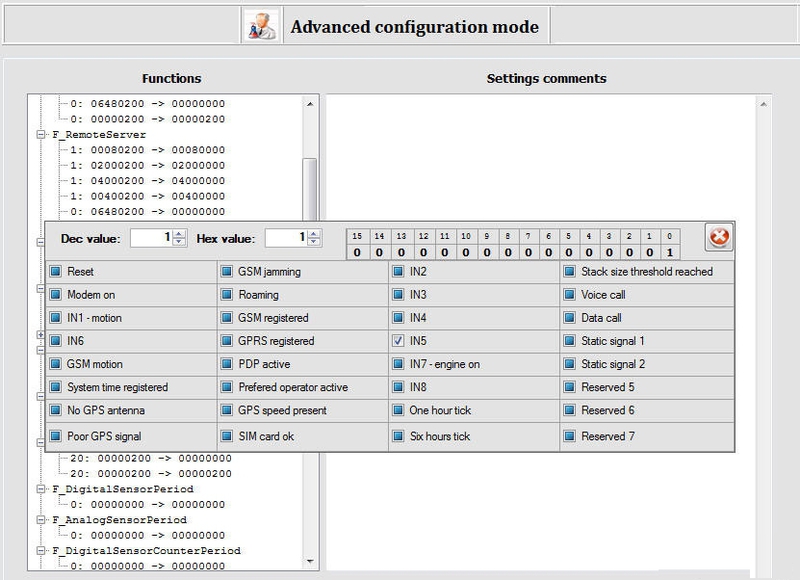
Everything had to be understood additionally in the concept of equipment configuration. At the heart of the work are two key concepts: events and functions.

Events are:
List of the most useful events:
All events have discrete values.
Function Description:
It makes no sense to list the entire list of functions and settings, but here are some of the most useful of them:
An example of a set of values for the function of collecting points over time:
A list of priority operators can be stored in the device’s memory and connection to GSM networks is carried out in accordance with this list, that is, the higher the operator in the list, the more priority it is.
An example of a set of values of a function responsible for the presence and amount of data that a device captures:
You can specify which CAN and OBD parameters will be generated under certain criteria or their combinations.
An example of a set of values for a function that opens GPRS sessions:
As a result, you can use various events and their combinations to control the frequency of data collection and the schedule for sending to the server. It is also possible to establish an Internet connection not only in time, but also in accordance with other conditions.
And here are the specific tracks of movement:
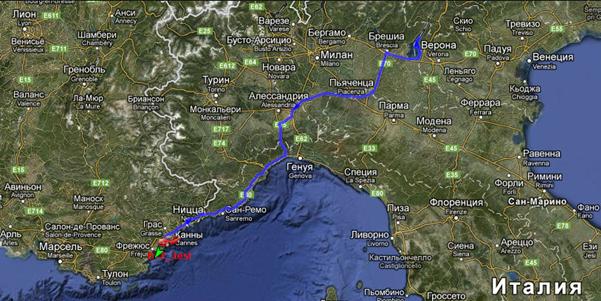

Minsk- Nice. Temperature +32 and crazy humidity drops. As a result, not a single satellite loss throughout the route.
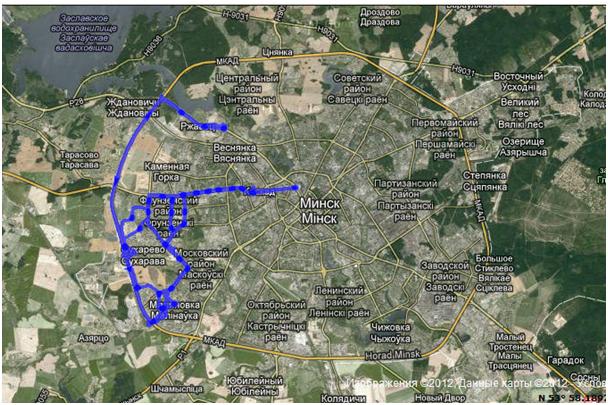
Detailed track within Minsk. Everything works perfectly.
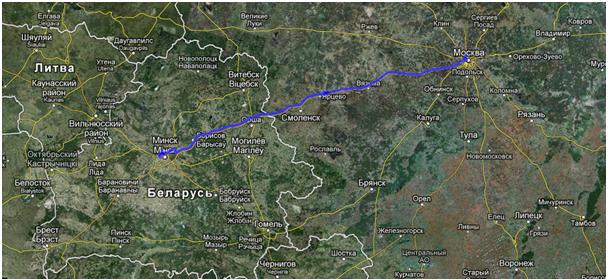

The classic route Minsk-Moscow - not a single loss of communication or freezing throughout the route.
As a result, I can say that the device is extremely functional and flexible to use. And of course, the low price in combination with the economical consumption of traffic and advanced functionality pleasantly surprise you.
It’s becoming more and more difficult to sort out these products of the competitive race of manufacturers. I’m reviewing BCE FM Blue, a controller from Baltic car equipment (BCE), a Lithuanian manufacturer of electronic equipment for cars.
FM blue- This is a GPS / GSM device that allows monitoring of mobile and stationary objects. The package includes a central unit, wires for connection, external GPS and GSM antennas and a 1A fuse.
It is quite convenient to determine the operation mode of the device thanks to the LED indication. Another unique advantage of BCE Blue is the complete absence of configuration connectors, as parameter programming is done via GPRS. If you work with a large number of such controllers, on each of them, in addition to the IMEI number, there is also a bar code that allows you to quickly and easily record devices, which saves a lot of time.
From myself, I note that when placing the central unit during the installation process, one should take into account the short length of the GPS cable and GSM antennas.
If it’s absolutely prosaic to list the technical characteristics of the device:
- Dimensions (HxWxD) - 26 x 80 x 55 mm.
- Weight - approximately 73 g.
- The range of operating temperatures in operation / storage mode is from -40? to +85? C.
- The supply voltage is 6–34 V, at least 10 V at startup.
- Consumption current: in active mode at 12V - less than 50 mA, in standby mode - less than 8 mA.
- Impulse protection - up to 120 V.
- Logging outages in the event log.
- 4 digital inputs.
- 1 x ADC - 0-16 V, 11 bits.
- 2 x ADC - 0-36 V, 11 bit.
- 2 digital outputs.
- CAN interface J1939 (FMS), J1979 (OBDII).
- 1-WIRE interface.
- RS-232 / RS485 interface.
- Ability to connect an external battery (Pb, 12V).
Initially disappointed by the lack of a built-in battery. But later it turned out that this model was provided for by manufacturers, since Li-Ion or NiMh batteries, widely used in most devices on the market, have a very narrow temperature range, which is especially noticeable at temperatures below zero. Also, these batteries have a limited number of charge / discharge cycles. Thus, the use of acidic external batteries is a deliberate choice of manufacturers, primarily because of their affordable price, lack of capacity limitations, as well as a wide temperature range.
The GSM module is one of the smallest modules in the world, the quad-band GSM / GPRS module Telit GE 865-QUAD. Despite its size, the module has an extended temperature range - from -40 ° C to + 85 ° C and is known for its reliability and stability. GPS-receiver is a module from the Swiss company U-Blox, which has also proven itself in the market.
GPS-modules NEO-6x , made by u-blox 6 technology, are small in size and low in power consumption, so that these characteristics are important, I think, everyone who works with m2m technologies. The built-in low-noise amplifier LNA is designed for use with both active and passive antennas. Also very interesting was the Kick Start mode, which makes it possible to carry out a “cold start” with a weak signal. The best result when testing about 30 seconds - the device showed in an open area.
I also liked the ability to configure the device so that every 20-30 minutes it would automatically connect to the satellite to download the latest data.
An obvious plus is the presence of the ATxmega256A3 microcontroller , which acts as a link between the GPS receiver, modem and peripheral devices, as well as the presence of a SIM card holder - Amphenol with gold-plated contacts.
We were pleased with the FAKRA antenna connectors . Connectors of different colors and with locks, so it is very difficult to get confused when connected. The main Molex Micro-Fit connector provides both electrical and mechanical connections and seems to be very reliable.
Micro-Fit and FAKRA are very convenient to seal, which means installers will not lose much time on this operation, which seems to me to be a plus too.
The device has 4 digital inputs. Each of them can be used as a pulse counter, as well as as a frequency meter. And although the measured frequency should not exceed 3 kHz, manufacturers say that, if necessary, it can be increased to 12-15 kHz. So far I have not had the opportunity to believe so.
There are 3 analog inputs in the device (1 input up to 16 V and 2 inputs up to 36 V). ADC gives an error of the order of 1.5%. The device has 2 outputs (closing minus) and one output with a stable positive voltage. It may be useful to power an additional device, but the same pin is used to connect a backup power source, so it will not work two functions at the same time, but it would be a pity it would be convenient. All outputs are controlled via SMS or GPRS.
It is also possible to connect fuel level sensors to the device (at the moment - up to 2 sensors via RS-232 or up to 4 sensors via RS-485).
Here are the protocols that BCE FM Blue supports:
- J1939 (CAN-interface) - the well-known FMS for trucks.
- The J1708 (RS-485 interface) is the predecessor of the J1939. Useful if you want to see fuel data on Renault and Volvo trucks. Note: support for this protocol will be implemented in one of the next firmware versions.
- OBD2 (CAN-interface) - a diagnostic protocol for cars (allows you to receive data on engine speed, coolant temperature, the need for engine diagnostics, fuel pressure, air temperature, as well as other useful diagnostic information).
As well as a 1-Wire interface (driver identification, the ability to connect temperature and humidity sensors). Of course, the number of supported protocols was impressive, you will not often find this on the market.
Convenient sleep mode settings turned out to be very relevant. Firstly, you can independently specify the criteria for entering sleep mode and waking up (vibration, external voltage, ignition, or any other digital input). And secondly, you can control the operation of GPS and GSM modules in sleep mode.
In addition to GPS data, the device also gives information received from GSM towers, including the distance to the tower. So the fact of moving the car can be fixed even if GPS does not work. And if you accumulate the base of towers, then it will be possible in this way even to determine the location of the device, with a discount on the error, of course.
The device transmits about 50 diagnostic codes (information about external voltage and current; state changes and errors when connecting to a GSM network, GPRS or server, GSM modem status, etc.), which can be very useful in different situations.
The manufacturer also provided XML settings for exporting already configured sensors to Wialon monitoring system objects . Everyone will be able to choose a sensor according to the needs of their business solution.
Well, of course, the data turned out to be pleasant that, compared with devices such as Teltonika FM4200 or Ruptela FM Pro3A, the device provides 50 percent savings on traffic, almost getting tired of the settings and the number of parameters transferred.
It turned out to be very convenient BCE Configuration Manager - a web-server for accounting and configuration of ALL controllers. With it, you can add new devices, change firmware, parameters and settings for each tracker, as well as create and edit lists of operators, relay data, and so on.
The idea is that all settings are changed using GPRS, which allows you to simply insert a SIM card into the module and connect it in the car, the service will automatically implement all other settings. BCE Configuration Manager also allows you to create groups of objects and change settings for them automatically, as well as create other users and delegate part of the rights to them.
All configurations can be edited independently in two modes: Simple mode and Advance mode.
It's nice to use Simple mode, which is obviously intended for visuals used to rearrange ticks and move sliders. And in this mode, of course, you can change only 20% of the parameters, but they are used in 80% of the solutions, this is enough to implement all standard functions, monitor inputs and CAN.
Advance Mode is more suitable for programmers or for very advanced users, quite difficult to use, but it can provide full access to tracker settings.
Everything had to be understood additionally in the concept of equipment configuration. At the heart of the work are two key concepts: events and functions.
Events are:
- Uncontrollable (for example, setting a roaming mode on a SIM card, GSM signal loss, device synchronizing time, etc.) - these events occur regardless of settings and are associated only with signal quality and / or other external circumstances.
- Conditionally controlled (turning off the GPS antenna, triggering inputs on the device, connecting to a priority GSM operator) - these events depend on physical actions in relation to the device and its inputs.
- Controlled functions (vibration and movement, speeding, setting up a GPRS connection, weak GPS signal, car generator operation etc.) - these events depend on the equipment settings and are triggered when the value of some internal changing parameter matches the value or level , which was set in the settings (in this case, these values and criteria for parameter control are set by special functions).
List of the most useful events:
- device modem is on;
- car movement is determined (conditions are set by the corresponding function);
- GPS antenna shutdown;
- weak GPS signal (conditions are set by the corresponding functions);
- GSM signal is muted (more than 80% of the signal);
- roaming mode of the SIM-card;
- GPRS installed
- TCP socket created (connection to server established);
- overspeed is detected (the limit is set by the corresponding function);
- The SIM card works with a priority operator (less expensive, for example, and the lists of priority operators themselves can be created and quickly edited in the web interface);
- the necessary amount of data has been collected for sending (it is set by the corresponding function, so you can configure the settings so that the packet size for sending always matches the details on the GSM operator’s tariff plan).
All events have discrete values.
Function Description:
- All functions have their own meanings.
- The values of functions may depend on a set of events (various combinations of them).
- The degree to which the function values depend on the event: 'true', 'false', 'don't care'.
- The values of the function can be constant and not depend on events at all.
- Depending on the conditions (set of events), there may be several function values.
- Some functions are intended for event management (i.e., in order to change the state of an event under certain conditions and other events)
It makes no sense to list the entire list of functions and settings, but here are some of the most useful of them:
An example of a set of values for the function of collecting points over time:
- 30 minutes - parking, SIM card in the home network;
- 1 hour - parking, roaming;
- 1 minute - movement, SIM card in the home network;
- 5 minutes - movement, roaming, connection to a priority operator;
- 10 minutes - movement, roaming, lack of connection to a priority operator.
A list of priority operators can be stored in the device’s memory and connection to GSM networks is carried out in accordance with this list, that is, the higher the operator in the list, the more priority it is.
An example of a set of values of a function responsible for the presence and amount of data that a device captures:
- GPS + LLS - when parking.
- GPS + CAN (OBD) + LLS - in motion.
- GPS - with the engine turned off.
- GPS + indication of the frequency at the inputs + LLS - with the engine running.
You can specify which CAN and OBD parameters will be generated under certain criteria or their combinations.
An example of a set of values for a function that opens GPRS sessions:
- 10 minutes - movement, SIM-card in the home network.
- 20 minutes - movement, roaming, connection to a priority operator.
- 40 minutes - roaming traffic, lack of connection to a priority operator.
- 1 hour - parking, roaming, connection to a priority operator.
- 4 hours - parking, roaming, lack of connection to a priority operator.
- 5 minutes - movement, roaming, the amount of data packet is equal to the volume of detail.
- 30 sec. - SIM card in the home network, GPS antenna disconnected.
As a result, you can use various events and their combinations to control the frequency of data collection and the schedule for sending to the server. It is also possible to establish an Internet connection not only in time, but also in accordance with other conditions.
And here are the specific tracks of movement:
Minsk- Nice. Temperature +32 and crazy humidity drops. As a result, not a single satellite loss throughout the route.
Detailed track within Minsk. Everything works perfectly.
The classic route Minsk-Moscow - not a single loss of communication or freezing throughout the route.
As a result, I can say that the device is extremely functional and flexible to use. And of course, the low price in combination with the economical consumption of traffic and advanced functionality pleasantly surprise you.