May 17, 2012 at 12:09
 HP, IBM, Cisco, and Hitachi Server Blade Comparison, Part One: Hardware Design, Cooling, Power

In this post, divided for convenience into several parts, I will compare the blade server platforms from the four most successful manufacturers in this segment. The comparison does not claim to be the ultimate truth and is not exhaustive - the subject will be the most important parameters, namely the hardware design, network infrastructure, features, the total cost of the system and the total cost of ownership. For comparison, open data is used. Conclusions about the arrangement of places in the comparison will be given in the last part of the comparison.
The material includes platforms
Cisco Unified Computing System (UCS)
HP BladeSystem c7000
IBM BladeCenter H
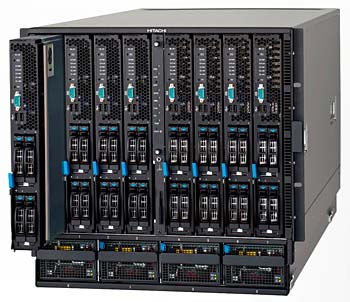
Hitachi Compute Blade 2000
So let's get started.
Hardware design
Cisco Unified Computing System (UCS)
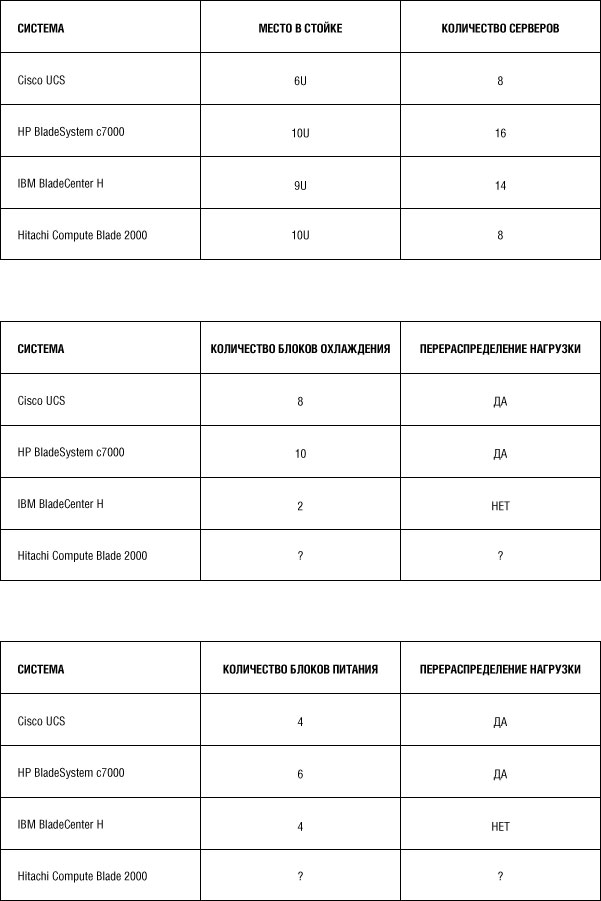
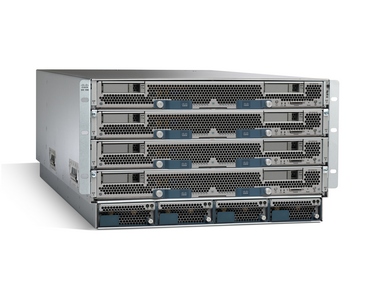
The server chassis is in a 6U rack, with a central switch requiring 1 or 2U. Up to 20 Chassis can be combined into a single system. The Fabric Interconnect central switch is responsible for switching and managing a distributed system. Servers inside the chassis are scaling units; they are neither managed nor switched domains. The number of servers in the chassis is 4 or 8, depending on the form factor of a particular model.
HP BladeSystem c7000
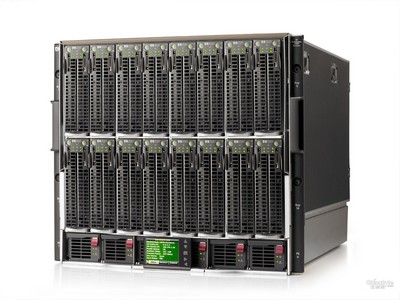
The server chassis is in a 10U rack. The blade infrastructure is traditional, switching is carried out at the chassis level. The number of servers in the chassis is up to 16, depending on the form factor of a particular model.
IBM BladeCenter H
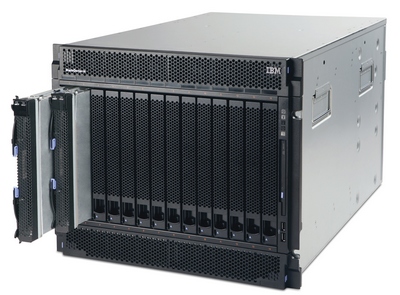
The server chassis is in a 9U rack. The blade infrastructure is traditional, switching is carried out at the chassis level. The number of servers in the chassis is up to 14, depending on the form factor of a particular model.
Hitachi Compute Blade 2000
The server chassis is in a 10U rack. The number of servers in the chassis is up to 8, depending on the form factor of a particular model.
Cooling
Cisco Unified Computing System (UCS)
UCS lacks control and switching components, which allows you to organize channels for the passage of air flow in front of server slots. For cooling, 8 fan blocks are responsible, the load can be redistributed between them depending on the intensity of specific servers. The chassis cooling system as a whole is well thought out, with a high density of the structure, the most productive servers are effectively cooled.
HP BladeSystem c7000
Up to 2 control modules and up to 8 switching modules are installed in the chassis, so the surface of the chassis available for blowing is seriously reduced. However, air ducts of complex configuration are provided for the passage of air flows. The tasks of efficient air blowing are assigned to 10 ventilation units with load redistribution.
IBM BladeCenter H
IBM BladeCenter H installs up to 2 control modules and up to 10 switching modules. This chassis also has a continuous backplane of a relatively small area, so the cooling air flows through it along complex paths. IBM BladeCenter differs from the other blade platforms under consideration by the presence of two main large-diameter fans. This solution, on the one hand, allows you to reduce the speed of rotation, but on the other hand, it does not allow flexible redistribution of the load depending on the heat emission of certain servers. The installation of high-performance servers may make it necessary to leave empty slots for better cooling and a corresponding loss of density.
Hitachi Compute Blade 2000
Unfortunately, in open sources there is no detailed description of the cooling subsystem of this chassis. The appearance of the chassis allows with a certain degree of probability to conclude that the solution should be close to the HP BladeSystem c7000, including several fan units and a closed rear of the chassis. The density of the elements in this chassis is lower than in others, and due to this it is able to cool more efficient servers with top-end processors.
Nutrition
Cisco UCS
The chassis uses 4 power supplies connected to a common bus supplying all active elements of the chassis, including servers and fans. Redundancy is implemented according to the N + N scheme, that is, every second block is redundant. There is the possibility of redistributing the load to increase the overall efficiency of the power system. The power system as a whole seems balanced.
HP BladeSystem c7000
The power scheme in the HP BladeSystem c7000 is generally similar to that of Cisco UCS, but its main difference is the number of power supplies - there are 6. At the same time, the system density is about two times higher, which indicates a slightly lower level of energy budget for powering a high-performance server . But an additional help here is the proprietary technology of load balancing, it is distributed to each block until a new connection is required, that is, the load level of each block at a selected point in time is close to 100%.
IBM BladeCenter H
IBM BladeCenter H is powered by a zone circuit — each of the two zones in the chassis is powered by its own two power supplies. The zone includes several server and switching blocks, which increases the risks - if both blocks are in the same zone during a failure, a failure may occur.
Hitachi Compute Blade 2000
The most informationally enclosed blade architecture remains a dark horse when using open sources. However, judging by the declared maximum power consumption of 9.6 kW, the chassis has a very good margin of safety. On the other hand, from these figures we can conclude that there is insufficient energy efficiency - in comparison with other platforms, the figure is extremely high.
For clarity, the results are summarized in tables:
Chassis Hardware Features