
 May 16, 2012 at 13:06
Inside View: Plastic Logic

On Monday, May 14, the first of three (held in Moscow, Dresden, Cambridge) PlasticLogic TechOpenDay was held at the Moscow office of RosNano . In view of the abundance of materials ( 1 , 2 , 3 ) devoted to this event and describing it, in my opinion, a little superficially, we will try to figure out what was presented to the public a couple of days ago.
How did I get to this event?
Quite by accident, on a working Saturday, the protagonist of a movie about prepreg phoned me and offered to attend this event. Honestly, at first I was wary of such an invitation, but the desire to see everything with my own eyes overcame the lack of time, and at 11-00 on Monday I was already considering the newcomers in the office of RusNano.
What is plastic electronics?
To understand what “plastic” and organic electronics are, it is best to familiarize yourself with the articles on the Wiki (unfortunately, there are no such articles in Russian in the volume in which they are presented in English): organic electronics , OFET (organic field -effect transistors) , organic semiconductors , conductive polymers .
In short, I would fundamentally share such things as organic semiconductors, OFET and just flexible electronics. Of course, technologically the easiest way to start is with conventional flexible electronics.when there is no need to reinvent the wheel, but you can simply replace the textolite with polymers that will play the role of the carrier of the rest of the silicon / metal filling.
Nowadays, flexible electronics can be found everywhere, especially in portable devices (from watches to communicators and digital cameras). By the way, once I happened to translate the review on flexible electronics - it presents quite interesting solutions. If the reader would be interested, I could try to find the translation mentioned above.
If someone needs a more scientific approach to the stated subject, then the main achievements in the field of flexible electronics can meet here , and on a flexible OLED here .
OFET is a bit more sophisticated technology than flexible electronics. Its main idea is to replace everything fragile, heavy and expensive (for example, glass, ITO, as a conductive layer on glass, etc.) with cheaper polymer materials. In this case, the dielectric (the layer between the drain / source and gate) can be either amorphized silicon oxide or a layer of another polymer.
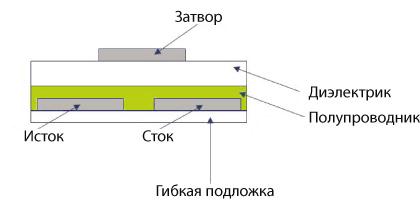
Schematic diagram of an OFET device
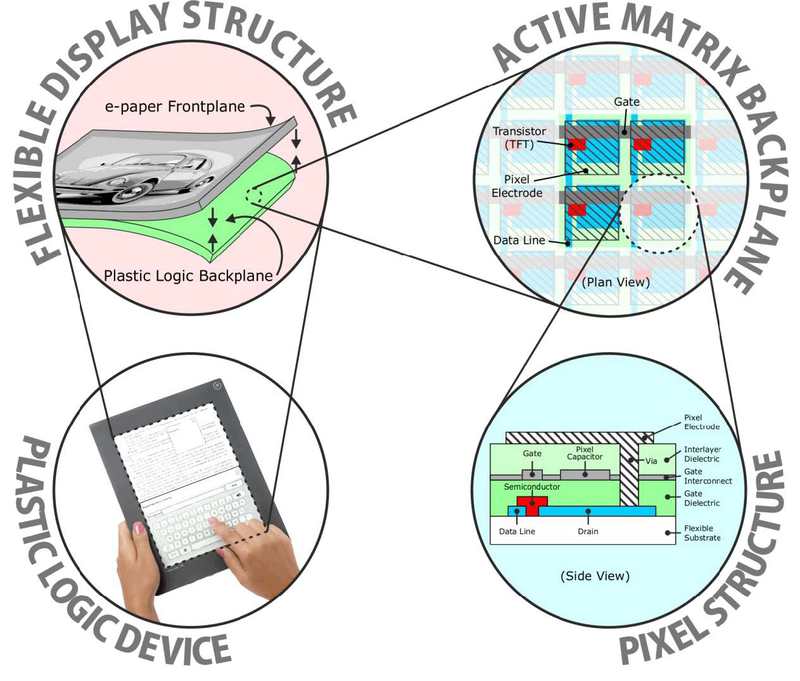
From a device to a separate OFET
Some types of polymers, for example, polyacetylene, have a “coupled” system of atomic orbitals, which, when a certain (frankly, not small) voltage is applied, makes the electrons tunnel from one atom to another, jump over, Thus, the electric current between the electrodes.
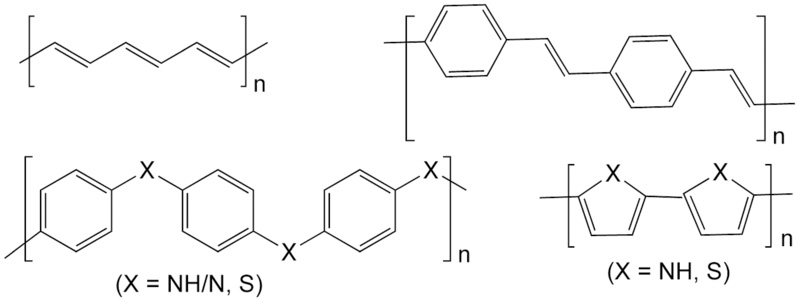
Examples of conductive polymers

Volt-ampere characteristic from Plastic Logic presentation. Please note: changing the current by an order of magnitude requires a potential difference of 10 V, and by 3 orders of magnitude - 30 V.
To understand what voltage for such jumps should be applied, take a look at the current-voltage characteristic taken from the English version of PlasticLogic's presentation. Changing the current by an order of magnitude requires 10 V, and by three orders of magnitude more than about 30 V, which is, to put it mildly, a bit much in comparison with silicon electronics (usually 5 V), but you have to sacrifice something.
Actually, this (the development and production of the TFT matrix of displays) forms the basis of the company's business, the ward of RosNano. In everything else, PlasticLogic readers are a hodgepodge. In addition, today, in addition to PlasticLogic, LG , a certain TRADIM organization , is promoting the ideology of plastic electronics , they say that even for the iPhone it has joined this race, so the competition will be serious.
And the last one. Fully organic microcircuits are a separate big issue that deserves a separate article. Maybe it is you,% username%, who wants to devote several days of painstaking search to this (I can even help;))?
But back to our ... experiments.
Experiment. Comparison of a regular E-Ink and a display from PlasticLogic.
We won’t say where, but a small piece of PlasticLogic was in my hands. What else is needed for happiness?
If you compare the pixel sizes with the most common E-Ink display, which, incidentally, was written about not so long ago , it turns out that the pixel sizes, or rather, the thin-film transistors that control these pixels, are quite comparable, that is, the manufacturer simply optimized the pixel structure for your technology, in some way without reducing their size (maybe the display hasn’t got a high resolution?):
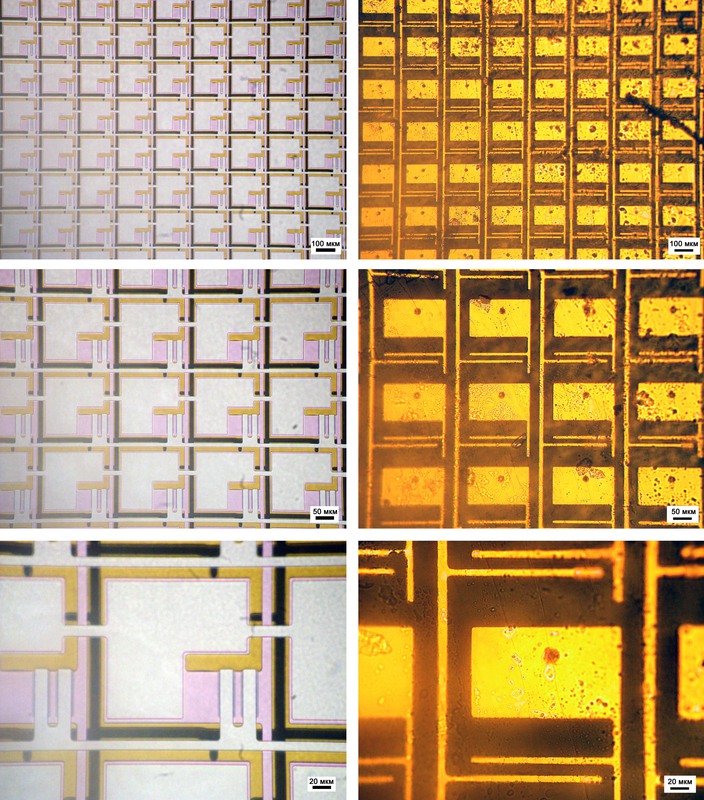
Comparison of the PocketBook E-Ink (left) and the PlasticLogic control matrix (right)
For connoisseurs of beauty, there are two reports: what E-Ink consists of and from which control transistors. As for the first one, there are some aluminum, titanium, chromium and copper in the E-Ink balls (that is, these are the elements that can make up the white and black dyes), and the film covering the electronic paper of a completely organic origin is really plastic electronics!
The second report is a little more interesting, as it is devoted to the story that silicon oxide is still used as an insulator in the transistors, and the contacts are made of gold, although PlasticLogic representatives at the presentation said that there are no rare metals, which is why production cheaper ...
Who spoke on behalf of PlasticLogic?
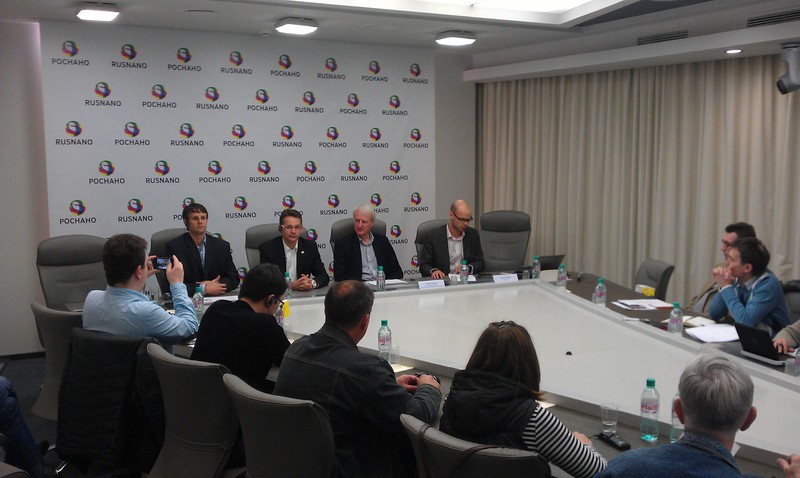
Peter Kitchin (second from right), vice president of the University of Cambridge Technology Center.
Peter Fisher (second from left), Vice President of Technology Engineering
David Gammy, senior manager of display development at Plastic Logic
Mike Banak (far left), senior scientific adviser at Plastic Logic
Read more about the speakers' biography here .
What was presented?
They talked about the history of the company, about people, technologies and trends ... Yes, I’m chatting all over - see for yourself (presentation in English, in Russian, because of indecent quality, I refuse to post it).
Of course, the most memorable were the color displays:
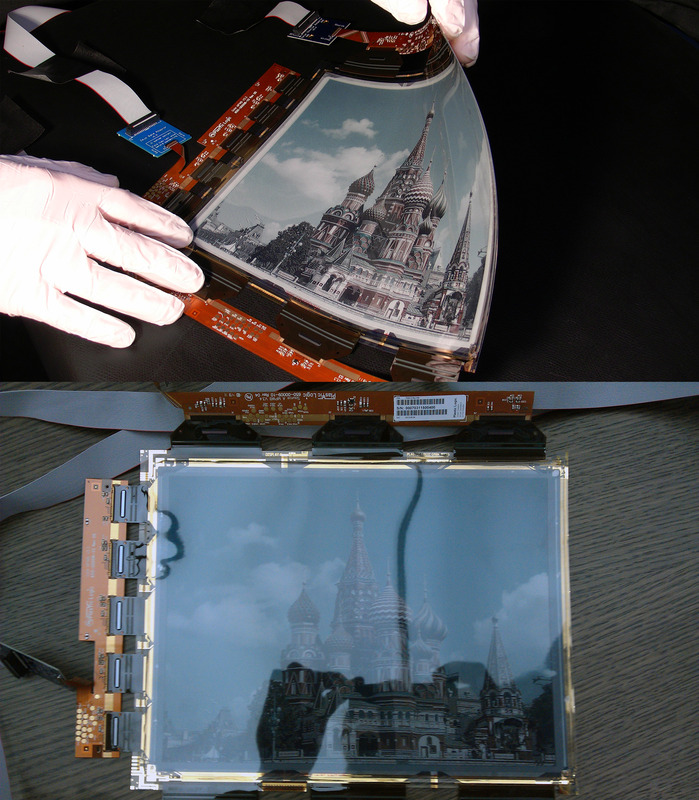
For comparison, a beautiful photo from the organizers (above) and how it actually looks (below). There is a lack of “anti-glare”
And a little more pale color photos:
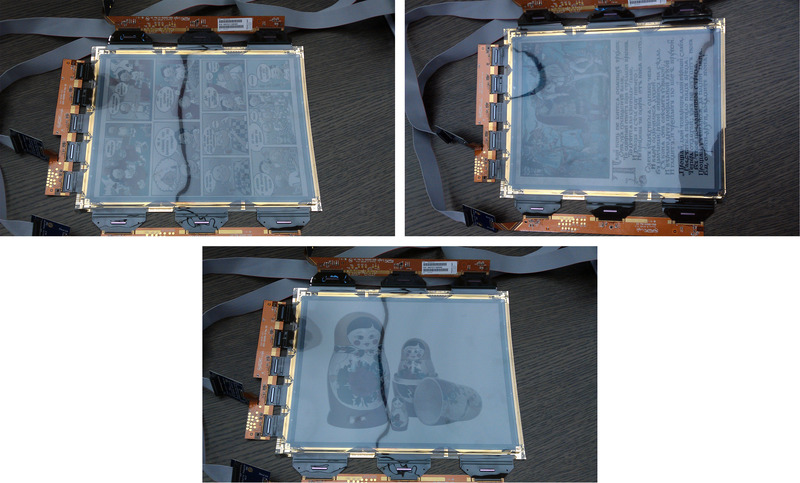
It is worth noting the perspicacity of the organizers - portable microscopes:
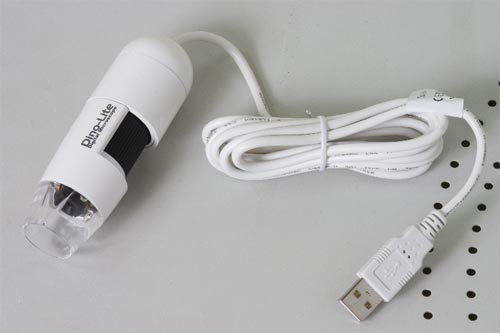
In my opinion, these cameras were used to demonstrate individual sub-pixels of displays ( here is an overview of microscopes)
Using these devices, we were able to look at color displays in a more familiar way, and also compare high resolution and low resolution:
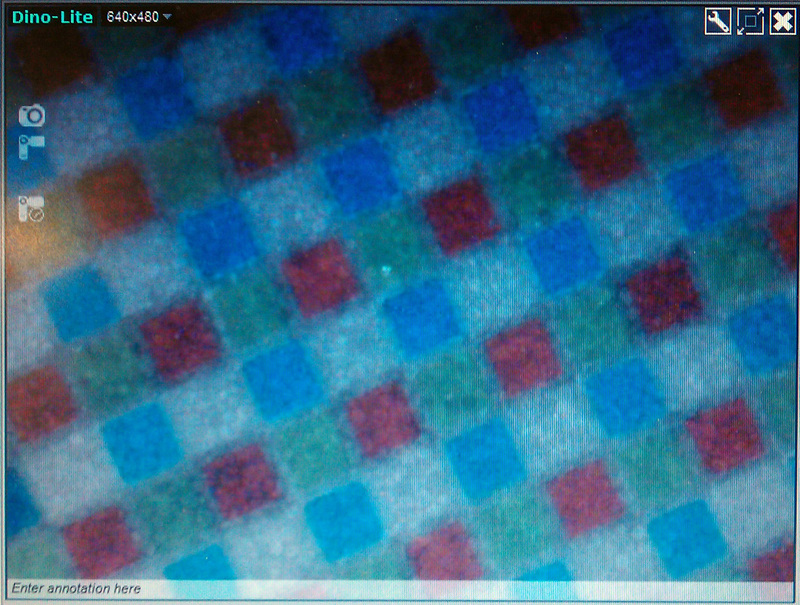
Just some pixels were painted in the appropriate colors ...
Yes, it is so simple! They simply applied an additional layer of color filters and the display became color.
By the way, the creation of a color display required the development of high-definition E-Ink. At the presentation there were displays with 225 PPI ( pixel per inch ). Since the formally declared color display resolution is 75 PPI, it turns out that PlasticLogic representatives obviously clamped the display with 280 PPI somewhere (4 sub-pixels form a pixel on the color display).
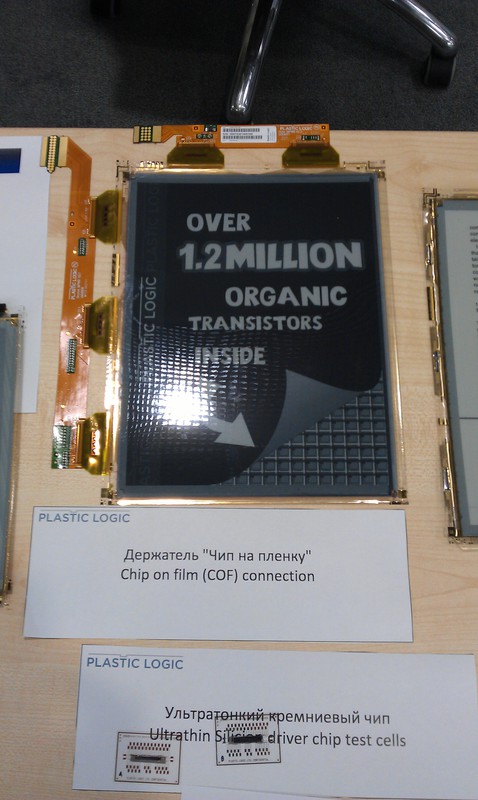
In addition to the transition to a pale color, a new trend was identified: the installation of ultra-thin silicon chips on a polymer substrate with pin assignment. Please note that all of the photos contain similar silicon chips, maybe these are drivers?
PlasticLogic can make displays of completely different sizes, but for some reason prefer A4 format to everyone else. For some reason, it seems to me that this is their main competitive advantage (in particular, in the Russian market).
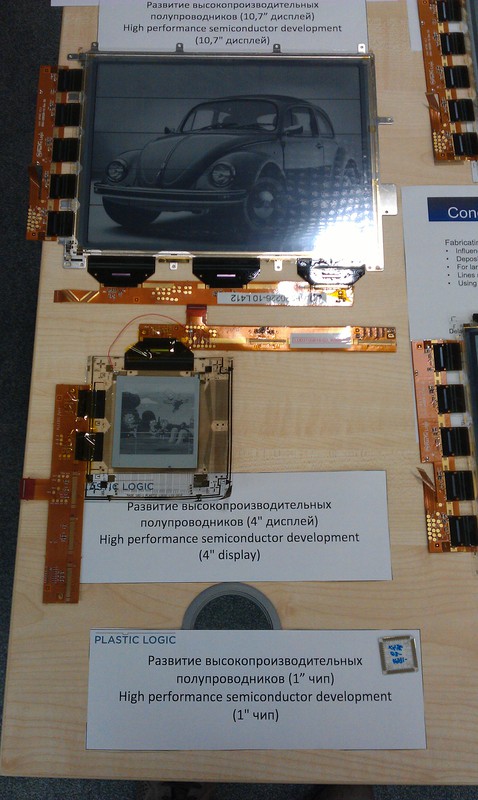
From small to large and vice versa ...
Thinner, lighter, faster and sharper - this is perhaps the slogan followed by PlasticLogic: The
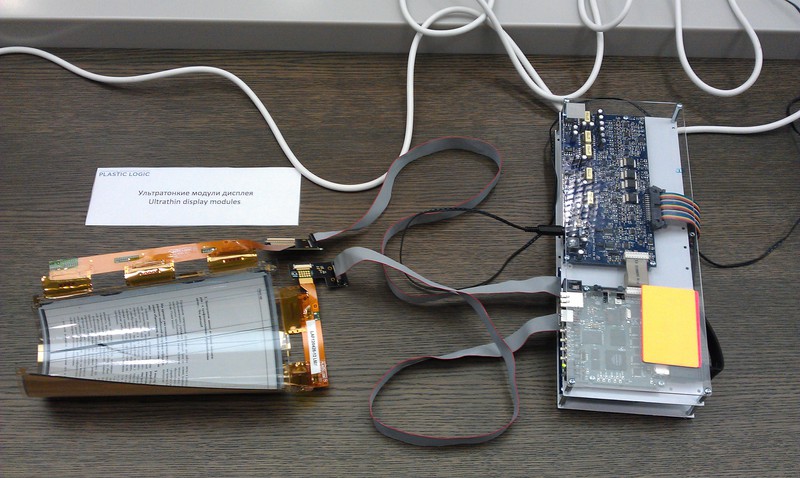
display is really the thinnest and lightest, however, during the presentation (2 hours) a lot of “killed” line of pixels appeared on it ...
This photo is worthy of the "Destroyers of Legends." It kept pounding me to ask how many such displays were needed so that the bullet would not go through - it could hardly hold on: the
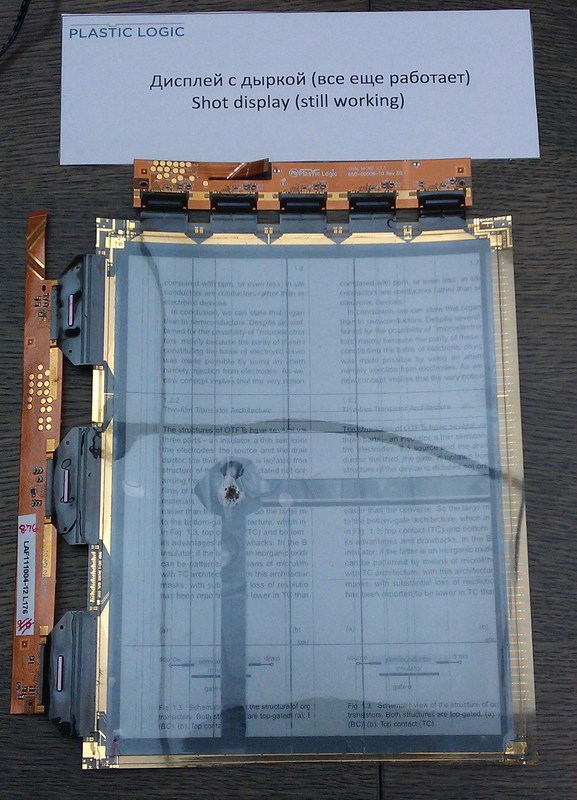
new market for PlasticLogic is body armor ... No joke, of course!
And another development of the company is matrices with the possibility of backlight, i.e. the manufacturer, together with RusNano, really wants to win the flexible TV market, and possibly new projects: A
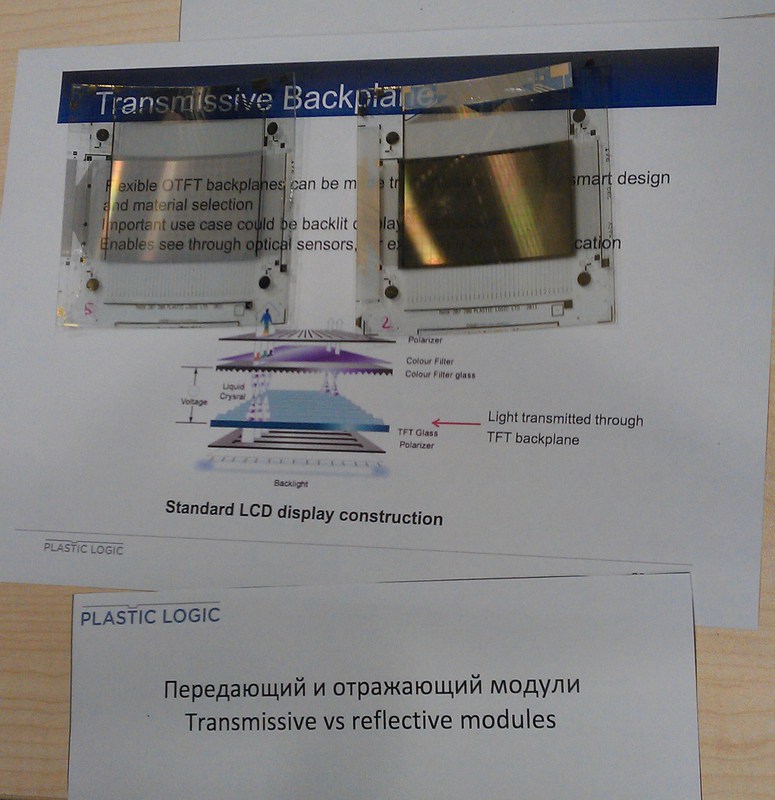
good start for flexible TVs and monitors, and possibly a revolution in image projection systems.
Moreover, there are even prototypes of flexible touch-displays, the use of which you can talk endlessly ... Yes, and in the above presentation, the areas of application of OFET are described in some detail - from RFID to TVs.
And finally, the sensational Chubais school reader is “unpacked” and “packed”. Well, let's see how it will be implemented. According to rumors, it is now expected to sign a contract for the supply of such readers, then the factory in Dresden will work to its fullest.
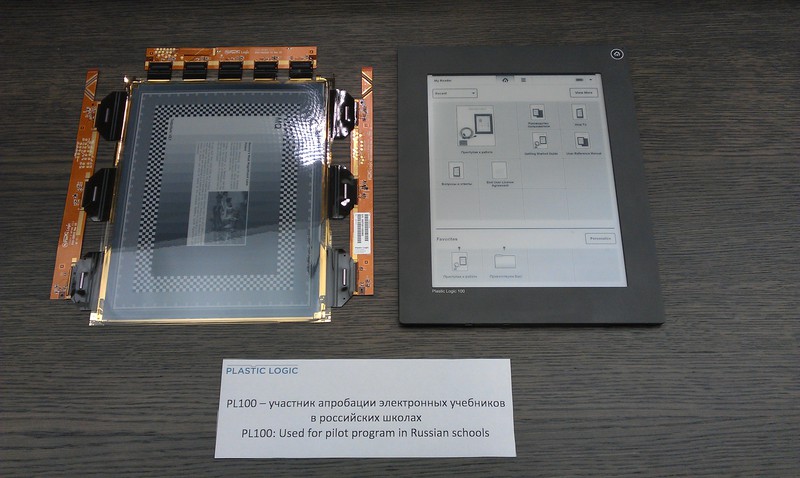
And finally, two videos. One trend is cutting the display. I can not deny myself the pleasure of demonstrating it:
And a keepsake photo:

It's alive! It's alive !!!
The second video demonstrates what movies in the E-Ink format to be. I already vividly imagine textbooks on school chemistry or physics with the revived Copernicus, Newton, telling about their laws, or atoms that either want or don't want to interact ... Already pulling back to school. Favorite jokes will definitely come to life:
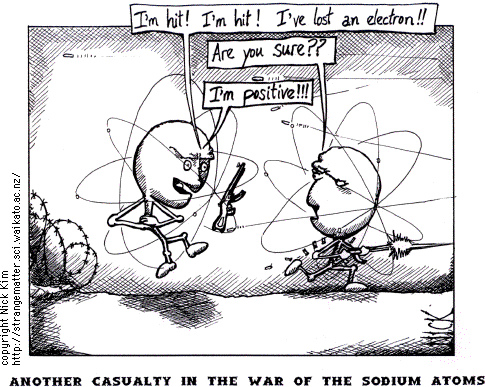
conclusions
Conclusions that I made for myself after the presentation.
Firstly , the transition to plastic electronics is inevitable: due to the appreciation of the rare metals used today in the manufacture of displays, and the desire for miniaturization. This is only a matter of time and technology development.
Secondly , RosNano in the person of PlasticLogic very early joined this race. This is not a used line at the Sitronics factory with a morally obsolete 90-nm process technology. This is the leading edge of one of the directions of development of modern microelectronics. And I’m ready to give up and give the opportunity to do all key developments in England, in the Cavendish Cambridge laboratory, the main thing is that then the production from Dresden will be transferred to us (while we are talking about Zelenograd).
Thirdly, shows interesting solutions and development directions: transparent matrices (imagine a car in which the windshield is equipped with such a device and which displays a map, navigation, etc., or a TV / projector 2 by 3 meters in size), touch panels (applications virtually limitless), color and high-speed displays. All this can make another small but important revolution in IT and human-computer communication interfaces.
In the end, I would like to add only one question: when will we learn to print microcircuits directly on our body? And it seems to me that very soon ...
PS : A few more entertaining videos from the PlasticLogic channel on YouTube.
How the factory in Dresden works:
Backlit reader:
Display bullying:
Tell me where to buy such a watch ?!
Firstly , a complete list of published articles on Habré:
Opening the Nvidia 8600M GT chip , a more detailed article is given here: Modern chips - an inside look Inside
view: CD and HDD
Inside view: LED bulbs
Inside view: LED industry in Russia
Inside view: Flash -memory and RAM
Inside view: the world around us
Inside view: LCD and E-Ink displays
Inside view: digital camera arrays
Inside view: Plastic Logic
Inside view: RFID and other marks
Inside view: graduate school in EPFL. Part 1
Inside Look: Graduate School at EPFL. Part 2
Inside view: the world around us - 2
Inside view: the world around us - 3
Inside view: the world around us - 4
Inside view: 13 LED lamps and a bottle of rum. Part 1
Inside view: 13 LED lamps and a bottle of rum. Part 2
Inside view: 13 LED lamps and a bottle of rum. Part 3
Inside Look: IKEA LED Strikes Back
Inside Look: Are Filament Lamps So Good?
and 3DNews:
Microview: comparing displays of modern smartphones
. Secondly , in addition to the HabraHabr blog , articles and videos can be read and viewed on Nanometer.ru , YouTube , and Dirty .
Thirdlyif you, dear reader, liked the article or you want to stimulate writing new ones, then proceed according to the following maxim: "pay what you want"
Yandex.Money 41001234893231
WebMoney (R296920395341 or Z333281944680)
Sometimes it is possible to read briefly, and sometimes not so much about the news of science and technology on my Telegram channel - we are welcome;)