Exynos 5250: Smarter, Greener!
Almost a year has passed since we talked about the representative of “green and smart” ARM processors: Exynos 4210 , which became the crown of the flagship Samsung GALAXY S II . And now, there was another occasion for discussion and expectations: Samsung Semiconductors launches the fresh Exynos 5250 processor in mass production.
The new architecture, designed to replace the Cortex-A9 CPU core on the market, was announced by ARM two years ago. It is with these processors that most smartphones and tablets are equipped with today. The brand new Cortex-A15 (codenamed Project Eagle: James Bond - neither give nor take) will take the next milestone of frequency, supporting the device at an impressive 2.5 GHz. This will enable ARM to enter a new level of competition for performance in a wide range of devices, even in servers.
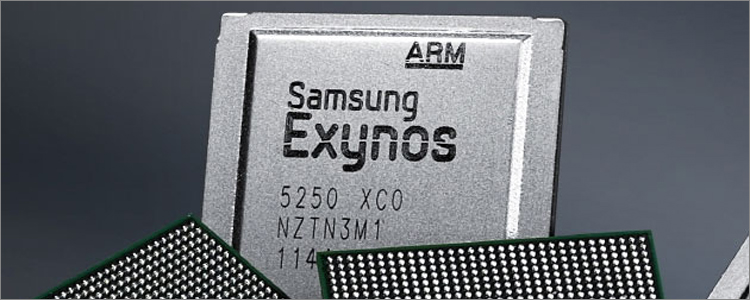
It's no secret that new mobile devices appear on the market literally every week, but processor architectures are updated only once every 2-3 years. The upcoming ARM Cortex-A15 is all the more interesting. Many companies are working hard on solutions based on this chip, but Samsung already has something to show.
Ever since the Samsung Exynos 5250 was announced last year, only lazy people haven’t read about it. The company produces a new processor using the technology of metal gates and high-k dielectrics (High-K Metal Gate), using its own 32-nm low-power manufacturing process. The processor consists of two Cortex-A15 cores with a frequency of up to 2 GHz and a new generation 4-core accelerator ARM Mali-T604. The transition to the 32-nm process technology, coupled with new energy-saving technologies, allowed us to reduce power consumption in the Exynos 5250 by 40-50% compared to the chips that were created earlier using the 45-nm technology.
In the picture below, you can see how much power consumption is reduced in 2-core Exynos 4212 processors, made using the 32-nm process technology against the predecessor Exynos 4210, using 45-nm manufacturing technology.

Exynos 5250 with a new ARM chip can process 14 billion instructions per second (DMIPS) at a frequency of 2 GHz. This figure is twice the capacity of the 2-core Cortex-A9 at a frequency of 1.4 GHz. The memory bandwidth was also doubled: up to 12.8 GB / s - thanks to the 2-channel 32-bit LPDDR2 / DDR3 memory controller with a frequency of 800 MHz.
As for the ARM Mali-T604 graphic 4-core accelerator, it is difficult to evaluate or objectively compare with anything, because no mobile device has ever carried something similar on board. According to Samsung, the Exynos 5250 will be 4 times faster than the Mali-400 graphics used in the GALAXY S II. Among the key accelerator supported APIs are: OpenVG 1.1, OpenGL ES 2.0, DirectX 11, and OpenCL 1.1.
Exynos 5250 supports resolutions up to WQXGA (2560x1600), which corresponds to the capabilities of the “company-which-we-don't-call” display, produced, by the way, also by Samsung. One solution aimed at saving energy is based on the eDP (embeded Display Port) interface. eDP is compatible with Panel Self Refresh (PSR) technology, which tells the processor not to display data on the LCD panel if a static picture is displayed.
The 4-line MIPI connection allows the support of the highest resolution sensors: 8-MP images are processed at up to 30 frames per second thanks to the ISP processor.
It is worth mentioning the built-in support for high-speed USB 3.0, SATA3, UART, as well as HSIC and C2C interfaces that interact with LTE modules. The eMMC 4.5 standard is also supported, which provides an internal MMC speed of up to 200 MB / s.

Undoubtedly, the Exynos 5250 is designed to replace Qualcomm's solutions in all future Samsung devices. It should compete strongly with the Qualcomm S4 processor, built on its own Krait architecture.
Video:
Specifications: tyk!
The new architecture, designed to replace the Cortex-A9 CPU core on the market, was announced by ARM two years ago. It is with these processors that most smartphones and tablets are equipped with today. The brand new Cortex-A15 (codenamed Project Eagle: James Bond - neither give nor take) will take the next milestone of frequency, supporting the device at an impressive 2.5 GHz. This will enable ARM to enter a new level of competition for performance in a wide range of devices, even in servers.
It's no secret that new mobile devices appear on the market literally every week, but processor architectures are updated only once every 2-3 years. The upcoming ARM Cortex-A15 is all the more interesting. Many companies are working hard on solutions based on this chip, but Samsung already has something to show.
Ever since the Samsung Exynos 5250 was announced last year, only lazy people haven’t read about it. The company produces a new processor using the technology of metal gates and high-k dielectrics (High-K Metal Gate), using its own 32-nm low-power manufacturing process. The processor consists of two Cortex-A15 cores with a frequency of up to 2 GHz and a new generation 4-core accelerator ARM Mali-T604. The transition to the 32-nm process technology, coupled with new energy-saving technologies, allowed us to reduce power consumption in the Exynos 5250 by 40-50% compared to the chips that were created earlier using the 45-nm technology.
In the picture below, you can see how much power consumption is reduced in 2-core Exynos 4212 processors, made using the 32-nm process technology against the predecessor Exynos 4210, using 45-nm manufacturing technology.
Exynos 5250 with a new ARM chip can process 14 billion instructions per second (DMIPS) at a frequency of 2 GHz. This figure is twice the capacity of the 2-core Cortex-A9 at a frequency of 1.4 GHz. The memory bandwidth was also doubled: up to 12.8 GB / s - thanks to the 2-channel 32-bit LPDDR2 / DDR3 memory controller with a frequency of 800 MHz.
As for the ARM Mali-T604 graphic 4-core accelerator, it is difficult to evaluate or objectively compare with anything, because no mobile device has ever carried something similar on board. According to Samsung, the Exynos 5250 will be 4 times faster than the Mali-400 graphics used in the GALAXY S II. Among the key accelerator supported APIs are: OpenVG 1.1, OpenGL ES 2.0, DirectX 11, and OpenCL 1.1.
Exynos 5250 supports resolutions up to WQXGA (2560x1600), which corresponds to the capabilities of the “company-which-we-don't-call” display, produced, by the way, also by Samsung. One solution aimed at saving energy is based on the eDP (embeded Display Port) interface. eDP is compatible with Panel Self Refresh (PSR) technology, which tells the processor not to display data on the LCD panel if a static picture is displayed.
The 4-line MIPI connection allows the support of the highest resolution sensors: 8-MP images are processed at up to 30 frames per second thanks to the ISP processor.
It is worth mentioning the built-in support for high-speed USB 3.0, SATA3, UART, as well as HSIC and C2C interfaces that interact with LTE modules. The eMMC 4.5 standard is also supported, which provides an internal MMC speed of up to 200 MB / s.
Undoubtedly, the Exynos 5250 is designed to replace Qualcomm's solutions in all future Samsung devices. It should compete strongly with the Qualcomm S4 processor, built on its own Krait architecture.
Video:
Specifications: tyk!