March 12, 2012 at 20:36
Cisco 1000 Series Routers
Hello, dear Khabrovites!
I would like to tell you about the Cisco 1000 Series of routers that preceded the introduction of the 2500 Series routers.
It so happened that I had two devices in my hands - routers 1020 and 1005.
I want to start with 1020, which is, in my opinion, more interesting.
So, the first Cisco 1020 router was shipped to customers in April 1995, and the last order was accepted in mid-October 1996. Its capabilities were very modest - one 10Base-T LAN interface and the ability to connect two analog modems, one of which was connected to the AUX port combined with the console port, and the second to the built-in PCMCIA slot. For each modem, an initialization string was required.
This router is running ComOS and neither before nor after this device, I did not come across the slightest mention of this operating system. Judging by the "hereditary" signs, she is the progenitor of IOS 11.x, but does not have command line autocompletion and a slightly unusual syntax - for example, the show version and show hardware commands are identical, but the latter has disappeared from use, the rip protocol is configured on each interface individually, etc.
There is only one user in the system - enable, and if you forget the password, then it is currently not possible to restore it. My copy fell into my hands in 2003 and after some correspondence with Cisco TAC, I managed to recover the password, but now Cisco is only talking about stopping support for this device. The main problem with password recovery is that by simple manipulation a CHALLENGE is generated, which is sent to the TAC and RESPONSE is reported in response, which allows resetting the enable password.
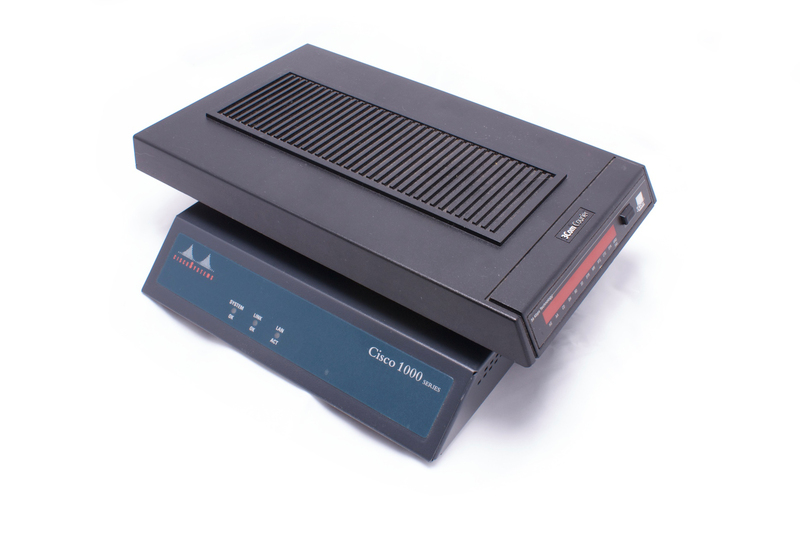
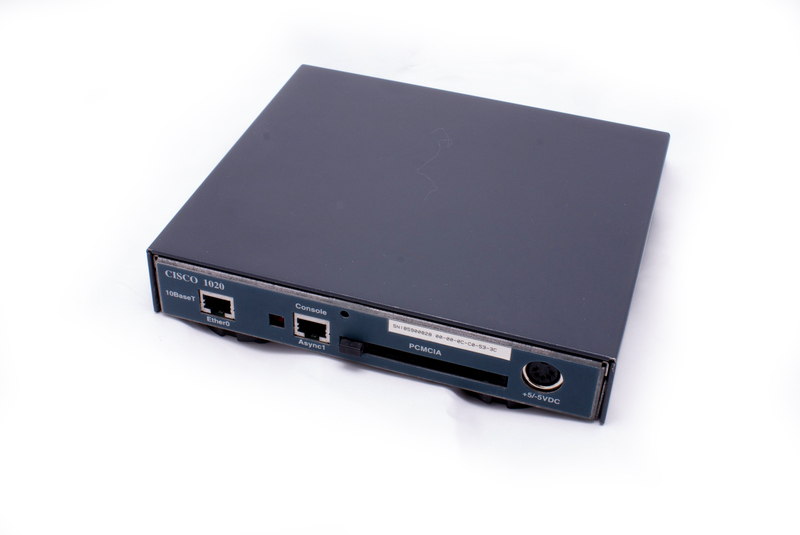
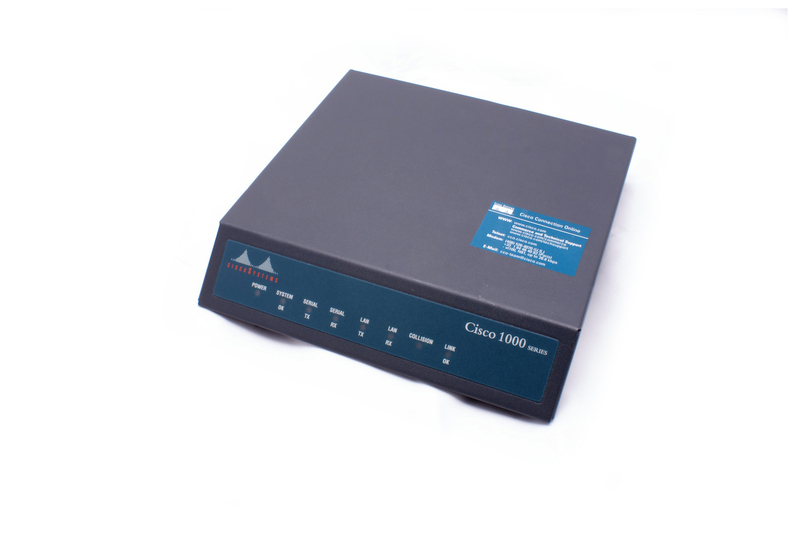
Photos of the appearance of the router:
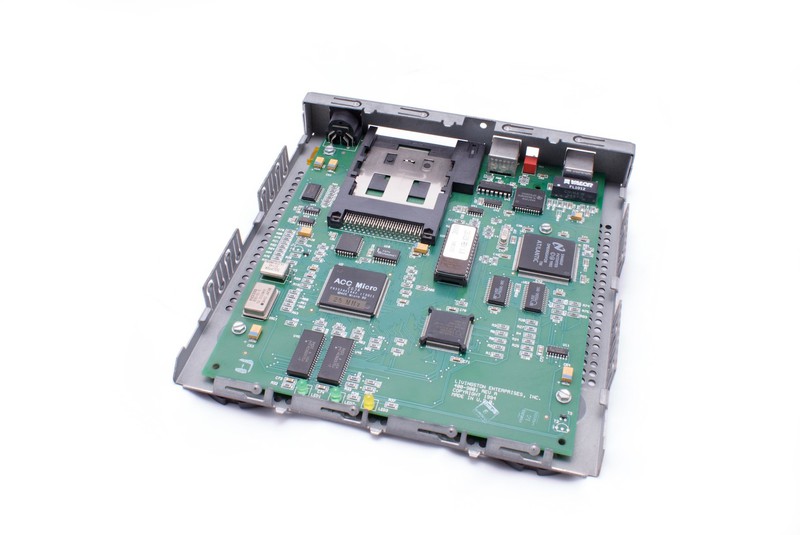
Rich inner world:
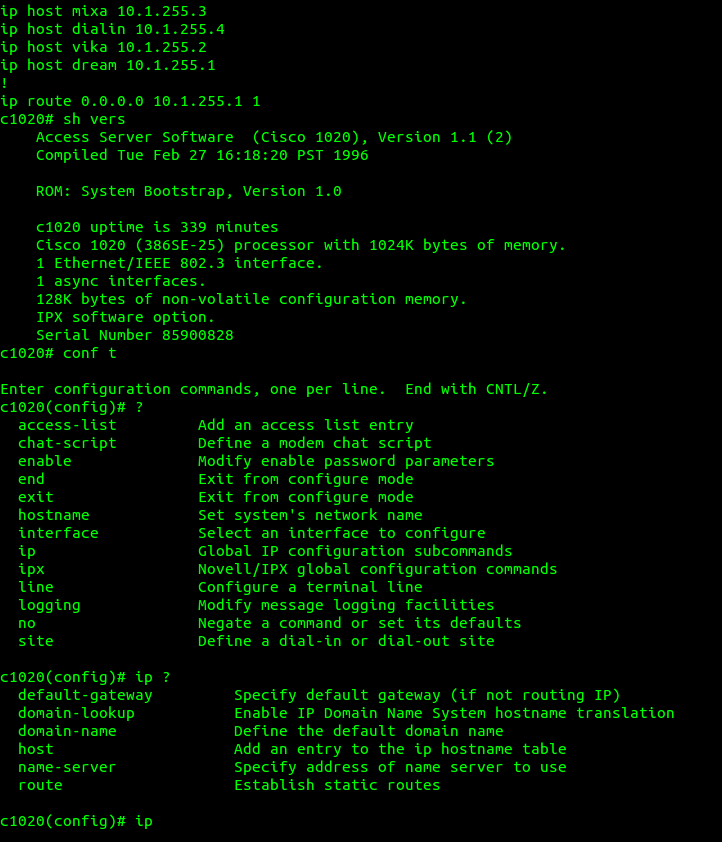
As you can see from the screenshots of the command line below, this router can quite successfully accept incoming connections or make calls to the head office (which, in fact, it has been doing for a long time), but it does not know how to NAT, which makes it completely useless outside a closed corporate network .
The main features of ComOS are:
Quite unconventionally, in my opinion, the use of the AMD 386-25 processor, although its performance is quite enough. ComOS is located on the flash-memory chip, but it is not possible to update it, although I came across references to firmware version 1.2.
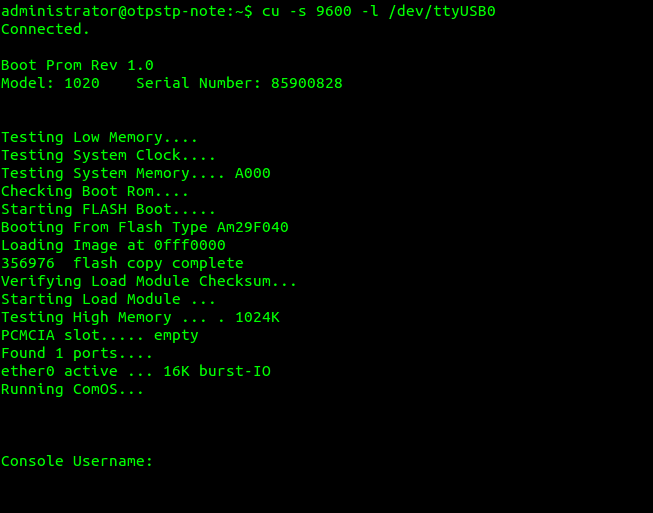
In the screenshots, the relationship with modern IOS is quite clearly visible:

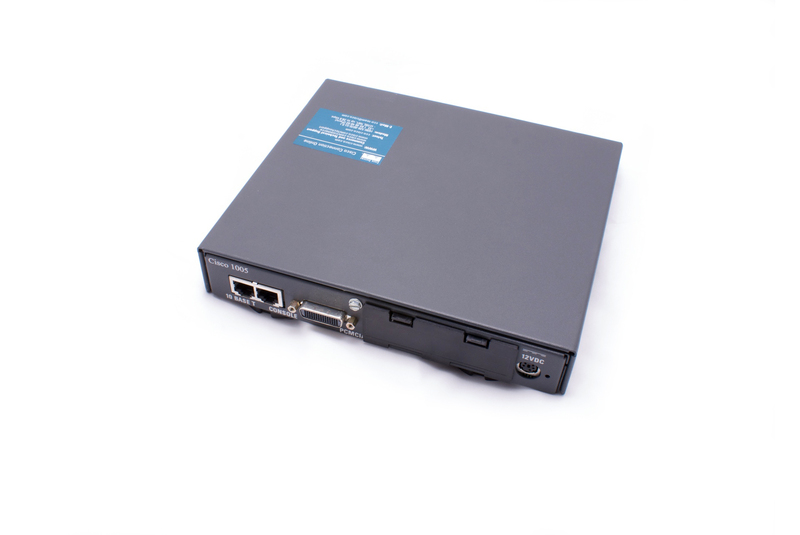
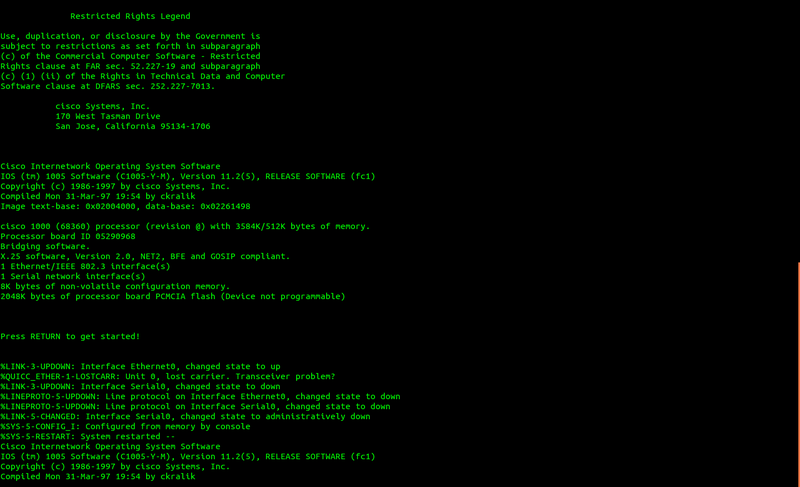
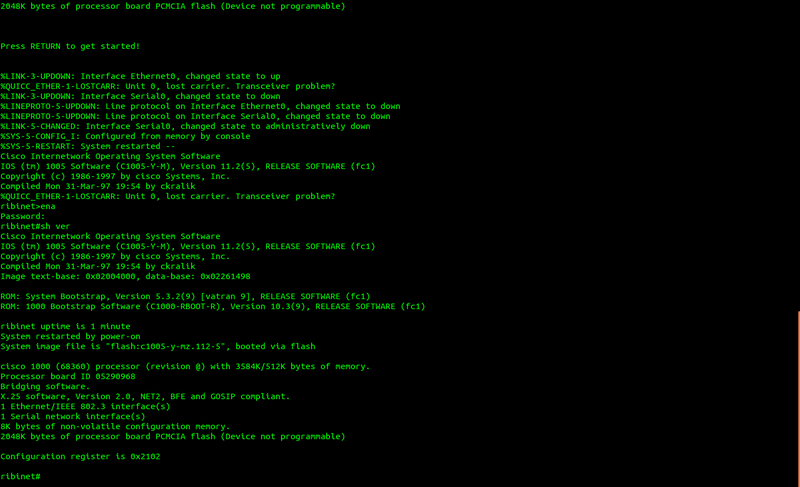
Cisco 1005 replaced this router. Despite the lower index, it was a device running full-fledged IOS version 11, a flash card installed in the PCMCIA slot made it possible to keep IOS up to date, and as the processor used a chip manufactured by Motorola. The serial interface was able to function both in synchronous (up to 2 mb / s) and in asynchronous mode (up to 115.200 kb / s).
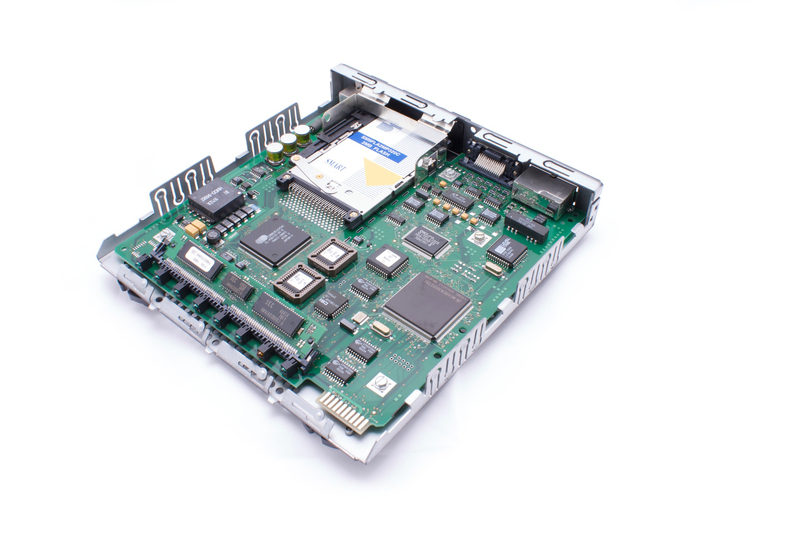
Inside view. You can see the memory bar and a few chips:
Unfortunately, in iOS 11.2. there is also no NAT support, although there are already very advanced packet management capabilities - route-map, ACL. The dynamic routing protocols RIP, IGRP, EIGRP are supported. Remote management is carried out by telnet protocol, SNMP is supported.
If you find a PCMCIA Flash-card, it is possible to upgrade iOS to version 12.07, where there is support for NAT, although at present, this can only be of sporting interest. If there is no flash at hand, then you can download the image from the TFTP server. Also, it is possible to increase RAM - using a regular SIMM.
The configuration looks very traditional:
That's all for today. I believe that the old iron is like the ancient gods: they fade, fade, but do not die forever. At my previous place of work, the old Cisco 2509 is still used to access the consoles of other routers and something tells me that it will stand idle for a very long time.
Do not forget that such devices were preceded by modern 10Gbs interfaces and record volumes of transmitted traffic. Evolution, however.
I would like to tell you about the Cisco 1000 Series of routers that preceded the introduction of the 2500 Series routers.
It so happened that I had two devices in my hands - routers 1020 and 1005.
I want to start with 1020, which is, in my opinion, more interesting.
So, the first Cisco 1020 router was shipped to customers in April 1995, and the last order was accepted in mid-October 1996. Its capabilities were very modest - one 10Base-T LAN interface and the ability to connect two analog modems, one of which was connected to the AUX port combined with the console port, and the second to the built-in PCMCIA slot. For each modem, an initialization string was required.
This router is running ComOS and neither before nor after this device, I did not come across the slightest mention of this operating system. Judging by the "hereditary" signs, she is the progenitor of IOS 11.x, but does not have command line autocompletion and a slightly unusual syntax - for example, the show version and show hardware commands are identical, but the latter has disappeared from use, the rip protocol is configured on each interface individually, etc.
There is only one user in the system - enable, and if you forget the password, then it is currently not possible to restore it. My copy fell into my hands in 2003 and after some correspondence with Cisco TAC, I managed to recover the password, but now Cisco is only talking about stopping support for this device. The main problem with password recovery is that by simple manipulation a CHALLENGE is generated, which is sent to the TAC and RESPONSE is reported in response, which allows resetting the enable password.
Photos of the appearance of the router:
Rich inner world:
As you can see from the screenshots of the command line below, this router can quite successfully accept incoming connections or make calls to the head office (which, in fact, it has been doing for a long time), but it does not know how to NAT, which makes it completely useless outside a closed corporate network .
The main features of ComOS are:
- Support IP, Novell IPX for LAN interface
- Support for WAN protocols: PPP (support for IP and IPX), IPX Control Protocol, SLIP, compressed SLIP. Authentication using PAP and CHAP. Dial-on-demand dialing, PPP header compression.
- Support ACL, SNMP MIB II
- Static routing, support of the dynamic routing protocol RIP for IP and IPX
Quite unconventionally, in my opinion, the use of the AMD 386-25 processor, although its performance is quite enough. ComOS is located on the flash-memory chip, but it is not possible to update it, although I came across references to firmware version 1.2.
In the screenshots, the relationship with modern IOS is quite clearly visible:
Cisco 1005 replaced this router. Despite the lower index, it was a device running full-fledged IOS version 11, a flash card installed in the PCMCIA slot made it possible to keep IOS up to date, and as the processor used a chip manufactured by Motorola. The serial interface was able to function both in synchronous (up to 2 mb / s) and in asynchronous mode (up to 115.200 kb / s).
Inside view. You can see the memory bar and a few chips:
Unfortunately, in iOS 11.2. there is also no NAT support, although there are already very advanced packet management capabilities - route-map, ACL. The dynamic routing protocols RIP, IGRP, EIGRP are supported. Remote management is carried out by telnet protocol, SNMP is supported.
If you find a PCMCIA Flash-card, it is possible to upgrade iOS to version 12.07, where there is support for NAT, although at present, this can only be of sporting interest. If there is no flash at hand, then you can download the image from the TFTP server. Also, it is possible to increase RAM - using a regular SIMM.
The configuration looks very traditional:
That's all for today. I believe that the old iron is like the ancient gods: they fade, fade, but do not die forever. At my previous place of work, the old Cisco 2509 is still used to access the consoles of other routers and something tells me that it will stand idle for a very long time.
Do not forget that such devices were preceded by modern 10Gbs interfaces and record volumes of transmitted traffic. Evolution, however.