August 11, 2011 at 21:54
Modern biometric identification methods
Recently on Habré there are a lot of articles devoted to the Google facial identification systems. To be honest, from many of them it bears journalism and, to put it mildly, incompetence. And I wanted to write a good article on biometrics, it’s not in the first one! There are a couple of good articles on biometrics on Habré - but they are quite short and incomplete. Here I will try to briefly outline the general principles of biometric identification and the modern achievements of mankind in this matter. Including identification by persons.
The article has a sequel , which, in essence, is its prequel.
A joint publication with a colleague in a journal ( BDI, 2009) will be used as the basis for the article.), redesigned for modern realities. There are no colleagues yet, but he supported the publication of the revised article here. At the time of publication, the article was a brief overview of the modern biometric technology market that we conducted for ourselves before we launched our product. The appraisal judgments on applicability put forward in the second part of the article are based on the opinions of people who have used and introduced products, as well as on the opinions of people involved in the production of biometric systems in Russia and Europe.
Let's start with the basics. In 95% of cases, biometrics are inherently mathematical statistics. And matstat is an exact science, the algorithms of which are used everywhere: both in radars and in Bayesian systems. Errors of the first and second kind can be taken as two main characteristics of any biometric system) In the theory of radar, they are usually called "false alarm" or "miss the target," and in biometrics the most well-established concepts are FAR (False Acceptance Rate) and FRR (False Rejection Rate). The first number characterizes the probability of a false coincidence of the biometric characteristics of two people. The second is the probability of denied access to a person with an admission. The better the system, the lower the FRR value for the same FAR values. Sometimes the EER comparative characteristic is used, which determines the point at which the FRR and FAR graphs intersect. But it is far from always representative. More details can be found, for example, here .
The following can be noted:if FAR and FRR are not given in the characteristics of the system for open biometric databases, then whatever manufacturers would declare its characteristics, this system is most likely incapable or much weaker than competitors .
But not only FAR and FRR determine the quality of a biometric system. If this were only the case, then the leading technology would be the recognition of people by DNA, for which FAR and FRR tend to zero. But it is obvious that this technology is not applicable at the present stage of human development! We have developed several empirical characteristics that allow us to evaluate the quality of the system. “Counterfeit Resistance” is an empirical feature that summarizes how easy it is to fool a biometric identifier. “Resistance to the environment” - a characteristic that empirically evaluates the stability of the system under various external conditions, such as changes in lighting or room temperature. “Ease of use” shows how difficult it is to use a biometric scanner, whether identification is possible “on the go”. An important characteristic is "Speed", and "Cost of the system." Do not forget that the biometric characteristics of a person can change over time, so if it is unstable, this is a significant minus.
The abundance of biometric methods is amazing. The main methods using static biometric characteristics of a person are identification by papillary pattern on fingers, iris, face geometry, retina, arm vein pattern, hand geometry. There is also a family of methods that use dynamic characteristics: voice identification, handwritten underline dynamics, heart rate, gait. Below is the distribution of the biometric market a couple of years ago. In every second source, these data fluctuate by 15-20 percent, so this is just an estimate. Also here under the concept of "geometry of the hand" are two different methods that will be discussed below.
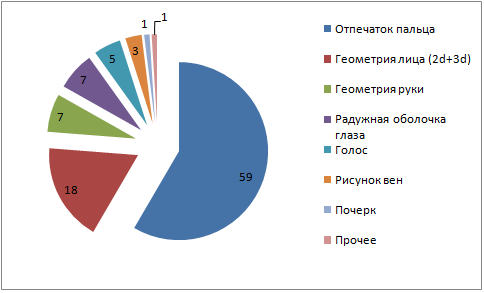
In the article we will consider only those characteristics that are applicable in access control and management systems (ACS) or in related tasks. Due to its superiority, these are primarily static characteristics. Of the dynamic characteristics at the moment, only voice recognition has at least some statistical significance (comparable to the worst static algorithms FAR ~ 0.1%, FRR ~ 6%), but only in ideal conditions.
In order to sense the probabilities of FAR and FRR, one can estimate how often false coincidences will arise if an identification system is installed at the checkpoint organization with a staff of N people. The probability of a false match of the fingerprint received by the scanner for a database of N fingerprints is FAR ∙ N. And every day, about N people pass through an access control point. Then the probability of a working day error is FAR ∙ (N ∙ N). Of course, depending on the goals of the identification system, the probability of error per unit time can vary greatly, but if one error is accepted during the working day, then:
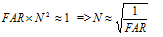 (1)
(1)
Then we find that stable operation of the identification system at FAR = 0.1% = 0.001 is possible at the number of staff N≈30.
Today, the concepts of “biometric algorithm” and “biometric scanner” are not necessarily interrelated. A company can produce these elements individually, or together. The greatest differentiation between scanner manufacturers and software manufacturers has been achieved in the biometrics market of the papillary finger pattern. The smallest 3D face scanner on the market. In fact, the level of differentiation largely reflects the development and saturation of the market. The more choices - the more topics worked out and brought to perfection. Different scanners have a different set of abilities. Basically, this is a set of tests for checking whether a biometric object is falsified or not. For finger scanners, this can be a relief check or temperature check, for eye scanners, it can be a pupil accommodation check, for face scanners, a face movement.
Scanners greatly influence the obtained statistics of FAR and FRR. In some cases, these numbers can change dozens of times, especially in real conditions. Typically, the characteristics of an algorithm are given for some “ideal” base, or just for a good one, where blurry and blurry frames are thrown out. Only a few algorithms honestly indicate both the base and the full issuance of FAR / FRR on it.
And now in more detail about each of the technologies
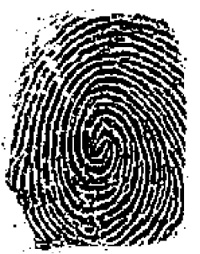
Fingerprinting (fingerprint recognition) is the most developed biometric method of personal identification to date. The catalyst for the development of the method was its widespread use in forensic science of the 20th century.
Each person has a unique papillary pattern of fingerprints, which is why identification is possible. Usually, algorithms use characteristic points on fingerprints: the end of a pattern line, a branching line, single points. Additionally, information on the morphological structure of the fingerprint is used: the relative position of the closed lines of the papillary pattern, “arched” and spiral lines. Features of the papillary pattern are converted into a unique code that preserves the information content of the fingerprint image. And it is the “fingerprint codes” that are stored in the database used for search and comparison. The time it takes to translate a fingerprint image into a code and its identification usually does not exceed 1s, depending on the size of the database. The time taken to present a hand is not taken into account.
VeriFinger SDK statistics obtained using the DP U.are.U fingerprint scanner were used as the FAR and FRR data source. Over the past 5-10 years, the characteristics of finger recognition have not stepped forward, so the figures given show a good idea of the average value of modern algorithms. The VeriFinger algorithm itself won the International Fingerprint Verification Competition for several years, where finger recognition algorithms competed.
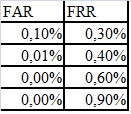
The characteristic FAR value for the fingerprint recognition method is 0.001%.
From formula (1) we get that the stable operation of the identification system at FAR = 0.001% is possible with a headcount of N≈300.
The advantages of the method. High reliability - statistical indicators of the method are better than indicators of identification methods by face, voice, and painting. Low cost fingerprint scanning devices. A fairly simple procedure for scanning the fingerprint.
Disadvantages: the papillary pattern of the fingerprint is very easily damaged by small scratches, cuts. People who have used scanners in enterprises with a staff of about several hundred people claim a high degree of scan failure. Many of the scanners inadequate to dry skin and do not miss the elderly. When communicating at the last MIPS exhibition, the head of the security service of a large chemical enterprise said that their attempt to introduce finger scanners at the enterprise (tried scanners of various systems) failed - the minimal impact of chemicals on the fingers of the employees caused the security systems of the scanners to fail - the scanners declared the fingers a fake. There is also a lack of protection against falsification of the print image, partly due to the widespread use of the method. Of course, not all scanners can be deceived by the methods of the Destroyers of Legends, but still. For some people with “inappropriate” fingers (especially body temperature, humidity), the probability of denied access can reach 100%. The number of such people varies from fractions of a percent for expensive scanners to ten percent for inexpensive.
Of course, it is worth noting that a large number of shortcomings are caused by the widespread use of the system, but these shortcomings do occur and they occur very often.
Currently, fingerprint recognition systems occupy more than half of the biometric market. Many Russian and foreign companies are engaged in the production of access control systems based on the fingerprint identification method. Due to the fact that this area is one of the oldest, it has received the greatest distribution and is by far the most developed. Fingerprint scanners have come a really long way to improvement. Modern systems are equipped with various sensors (temperature, pressure, etc.), which increase the degree of protection against fakes. Every day, systems are becoming more convenient and compact. In fact, the developers have already reached a certain limit in this area, and there is nowhere to develop the method further. In addition, most companies produce turnkey systems, which are equipped with everything you need, including software. Integrators in this area simply do not need to assemble the system on their own, since it is disadvantageous and will take more time and effort than to buy a ready-made and already inexpensive system, the more the choice will be really wide.
Among foreign companies engaged in fingerprint recognition systems, SecuGen (USB scanners for PCs, scanners that can be installed in enterprises or built in locks, SDKs and software for connecting the system with a computer) can be noted; Bayometric Inc. (fingerprint scanners, TAA / Access control systems, fingerprint SDKs, embedded fingerprint modules); DigitalPersona, Inc. (USB scanners, SDK). In Russia, the following companies work in this area: BioLink (fingerprint scanners, biometric access control devices, software); Sonda (fingerprint scanners, biometric access control devices, SDK); SmartLock (fingerprint scanners and modules), etc.
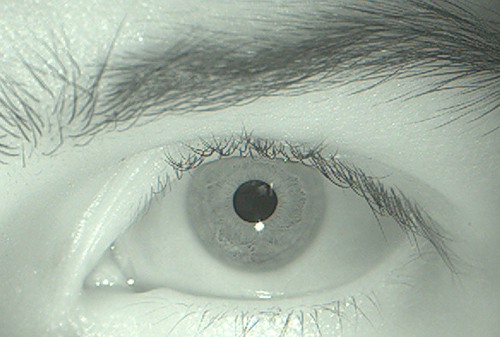
The iris is a unique characteristic of a person. The iris pattern is formed at the eighth month of fetal development, finally stabilizes at the age of about two years and practically does not change during life, except as a result of severe injuries or sharp pathologies. The method is one of the most accurate among biometric methods.
The iris identification system is logically divided into two parts: an image capturing device, its primary processing and transmission to a computer, and a computer that compares the image with the images in the database and sends the admission command to the executive device.
The primary image processing time in modern systems is approximately 300-500ms, the speed of comparison of the received image with the base is at the level of 50,000-150000 comparisons per second on a regular PC. This comparison speed does not impose restrictions on the application of the method in large organizations when used in access systems. When using specialized calculators and search optimization algorithms, it becomes even possible to identify a person among the inhabitants of an entire country.
I can immediately answer that I am somewhat biased and positive about this method, since it was on this field that we launched our startup. The paragraph at the end will be dedicated to small self-PR.
The characteristics of FAR and FRR for the iris are the best in the class of modern biometric systems (with the possible exception of the retina recognition method). The article presents the characteristics of the iris recognition library of our algorithm - EyeR SDK, which correspond to the VeriEye algorithm tested on the same bases. CASIA bases obtained by their scanner were used.
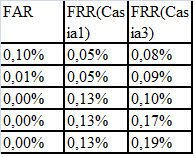
The characteristic value of FAR is 0.00001%.
According to the formula (1), N≈3000 is the number of the organization’s personnel at which the employee’s identification is quite stable.
It is worth noting an important feature that distinguishes the recognition system for the iris from other systems. In the case of using a camera resolution of 1.3MP, you can capture two eyes in one frame. Since the probabilities FAR and FRR are statistically independent probabilities, when recognized by two eyes, the FAR value will be approximately equal to the square of the FAR value for one eye. For example, for FAR 0.001% when using two eyes, the probability of false tolerance will be 10-8%, with FRR only two times higher than the corresponding FRR for one eye with FAR = 0.001%.
The advantages of the method. The statistical reliability of the algorithm. Capture the image of the iris can be done at a distance of several centimeters to several meters, while the physical contact of a person with the device does not occur. The iris is protected from damage - which means it will not change over time. It is also possible to use a high number of anti-fake methods.
The disadvantages of the method. The price of a system based on the iris is higher than the price of a system based on finger recognition or on face recognition. Low availability of turnkey solutions. Any integrator who comes to the Russian market today and says “give me a ready-made system” is likely to break off. Most of them sell expensive turnkey systems installed by large companies such as Iridian or LG.
According to various estimates, the specific weight of iris identification technologies in the global biometric market is from 6 to 9 percent (while fingerprint recognition technologies occupy more than half of the market). It should be noted that from the very beginning of the development of this method, its strengthening in the market was slowed by the high cost of equipment and components necessary to assemble an identification system. However, with the development of digital technology, the cost of a separate system began to decline.
The leader in software development in this area is Iridian Technologies.
Entering the market for a large number of manufacturers was limited by the technical complexity of the scanners and, as a consequence, their high cost, as well as the high price of software due to Iridian's exclusive market position. These factors allowed only large companies to develop in the field of iris recognition, most likely already engaged in the production of some components suitable for the identification system (high-resolution optics, miniature cameras with infrared illumination, etc.). Examples of such companies are LG Electronics, Panasonic, OKI. They entered into an agreement with Iridian Technologies, and as a result of collaboration, the following identification systems appeared: Iris Access 2200, BM-ET500, OKI IrisPass. Subsequently, improved systems models arose. due to the technical capabilities of these companies to independently develop in this area. It should be said that the above companies have also developed their own software, but in the end, in the finished system they prefer Iridian Technologies software.
The products of foreign companies “prevail” on the Russian market. Although one can be bought with difficulty. For a long time, the company Papilon assured everyone that they have recognition by the iris. But even representatives of RosAtom, their direct purchaser, for whom they made the system, say that this is not true. At some point, some other Russian company appeared, which made iris scanners. Now I do not remember the name. They bought an algorithm from someone, perhaps from the same VeriEye. The scanner itself was a 10-15 year old system, not a contactless one.
In the last year, a couple of new manufacturers entered the world market in connection with the expiration of the primary patent for recognizing a person by eye. The most trustworthy of them, in my opinion, is AOptix. At least their previews and documentation are not suspicious. The second company is SRI International. Even at first glance, the person involved in iris recognition systems, their videos seem very false. Although I would not be surprised if in reality they can do something. Both that and that system does not show data on FAR and FRR, and also, apparently, is not protected from fakes.
There are many face recognition methods. All of them are based on the fact that facial features and the shape of the skull of each person are individual. This area of biometrics seems attractive to many, because we recognize each other primarily by face. This area is divided into two directions: 2-D recognition and 3-D recognition. Each of them has advantages and disadvantages, but much also depends on the scope and requirements for a particular algorithm.
In brief, I’ll talk about 2-d and move on to one of the most interesting methods today - 3-d.
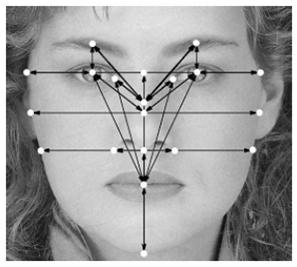
2-D face recognition is one of the most statistically ineffective methods of biometrics. It appeared a long time ago and was used mainly in forensics, which contributed to its development. Subsequently, computer interpretations of the method appeared, as a result of which it became more reliable, but, of course, inferior and every year more and more inferior to other biometric methods of identification. Currently, due to poor statistical indicators, it is used in multimodal or, as it is also called, cross biometrics, or in social networks.
For FAR and FRR, data for VeriLook algorithms are used. Again, for modern algorithms, it has very ordinary characteristics. Algorithms with a FRR of 0.1% are sometimes flashed with a similar FAR, but the bases from which they are obtained are very doubtful (cut out background, same facial expression, same hairstyle, lighting).
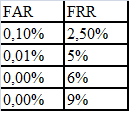
The characteristic value of FAR is 0.1%.
From formula (1) we obtain N≈30 - the number of employees of the organization at which the employee identification is quite stable.
As you can see, the statistical indicators of the method are quite modest: this eliminates the advantage of the method that it is possible to conduct covert shooting of people in crowded places. It is amusing to observe how a couple of times a year another project to detect criminals is financed through video cameras installed in crowded places. Over the past ten years, the statistical characteristics of the algorithm have not improved, and the number of such projects has increased. Although, it is worth noting that the algorithm is quite suitable for leading a person in a crowd through many cameras.
The advantages of the method. With 2-D recognition, unlike most biometric methods, expensive equipment is not required. With appropriate equipment, the ability to recognize at significant distances from the camera.
Disadvantages. Low statistical confidence. Lighting requirements are presented (for example, it is not possible to register faces of people entering from the street on a sunny day). For many algorithms, the inadmissibility of any external interference, such as glasses, a beard, some elements of the hairstyle. Necessarily a frontal image of the face, with very slight deviations. Many algorithms do not take into account possible changes in facial expressions, that is, the expression should be neutral.
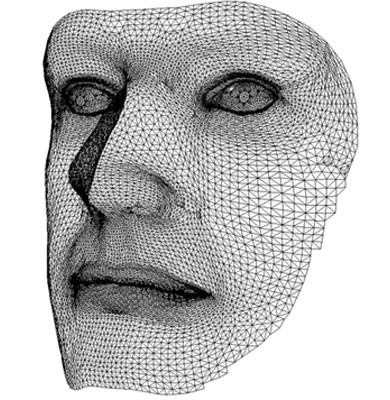
The implementation of this method is a rather complicated task. Despite this, there are currently many methods for 3-D face recognition. Methods cannot be compared with each other, since they use different scanners and databases. not all of them produce FAR and FRR; completely different approaches are used.
The transition from 2-d to 3-d method is a method that implements the accumulation of information about a person. This method has better characteristics than the 2d method, but just like it uses only one camera. When a subject is entered into the database, the subject turns his head and the algorithm combines the image together, creating a 3d template. And for recognition, several frames of the video stream are used. This method is more likely to be experimental and I have never seen an implementation for access control systems.
The most classic method is the template projection method. It consists in the fact that a grid is projected onto the object (face). Then the camera takes pictures at a speed of tens of frames per second, and the resulting images are processed by a special program. A beam incident on a curved surface bends - the greater the curvature of the surface, the stronger the bend of the beam. Initially, a source of visible light was applied through the "blinds". Then the visible light was replaced by infrared, which has several advantages. Usually, at the first stage of processing, images are discarded in which faces are not visible at all or there are foreign objects that interfere with identification. Based on the received images, a 3-D model of the face is restored, on which unnecessary interference (hairstyle, beard, mustache and glasses) is allocated and removed. Then the model is analyzed - anthropometric features are highlighted, which are ultimately recorded in a unique code that is recorded in the database. Image capture and processing time is 1-2 seconds for the best models.
The 3-d recognition method based on the image received from several cameras is also gaining popularity. An example of this is Vocord with its 3d scanner. This method gives the accuracy of positioning, according to the assurances of the developers, above the method of projecting a template. But, until I see FAR and FRR at least on their own base - I won’t believe it !!! But it has been developed for 3 years already, and progress at the exhibitions is not yet visible.
Full data on FRR and FAR for algorithms of this class are not openly given on manufacturers' websites. But for the best models of Bioscript (3D EnrolCam, 3D FastPass), working by the method of projecting a template with FAR = 0.0047%, FRR is 0.103%.
It is believed that the statistical reliability of the method is comparable to the reliability of the fingerprint identification method.
The advantages of the method. No need to contact the scanning device. Low sensitivity to external factors, both on the person himself (the appearance of glasses, a beard, a change in hairstyle), and in his surroundings (light, head rotation). High level of reliability comparable to fingerprint identification.
The disadvantages of the method. The high cost of equipment. Commercially available complexes were superior in price even to iris scanners. Changes in facial expressions and interference on the face worsen the statistical reliability of the method. The method is still not well developed, especially in comparison with the long-used fingerprinting, which complicates its widespread use.
Facial recognition is ranked among the “three great biometrics” along with recognition by fingerprints and iris. I must say that this method is quite common, and so far it is preferred over recognition by the iris of the eye. The specific weight of face recognition technologies in the total volume of the global biometric market can be estimated at 13-18 percent. In Russia, this technology also shows more interest than, for example, to identification by the iris. As mentioned earlier, there are many 3-D recognition algorithms. For the most part, companies prefer to develop off-the-shelf systems, including scanners, servers, and software. However, there are those who offer the consumer only the SDK. To date, the following companies can be noted, engaged in the development of this technology: Geometrix, Inc. (3D face scanners, software), Genex Technologies (3D face scanners, software) in the USA, Cognitec Systems GmbH (SDK, special computers, 2D cameras) in Germany, Bioscrypt (3D face scanners, software) is a subsidiary of the American company L- 1 Identity Solutions.
В России в данном направлении работают компании Artec Group (3D сканеры лица и ПО) – компания, головной офис которой находится в Калифорнии, а разработки и производство ведутся в Москве. Также несколько российских компаний владеют технологией 2D распознавания лица – Vocord, ITV и др.
В области распознавания 2D лица основным предметом разработки является программное обеспечение, т.к. обычные камеры отлично справляются с захвата изображения лица. Решение задачи распознавания по изображению лица в какой-то степени зашло в тупик – уже на протяжении нескольких лет практически не происходит улучшения статистических показателей алгоритмов. В этой области происходит планомерная «работа над ошибками».
3D face recognition is now a much more attractive area for developers. Many teams work in it and regularly hear about new discoveries. Many works are in the state of "just about to be released." But so far the market has only old offers, in recent years the choice has not changed.
One of the interesting points that I sometimes think about and which Habr will probably answer: is kinect accuracy enough to create such a system? There are quite a few projects for pulling a 3d model of a person through him.
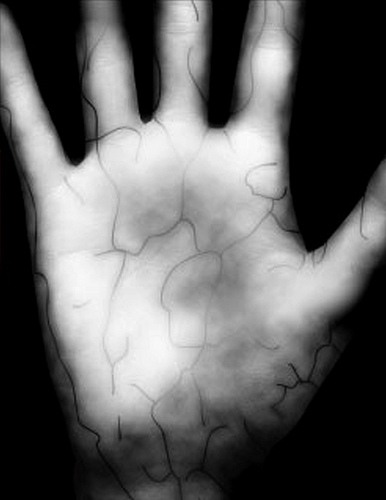
This is a new technology in the field of biometrics, its widespread use began only about 5-10 years ago. An infrared camera takes pictures of the outside or inside of the hand. The vein pattern is formed due to the fact that the hemoglobin of the blood absorbs IR radiation. As a result, the degree of reflection decreases, and the veins are visible on the camera as black lines. A special program based on the received data creates a digital convolution. No human contact with the scanning device.
The technology is comparable in reliability with recognition by the iris of the eye, in some ways surpassing it, and in some ways inferior.
The FRR and FAR values are for the Palm Vein Scanner. According to the developer, at FAR, 0.0008% FRR is 0.01%. More than one firm does not give a more accurate graph for several values.
The advantages of the method. No need to contact the scanning device. High reliability - the statistical indicators of the method are comparable with the indications of the iris. Hidden characteristics: in contrast to all of the above, it is very difficult to obtain this characteristic from a person "on the street", for example, by photographing him with a camera.
The disadvantages of the method. Illumination of the scanner by sunlight and rays of halogen lamps is unacceptable. Some age-related diseases, such as arthritis, severely worsen FAR and FRR. The method is less studied in comparison with other static methods of biometrics.
Hand vein pattern recognition is a fairly new technology, and therefore its share in the global market is small and amounts to about 3%. However, there is growing interest in this method. The fact is that, being fairly accurate, this method does not require such expensive equipment as, for example, recognition methods by face geometry or iris. Now many companies are developing in this area. For example, by order of the English company TDSi, software for the biometric palm vein reader PalmVein, developed by Fujitsu, was developed. The scanner itself was developed by Fujitsu primarily to combat financial fraud in Japan.
Also in the field of vein pattern identification are the following Veid Pte companies. Ltd. (scanner, software), Hitachi VeinID (scanners)
In Russia, companies involved in this technology, I do not know.
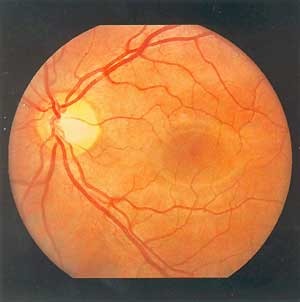
Until recently, it was believed that the most reliable method of biometric identification and authentication of a person is a method based on scanning the retina of the eye. It contains the best features of identification by the iris and veins of the hand. The scanner reads the pattern of capillaries on the surface of the retina. The retina has a fixed structure, unchanged in time, except as a result of a disease, for example, cataracts.
The retina is scanned using low-intensity infrared light directed through the pupil to the blood vessels on the back of the eye. Retinal scanners are widespread in access control systems for highly classified objects, since they have one of the lowest percent of access denied by registered users and there is practically no erroneous access permission.
Unfortunately, a number of difficulties arise when using this method of biometrics. The scanner here is a very complex optical system, and a person should not move for a considerable time while the system is being induced, which causes unpleasant sensations.
According to EyeDentify for the ICAM2001 scanner with FAR = 0.001%, the FRR value is 0.4%.
Benefits. High level of statistical reliability. Due to the low prevalence of systems, there is little likelihood of developing a way to "cheat" them.
Disadvantages. Difficult to use system with high processing time. The high cost of the system. The absence of a wide supply market and, as a consequence, the insufficient development of the method.

This method, quite common 10 years ago and which has evolved from forensics in recent years, is on the decline. It is based on obtaining the geometric characteristics of the hands: finger lengths, palm widths, etc. This method, like the retina of the eye, is dying, and since it has much lower characteristics, we will not even introduce it for a more complete description.
Sometimes it is believed that in recognition systems by veins, geometric recognition methods are used. But on sale, we have never seen such an explicitly declared one. And besides, often when recognizing by veins, only a palm is taken, while when recognizing by geometry, a finger is taken.
At one time, we developed a good eye recognition algorithm. But at that time such a high-tech thing was not needed in this country, but I didn’t want to go to bourgeois (where we were invited after the first article). But suddenly, after a year and a half, there were investors who wanted to build a “biometric portal” - a system that would eat 2 eyes and use the color component of the iris (for which the investor had a world patent). Actually now we are doing this. But this is not an article about self-PR, this is a brief digression. If anyone is interested there is a bit of information here, but sometime in the future, when we enter the market (or do not enter) I will write a few words about the ups and downs of the biometric project in Russia.
Even in the class of static biometric systems, there is a large selection of systems. Which one to choose? It all depends on the security requirements. The most statistically reliable and fake-resistant access systems are access systems for the iris and veins of the hands. On the first of them there is a wider market of offers. But this is not the limit. Biometric identification systems can be combined to achieve astronomical accuracy. The cheapest and easiest to use, but with good statistics, are finger access systems. 2D face tolerance is convenient and cheap, but has a limited scope due to poor statistics.
Consider the characteristics that each of the systems will have: resistance to fake, resistance to the environment, ease of use, cost, speed, stability of the biometric feature over time. Let's rank grades from 1 to 10 in each column. The closer the score is to 10, the better the system in this regard. The principles for selecting ratings were described at the very beginning of the article.
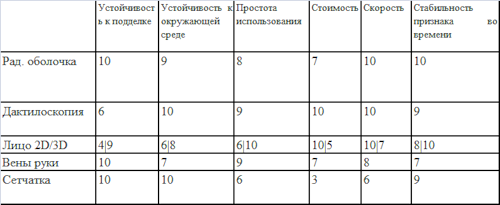
Also consider the ratio of FAR and FRR for these systems. This ratio determines the effectiveness of the system and the breadth of its use.
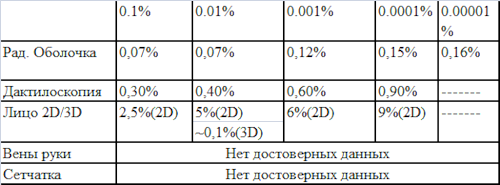
It is worth remembering that for the iris you can increase the accuracy of the system almost quadratically, without loss of time, if you complicate the system by making it in two eyes. For the fingerprint method - by combining several fingers, and recognition by veins, by combining two hands, but such an improvement is possible only with an increase in the time spent working with a person.
Summarizing the results for the methods, we can say that for medium and large objects, as well as for objects with the highest security requirement, you should use the iris as a biometric access and, possibly, recognition by the veins of the hands. For objects with the number of personnel up to several hundred people, access by fingerprints will be optimal. 2D facial recognition systems are very specific. They may be required in cases where recognition requires the absence of physical contact, but it is impossible to put a control system in the iris. For example, if it is necessary to identify a person without his participation, a hidden camera, or an external detection camera, but this is possible only with a small number of subjects in the database and a small flow of people filmed by the camera.
Some manufacturers, for example Neurotechnology, have demos of the biometrics methods that they release on the site, so it’s quite possible to connect them and play. For those who decide to delve into the problem more seriously, I can advise the only book that I saw in Russian - "Guide to Biometrics" R.M. Ball, J.H. Connell, S. Pancanti. There are many algorithms and their mathematical models. Not everything is complete and not everything corresponds to the present, but the base is not bad and comprehensive.
In this opus, I did not go into the problem of authentication, but only affected identification. In principle, from the characteristics of FAR / FRR and the possibility of falsification, all conclusions on the issue of authentication are self-evident.
The article has a sequel , which, in essence, is its prequel.
A joint publication with a colleague in a journal ( BDI, 2009) will be used as the basis for the article.), redesigned for modern realities. There are no colleagues yet, but he supported the publication of the revised article here. At the time of publication, the article was a brief overview of the modern biometric technology market that we conducted for ourselves before we launched our product. The appraisal judgments on applicability put forward in the second part of the article are based on the opinions of people who have used and introduced products, as well as on the opinions of people involved in the production of biometric systems in Russia and Europe.
general information
Let's start with the basics. In 95% of cases, biometrics are inherently mathematical statistics. And matstat is an exact science, the algorithms of which are used everywhere: both in radars and in Bayesian systems. Errors of the first and second kind can be taken as two main characteristics of any biometric system) In the theory of radar, they are usually called "false alarm" or "miss the target," and in biometrics the most well-established concepts are FAR (False Acceptance Rate) and FRR (False Rejection Rate). The first number characterizes the probability of a false coincidence of the biometric characteristics of two people. The second is the probability of denied access to a person with an admission. The better the system, the lower the FRR value for the same FAR values. Sometimes the EER comparative characteristic is used, which determines the point at which the FRR and FAR graphs intersect. But it is far from always representative. More details can be found, for example, here .
The following can be noted:if FAR and FRR are not given in the characteristics of the system for open biometric databases, then whatever manufacturers would declare its characteristics, this system is most likely incapable or much weaker than competitors .
But not only FAR and FRR determine the quality of a biometric system. If this were only the case, then the leading technology would be the recognition of people by DNA, for which FAR and FRR tend to zero. But it is obvious that this technology is not applicable at the present stage of human development! We have developed several empirical characteristics that allow us to evaluate the quality of the system. “Counterfeit Resistance” is an empirical feature that summarizes how easy it is to fool a biometric identifier. “Resistance to the environment” - a characteristic that empirically evaluates the stability of the system under various external conditions, such as changes in lighting or room temperature. “Ease of use” shows how difficult it is to use a biometric scanner, whether identification is possible “on the go”. An important characteristic is "Speed", and "Cost of the system." Do not forget that the biometric characteristics of a person can change over time, so if it is unstable, this is a significant minus.
The abundance of biometric methods is amazing. The main methods using static biometric characteristics of a person are identification by papillary pattern on fingers, iris, face geometry, retina, arm vein pattern, hand geometry. There is also a family of methods that use dynamic characteristics: voice identification, handwritten underline dynamics, heart rate, gait. Below is the distribution of the biometric market a couple of years ago. In every second source, these data fluctuate by 15-20 percent, so this is just an estimate. Also here under the concept of "geometry of the hand" are two different methods that will be discussed below.
In the article we will consider only those characteristics that are applicable in access control and management systems (ACS) or in related tasks. Due to its superiority, these are primarily static characteristics. Of the dynamic characteristics at the moment, only voice recognition has at least some statistical significance (comparable to the worst static algorithms FAR ~ 0.1%, FRR ~ 6%), but only in ideal conditions.
In order to sense the probabilities of FAR and FRR, one can estimate how often false coincidences will arise if an identification system is installed at the checkpoint organization with a staff of N people. The probability of a false match of the fingerprint received by the scanner for a database of N fingerprints is FAR ∙ N. And every day, about N people pass through an access control point. Then the probability of a working day error is FAR ∙ (N ∙ N). Of course, depending on the goals of the identification system, the probability of error per unit time can vary greatly, but if one error is accepted during the working day, then:
(1) Then we find that stable operation of the identification system at FAR = 0.1% = 0.001 is possible at the number of staff N≈30.
Biometric scanners
Today, the concepts of “biometric algorithm” and “biometric scanner” are not necessarily interrelated. A company can produce these elements individually, or together. The greatest differentiation between scanner manufacturers and software manufacturers has been achieved in the biometrics market of the papillary finger pattern. The smallest 3D face scanner on the market. In fact, the level of differentiation largely reflects the development and saturation of the market. The more choices - the more topics worked out and brought to perfection. Different scanners have a different set of abilities. Basically, this is a set of tests for checking whether a biometric object is falsified or not. For finger scanners, this can be a relief check or temperature check, for eye scanners, it can be a pupil accommodation check, for face scanners, a face movement.
Scanners greatly influence the obtained statistics of FAR and FRR. In some cases, these numbers can change dozens of times, especially in real conditions. Typically, the characteristics of an algorithm are given for some “ideal” base, or just for a good one, where blurry and blurry frames are thrown out. Only a few algorithms honestly indicate both the base and the full issuance of FAR / FRR on it.
And now in more detail about each of the technologies
Fingerprints
Fingerprinting (fingerprint recognition) is the most developed biometric method of personal identification to date. The catalyst for the development of the method was its widespread use in forensic science of the 20th century.
Each person has a unique papillary pattern of fingerprints, which is why identification is possible. Usually, algorithms use characteristic points on fingerprints: the end of a pattern line, a branching line, single points. Additionally, information on the morphological structure of the fingerprint is used: the relative position of the closed lines of the papillary pattern, “arched” and spiral lines. Features of the papillary pattern are converted into a unique code that preserves the information content of the fingerprint image. And it is the “fingerprint codes” that are stored in the database used for search and comparison. The time it takes to translate a fingerprint image into a code and its identification usually does not exceed 1s, depending on the size of the database. The time taken to present a hand is not taken into account.
Statistical characteristics of the method
VeriFinger SDK statistics obtained using the DP U.are.U fingerprint scanner were used as the FAR and FRR data source. Over the past 5-10 years, the characteristics of finger recognition have not stepped forward, so the figures given show a good idea of the average value of modern algorithms. The VeriFinger algorithm itself won the International Fingerprint Verification Competition for several years, where finger recognition algorithms competed.
The characteristic FAR value for the fingerprint recognition method is 0.001%.
From formula (1) we get that the stable operation of the identification system at FAR = 0.001% is possible with a headcount of N≈300.
Advantages and disadvantages of the method
The advantages of the method. High reliability - statistical indicators of the method are better than indicators of identification methods by face, voice, and painting. Low cost fingerprint scanning devices. A fairly simple procedure for scanning the fingerprint.
Disadvantages: the papillary pattern of the fingerprint is very easily damaged by small scratches, cuts. People who have used scanners in enterprises with a staff of about several hundred people claim a high degree of scan failure. Many of the scanners inadequate to dry skin and do not miss the elderly. When communicating at the last MIPS exhibition, the head of the security service of a large chemical enterprise said that their attempt to introduce finger scanners at the enterprise (tried scanners of various systems) failed - the minimal impact of chemicals on the fingers of the employees caused the security systems of the scanners to fail - the scanners declared the fingers a fake. There is also a lack of protection against falsification of the print image, partly due to the widespread use of the method. Of course, not all scanners can be deceived by the methods of the Destroyers of Legends, but still. For some people with “inappropriate” fingers (especially body temperature, humidity), the probability of denied access can reach 100%. The number of such people varies from fractions of a percent for expensive scanners to ten percent for inexpensive.
Of course, it is worth noting that a large number of shortcomings are caused by the widespread use of the system, but these shortcomings do occur and they occur very often.
Market situation
Currently, fingerprint recognition systems occupy more than half of the biometric market. Many Russian and foreign companies are engaged in the production of access control systems based on the fingerprint identification method. Due to the fact that this area is one of the oldest, it has received the greatest distribution and is by far the most developed. Fingerprint scanners have come a really long way to improvement. Modern systems are equipped with various sensors (temperature, pressure, etc.), which increase the degree of protection against fakes. Every day, systems are becoming more convenient and compact. In fact, the developers have already reached a certain limit in this area, and there is nowhere to develop the method further. In addition, most companies produce turnkey systems, which are equipped with everything you need, including software. Integrators in this area simply do not need to assemble the system on their own, since it is disadvantageous and will take more time and effort than to buy a ready-made and already inexpensive system, the more the choice will be really wide.
Among foreign companies engaged in fingerprint recognition systems, SecuGen (USB scanners for PCs, scanners that can be installed in enterprises or built in locks, SDKs and software for connecting the system with a computer) can be noted; Bayometric Inc. (fingerprint scanners, TAA / Access control systems, fingerprint SDKs, embedded fingerprint modules); DigitalPersona, Inc. (USB scanners, SDK). In Russia, the following companies work in this area: BioLink (fingerprint scanners, biometric access control devices, software); Sonda (fingerprint scanners, biometric access control devices, SDK); SmartLock (fingerprint scanners and modules), etc.
Iris
The iris is a unique characteristic of a person. The iris pattern is formed at the eighth month of fetal development, finally stabilizes at the age of about two years and practically does not change during life, except as a result of severe injuries or sharp pathologies. The method is one of the most accurate among biometric methods.
The iris identification system is logically divided into two parts: an image capturing device, its primary processing and transmission to a computer, and a computer that compares the image with the images in the database and sends the admission command to the executive device.
The primary image processing time in modern systems is approximately 300-500ms, the speed of comparison of the received image with the base is at the level of 50,000-150000 comparisons per second on a regular PC. This comparison speed does not impose restrictions on the application of the method in large organizations when used in access systems. When using specialized calculators and search optimization algorithms, it becomes even possible to identify a person among the inhabitants of an entire country.
I can immediately answer that I am somewhat biased and positive about this method, since it was on this field that we launched our startup. The paragraph at the end will be dedicated to small self-PR.
Statistical characteristics of the method
The characteristics of FAR and FRR for the iris are the best in the class of modern biometric systems (with the possible exception of the retina recognition method). The article presents the characteristics of the iris recognition library of our algorithm - EyeR SDK, which correspond to the VeriEye algorithm tested on the same bases. CASIA bases obtained by their scanner were used.
The characteristic value of FAR is 0.00001%.
According to the formula (1), N≈3000 is the number of the organization’s personnel at which the employee’s identification is quite stable.
It is worth noting an important feature that distinguishes the recognition system for the iris from other systems. In the case of using a camera resolution of 1.3MP, you can capture two eyes in one frame. Since the probabilities FAR and FRR are statistically independent probabilities, when recognized by two eyes, the FAR value will be approximately equal to the square of the FAR value for one eye. For example, for FAR 0.001% when using two eyes, the probability of false tolerance will be 10-8%, with FRR only two times higher than the corresponding FRR for one eye with FAR = 0.001%.
Advantages and disadvantages of the method
The advantages of the method. The statistical reliability of the algorithm. Capture the image of the iris can be done at a distance of several centimeters to several meters, while the physical contact of a person with the device does not occur. The iris is protected from damage - which means it will not change over time. It is also possible to use a high number of anti-fake methods.
The disadvantages of the method. The price of a system based on the iris is higher than the price of a system based on finger recognition or on face recognition. Low availability of turnkey solutions. Any integrator who comes to the Russian market today and says “give me a ready-made system” is likely to break off. Most of them sell expensive turnkey systems installed by large companies such as Iridian or LG.
Market situation
According to various estimates, the specific weight of iris identification technologies in the global biometric market is from 6 to 9 percent (while fingerprint recognition technologies occupy more than half of the market). It should be noted that from the very beginning of the development of this method, its strengthening in the market was slowed by the high cost of equipment and components necessary to assemble an identification system. However, with the development of digital technology, the cost of a separate system began to decline.
The leader in software development in this area is Iridian Technologies.
Entering the market for a large number of manufacturers was limited by the technical complexity of the scanners and, as a consequence, their high cost, as well as the high price of software due to Iridian's exclusive market position. These factors allowed only large companies to develop in the field of iris recognition, most likely already engaged in the production of some components suitable for the identification system (high-resolution optics, miniature cameras with infrared illumination, etc.). Examples of such companies are LG Electronics, Panasonic, OKI. They entered into an agreement with Iridian Technologies, and as a result of collaboration, the following identification systems appeared: Iris Access 2200, BM-ET500, OKI IrisPass. Subsequently, improved systems models arose. due to the technical capabilities of these companies to independently develop in this area. It should be said that the above companies have also developed their own software, but in the end, in the finished system they prefer Iridian Technologies software.
The products of foreign companies “prevail” on the Russian market. Although one can be bought with difficulty. For a long time, the company Papilon assured everyone that they have recognition by the iris. But even representatives of RosAtom, their direct purchaser, for whom they made the system, say that this is not true. At some point, some other Russian company appeared, which made iris scanners. Now I do not remember the name. They bought an algorithm from someone, perhaps from the same VeriEye. The scanner itself was a 10-15 year old system, not a contactless one.
In the last year, a couple of new manufacturers entered the world market in connection with the expiration of the primary patent for recognizing a person by eye. The most trustworthy of them, in my opinion, is AOptix. At least their previews and documentation are not suspicious. The second company is SRI International. Even at first glance, the person involved in iris recognition systems, their videos seem very false. Although I would not be surprised if in reality they can do something. Both that and that system does not show data on FAR and FRR, and also, apparently, is not protected from fakes.
Face recognition
There are many face recognition methods. All of them are based on the fact that facial features and the shape of the skull of each person are individual. This area of biometrics seems attractive to many, because we recognize each other primarily by face. This area is divided into two directions: 2-D recognition and 3-D recognition. Each of them has advantages and disadvantages, but much also depends on the scope and requirements for a particular algorithm.
In brief, I’ll talk about 2-d and move on to one of the most interesting methods today - 3-d.
2-D face recognition
2-D face recognition is one of the most statistically ineffective methods of biometrics. It appeared a long time ago and was used mainly in forensics, which contributed to its development. Subsequently, computer interpretations of the method appeared, as a result of which it became more reliable, but, of course, inferior and every year more and more inferior to other biometric methods of identification. Currently, due to poor statistical indicators, it is used in multimodal or, as it is also called, cross biometrics, or in social networks.
Statistical characteristics of the method
For FAR and FRR, data for VeriLook algorithms are used. Again, for modern algorithms, it has very ordinary characteristics. Algorithms with a FRR of 0.1% are sometimes flashed with a similar FAR, but the bases from which they are obtained are very doubtful (cut out background, same facial expression, same hairstyle, lighting).
The characteristic value of FAR is 0.1%.
From formula (1) we obtain N≈30 - the number of employees of the organization at which the employee identification is quite stable.
As you can see, the statistical indicators of the method are quite modest: this eliminates the advantage of the method that it is possible to conduct covert shooting of people in crowded places. It is amusing to observe how a couple of times a year another project to detect criminals is financed through video cameras installed in crowded places. Over the past ten years, the statistical characteristics of the algorithm have not improved, and the number of such projects has increased. Although, it is worth noting that the algorithm is quite suitable for leading a person in a crowd through many cameras.
Advantages and disadvantages of the method
The advantages of the method. With 2-D recognition, unlike most biometric methods, expensive equipment is not required. With appropriate equipment, the ability to recognize at significant distances from the camera.
Disadvantages. Low statistical confidence. Lighting requirements are presented (for example, it is not possible to register faces of people entering from the street on a sunny day). For many algorithms, the inadmissibility of any external interference, such as glasses, a beard, some elements of the hairstyle. Necessarily a frontal image of the face, with very slight deviations. Many algorithms do not take into account possible changes in facial expressions, that is, the expression should be neutral.
3-D face recognition
The implementation of this method is a rather complicated task. Despite this, there are currently many methods for 3-D face recognition. Methods cannot be compared with each other, since they use different scanners and databases. not all of them produce FAR and FRR; completely different approaches are used.
The transition from 2-d to 3-d method is a method that implements the accumulation of information about a person. This method has better characteristics than the 2d method, but just like it uses only one camera. When a subject is entered into the database, the subject turns his head and the algorithm combines the image together, creating a 3d template. And for recognition, several frames of the video stream are used. This method is more likely to be experimental and I have never seen an implementation for access control systems.
The most classic method is the template projection method. It consists in the fact that a grid is projected onto the object (face). Then the camera takes pictures at a speed of tens of frames per second, and the resulting images are processed by a special program. A beam incident on a curved surface bends - the greater the curvature of the surface, the stronger the bend of the beam. Initially, a source of visible light was applied through the "blinds". Then the visible light was replaced by infrared, which has several advantages. Usually, at the first stage of processing, images are discarded in which faces are not visible at all or there are foreign objects that interfere with identification. Based on the received images, a 3-D model of the face is restored, on which unnecessary interference (hairstyle, beard, mustache and glasses) is allocated and removed. Then the model is analyzed - anthropometric features are highlighted, which are ultimately recorded in a unique code that is recorded in the database. Image capture and processing time is 1-2 seconds for the best models.
The 3-d recognition method based on the image received from several cameras is also gaining popularity. An example of this is Vocord with its 3d scanner. This method gives the accuracy of positioning, according to the assurances of the developers, above the method of projecting a template. But, until I see FAR and FRR at least on their own base - I won’t believe it !!! But it has been developed for 3 years already, and progress at the exhibitions is not yet visible.
Method Statistics
Full data on FRR and FAR for algorithms of this class are not openly given on manufacturers' websites. But for the best models of Bioscript (3D EnrolCam, 3D FastPass), working by the method of projecting a template with FAR = 0.0047%, FRR is 0.103%.
It is believed that the statistical reliability of the method is comparable to the reliability of the fingerprint identification method.
Advantages and disadvantages of the method
The advantages of the method. No need to contact the scanning device. Low sensitivity to external factors, both on the person himself (the appearance of glasses, a beard, a change in hairstyle), and in his surroundings (light, head rotation). High level of reliability comparable to fingerprint identification.
The disadvantages of the method. The high cost of equipment. Commercially available complexes were superior in price even to iris scanners. Changes in facial expressions and interference on the face worsen the statistical reliability of the method. The method is still not well developed, especially in comparison with the long-used fingerprinting, which complicates its widespread use.
Market situation
Facial recognition is ranked among the “three great biometrics” along with recognition by fingerprints and iris. I must say that this method is quite common, and so far it is preferred over recognition by the iris of the eye. The specific weight of face recognition technologies in the total volume of the global biometric market can be estimated at 13-18 percent. In Russia, this technology also shows more interest than, for example, to identification by the iris. As mentioned earlier, there are many 3-D recognition algorithms. For the most part, companies prefer to develop off-the-shelf systems, including scanners, servers, and software. However, there are those who offer the consumer only the SDK. To date, the following companies can be noted, engaged in the development of this technology: Geometrix, Inc. (3D face scanners, software), Genex Technologies (3D face scanners, software) in the USA, Cognitec Systems GmbH (SDK, special computers, 2D cameras) in Germany, Bioscrypt (3D face scanners, software) is a subsidiary of the American company L- 1 Identity Solutions.
В России в данном направлении работают компании Artec Group (3D сканеры лица и ПО) – компания, головной офис которой находится в Калифорнии, а разработки и производство ведутся в Москве. Также несколько российских компаний владеют технологией 2D распознавания лица – Vocord, ITV и др.
В области распознавания 2D лица основным предметом разработки является программное обеспечение, т.к. обычные камеры отлично справляются с захвата изображения лица. Решение задачи распознавания по изображению лица в какой-то степени зашло в тупик – уже на протяжении нескольких лет практически не происходит улучшения статистических показателей алгоритмов. В этой области происходит планомерная «работа над ошибками».
3D face recognition is now a much more attractive area for developers. Many teams work in it and regularly hear about new discoveries. Many works are in the state of "just about to be released." But so far the market has only old offers, in recent years the choice has not changed.
One of the interesting points that I sometimes think about and which Habr will probably answer: is kinect accuracy enough to create such a system? There are quite a few projects for pulling a 3d model of a person through him.
Hand vein recognition
This is a new technology in the field of biometrics, its widespread use began only about 5-10 years ago. An infrared camera takes pictures of the outside or inside of the hand. The vein pattern is formed due to the fact that the hemoglobin of the blood absorbs IR radiation. As a result, the degree of reflection decreases, and the veins are visible on the camera as black lines. A special program based on the received data creates a digital convolution. No human contact with the scanning device.
The technology is comparable in reliability with recognition by the iris of the eye, in some ways surpassing it, and in some ways inferior.
The FRR and FAR values are for the Palm Vein Scanner. According to the developer, at FAR, 0.0008% FRR is 0.01%. More than one firm does not give a more accurate graph for several values.
Advantages and disadvantages of the method
The advantages of the method. No need to contact the scanning device. High reliability - the statistical indicators of the method are comparable with the indications of the iris. Hidden characteristics: in contrast to all of the above, it is very difficult to obtain this characteristic from a person "on the street", for example, by photographing him with a camera.
The disadvantages of the method. Illumination of the scanner by sunlight and rays of halogen lamps is unacceptable. Some age-related diseases, such as arthritis, severely worsen FAR and FRR. The method is less studied in comparison with other static methods of biometrics.
Market situation
Hand vein pattern recognition is a fairly new technology, and therefore its share in the global market is small and amounts to about 3%. However, there is growing interest in this method. The fact is that, being fairly accurate, this method does not require such expensive equipment as, for example, recognition methods by face geometry or iris. Now many companies are developing in this area. For example, by order of the English company TDSi, software for the biometric palm vein reader PalmVein, developed by Fujitsu, was developed. The scanner itself was developed by Fujitsu primarily to combat financial fraud in Japan.
Also in the field of vein pattern identification are the following Veid Pte companies. Ltd. (scanner, software), Hitachi VeinID (scanners)
In Russia, companies involved in this technology, I do not know.
Retina
Until recently, it was believed that the most reliable method of biometric identification and authentication of a person is a method based on scanning the retina of the eye. It contains the best features of identification by the iris and veins of the hand. The scanner reads the pattern of capillaries on the surface of the retina. The retina has a fixed structure, unchanged in time, except as a result of a disease, for example, cataracts.
The retina is scanned using low-intensity infrared light directed through the pupil to the blood vessels on the back of the eye. Retinal scanners are widespread in access control systems for highly classified objects, since they have one of the lowest percent of access denied by registered users and there is practically no erroneous access permission.
Unfortunately, a number of difficulties arise when using this method of biometrics. The scanner here is a very complex optical system, and a person should not move for a considerable time while the system is being induced, which causes unpleasant sensations.
According to EyeDentify for the ICAM2001 scanner with FAR = 0.001%, the FRR value is 0.4%.
Advantages and disadvantages of the method
Benefits. High level of statistical reliability. Due to the low prevalence of systems, there is little likelihood of developing a way to "cheat" them.
Disadvantages. Difficult to use system with high processing time. The high cost of the system. The absence of a wide supply market and, as a consequence, the insufficient development of the method.
Hand geometry
This method, quite common 10 years ago and which has evolved from forensics in recent years, is on the decline. It is based on obtaining the geometric characteristics of the hands: finger lengths, palm widths, etc. This method, like the retina of the eye, is dying, and since it has much lower characteristics, we will not even introduce it for a more complete description.
Sometimes it is believed that in recognition systems by veins, geometric recognition methods are used. But on sale, we have never seen such an explicitly declared one. And besides, often when recognizing by veins, only a palm is taken, while when recognizing by geometry, a finger is taken.
A bit of self
At one time, we developed a good eye recognition algorithm. But at that time such a high-tech thing was not needed in this country, but I didn’t want to go to bourgeois (where we were invited after the first article). But suddenly, after a year and a half, there were investors who wanted to build a “biometric portal” - a system that would eat 2 eyes and use the color component of the iris (for which the investor had a world patent). Actually now we are doing this. But this is not an article about self-PR, this is a brief digression. If anyone is interested there is a bit of information here, but sometime in the future, when we enter the market (or do not enter) I will write a few words about the ups and downs of the biometric project in Russia.
conclusions
Even in the class of static biometric systems, there is a large selection of systems. Which one to choose? It all depends on the security requirements. The most statistically reliable and fake-resistant access systems are access systems for the iris and veins of the hands. On the first of them there is a wider market of offers. But this is not the limit. Biometric identification systems can be combined to achieve astronomical accuracy. The cheapest and easiest to use, but with good statistics, are finger access systems. 2D face tolerance is convenient and cheap, but has a limited scope due to poor statistics.
Consider the characteristics that each of the systems will have: resistance to fake, resistance to the environment, ease of use, cost, speed, stability of the biometric feature over time. Let's rank grades from 1 to 10 in each column. The closer the score is to 10, the better the system in this regard. The principles for selecting ratings were described at the very beginning of the article.
Also consider the ratio of FAR and FRR for these systems. This ratio determines the effectiveness of the system and the breadth of its use.
It is worth remembering that for the iris you can increase the accuracy of the system almost quadratically, without loss of time, if you complicate the system by making it in two eyes. For the fingerprint method - by combining several fingers, and recognition by veins, by combining two hands, but such an improvement is possible only with an increase in the time spent working with a person.
Summarizing the results for the methods, we can say that for medium and large objects, as well as for objects with the highest security requirement, you should use the iris as a biometric access and, possibly, recognition by the veins of the hands. For objects with the number of personnel up to several hundred people, access by fingerprints will be optimal. 2D facial recognition systems are very specific. They may be required in cases where recognition requires the absence of physical contact, but it is impossible to put a control system in the iris. For example, if it is necessary to identify a person without his participation, a hidden camera, or an external detection camera, but this is possible only with a small number of subjects in the database and a small flow of people filmed by the camera.
Note to the young technician
Some manufacturers, for example Neurotechnology, have demos of the biometrics methods that they release on the site, so it’s quite possible to connect them and play. For those who decide to delve into the problem more seriously, I can advise the only book that I saw in Russian - "Guide to Biometrics" R.M. Ball, J.H. Connell, S. Pancanti. There are many algorithms and their mathematical models. Not everything is complete and not everything corresponds to the present, but the base is not bad and comprehensive.
PS
In this opus, I did not go into the problem of authentication, but only affected identification. In principle, from the characteristics of FAR / FRR and the possibility of falsification, all conclusions on the issue of authentication are self-evident.