June 17, 2010 at 16:43
Game wheels and joysticks - 21st century technology in gaming devices
The article was written for the Computer Build magazine and therefore the text is deliberately simplified. The magazine did not accept the article, here I am publishing it here.
The 20th century was the century of analog technology. Radio, television, telephony - everything was built on the creation in the place of transmission of electrical analogs of audio and video information and its recreation at the place of reception. It was an age of lamps, relays and potentiometers.
The birth of the transistor gave rise to the century of semiconductors, and semiconductors gave the world digital technology, and by the time of the 21st century, digital technology is increasingly replacing analog from our lives. Analog television has not survived so long; analog telephony is quickly losing ground in front of digital cellular communications. There is no doubt that the 21st century will be the century of digital technology and semiconductors.
Let's see how the global evolution of technology has affected the devices for managing computer games.
Consider 2 large classes of gaming devices - joysticks and game wheels . We will not consider the appearance and ergonomics of devices - this is described in plenty of articles in magazines and networks, but let's look inside and try to understand where technologies are moving in the devices of market leaders.
Joysticks were apparently the first devices to control computer games. The first joysticks were very primitive - in fact, it was just 4 buttons assembled in one case, which were pressed when the joystick handle was rejected in one direction or another. Often no interface was provided for connecting such joysticks, and the device’s contacts were simply directly soldered to the keyboard buttons.
I think many people still remember such joysticks for the ZX Spectrum:

They are usually called "discrete", because they are able to give only values 0 or 1, on / off.
With the advent of the IBM PC, the first serious flight simulators appeared. For example, the F-19 Stealth Fighter game gave a "ticket to the sky" for many virtual pilots.
Of course, a surge of interest in virtual flights could not pass by manufacturers of gaming devices.
And so the joysticks for the IBM PC began to appear.
A typical representative of the joysticks of those years:
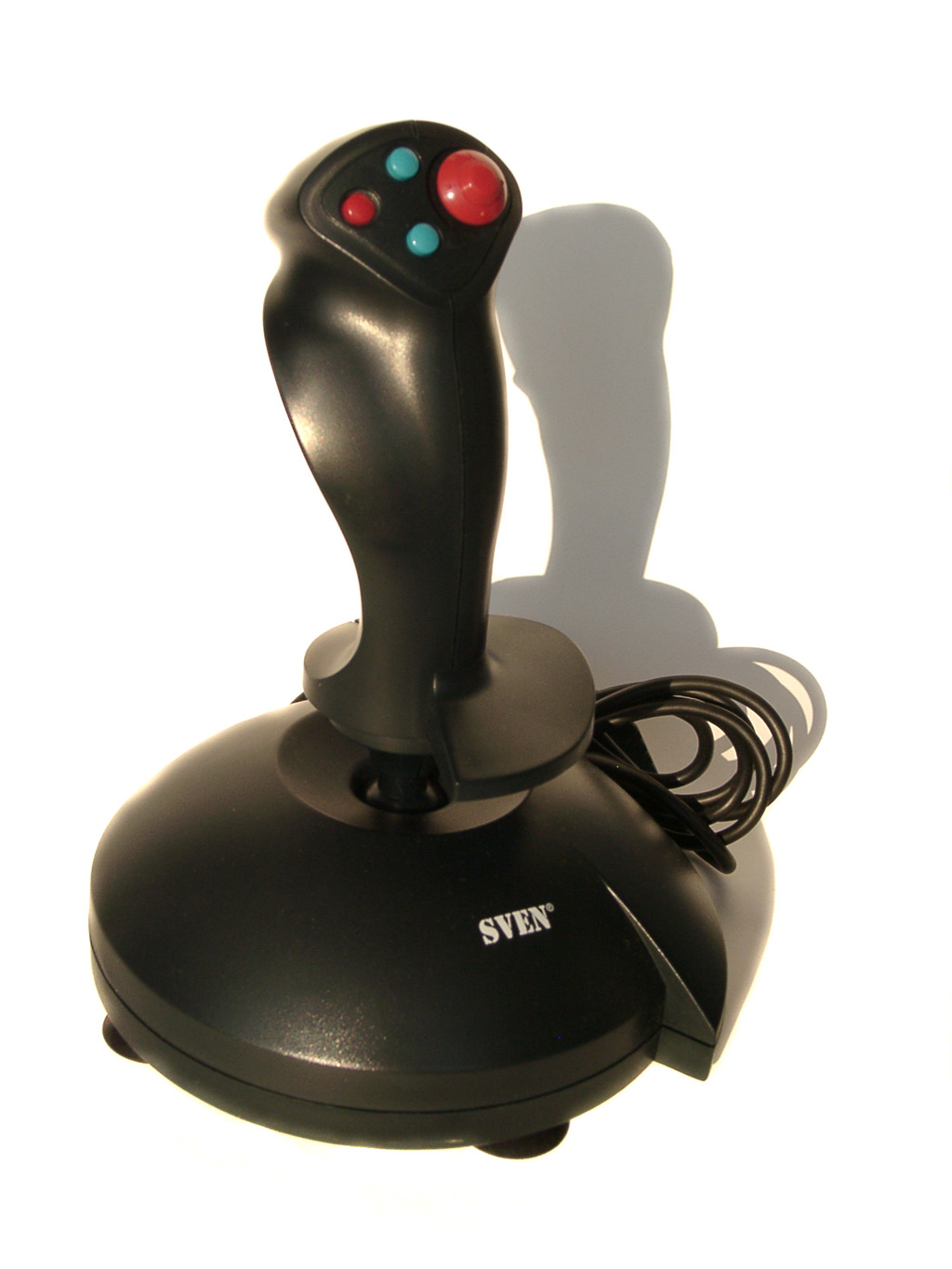
What is interesting - these models are still sold!
Unlike discrete joysticks, these joysticks were ANALOGUE. Now, rejecting the knob, the user received not 0 and 1, but a range of values from 0 to 255, and analog sensors - potentiometers - settled inside . The range of values that the sensor gave out to the game was associated with the bit depth of the controller - 8 bit.
The analog axes gave players the opportunity to control games much more precisely, bringing the virtual airplane control closer to the real airplane.
However, the first problems immediately emerged. The angle of deviation of the handle is determined using a potentiometer mounted on the axis of rotation. We recall the school physics course - the potentiometer is based on the friction of the engine on the resistive layer:
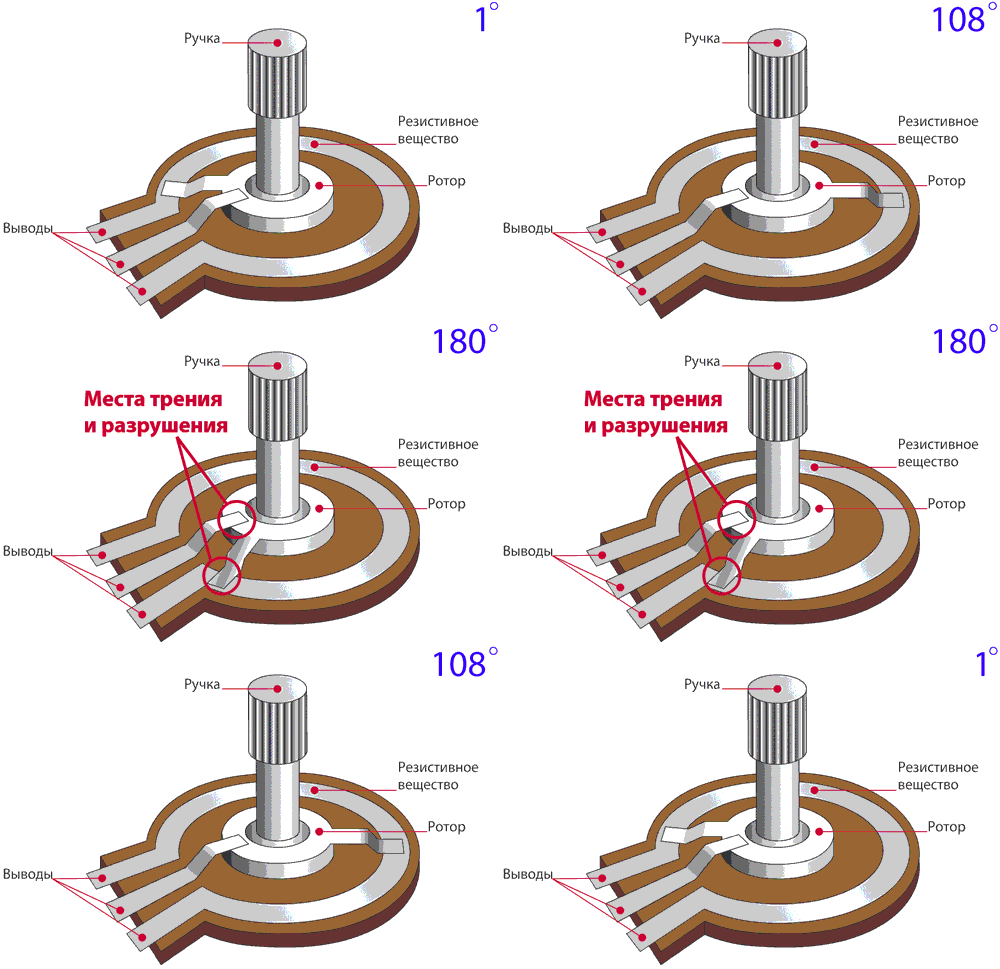
By changing the resistance between the extreme and the central output, the angle by which the joystick handle is rejected is determined.
Because Since the engine slides along the resistive layer, the potentiometer's service life is limited by the time during which the resistive substance is erased. The manufacturers of potentiometers honestly warn about this, indicating in the characteristics such a parameter as the "number of cycles" that the sensor will serve, roughly speaking - how many times can it be turned until it stops working normally. For most potentiometers that are used in gaming devices, this figure is from 500 thousand to a million cycles. It seems like a lot, but let's count. On average, a player makes 1 movement per second, which means that after 500 thousand seconds of the game, the device will stop working normally. And 500 thousand seconds is only 138 hours. Those. if you play 1 hour a day, then in less than six months such a joystick is guaranteed,
But manufacturers of joysticks are delicately silent about this design feature, you will not see the inscription “Designed for 500 thousand cycles” on any joystick. But there are figures of the warranty period - from 6 to 12 months. The warranty period in this case is clearly tied to the resource of the potentiometer, so in the case of the joystick, it is also the lifetime of the device.
The discovery for users turned out to be unpleasant - it’s unprofitable to play, not so much an hour a day, changing the joysticks once every six months. What to do? The skillful hands of our citizens quickly mastered disassembling joysticks and lubricating potentiometers with special greases of the WD-40 type, which greatly prolonged the potentiometer's life.
For their part, manufacturers began to solve the problem by using more expensive potentiometers with a longer resource, but it was clear that they were half measures.
It was necessary to search for a contactless solution, and it was proposed in the form of optical sensors .
The first such solution was proposed by Microsoft in the Microsoft SideWinder Precision Pro joystick. With the advent of optical sensors for mice, Microsoft tried to apply the same technology inside the joystick, but the solution was not successful and more joysticks with such sensors were not released.
A simple optical encoder (as in a regular mouse with a ball) turned out to be simpler and more reliable :
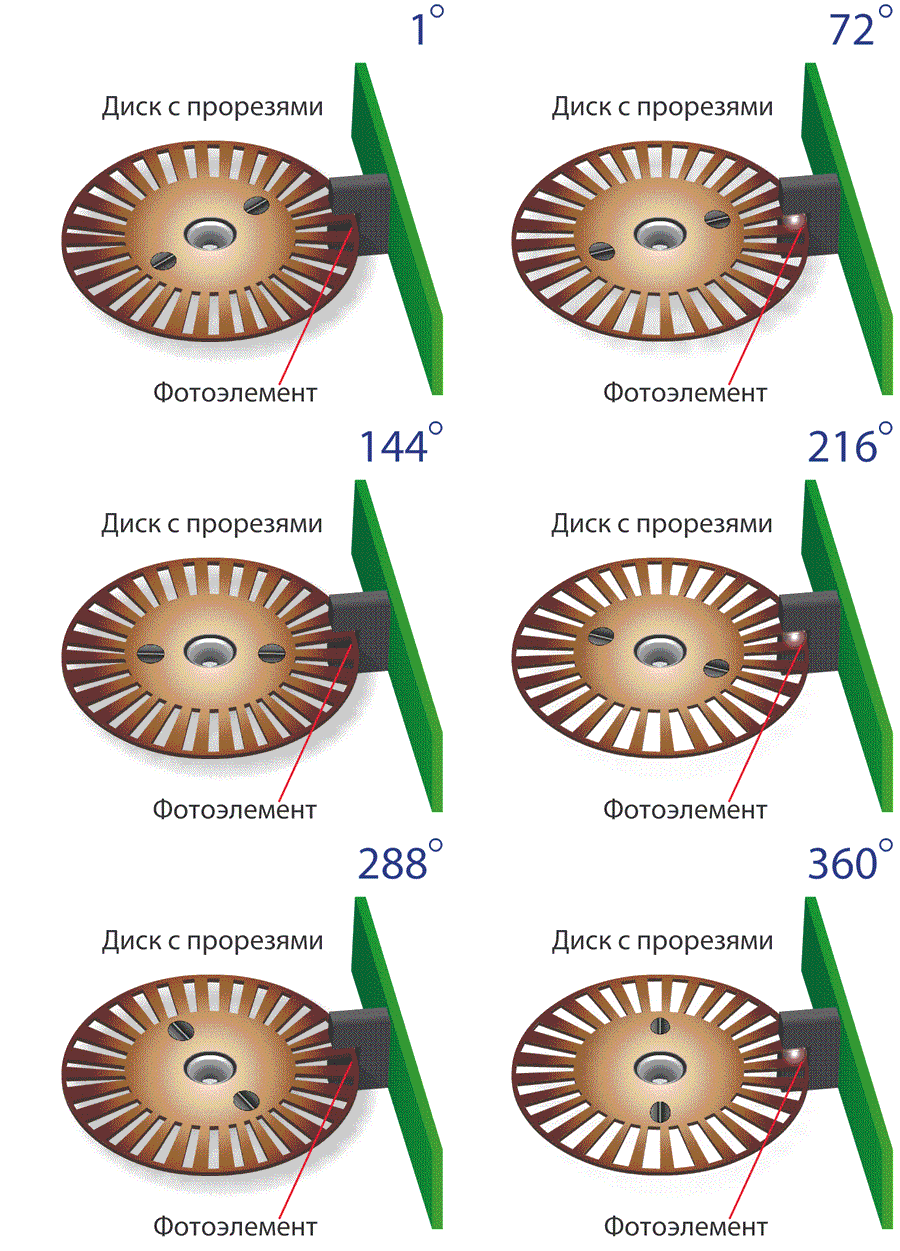
For example, the Cyborg 3D Force Stick joystick is built on this principle:


The use of such sensors allowed raising the resource of joysticks to a new level.
But such a sensor also has disadvantages. The minimum angle of rotation of the joystick axis is equal to the width of the encoder slot, and the requirements for joystick accuracy grew with the advent of new flight simulators, and for many players in the IL-2 Sturmovik, for example, this accuracy was completely insufficient. Many players abandoned the perpetual sensor on the optical encoder in favor of a more accurate sensor on potentiometers.
A sensor was required not only non-contact and durable, but also accurate.
The solution was found in magnetic sensors. From that moment, digital semiconductor technology of the 21st century came into gaming devices. With all confidence, we can say that magnetic technology is the future of sensors for gaming devices.
The first mass device based on magnetic Hall sensors was the Saitek X52 joystick.
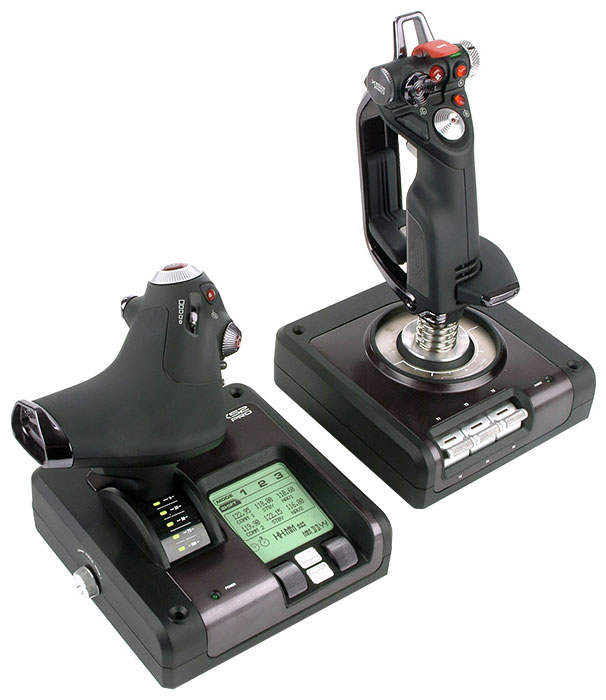
Hall sensors were invented to measure magnetic field strength. Roughly speaking, the sensor can accurately determine the distance to the permanent magnet. Thus, by placing magnets on the joystick handle, moving the magnet closer or closer to the sensor, you can determine how much the handle has shifted. The distance is measured with high accuracy, which is determined by the capacity of the controller. The 10bit controller allows you to position the joystick with an accuracy of 1024 counts per axis.
It seemed that a solution had been found - a joystick was obtained on eternal proximity sensors with high positioning accuracy. However, already the first users found an unpleasant feature of the Hall sensors - the output data changes nonlinearly, and this leads to an incorrect measurement of the angle of deviation of the joystick handle in the middle positions of the handle.
The next stage in the development of this technology was the use of 3D Hall sensors . These sensors do not determine the field strength, but the direction to the source of the magnetic field. This sensor was first used in the Thrustmaster T.16000 joystick: The

new sensor is non-contact and completely linear. The accuracy of 16,394 counts per axis leaves far behind all the joysticks that have been released before.
Unfortunately, the developers of Thrustmaster T.16000 did not take into account one important point - the 3D Hall is extremely sensitive to the accuracy of magnet movement. Because Since they fixed it on the plastic hemisphere, the inevitable wear of the plastic leads to the fact that the magnet does not begin to move along the ideal hemisphere, but with “jumps”, which leads to problems with positioning accuracy.
Logitech tried to solve this problem by installing the axis of the Logitech Flight System G940 joystick on bearings.
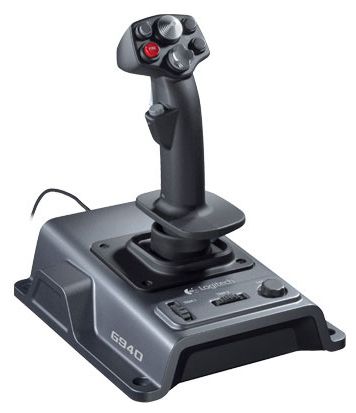

Now the magnet is guaranteed to move along an absolutely right trajectory, without backlashes and jumps, but the ill-conceived feedback system implemented on this model scared away many users (not to mention the price of 13,000 rubles).
Radically solve the issue of accuracy and durability of sensors, as well as the resource of mechanical parts of the joystick, Saitek decided in the X65F model :
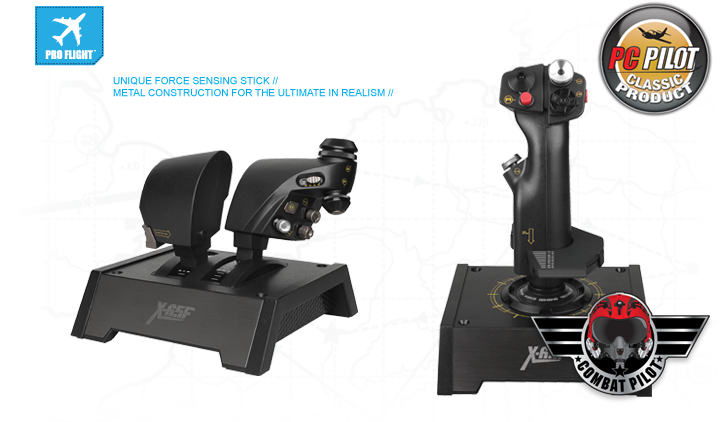
In this joystick, the handle is fixed completely motionless, the player’s movements are removed from the handle with the help of load cells - sensors that measure pressure. The player applies force to the handle, strain gauges record the pressure and transfer it to the game. This solves the problem of the durability of the mechanics (the handle is stationary, which means that it will not have any wear), the durability of the sensors - the load cells have a huge resource, and the high-performance controller will provide accuracy. However, it is not yet clear how convenient it will be to play without tipping the handle. The joystick is not yet for sale and there is no possibility to test its capabilities yet. Most likely, this joystick will remain a niche device for a small circle of lovers of modern combat aircraft, as control of aircraft of the First and Second World Wars requires that the handle deviates. But wait and see.
To summarize the subtotal.
Over the past 20 years, joysticks have evolved from primitive discrete switches to high-tech devices using the latest 21st-century technology. The new joysticks use the most advanced sensors for measuring angles - magnetic, which allows you to make devices with a very large resource and the highest positioning accuracy.
Today, joysticks with all types of sensors are available to the buyer - on potentiometers, optical encoders, Hall sensors and 3D Halls. I will take the liberty of asserting that soon enough potentiometers and optics will be a thing of the past - as soon as magnetic sensors become cheaper, and manufacturers take into account the errors of the first devices using new technology.
Game wheels were born later than joysticks. At first, it seemed that for racing games there was enough a joystick, or even just a keyboard, because the first racing games did not have a high level of realism.
However, racing games became more and more, the physical model of cars was becoming more complicated, and many players wanted to get a control device close to a real car. So the first rudders and pedals for racing games appeared.
The usual kit for racing games consists of the steering wheel itself, a pedal block (2, less often 3 pedals) and sometimes a gearbox block and a hand brake.
So, with what sensors measure the angle of deviation of the steering wheel and pedals modern mass-marketed game sets for racing games? There are not so many of them as in joysticks.
The first type is, of course,potentiometer . The vast majority of game kits for racing games on the market today are made on potentiometers with an 8bit controller. This is natural - manufacturers simply mechanically moved the angle measurement system from the joystick to the steering wheel.
However, these devices are far from equivalent and the main difference between the steering wheel and the joystick is the angle of rotation. If in joysticks it is usually not more than 40 degrees, then in the rudders the minimum angle is 180 degrees, and 250-270 degrees is considered the norm. And if we talk about a complete simulation of driving, the steering angle must reach 900 degrees!
Therefore, the use of potentiometers brought to the steering wheel even more problems than in joysticks.
We remember the problem of the limited resource of potentiometers; the rudders and pedals with such a sensor are a “bomb with a clockwork” - we can say for sure when it “explodes”, i.e. when the steering wheel and pedals cease to work normally due to the destruction of the resistive layer.
The second problem is that if a joystick with an 8bit controller (256 values per axis) when the handle is deflected by 40 degrees allows you to measure the angle of the handle with an accuracy of 40/256 = 0.15 degrees, then the same system in the steering wheel with an angle of rotation of 250 degrees gives an accuracy of 250/256 = 1 degree. Not enough for precise control! Turn the steering wheel by 0.5 degrees will not work.
And that's not all. Most low-cost potentiometers operate at angles from 180 to 200 tons. And what if the steering wheel rotates 250 degrees? Manufacturers went the simplest way - the potentiometer is not installed directly on the steering axis, but connected to it through the gear. But since Since such a gearbox requires high precision of gear adjustment, which is rather difficult to provide for the mass production of inexpensive products, as a result, the user also gets an additional backlash in the central position:
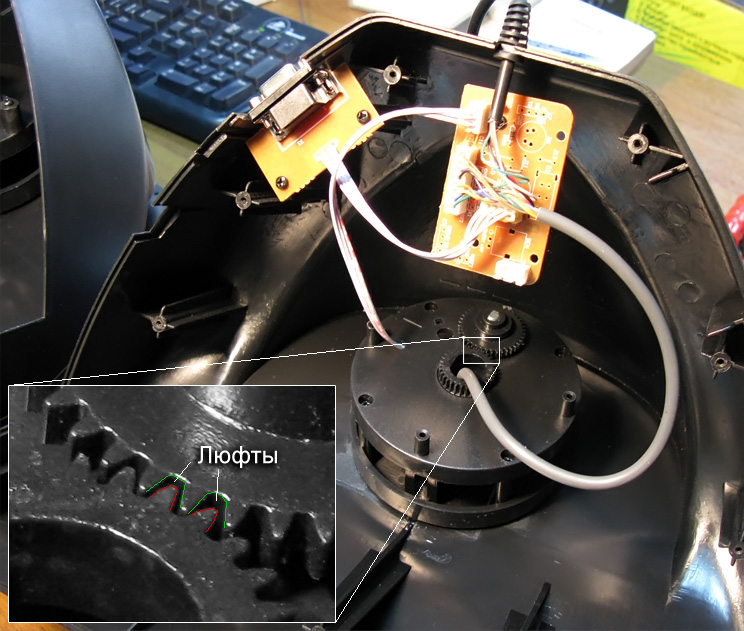
This backlash leads to a dead zone in the central position of the steering wheel of about 5 8 degrees, in which the steering wheel does not work at all.
In total, the use of potentiometers in the game wheels should be recognized as a very unfortunate decision. The only thing that justifies their use is the low price of the game kit.
The second type of sensors that are used in game wheels are optical encoders , which we also talked about above.
They are non-contact (and therefore reliable), have no restrictions on the angle of rotation, which means that they will not create problems either for turning 250 or even 900 degrees.
It would seem that this is the ideal solution for the steering wheel. But, unfortunately, everything is not as simple as it seems at first glance.
The first problem is that the optical encoder does not have any starting position. All he can do is transmit values on / off through a certain angle of rotation. And how then to determine where the central position of the steering wheel is? The steering wheel on the optical encoder requires calibration every time it is turned on.
In order for the system to know where the central position is, the steering wheel must be turned to one side all the way, then to the other side all the way, the system will calculate how many slots passed before the photocell, divide this value by 2, this will be the center.
It is logical to entrust the calibration work to a special actuator. As a result, the rudders acquired their own electric motor, which calibrated the rudder each time it was turned on, turning it back and forth. The presence of an electric motor also made it possible to use an active feedback system, i.e. Force Feedback, when the steering wheel reacted to the situation in the game like the steering wheel of a real car, trying to break out of the player’s hands when driving on rough roads, when the wheel grip with asphalt is lost, the steering wheel begins to spin softer, etc.
The next problem with the optical encoder is the accuracy that was not even enough for the joystick with its 40 degrees of rotation. As we recall, the minimum angle by which the steering wheel can be turned is determined by the width of the slot. To increase accuracy, you can:
a) make a slot ỳ narrower, and the disk itself is larger
b) assume that, for example, 10 slots = 1 degree of rotation in the game, then the minimum angle of rotation of the game wheel will be 0.1 degrees, which is already enough for precise control.
None of the manufacturers went the first way - a large disk is an increase in size, narrowing of slots is a problem with the photocell, although such a solution would allow installing a disk with slots directly on the steering axis, no gearbox would be required.
Everyone went the second way - they began to install a small disk with wide slots, but not directly on the steering axis, but through a gear reducer.
It seems that the problem of steering accuracy and durability has been resolved, but what to do with the pedals? Space in the body of the pedals is incomparably smaller than in the body of the steering wheel. Installing an optical disk and gear in the pedals is not a trivial task, especially when you consider the struggle for the price of the final product. Cheap pedals with an exact gearbox will definitely not be. As a result, most manufacturers settled on a compromise - steering wheel on optics, pedals on potentiometers. As a result, users of these rudders also thoroughly studied the internal structure of their pedals and potentiometers in them and write instructions to other users how to disassemble the potentiometers and lubricate their WD-40.
Today, there is only one model on the market - Saitek R660GT, in which optical encoders are installed in the steering wheel and pedals. But for this I had to pay accuracy. The steering wheel has a total of 128 samples at 270 degrees of rotation, pedals - 60 samples at 15 degrees.

All other models, up to the very expensive Logitech G25 and G27, have pedals on potentiometers .
Thus, the use of a seemingly simple optical sensor entailed a complication in the design of the steering wheel - it required an electric motor, a complex controller, an additional power supply and gearbox, and besides, few people managed to put the optics in the pedals.
It seems logical that the solution to the problems of durability and accuracy of the steering wheel and pedals lies, like the joysticks, in the field of magnetic sensors - they are both compact and high-precision.
However, it was impossible to directly transfer the joystick technology to the steering wheels - Hall sensors, which are used in joysticks, are not applicable in the steering wheels. For a very banal reason - they cannot measure angles greater than 45 degrees.
It seems logical to use an optical sensor in the steering wheel, and Hall sensors in the pedals, however, the merging of optical and magnetic technologies in one device will lead to a sharp complication of the controller, and it is not so simple, because it also has to control the electric motor.
But each problem has a solution and it is found. Magnetic sensors capable of measuring large angles have long been created and are successfully used in the automotive industry. However, their use in gaming devices is hindered by the high price, for example, a non-contact rotation angle sensor HRS100SSAB090 from HONEYWELL costs from $ 30, and they need a minimum of 3 pcs per wheel.
So far, only Gametrix , which recently entered the Russian market, has been able to solve this problem .
In the first model, called the Gametrix Viper , contactless magnetic sensors called MaRS are installed on the steering wheel and pedals. These sensors have an infinite resource, because there are no rubbing parts in them.
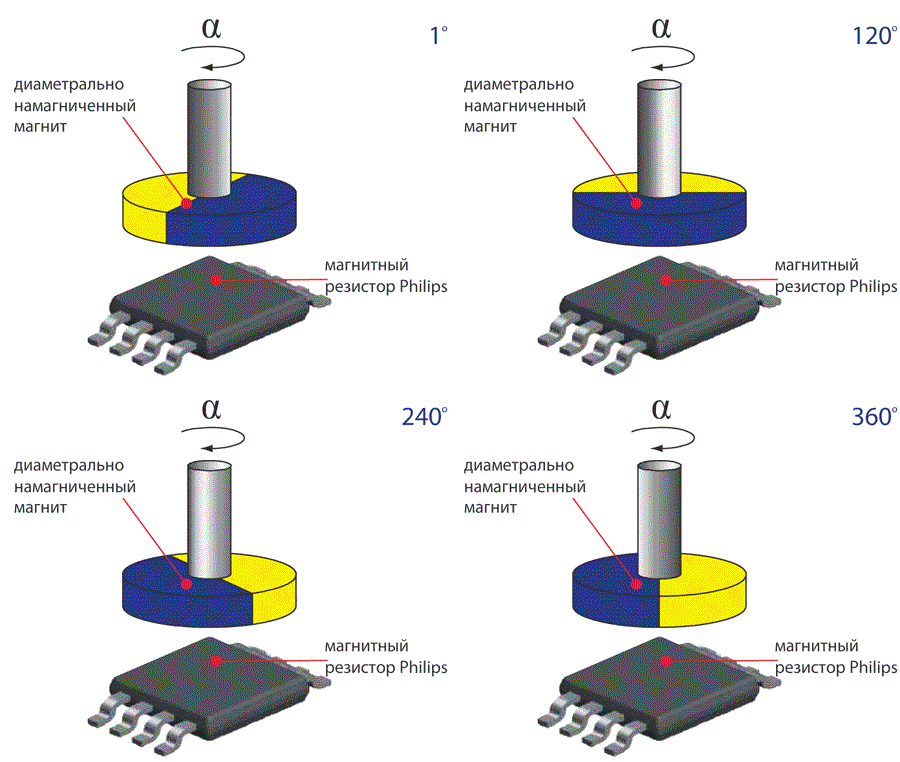
The sensors are based on magnetic resistors from NXP-Philips, which have long and successfully been used in the automotive industry.
They allow you to measure any angle with the highest accuracy. For example, a 12bit Gametrix Viper controller allows you to measure steering angles with an accuracy of 0.05 degrees!
I think it would not be an exaggeration to say that in the game wheels, as well as in the joysticks, the future lies with magnetic technology.
Progress is happening before our eyes, technology is replacing each other faster and faster. In the market of gaming devices today we are witnessing an amazing situation: all generations of gaming devices are represented in stores - from primitive joysticks and rudders of the early 90s to devices using the most advanced technologies of the 21st century.
I hope this article will help you make the right choice when buying.
Sorry for the large pictures, there’s no time to press each manually, but I don’t know how to automate the process.
I took the schemes from the respected Bumburum here . I hope he forgives me for this.
The 20th century was the century of analog technology. Radio, television, telephony - everything was built on the creation in the place of transmission of electrical analogs of audio and video information and its recreation at the place of reception. It was an age of lamps, relays and potentiometers.
The birth of the transistor gave rise to the century of semiconductors, and semiconductors gave the world digital technology, and by the time of the 21st century, digital technology is increasingly replacing analog from our lives. Analog television has not survived so long; analog telephony is quickly losing ground in front of digital cellular communications. There is no doubt that the 21st century will be the century of digital technology and semiconductors.
Let's see how the global evolution of technology has affected the devices for managing computer games.
Consider 2 large classes of gaming devices - joysticks and game wheels . We will not consider the appearance and ergonomics of devices - this is described in plenty of articles in magazines and networks, but let's look inside and try to understand where technologies are moving in the devices of market leaders.
Joysticks
Joysticks were apparently the first devices to control computer games. The first joysticks were very primitive - in fact, it was just 4 buttons assembled in one case, which were pressed when the joystick handle was rejected in one direction or another. Often no interface was provided for connecting such joysticks, and the device’s contacts were simply directly soldered to the keyboard buttons.
I think many people still remember such joysticks for the ZX Spectrum:
They are usually called "discrete", because they are able to give only values 0 or 1, on / off.
With the advent of the IBM PC, the first serious flight simulators appeared. For example, the F-19 Stealth Fighter game gave a "ticket to the sky" for many virtual pilots.
Of course, a surge of interest in virtual flights could not pass by manufacturers of gaming devices.
And so the joysticks for the IBM PC began to appear.
A typical representative of the joysticks of those years:
What is interesting - these models are still sold!
Unlike discrete joysticks, these joysticks were ANALOGUE. Now, rejecting the knob, the user received not 0 and 1, but a range of values from 0 to 255, and analog sensors - potentiometers - settled inside . The range of values that the sensor gave out to the game was associated with the bit depth of the controller - 8 bit.
The analog axes gave players the opportunity to control games much more precisely, bringing the virtual airplane control closer to the real airplane.
However, the first problems immediately emerged. The angle of deviation of the handle is determined using a potentiometer mounted on the axis of rotation. We recall the school physics course - the potentiometer is based on the friction of the engine on the resistive layer:
By changing the resistance between the extreme and the central output, the angle by which the joystick handle is rejected is determined.
Because Since the engine slides along the resistive layer, the potentiometer's service life is limited by the time during which the resistive substance is erased. The manufacturers of potentiometers honestly warn about this, indicating in the characteristics such a parameter as the "number of cycles" that the sensor will serve, roughly speaking - how many times can it be turned until it stops working normally. For most potentiometers that are used in gaming devices, this figure is from 500 thousand to a million cycles. It seems like a lot, but let's count. On average, a player makes 1 movement per second, which means that after 500 thousand seconds of the game, the device will stop working normally. And 500 thousand seconds is only 138 hours. Those. if you play 1 hour a day, then in less than six months such a joystick is guaranteed,
But manufacturers of joysticks are delicately silent about this design feature, you will not see the inscription “Designed for 500 thousand cycles” on any joystick. But there are figures of the warranty period - from 6 to 12 months. The warranty period in this case is clearly tied to the resource of the potentiometer, so in the case of the joystick, it is also the lifetime of the device.
The discovery for users turned out to be unpleasant - it’s unprofitable to play, not so much an hour a day, changing the joysticks once every six months. What to do? The skillful hands of our citizens quickly mastered disassembling joysticks and lubricating potentiometers with special greases of the WD-40 type, which greatly prolonged the potentiometer's life.
For their part, manufacturers began to solve the problem by using more expensive potentiometers with a longer resource, but it was clear that they were half measures.
It was necessary to search for a contactless solution, and it was proposed in the form of optical sensors .
The first such solution was proposed by Microsoft in the Microsoft SideWinder Precision Pro joystick. With the advent of optical sensors for mice, Microsoft tried to apply the same technology inside the joystick, but the solution was not successful and more joysticks with such sensors were not released.
A simple optical encoder (as in a regular mouse with a ball) turned out to be simpler and more reliable :
For example, the Cyborg 3D Force Stick joystick is built on this principle:
The use of such sensors allowed raising the resource of joysticks to a new level.
But such a sensor also has disadvantages. The minimum angle of rotation of the joystick axis is equal to the width of the encoder slot, and the requirements for joystick accuracy grew with the advent of new flight simulators, and for many players in the IL-2 Sturmovik, for example, this accuracy was completely insufficient. Many players abandoned the perpetual sensor on the optical encoder in favor of a more accurate sensor on potentiometers.
A sensor was required not only non-contact and durable, but also accurate.
The solution was found in magnetic sensors. From that moment, digital semiconductor technology of the 21st century came into gaming devices. With all confidence, we can say that magnetic technology is the future of sensors for gaming devices.
The first mass device based on magnetic Hall sensors was the Saitek X52 joystick.
Hall sensors were invented to measure magnetic field strength. Roughly speaking, the sensor can accurately determine the distance to the permanent magnet. Thus, by placing magnets on the joystick handle, moving the magnet closer or closer to the sensor, you can determine how much the handle has shifted. The distance is measured with high accuracy, which is determined by the capacity of the controller. The 10bit controller allows you to position the joystick with an accuracy of 1024 counts per axis.
It seemed that a solution had been found - a joystick was obtained on eternal proximity sensors with high positioning accuracy. However, already the first users found an unpleasant feature of the Hall sensors - the output data changes nonlinearly, and this leads to an incorrect measurement of the angle of deviation of the joystick handle in the middle positions of the handle.
The next stage in the development of this technology was the use of 3D Hall sensors . These sensors do not determine the field strength, but the direction to the source of the magnetic field. This sensor was first used in the Thrustmaster T.16000 joystick: The
new sensor is non-contact and completely linear. The accuracy of 16,394 counts per axis leaves far behind all the joysticks that have been released before.
Unfortunately, the developers of Thrustmaster T.16000 did not take into account one important point - the 3D Hall is extremely sensitive to the accuracy of magnet movement. Because Since they fixed it on the plastic hemisphere, the inevitable wear of the plastic leads to the fact that the magnet does not begin to move along the ideal hemisphere, but with “jumps”, which leads to problems with positioning accuracy.
Logitech tried to solve this problem by installing the axis of the Logitech Flight System G940 joystick on bearings.
Now the magnet is guaranteed to move along an absolutely right trajectory, without backlashes and jumps, but the ill-conceived feedback system implemented on this model scared away many users (not to mention the price of 13,000 rubles).
Radically solve the issue of accuracy and durability of sensors, as well as the resource of mechanical parts of the joystick, Saitek decided in the X65F model :
In this joystick, the handle is fixed completely motionless, the player’s movements are removed from the handle with the help of load cells - sensors that measure pressure. The player applies force to the handle, strain gauges record the pressure and transfer it to the game. This solves the problem of the durability of the mechanics (the handle is stationary, which means that it will not have any wear), the durability of the sensors - the load cells have a huge resource, and the high-performance controller will provide accuracy. However, it is not yet clear how convenient it will be to play without tipping the handle. The joystick is not yet for sale and there is no possibility to test its capabilities yet. Most likely, this joystick will remain a niche device for a small circle of lovers of modern combat aircraft, as control of aircraft of the First and Second World Wars requires that the handle deviates. But wait and see.
To summarize the subtotal.
Over the past 20 years, joysticks have evolved from primitive discrete switches to high-tech devices using the latest 21st-century technology. The new joysticks use the most advanced sensors for measuring angles - magnetic, which allows you to make devices with a very large resource and the highest positioning accuracy.
Today, joysticks with all types of sensors are available to the buyer - on potentiometers, optical encoders, Hall sensors and 3D Halls. I will take the liberty of asserting that soon enough potentiometers and optics will be a thing of the past - as soon as magnetic sensors become cheaper, and manufacturers take into account the errors of the first devices using new technology.
Game wheels
Game wheels were born later than joysticks. At first, it seemed that for racing games there was enough a joystick, or even just a keyboard, because the first racing games did not have a high level of realism.
However, racing games became more and more, the physical model of cars was becoming more complicated, and many players wanted to get a control device close to a real car. So the first rudders and pedals for racing games appeared.
The usual kit for racing games consists of the steering wheel itself, a pedal block (2, less often 3 pedals) and sometimes a gearbox block and a hand brake.
So, with what sensors measure the angle of deviation of the steering wheel and pedals modern mass-marketed game sets for racing games? There are not so many of them as in joysticks.
The first type is, of course,potentiometer . The vast majority of game kits for racing games on the market today are made on potentiometers with an 8bit controller. This is natural - manufacturers simply mechanically moved the angle measurement system from the joystick to the steering wheel.
However, these devices are far from equivalent and the main difference between the steering wheel and the joystick is the angle of rotation. If in joysticks it is usually not more than 40 degrees, then in the rudders the minimum angle is 180 degrees, and 250-270 degrees is considered the norm. And if we talk about a complete simulation of driving, the steering angle must reach 900 degrees!
Therefore, the use of potentiometers brought to the steering wheel even more problems than in joysticks.
We remember the problem of the limited resource of potentiometers; the rudders and pedals with such a sensor are a “bomb with a clockwork” - we can say for sure when it “explodes”, i.e. when the steering wheel and pedals cease to work normally due to the destruction of the resistive layer.
The second problem is that if a joystick with an 8bit controller (256 values per axis) when the handle is deflected by 40 degrees allows you to measure the angle of the handle with an accuracy of 40/256 = 0.15 degrees, then the same system in the steering wheel with an angle of rotation of 250 degrees gives an accuracy of 250/256 = 1 degree. Not enough for precise control! Turn the steering wheel by 0.5 degrees will not work.
And that's not all. Most low-cost potentiometers operate at angles from 180 to 200 tons. And what if the steering wheel rotates 250 degrees? Manufacturers went the simplest way - the potentiometer is not installed directly on the steering axis, but connected to it through the gear. But since Since such a gearbox requires high precision of gear adjustment, which is rather difficult to provide for the mass production of inexpensive products, as a result, the user also gets an additional backlash in the central position:
This backlash leads to a dead zone in the central position of the steering wheel of about 5 8 degrees, in which the steering wheel does not work at all.
In total, the use of potentiometers in the game wheels should be recognized as a very unfortunate decision. The only thing that justifies their use is the low price of the game kit.
The second type of sensors that are used in game wheels are optical encoders , which we also talked about above.
They are non-contact (and therefore reliable), have no restrictions on the angle of rotation, which means that they will not create problems either for turning 250 or even 900 degrees.
It would seem that this is the ideal solution for the steering wheel. But, unfortunately, everything is not as simple as it seems at first glance.
The first problem is that the optical encoder does not have any starting position. All he can do is transmit values on / off through a certain angle of rotation. And how then to determine where the central position of the steering wheel is? The steering wheel on the optical encoder requires calibration every time it is turned on.
In order for the system to know where the central position is, the steering wheel must be turned to one side all the way, then to the other side all the way, the system will calculate how many slots passed before the photocell, divide this value by 2, this will be the center.
It is logical to entrust the calibration work to a special actuator. As a result, the rudders acquired their own electric motor, which calibrated the rudder each time it was turned on, turning it back and forth. The presence of an electric motor also made it possible to use an active feedback system, i.e. Force Feedback, when the steering wheel reacted to the situation in the game like the steering wheel of a real car, trying to break out of the player’s hands when driving on rough roads, when the wheel grip with asphalt is lost, the steering wheel begins to spin softer, etc.
The next problem with the optical encoder is the accuracy that was not even enough for the joystick with its 40 degrees of rotation. As we recall, the minimum angle by which the steering wheel can be turned is determined by the width of the slot. To increase accuracy, you can:
a) make a slot ỳ narrower, and the disk itself is larger
b) assume that, for example, 10 slots = 1 degree of rotation in the game, then the minimum angle of rotation of the game wheel will be 0.1 degrees, which is already enough for precise control.
None of the manufacturers went the first way - a large disk is an increase in size, narrowing of slots is a problem with the photocell, although such a solution would allow installing a disk with slots directly on the steering axis, no gearbox would be required.
Everyone went the second way - they began to install a small disk with wide slots, but not directly on the steering axis, but through a gear reducer.
It seems that the problem of steering accuracy and durability has been resolved, but what to do with the pedals? Space in the body of the pedals is incomparably smaller than in the body of the steering wheel. Installing an optical disk and gear in the pedals is not a trivial task, especially when you consider the struggle for the price of the final product. Cheap pedals with an exact gearbox will definitely not be. As a result, most manufacturers settled on a compromise - steering wheel on optics, pedals on potentiometers. As a result, users of these rudders also thoroughly studied the internal structure of their pedals and potentiometers in them and write instructions to other users how to disassemble the potentiometers and lubricate their WD-40.
Today, there is only one model on the market - Saitek R660GT, in which optical encoders are installed in the steering wheel and pedals. But for this I had to pay accuracy. The steering wheel has a total of 128 samples at 270 degrees of rotation, pedals - 60 samples at 15 degrees.
All other models, up to the very expensive Logitech G25 and G27, have pedals on potentiometers .
Thus, the use of a seemingly simple optical sensor entailed a complication in the design of the steering wheel - it required an electric motor, a complex controller, an additional power supply and gearbox, and besides, few people managed to put the optics in the pedals.
It seems logical that the solution to the problems of durability and accuracy of the steering wheel and pedals lies, like the joysticks, in the field of magnetic sensors - they are both compact and high-precision.
However, it was impossible to directly transfer the joystick technology to the steering wheels - Hall sensors, which are used in joysticks, are not applicable in the steering wheels. For a very banal reason - they cannot measure angles greater than 45 degrees.
It seems logical to use an optical sensor in the steering wheel, and Hall sensors in the pedals, however, the merging of optical and magnetic technologies in one device will lead to a sharp complication of the controller, and it is not so simple, because it also has to control the electric motor.
But each problem has a solution and it is found. Magnetic sensors capable of measuring large angles have long been created and are successfully used in the automotive industry. However, their use in gaming devices is hindered by the high price, for example, a non-contact rotation angle sensor HRS100SSAB090 from HONEYWELL costs from $ 30, and they need a minimum of 3 pcs per wheel.
So far, only Gametrix , which recently entered the Russian market, has been able to solve this problem .
In the first model, called the Gametrix Viper , contactless magnetic sensors called MaRS are installed on the steering wheel and pedals. These sensors have an infinite resource, because there are no rubbing parts in them.
The sensors are based on magnetic resistors from NXP-Philips, which have long and successfully been used in the automotive industry.
They allow you to measure any angle with the highest accuracy. For example, a 12bit Gametrix Viper controller allows you to measure steering angles with an accuracy of 0.05 degrees!
I think it would not be an exaggeration to say that in the game wheels, as well as in the joysticks, the future lies with magnetic technology.
To summarize.
Progress is happening before our eyes, technology is replacing each other faster and faster. In the market of gaming devices today we are witnessing an amazing situation: all generations of gaming devices are represented in stores - from primitive joysticks and rudders of the early 90s to devices using the most advanced technologies of the 21st century.
I hope this article will help you make the right choice when buying.
Sorry for the large pictures, there’s no time to press each manually, but I don’t know how to automate the process.
I took the schemes from the respected Bumburum here . I hope he forgives me for this.