
Bulgarian "almost Apple" 1988
This article is about a clone of the American computer Apple, which was available in the Soviet Union and produced in Bulgaria.
On the line of these computers was brought up the modern generation of it-shnikov.
Meet - the new exhibit of our computer history museum, Pravez 8D.
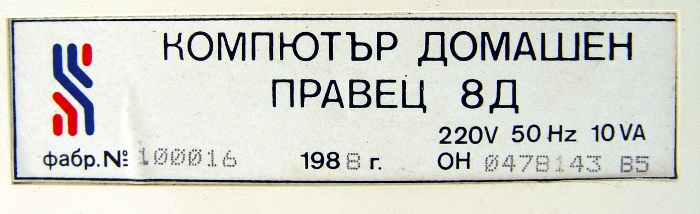
Today I want to tell you about another very interesting exhibit of our museum of computer antiquity . It will be about the Pravets 8D computer.
The line of these computers can be called legendary only because at one time it stood in every third school (Pravtsy 8A was delivered to educational institutions) of the entire Soviet Union, as well as of most socialist countries of the world. Many of today's IT specialists started precisely with Pravtsev; it was he who became for many their “first computer in life”.
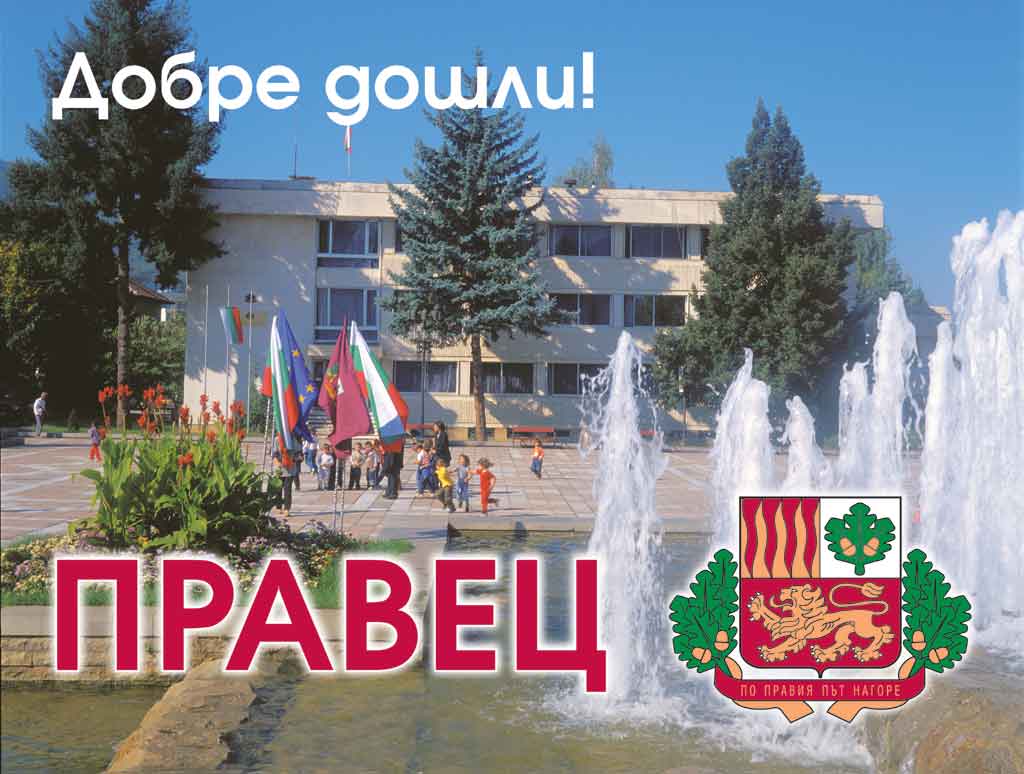
The name “Pravets” itself comes from the name of a small village in Bulgaria, in which there is a factory called “WORLD PROCESSORS SYSTEMS”, on which these computers were actually manufactured. Computers were made to ensure that in the socialist countries there was at least something that could be contrasted with the American Apple, which in those years had already gained some popularity.
The first computer that went into the series was IMCO-1 (MicroKomputer is individual, sometimes it stands for: Ivan Marangozov Copy of the Original, in honor of the creator) and it was released in 1980. They tried to make it as similar as possible in functionality to Apple II. It almost happened - the computer received 48 KB of RAM (expandable to 64 KB), ROM 12 KB. The central processor is 1 MHz (exactly the same as the Apple II). A tape drive was used as a drive, since there were no drives in Bulgaria yet.
This model was interesting first of all at the price of $ 2600, while the Japanese and American counterparts were much more expensive.
IMCO-1 was produced until 1982, until it was replaced by IMCO-2 or, as it was also called, Pravets-82. By the way, the success of IMCO-1 prompted the Bulgarians to expand the department for the production of electronic components in the town of Pravets to a factory for the production of personal computers. After Pravets-82 there was Pravets 8M (IMKO-2M), which was already based on 2 Z80 and MOS 6502 processors popular at that time.
Computers of the Pravets 8 series were fully compatible with Apple II, both software and hardware. On Pravets, it was possible without any modifications to use the programs of the original Apple II, as well as its expansion board. The ROM of the character generator and control programs of the Monitor was slightly modified to support the Cyrillic alphabet (capital letters of the Cyrillic alphabet instead of lowercase Latin letters), as well as to display the name "PRAVETS" ("IMKO", "IMKO-2M") instead of APPLE II when turned on. In addition, Pravets 8 issued its own expansion cards - to increase RAM to 192 or 256 KB, as well as a U-LAN board that allows computers to be connected to a local network. Used operating systems - Apple DOS , ProDOS , UCSD P-System , CP / M(with CP / M card), the most frequently used programming languages are assembly language , Applesoft BASIC , UCSD Pascal , Logo .
In 1985, the factory management (not without instructions from the first secretary of the Communist Party of Bulgaria Todor Zhivkov, who, incidentally, was from the town of Pravets) decided to create a “home computer” Pravets 8D:
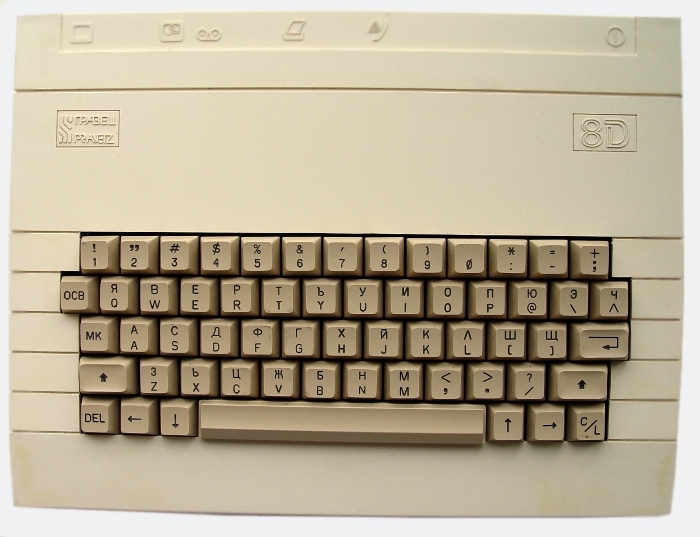
For this model, a smaller case with an integrated keyboard unit was specially made . The monitor was not supplied with it - instead, it was supposed to use a conventional household TV. Also ROM was changed to support both Latin and Cyrillic.
Initially, a cassette recorder was used as external memory (which was supposed to be for those with a TV), later, in 1990, a disk drive controller and DOS-8D disk operating system appeared. The approximate price was around $ 290.
Pravets 8D looked, at the time of production it was quite “fashionable” when compared with similar computers of that time, for example Vesta IK-31 or Parus VI-201 .

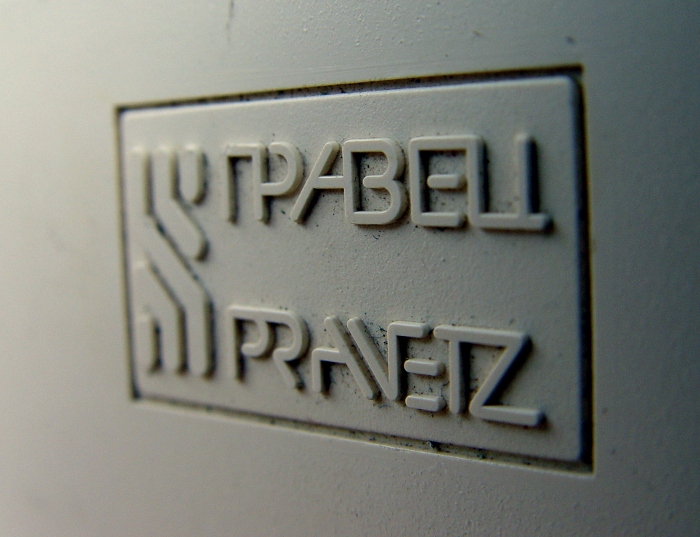
Take, for example, the case - white matte plastic, with branded melted badges on the periphery (by the way, they are very, very similar to the icons on Apple computers ):

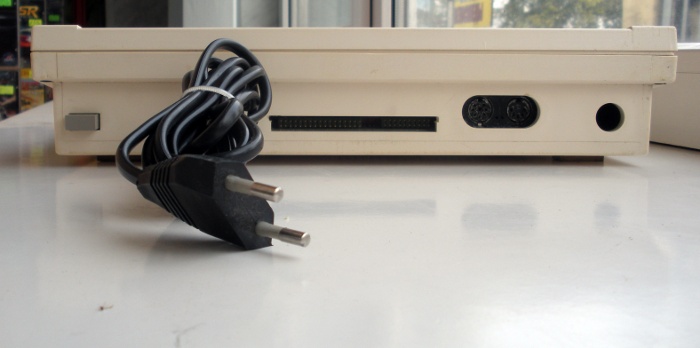
The power supply is built-in inside, everything is very neat and clear.
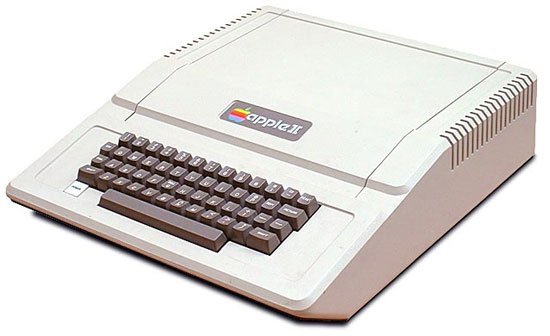
In general, the Bulgarians managed to achieve a very large “similarity” to the original - Apple II both in case and in parameters:
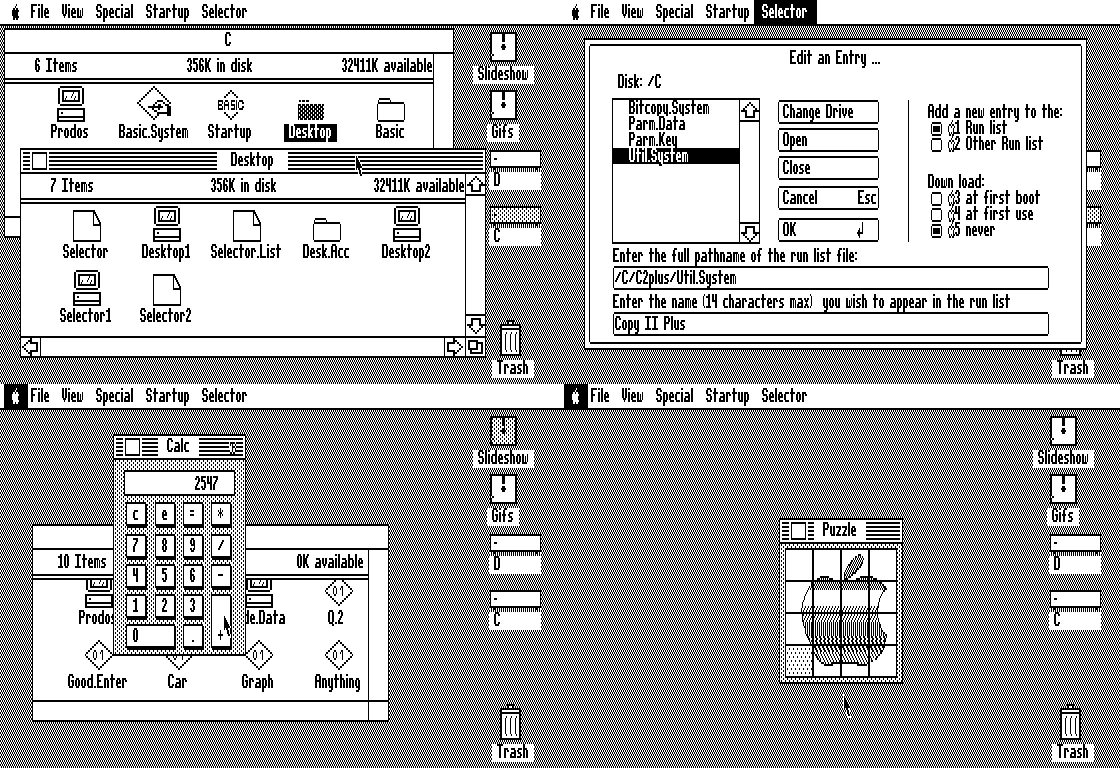
Well, as I said, the software could use the same thing:
Well, my favorite toy at school Pravets was “ Moon patrol ”(moon patrol), in which it was necessary to jump over the holes and shoot from everything above and to the right:
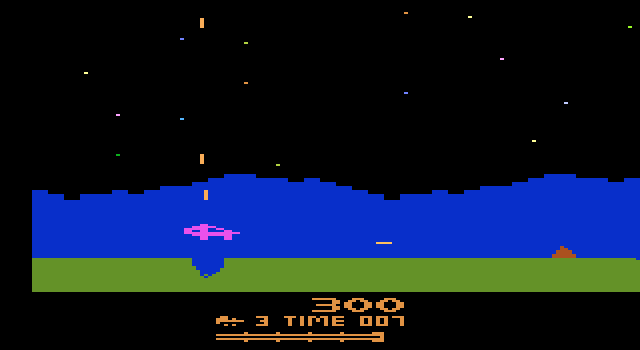
... only the monitors we had were not color, but black and green.
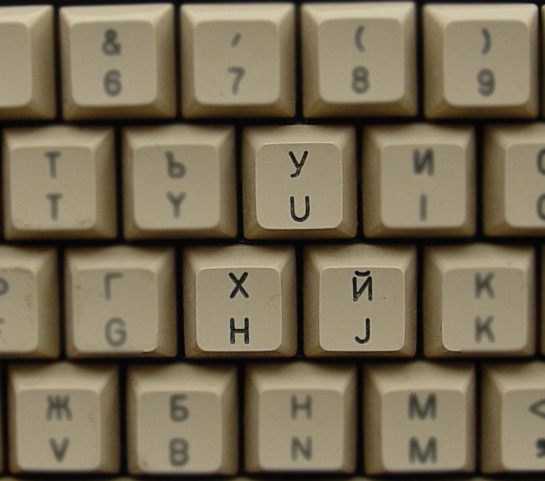
The Pravets keyboard is a little different from modern ones. First of all, the layout - you don’t have any “fizva”. The Cyrillic alphabet is located relative to the Latin alphabet according to the principle of transcription correspondence:

This layout is often called “Yavert”, and its correct name is “phonetic”
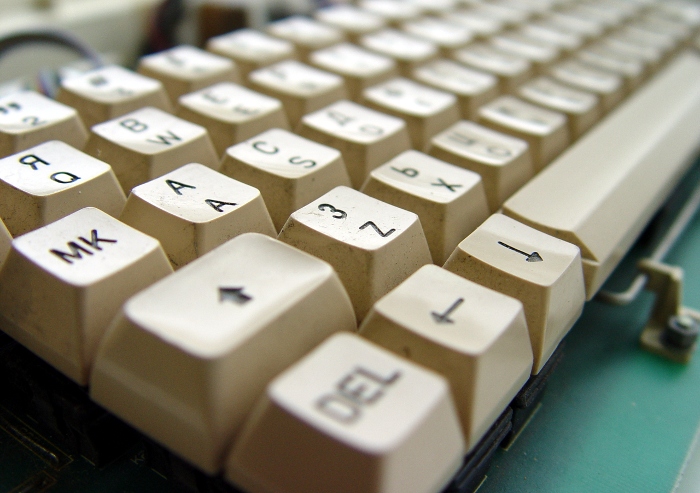
Not on one keyboard of the world was this “chord” so convenient for typing :)
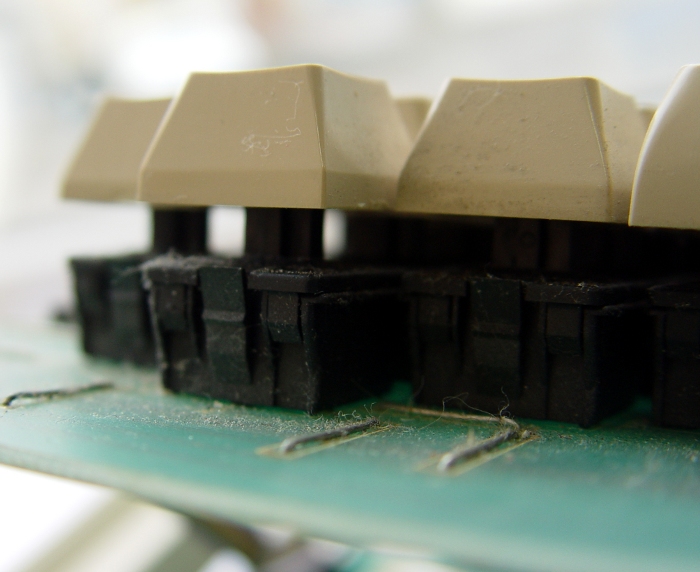
Each key on these keyboards was a separate element soldered into the board, unlike modern keyboards, where the keys have a common plate:
The “space” has a separate
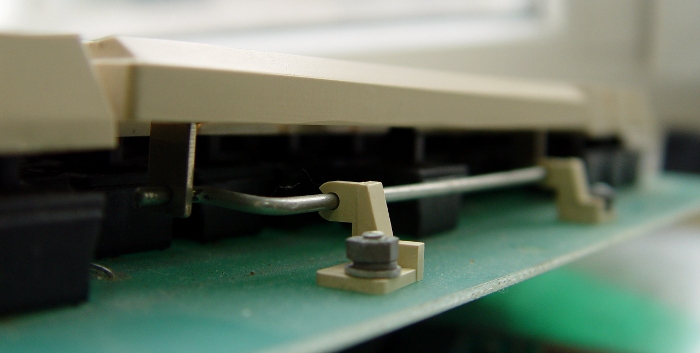
bracket for the bracket in order to press it, it was possible from any direction, and not just in the center: The
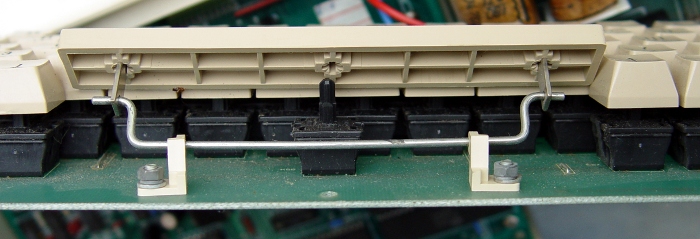
buttons are “put on” the key. All keys, except for the space, are glued, apparently, that would not fly off.
The Pravets 8D computer itself consists of 3 parts - a printed circuit board with a keyboard, a power supply and a motherboard (if we draw analogies with modern computers).
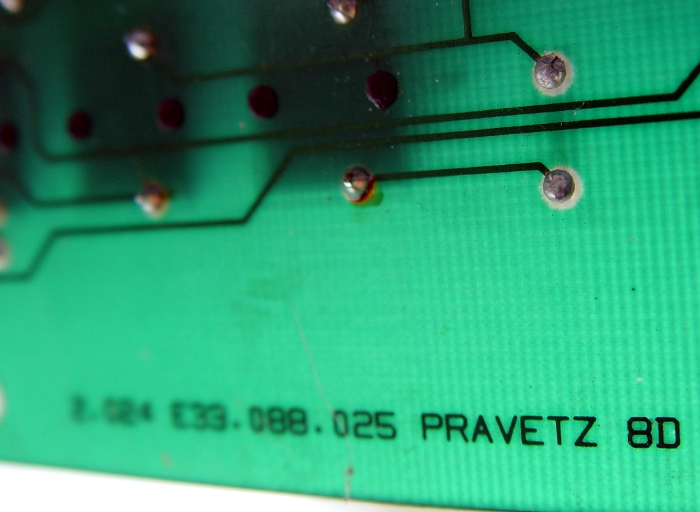
On the keyboard board, the name “PRAVETZ 8D” is proudly aligned.
And here is what this Apple counterpart looks like inside:
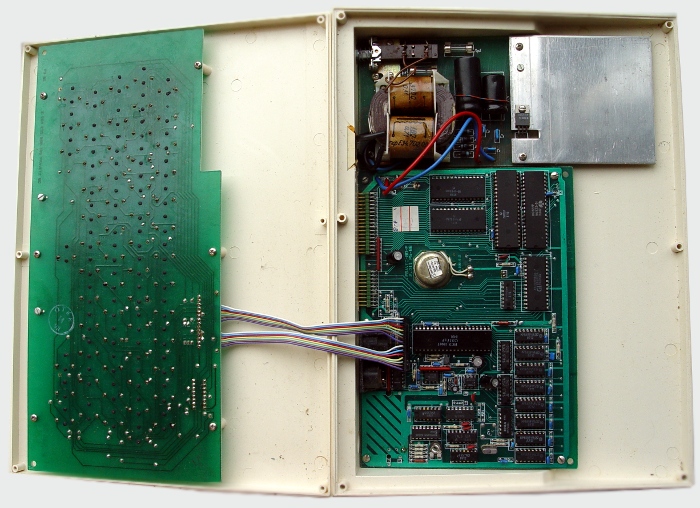
The keyboard is on the left, the power supply is at the top right, and the rest is the computer itself.
The keyboard was replaceable and connected with such an “almost plume”:
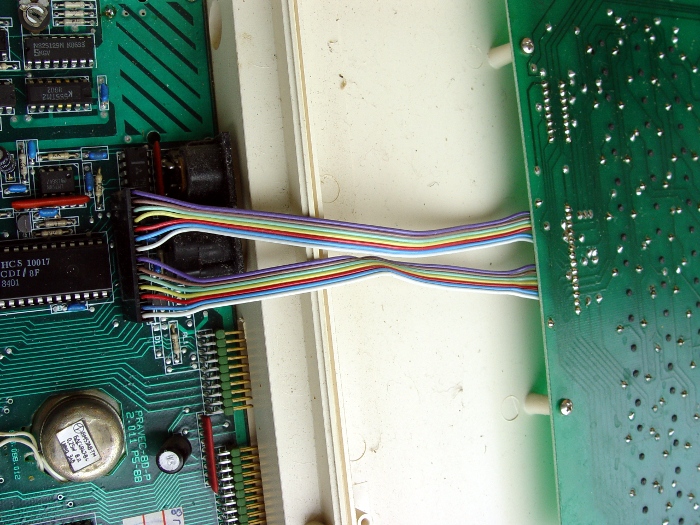
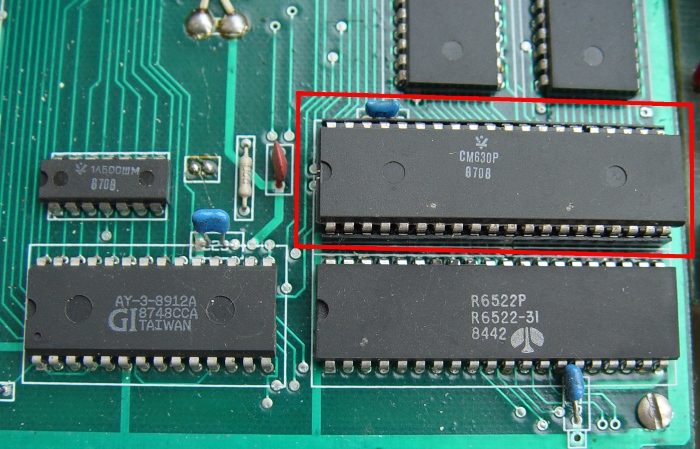
the CM630P central processor, which is actually a complete clone of the MOS Technology 6502 processor used in computers such as Apple I, Apple II, and Commodore PET, the programmable AY sound generator on the left -3-8912 with the help of which it was possible to generate a 3-voice polyphony (8 octaves + white noise):
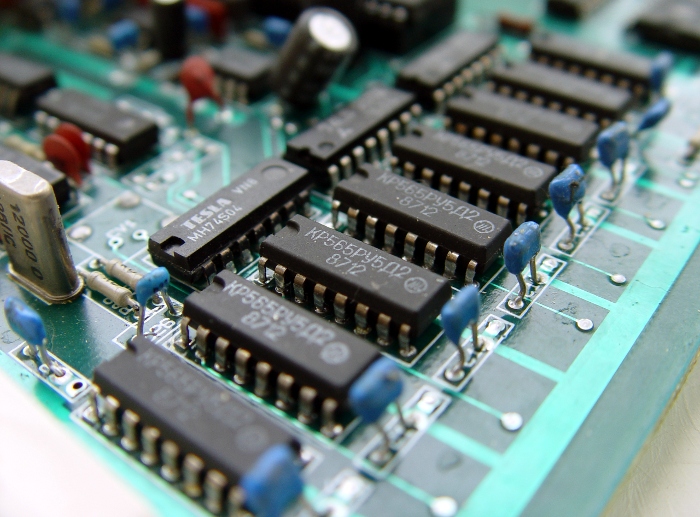
And this is how the RAM looks:
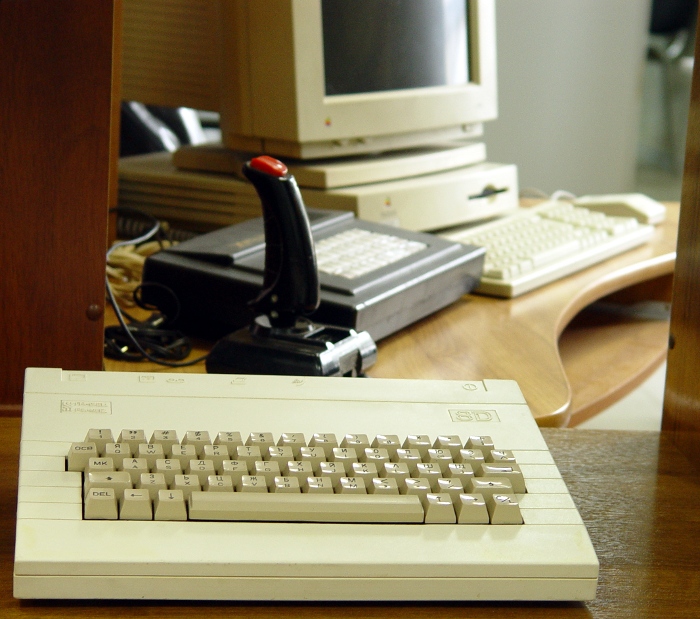
In general, this computer is really very interesting both as an Apple clone and as just very old, but legendary Soviet computer.
He will take a worthy place in our Museum of Computer Antiquities .
On the line of these computers was brought up the modern generation of it-shnikov.
Meet - the new exhibit of our computer history museum, Pravez 8D.
Today I want to tell you about another very interesting exhibit of our museum of computer antiquity . It will be about the Pravets 8D computer.
The line of these computers can be called legendary only because at one time it stood in every third school (Pravtsy 8A was delivered to educational institutions) of the entire Soviet Union, as well as of most socialist countries of the world. Many of today's IT specialists started precisely with Pravtsev; it was he who became for many their “first computer in life”.
The name “Pravets” itself comes from the name of a small village in Bulgaria, in which there is a factory called “WORLD PROCESSORS SYSTEMS”, on which these computers were actually manufactured. Computers were made to ensure that in the socialist countries there was at least something that could be contrasted with the American Apple, which in those years had already gained some popularity.
The first computer that went into the series was IMCO-1 (MicroKomputer is individual, sometimes it stands for: Ivan Marangozov Copy of the Original, in honor of the creator) and it was released in 1980. They tried to make it as similar as possible in functionality to Apple II. It almost happened - the computer received 48 KB of RAM (expandable to 64 KB), ROM 12 KB. The central processor is 1 MHz (exactly the same as the Apple II). A tape drive was used as a drive, since there were no drives in Bulgaria yet.
This model was interesting first of all at the price of $ 2600, while the Japanese and American counterparts were much more expensive.
IMCO-1 was produced until 1982, until it was replaced by IMCO-2 or, as it was also called, Pravets-82. By the way, the success of IMCO-1 prompted the Bulgarians to expand the department for the production of electronic components in the town of Pravets to a factory for the production of personal computers. After Pravets-82 there was Pravets 8M (IMKO-2M), which was already based on 2 Z80 and MOS 6502 processors popular at that time.
Computers of the Pravets 8 series were fully compatible with Apple II, both software and hardware. On Pravets, it was possible without any modifications to use the programs of the original Apple II, as well as its expansion board. The ROM of the character generator and control programs of the Monitor was slightly modified to support the Cyrillic alphabet (capital letters of the Cyrillic alphabet instead of lowercase Latin letters), as well as to display the name "PRAVETS" ("IMKO", "IMKO-2M") instead of APPLE II when turned on. In addition, Pravets 8 issued its own expansion cards - to increase RAM to 192 or 256 KB, as well as a U-LAN board that allows computers to be connected to a local network. Used operating systems - Apple DOS , ProDOS , UCSD P-System , CP / M(with CP / M card), the most frequently used programming languages are assembly language , Applesoft BASIC , UCSD Pascal , Logo .
In 1985, the factory management (not without instructions from the first secretary of the Communist Party of Bulgaria Todor Zhivkov, who, incidentally, was from the town of Pravets) decided to create a “home computer” Pravets 8D:
For this model, a smaller case with an integrated keyboard unit was specially made . The monitor was not supplied with it - instead, it was supposed to use a conventional household TV. Also ROM was changed to support both Latin and Cyrillic.
Initially, a cassette recorder was used as external memory (which was supposed to be for those with a TV), later, in 1990, a disk drive controller and DOS-8D disk operating system appeared. The approximate price was around $ 290.
Pravets 8D looked, at the time of production it was quite “fashionable” when compared with similar computers of that time, for example Vesta IK-31 or Parus VI-201 .
Take, for example, the case - white matte plastic, with branded melted badges on the periphery (by the way, they are very, very similar to the icons on Apple computers ):
The power supply is built-in inside, everything is very neat and clear.
In general, the Bulgarians managed to achieve a very large “similarity” to the original - Apple II both in case and in parameters:
Well, as I said, the software could use the same thing:
Well, my favorite toy at school Pravets was “ Moon patrol ”(moon patrol), in which it was necessary to jump over the holes and shoot from everything above and to the right:
... only the monitors we had were not color, but black and green.
The Pravets keyboard is a little different from modern ones. First of all, the layout - you don’t have any “fizva”. The Cyrillic alphabet is located relative to the Latin alphabet according to the principle of transcription correspondence:
This layout is often called “Yavert”, and its correct name is “phonetic”
Not on one keyboard of the world was this “chord” so convenient for typing :)
Each key on these keyboards was a separate element soldered into the board, unlike modern keyboards, where the keys have a common plate:
The “space” has a separate
bracket for the bracket in order to press it, it was possible from any direction, and not just in the center: The
buttons are “put on” the key. All keys, except for the space, are glued, apparently, that would not fly off.
The Pravets 8D computer itself consists of 3 parts - a printed circuit board with a keyboard, a power supply and a motherboard (if we draw analogies with modern computers).
On the keyboard board, the name “PRAVETZ 8D” is proudly aligned.
And here is what this Apple counterpart looks like inside:
The keyboard is on the left, the power supply is at the top right, and the rest is the computer itself.
The keyboard was replaceable and connected with such an “almost plume”:
the CM630P central processor, which is actually a complete clone of the MOS Technology 6502 processor used in computers such as Apple I, Apple II, and Commodore PET, the programmable AY sound generator on the left -3-8912 with the help of which it was possible to generate a 3-voice polyphony (8 octaves + white noise):
And this is how the RAM looks:
In general, this computer is really very interesting both as an Apple clone and as just very old, but legendary Soviet computer.
He will take a worthy place in our Museum of Computer Antiquities .