How to destroy bitcoins
- Transfer
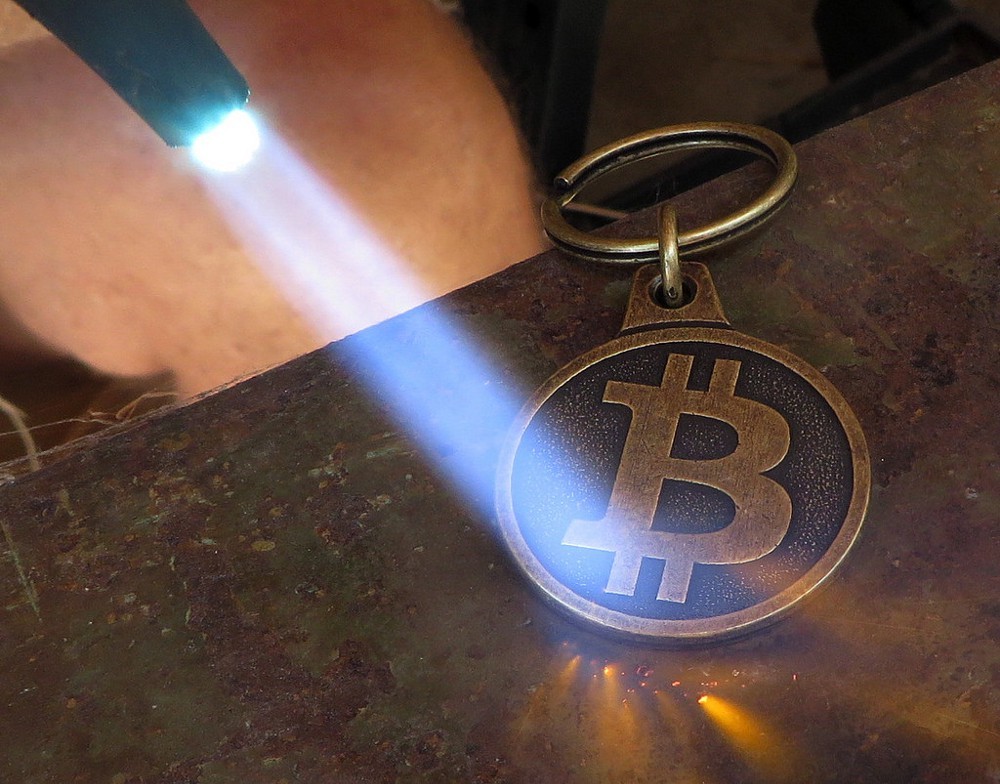
We know how to create bitcoins , but how can you destroy them?
Burn bitcoins - so make them impossible to spend. This can come up with several applications - for example, quickly launch a new cryptocurrency (as they did in Counterparty ) or slightly increase the cost of the remaining bitcoins, reducing the number of available ones. In this article we describe three methods for burning bitcoins.
Simplest method
It is very easy to burn bitcoins by sending them to a dummy address. Fortunately, Bitcoin users have the chance to accidentally burn Bitcoins in this way is extremely small, since the address contains a 4-byte checksum that prevents typos (there is a detailed instruction on creating Bitcoin addresses on the bitcoin wiki ).
That is why to create a fictitious Bitcoin address you need to spend a little effort, and not just hit a couple of times on the keyboard. The hash160 is used to create the address, it can take any values, and this value is converted into the first characters of the address (and the last ones indicate the checksum).
Known examples of fictitious addresses:
• 1BitcoinEaterAddressDontSendf59kuE (BTC obtained 2.10556692),
• 1CounterpartyXXXXXXXXXXXXXXXUWLpVr (2 BTC 130,84717717),
• 1111111111111111111114oLvT2 (43.2884582 BTC), in that the smallest possible address encoded hash160,
• 1QLbz7JHiBTspS962RLKV8GndWFwi5j6Qr(0.01159201 BTC), the maximum possible hash160 is encoded at this address.
Sending bitcoins to such an address you almost certainly burn them, but you cannot prove it, because in principle such a private key can exist for such an address. However, the search for such a key can take more energy than will be generated by our solar system for the entire time of its life.
Meaningful method
For quite a long time, Bitcoin users have included various data in the blockchain, whether it is proof of copyright to a document , proof of identity , securing contracts or a digital representation of real assets .
In 2013, a simple way to add data to any bitcoin transaction was introduced. Until now, the incorrect OP_RETURN instruction was made standard, and the user found the ability to add up to 40 bytes of data to the transaction.
Prior to standardizationThis type of data output in the blockchain was not an easy task, and included the use of a variety of dummy addresses encoding arbitrary data. The introduction of the standard has simplified the process and allowed Bitcoin nodes to forget the complicated way and limit the blockchain swelling .
Since its introduction , 3.66 BTC has already been spent on conclusions via OP_RETURN , and the number of such conclusions is only growing, indicating a growing number of ways to use the blockchain in various ways.
Unambiguous method
And although the previous methods are quite effective, they do not destroy bitcoins. You can still see them in the blockchain, you just can't spend it. However, there is a way to effectively destroy bitcoins by removing them from the blockchain.
Making my website with statistics on transactions of Bitcoins, I took measures in order not to skip any transaction data, and so that the data in the database was consistent. I calculated the number of existing bitcons as the sum of bitcoins stored in unspent, but confirmed outputs. If everything is correct, this amount should coincide with the number of existing bitcoins (this number can be calculated only if you know the number of blocks in the main chain of the blockchain).
However, I found that 10.19768818 BTC disappeared somewhere. At first I thought I missed some transactions or that I had an error in the code. Understanding this, I saw that I was right: 1031 did not receive the reward that was intended for them. A block reward is a combination of coins created (50 BTC at the very beginning of Bitcoin, halving every 210,000 blocks) and commissions contained in block transactions.
This discrepancy could arise from the fact that miners missed several transaction fees, or excessive commission was paid for a coinbase transaction, and was not included in the output value of the miner transaction, or it was done intentionally, who knows.
The first such block is dated May 18, 2011, and the last one appeared on August 15, 2015 (it lacked only one satosi, and nain it with the help of CoiniumServ ). Most of these blocks were minted between January 2012 and March 2013.
Several pools of mine lines were blocks and did not pick up the award. According to the Blocktrail API, more than half of these blocks are nicked by EclipseMC and Eligius . Interestingly, these two pools began to mine them at the same time - perhaps they used the same software. However, EclipseMC finished mining in September 2012, and Eligius - in January 2013. Other pools, like Slush or P2Pool, also namynil such blocks, but very few.
Missing bitcoins are gone forever. Sending bitcoins to fictitious addresses or spending on inappropriate conclusions for this does not lead to their disappearance - they can be seen in the blockchain. And if you do not request the entire reward for the block, the bitcoins actually disappear - they cannot be seen in the blockchain. The only check for the value of the reward for the block is (judging by the bitcoind source code ) that it should not exceed the maximum value - it turns out that you can completely destroy the entire reward, including the generated coins.
Conclusion
There are other ways of burning bitcoins (for example, using non-standard incorrect scripts ), but the most common ones are bogus addresses and OP_RETURN scripts. And although this is not supported by evidence, I was very interested to find out which pools used the same software just by examining the blockchain.