The technosphere of mankind weighs 30 teratonnes (30 × 10¹² tons)
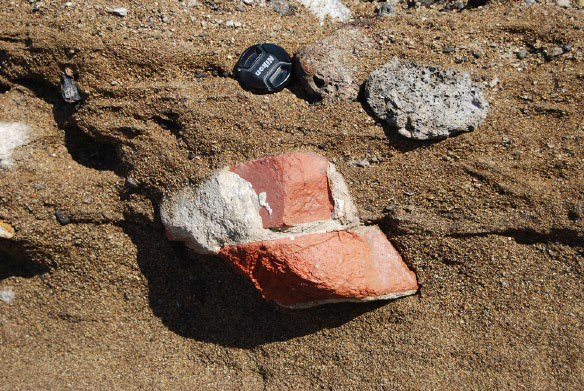
Stones and concrete fragments in sediment. Beach Tunnelboka, Catalonia (Spain)
Agent Smith in the film "The Matrix" said that humanity is like a viral infection, which can only one thing - to multiply uncontrollably, spreading exponentially and filling all the space around. In fact, he is wrong. The biomass of humanity today is not so great - about 300 million tons , which is only about 1.3% of the biomass of all animals and microorganisms on Earth. It would seem a little. On the other hand, the biomass of humans is about 10 times greater than the biomass of all wild vertebrates on Earth, and about twice as much as the mass of all large vertebrates that lived on Earth before man appeared.
Inorganic artificial technosphere serves to maintain our lives. The mass of the technosphere is about 5 orders of magnitude greater than the human biomass. In art, to change the world around us no living being can compare with a human being.
All living organisms dynamically interact with the outside world, it is completely normal and natural. Plants take roots into the soil to extract mineral resources, and take carbon dioxide from the atmosphere. Herbivores devour plants, send not fully digested excrement along with valuable minerals back to the soil, at the same time taking oxygen from the atmosphere, but adding carbon dioxide and sometimes methane to it. Predatory animals devour herbivores, also enriching the soil with excrement and their corpses, which eventually turn into oil, coal and other breeds. All living biomass is served by a whole arsenal of microbes and invertebrates, which contribute to the transformation of the world.
Some organisms can change the surrounding space, adapting it to fit their needs. Birds, ants and termites know how to build dwellings from branches. Various primates, birds, fish and insects are able to use tools for work. Some large and even small mammals, like beavers, are considered “ecosystem engineers”. They do not just build houses, but change the natural space as it is convenient for them to live.
What is the technosphere
The farthest on this path is rational man (homo sapiens), who consciously or unconsciously carries out the transformation of the surrounding world with the help of technology. The evolution of human society and technology occurs in parallel. These are co-dependent entities, and therefore scientists are talking about the process of the so-called “co-evolution,” that is, joint evolution. At the same time, the evolution of tools and technologies from generation to generation occurs so quickly that it is much higher than the rate of evolution by natural selection, not only among the human species, but among all known organisms.
To understand and analyze the pace of this joint evolution, it is customary to use the concept of the technosphere - a new component of the Earth, which is represented as a branch of the biosphere in the sensein which it was formulated by academician Vladimir Vernadsky .
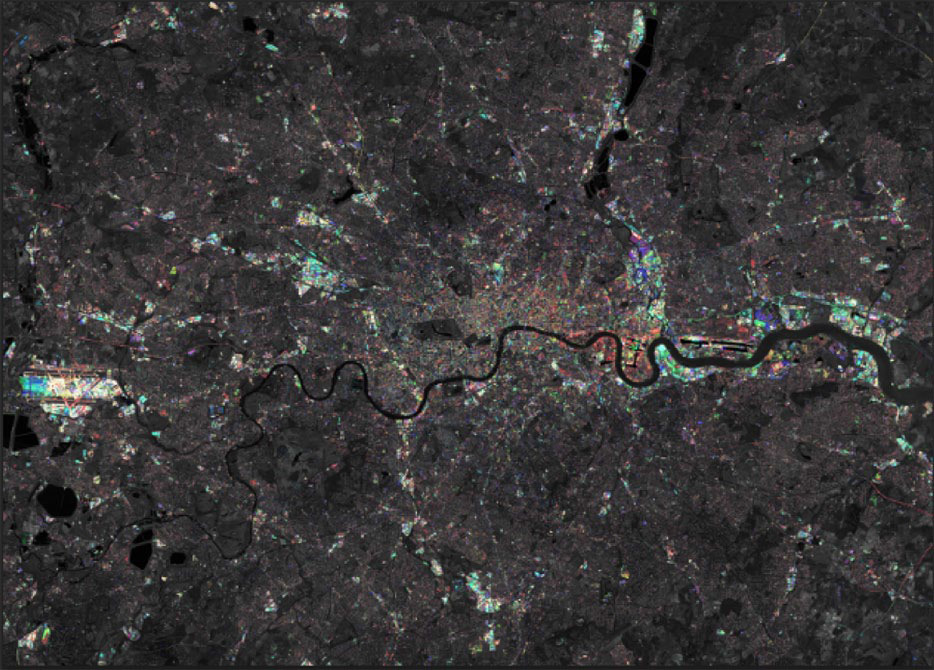
A map of changes in the urban and suburban technosphere around London for 20 years according to Landsat satellites (a map of 50 km horizontally). Changes are marked in red in 1989, in green - in 2001, in blue - in 2012. The map shows only superficial changes. In the historical places of the city, the technosphere deposits are up to 30 meters. Source: Territorial Agency / John Palmesino and Ann-Sofi Rönnskog, with David Hellström
The technosphere encompasses the complex human social structures along with the physical infrastructure and technological artifacts that support the energy, information and material flows that ensure the efficiency of the system. These include power plants and electricity transmission lines, roads and buildings, plastics and tools, airplanes and pens, transistors and electronics, man-made physical elements, plants and animals — anything. The components of the technosphere change very quickly, co-evolving with each other, with complex and frequent changes within. Parts of the technosphere — such as cultivated plant and animal varieties — simultaneously enter other parts of the biosphere. There is nothing surprising here, for example, water is also part of the hydrosphere and atmosphere at the same time.
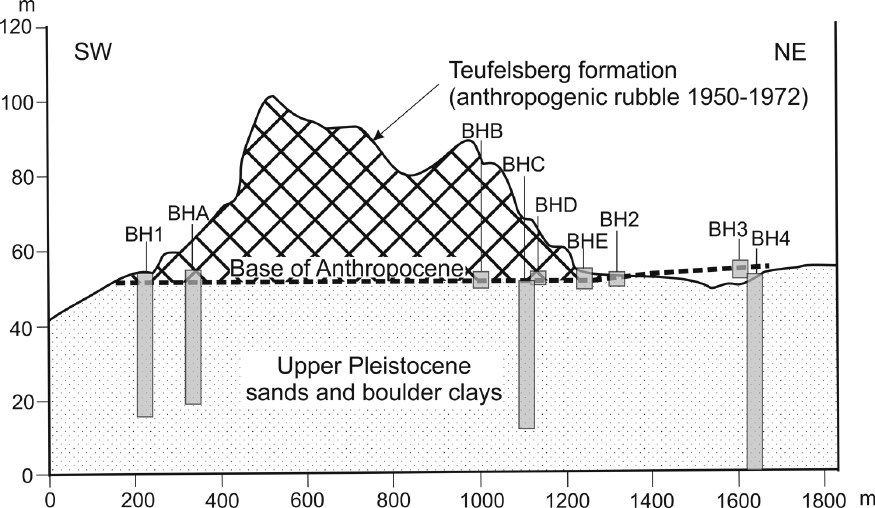
Estimation of the depth of human deposits (crushed stone and other materials) on the territory of Berlin The
physical technosphere consists of materials in which the human component is present, that is, these materials are partially used by humans and / or partially replaced by them. This includes the extraction, processing and processing of mineral resources into new forms and combinations of elements, mixtures and products, all tools, machinery, consumer goods, buildings, roads, agricultural land and plantations, along with the land beneath them. The parts of the technosphere at the end of their life cycle are more or less recycled and reused: these are some metals, some glass, paper, plastic, and some layers of rubble under cities. The remaining parts accumulate over the years in the form of a specific human geological layer - the so-calledEarth archaeosphere . Most of these residues are deposited in solid form, although some of them are present in gaseous form, including in the form of carbon dioxide and methane in the atmosphere. A part dissolves and pollutes the hydrosphere and lithosphere.
Physical Technosphere Size
Geologist Jan Zalasiewicz of the University of Leicester and his colleagues, on the basis of the published scientific works of the predecessors, estimated the total volume and mass of the main components of the physical technosphere. In Table 1, a teraton (Tm) corresponds to 10 12 tons.
| Component | Area (10 6 km 2 ) | Thickness (cm) | Density (g / cm 3 ) | Mass (tm) | Share (%) |
|---|---|---|---|---|---|
| Cities | 3.70 | 200 | 1.50 | 11.10 | 36.9 |
| Rural settlements | 4.20 | 100 | 1.50 | 6.30 | 20.9 |
| Pastures | 33.50 | ten | 1.50 | 6.30 | 20.9 |
| Fields | 16.70 | 15 | 1.50 | 3.76 | 12.5 |
| Plowed sea bottom | 15.00 | ten | 1.50 | 2.25 | 7.5 |
| Land used and soil erosion | 5.30 | ten | 1.50 | 0.80 | 2.7 |
| Country Roads | 0.50 | 50 | 1.50 | 0.38 | 1,3 |
| Forest plantations | 2.70 | ten | 1.00 | 0.27 | 0.9 |
| Reservoirs | 0.20 | 100 | 1.00 | 0.20 | 0.7 |
| Railways | 0.03 | 50 | 1.50 | 0.02 | 0.1 |
| Total | 81.83 | 30.11 |
The scientific article was published on November 28, 2016 in The Anthropocene Review (doi: 10.1177 / 2053019616677743).