"Hardcore" and its technology
The main character is reanimated in the premises of a science fiction laboratory. On the screen, an expensive animatronic creates the illusion that a person is collected piece by piece. The character does not remember anything, but the beauty that brings him to his senses seems to be his wife. This is followed by her abduction, demonstration of negative characters, goal setting and a series of bloody scenes with a large amount of violence.
In principle, such a thing could well have been a fighter of the late eighties behind the authorship of Paul Verhoeven . Cyborgs were in Robocop , lost memories - in “ Remember all". The difference with “Hardcore” is that everything happens from the point of view of the main character. All jumps, blows and shootouts look on the screen as if the viewer is looking through the eyes of the main character and acts with his hands.
Cinematic camera - an expensive and fragile machine. It’s impossible to fix the usual on a person’s head, and the character’s chest, legs and arms are visible in the film. The solution to the problem is obvious to people familiar with the action camera market.

The history of this camera format begins somewhere in the sixties. In those distant years, television already existed and actively developed. Transfer Ripcord told about, at that time, a new kind of extreme sport - skydiving. When shooting with the hands get unnecessary shaking, besides the camera interfered. To shoot the long jump process, one of the telecast participants, Robert Sinclair, secured a 35 mm camera on the helmet. The logical solution: when jumping, the head remained the most stable part of the body. Probably, Sinclair can be considered the first to create an action camera format.

Sinclair with one of his cameras.
Formula 1 pilot Jackie StewartI tried to mount on a helmet photo and video cameras. In the photo below, he is captured with a special rig, which consists of the camera itself and the battery.

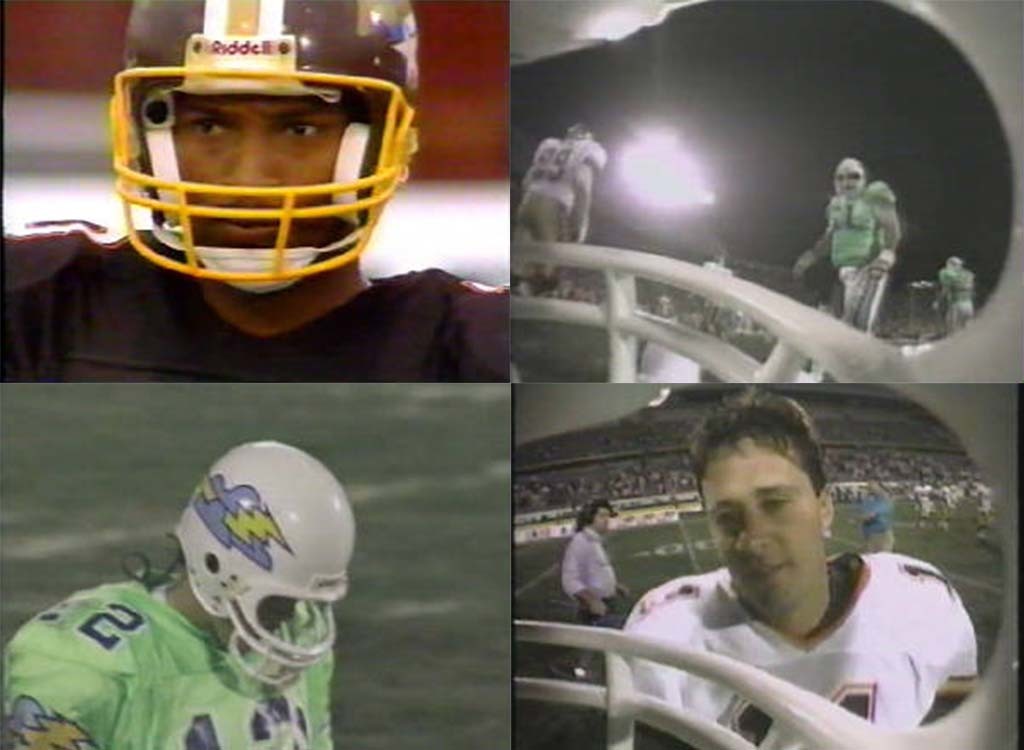
The next few decades, action cameras continued to look like this: expensive, often unique solutions, heavy, rare. Worst of all, they were analog - the film was not allowed on the air from such a camera. In 1986, the Canon Ci-10 action camera with a radio signal transmission was first used for broadcast on live television. In 1991, the opportunity to broadcast team sports from the point of view of the player first appeared. The helmet cost 200 thousand dollars and contained everything inside: an antenna, a camera and a battery.
In the nineties, digital camera technology evolved, and in zero they replaced the film even in cheap consumer devices. Around the middle of the two thousandth, the company appears GoPro. She still can not be any hero: some prototypes and the format of a wrist camera are available. The founder and head of GoPro Nick Woodman , a photo with one of the earliest prototypes that were supposed to be removed while surfing. The first GoPro was film. She could take photographs on a 35 mm film, was enclosed in a waterproof case and was attached to her wrist. Sales began in 2005. The digital GoPro Hero Digital could record 10 seconds of video at a resolution of 320 × 240 at 10 frames per second without a sound of 32 megabytes of internal memory, there was no memory card slot.

But back to the film. In 2007, for the first time, the idea to shoot from the first person came to the tracer Sergey Valyaev. A year later, he put together a primitive system for that. On the cap, he secured the surveillance camera, and threw the wires in a backpack. The signal converter Archos converted the analog signal into a digital picture with low quality in 480 lines of interlaced scanning. Later there were motorcycle helmets and other experiments, but already then there was an understanding that the camera should be fixed not on the forehead, but in the area of the mouth. From the jaw it turns out to capture the chest, arms and legs, and from the forehead there is too little body in the frame.
A little later, Ilya Naishuller, the frontman of the Biting Elbows music group, loaned Valyaev his GoPro. After watching the footage of the parkour, Nayshuller proposed to make a clip for his group.
For the shootings, they acquired the Predator airsoft mask, cut out unnecessary elements, made slots for the face and fixed the camera at the mouth. So in 2011 we got a video for the song The Stampede.

In 2013, the second video-continuation of Bad Motherfucker. The video is similar, but the level of work is different: there are professionally performed stuntmen tricks and pyrotechnic effects, noticeable violence. Although the level of production was already higher, the shooting was carried out on the same mask without any stabilization.
Timur Bekmambetov became interested in Naishuller, who wrote to the director of the video on Facebook the day after the release of Bad Motherfucker. Bekmambetov offered to create a full-length film and expressed a desire to participate in its creation as a producer. Not immediately, but Naishuller agreed: he was afraid that he would not be able to maintain the rhythm of the five-minute video during the 90 minutes of the film. While someone doubted and was looking for ideas for a future picture, Valyaev slowly created a professional mount for GoPro to shoot such videos. As it turned out, there was simply no such body kit in the world.
The initial stages of working on Hardcore are largely experimental. It touched the mask. It took several iterations to come to its final form. They got rid of the original mask, because the operator sweated heavily in it, and there was no space for additional equipment. The film uses 4-5 kinds of masks.
Stabilization was needed to avoid constant shaking. Keeping the camera in your mouth is constantly impossible - you will not be able to communicate with the members of the film crew, it will constantly pour saliva. Motorcycle helmet is a good way out, but it is not suitable for shooting and has a low viewing angle. And still the mask had to fit a wide range of parameters of the heads of operators.

Sometimes two cameras appeared on the mask - not for the 3D effect, but for shooting in different settings or for sending the picture to the director via Wi-Fi. Accordingly, there are a Wi-Fi router, a microphone and power on it. In the final version, there is magnetic stabilization, which did not remove all vibrations, as the Steadicam level system would have done, but smoothed them out. Commercial version of the mask trying to sell under the name Adventure Mask .
The film has a villain, a romantic partner and a character who can be called an ally. The role of the latter is almost the only actor in the film. Fearing failure, Naishuller invited Charlto Copley for this role, but the actor agreed.
You can list the personal qualities of the actor or the reasons for choosing Copley. But there are several technical details. Charlto had to work in technically difficult scenes: in “District No. 9” he already faced the need to play against the scene, which later will add computer graphics.


This problem was fully revealed when working with an actor wearing a mask with two cameras. One of the cameras is highlighted, you need to look at it. But instinctively the actor's eyes are confusing. On the second day of the shooting, opaque glasses appeared on Valyayev’s head to hide real eyes.
There is not a single case where something is rendered impossible, and then they just add the hands of the main character. Almost everything that happens on the screen is relatively real and shot on GoPro Hero 3. However, it is not enough just to fix the camera on the stuntmen. It took a lot of graphic improvements and the work of several studios in order for the picture to get its finished look. And the process was far from just removing the cables of insurance.
In addition to countless deletions of unwanted shadows near the head of the protagonist, some scenes still required significant computer graphics intervention. This fall from an aerostat on a rescue capsule, which cannot be removed in any other way - the life of an actress in a frame cannot be sacrificed, and even for a stuntman it would be too risky. Capsuledropped the Studio Division using the Blender software package.

The fall consists of two parts: before the clouds and after. The fragment before is a pretty blue sky and white clouds into which the capsule dives.

In order not to be bored, effects of turbulence are observed in the clouds. After them begins to fall on the highway in Moscow. The sky for this part was captured using a panoramic shot from six GoPro on the octacopter.

Since the Federation Tower is higher than where the octacopter can rise, the studio resorted to camera mapping.
The Boston Zero VFX worked closely on the chase scene, which consists of pursuing, destroying four wagons, explosions, and a destructive line-up from a minigun (Gatling's guns). Usually, studios for reproducing objects are provided with scans of objects or photographs from filming. But in this case, nothing like this was provided. In the scene where the characters catch up with the motorcade and see it from afar, the wagons were recreated from scratch and placed on the road.
Another problem was the strong distortion of the camera. The data with GoPro itself was an obstacle: camera lenses give a fisheye. Most often you need an undistorted version tracking to create a virtual camera. In this case, it was necessary to produce distortion volumes of the tracking package so that it could smooth the image for work. Then the objects were rendered, and the distortions returned to their place. At the same time it was necessary to ensure that the error never crept in.


The original scene of the chase was overgrown with powerful explosions, details and shots. There was a lot of additional damage and blood. The two main explosions of the vans began as the turning of real cars on the road without pyrotechnic effects. During the flight, they were overgrown with explosion and damage. The already overgrown polygon falls to the ground. After the explosions, they become models.
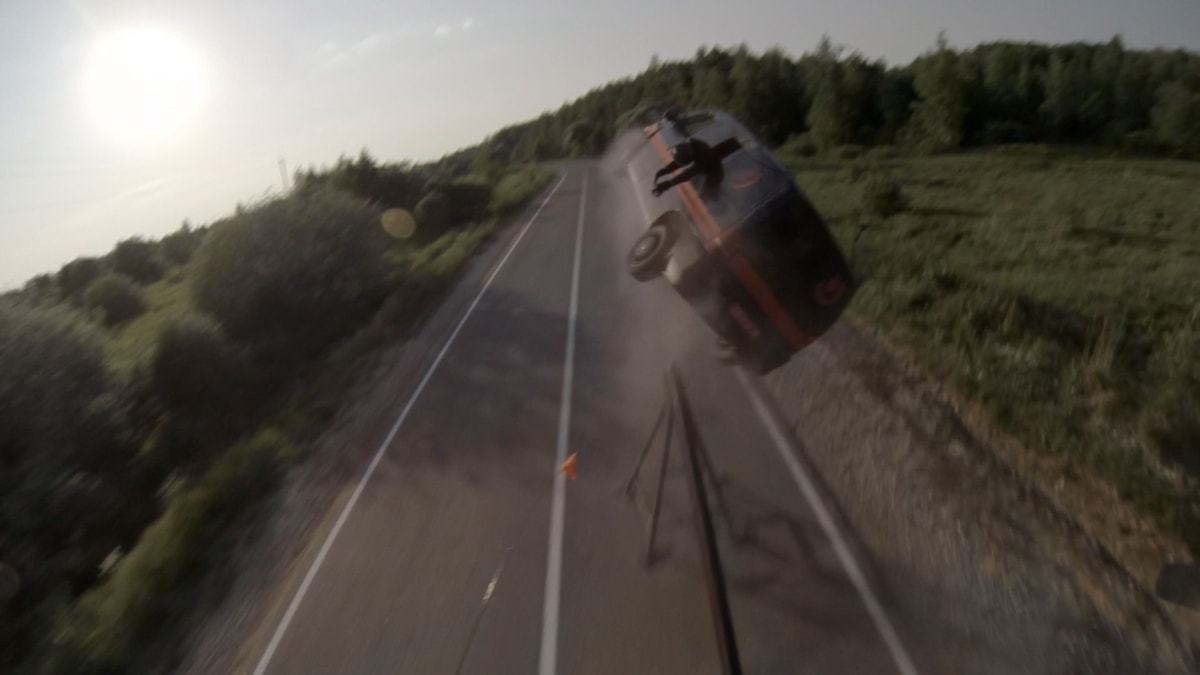

In another aspect, digital technology replaces an already damaged van with an untouched one. As a result, in the film he fights with spectacular damage, although he was already beaten. For the scene of passing through the van, a combination of the real interior of the vehicle, their render, and digital stuntmen was needed. Also, the studio was engaged in gluing: in a separate moment it was necessary to connect two frames, where Henry's head looks in two opposite directions. Two frames with a difference of 180 ° connected in the illusion of turning the head.


The whole piece of the studio consists of almost 45 frames gathered together.
Studio VFX Legion worked on several scenes. GoPro solved the distortion problem in the same way: the picture was straightened to the state of a four-pointed star, the necessary effects were added, and then again distorted into a rectangle. For example, this failed fall from an aerostat, several other studios refused to work on because of its complexity. By the way, in the VFX Legion and determined the appearance of the flying laboratory. She was painted in Maya and textured in Substance Painter. Render was performed in the RedShift package.
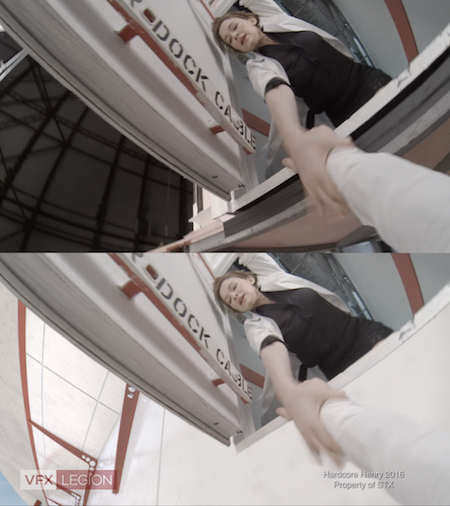
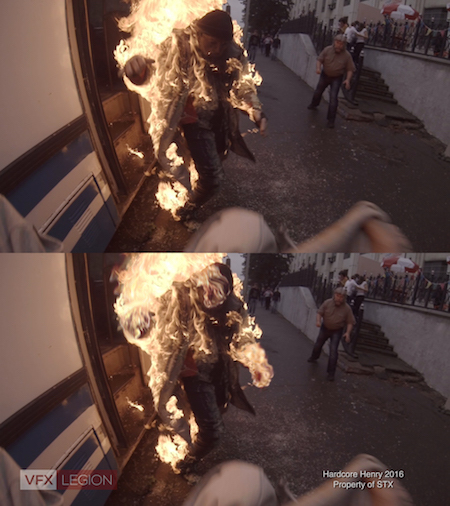
For overlay fragments in the studio used Adobe After Effects. The face of the burning stuntman was covered with flames, pictures appeared on the monitors, and blood and smoke were added in some places. It is especially interesting that the collision and death of the first Jimmy is the gluing together with three GoPro, where the real Charlto is replaced with a doll.
A toy robot smashed against a wall is Nishuller’s favorite childhood artifact. It exists in one copy, and the question of the destruction of childhood memories of the director was not. The 3D copy was broken during the shooting process, so the toy is broken on the screen with computer graphics.
Mammal Studios solved the problem of distortions of the GoPro camera using 3DEqualizer and Nuke. This studio created a scene with a sniper rifle. The sight correctly displays the enlarged image, the surrounding space is blurred and moves correctly.

In one scene, a flamethrower in a mirrored suit attacks Henry. Henry dodges a jet of fire. Hurts Jimmy, who opens fire. Henry knocks down the flamethrower and takes away his weapon. The flamethrower continues to spit a stream of fire, reflections on the adversary's mirror suit are working. All this happens in one scene, without transitions.
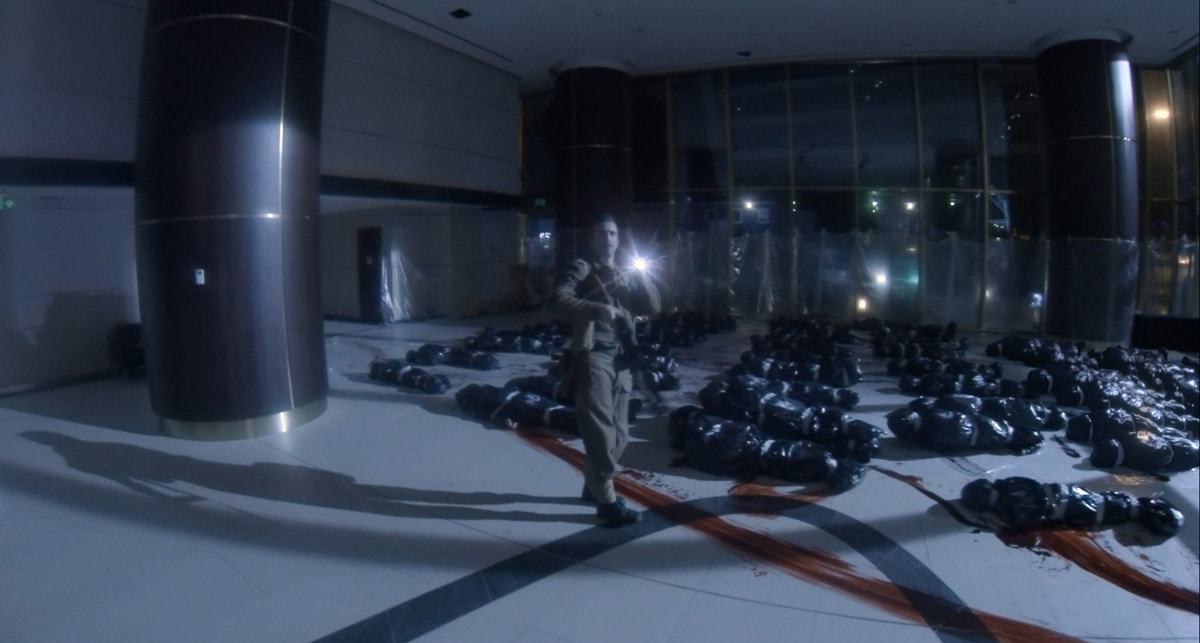
The studio had to solve the problem of the original data. On the Internet, found photos of the building of the Russian Academy of Sciences, where the filming took place. So managed to estimate the size of the windows and columns on the stage. A coarse geometry was developed, the dimensions of the future scene are indicated. With it removed unnecessary objects for further work. Fire simulations were created in Maya and rendered in Phoenix. In the frame added fire, smoke, shots.
The final scene was filmed in a pavilion covered with dark matter. These are several weeks in which the set was gradually destroyed and filled with blood, and the cyborgs on it were killed one by one. In the Russian studio CGF, the black matter was pulled into the view of Moscow from a skyscraper.
Demonstration of visual effects from the studio CGF
The initial movie titles is in itself unique and sets the tone for the entire film. He was made one of the last. One of the critics praised the advanced caption graphics: it looked like it really crippled and killed people. In fact, this is a combination of many dolls, sometimes the faces of people with computer graphics impurities.
A montage with fragments of a previs and final opening credits.
Sometimes the plot of this film is said to be completely absent. The critic will notice that the storyline is a reason to associate several beautiful scenes with exciting stunt stunts. In fact, it is difficult for film critics to guess the real motives of what is happening on the screen, since it is a representative of another genre: video games.
Parts of the film are best described in terms of a first-person shooter: a tutorial, a respawn from one of the characters, a chase on a vehicle where we control a huge cannon, a sniper scene, a real escort mission.and the final boss fight. Even the end of the film is a multiplayer humiliation of GG EZ (good game, it was easy to beat you, which Henry brings with his finger. Well, except that without GG - otherwise everything would be too obvious. For a first-person shooter in the film is actually too many plot twists and turns. "Hardcore" is a very competently performed ode to the genre of corridor shooter.
Artists, make-up specialists and cameramen most often use the word “simplicity” in descriptions of the creation of the film: obvious, simple solutions work on GoPro. Simple colors, several times reinforced replanting with fake blood, understandable images. It is not surprising that the plot was simple. It makes no sense to blame the expected turn of the story at the end of little interest.
The most inspiring film is not its plot. Almost everything was taken not on expensive equipment for tens of thousands of dollars, but on cameras and technology that are relatively accessible to the average consumer. These are not expensive specialized rigs from major manufacturers, but equipment from an electronics store and knee-made masks.
Anyone can fork out for an action camera and a helmet, and then with a varying degree of success, try to repeat a few minutes of this. It will probably turn out to be not very interesting, but the availability of the technology is here. Blaming the existence of this film needs miniaturization of consumer electronics and talent of people who managed to make out the right moment.
In the US, Hardcore Henry was expecting a massive campaign of support, many people were able to do long interviews with the director and the main actor, there were even joint projects. One of them was advertising for the Alamo Drafthouse Cinema network of cinemas . Formally, the movie was shot by another man - Blaine Gibson , director of Rooster Teeth. But in the video it is noticeable that Ilya appeared on the set and took control of the shooting. Already at that time no one else in the world could surpass him in shooting films from the first person.
After Hardcore, Nishuller shot a music video, but not for his band. This time he was offered to make a video for the popular Canadian artist The Weeknd . A Canadian contacted Naishuller himself - he liked the film he had shot. In matters of filming the director was given complete freedom. The customer trusted the director in many ways.
 For the first Biting Elbows clips, Valyaev put on a mask, for Hardcore - a helmet, in his latest work, Naishuller runs in a large design. This is a whole backpack with a receiver for the camera, a mask and a counterweight on the head.
Naishuller himself today more to work in the US. He has suffered enough conflicts with the Russian police during the filming of Hardcore. He opened Versus Pictures production with partners and is trying to create new products for both Russia and the US market. Four years ago, on the personal page of "Vkontakte", Nayshuller gathered acquaintances and anyone who wanted to shoot a Bad Motherfucker video. Today it is the person who shoots the best in the world in the POV genre.
In principle, such a thing could well have been a fighter of the late eighties behind the authorship of Paul Verhoeven . Cyborgs were in Robocop , lost memories - in “ Remember all". The difference with “Hardcore” is that everything happens from the point of view of the main character. All jumps, blows and shootouts look on the screen as if the viewer is looking through the eyes of the main character and acts with his hands.
Cinematic camera - an expensive and fragile machine. It’s impossible to fix the usual on a person’s head, and the character’s chest, legs and arms are visible in the film. The solution to the problem is obvious to people familiar with the action camera market.
The history of this camera format begins somewhere in the sixties. In those distant years, television already existed and actively developed. Transfer Ripcord told about, at that time, a new kind of extreme sport - skydiving. When shooting with the hands get unnecessary shaking, besides the camera interfered. To shoot the long jump process, one of the telecast participants, Robert Sinclair, secured a 35 mm camera on the helmet. The logical solution: when jumping, the head remained the most stable part of the body. Probably, Sinclair can be considered the first to create an action camera format.
Sinclair with one of his cameras.
Formula 1 pilot Jackie StewartI tried to mount on a helmet photo and video cameras. In the photo below, he is captured with a special rig, which consists of the camera itself and the battery.
The next few decades, action cameras continued to look like this: expensive, often unique solutions, heavy, rare. Worst of all, they were analog - the film was not allowed on the air from such a camera. In 1986, the Canon Ci-10 action camera with a radio signal transmission was first used for broadcast on live television. In 1991, the opportunity to broadcast team sports from the point of view of the player first appeared. The helmet cost 200 thousand dollars and contained everything inside: an antenna, a camera and a battery.
In the nineties, digital camera technology evolved, and in zero they replaced the film even in cheap consumer devices. Around the middle of the two thousandth, the company appears GoPro. She still can not be any hero: some prototypes and the format of a wrist camera are available. The founder and head of GoPro Nick Woodman , a photo with one of the earliest prototypes that were supposed to be removed while surfing. The first GoPro was film. She could take photographs on a 35 mm film, was enclosed in a waterproof case and was attached to her wrist. Sales began in 2005. The digital GoPro Hero Digital could record 10 seconds of video at a resolution of 320 × 240 at 10 frames per second without a sound of 32 megabytes of internal memory, there was no memory card slot.
Mask
But back to the film. In 2007, for the first time, the idea to shoot from the first person came to the tracer Sergey Valyaev. A year later, he put together a primitive system for that. On the cap, he secured the surveillance camera, and threw the wires in a backpack. The signal converter Archos converted the analog signal into a digital picture with low quality in 480 lines of interlaced scanning. Later there were motorcycle helmets and other experiments, but already then there was an understanding that the camera should be fixed not on the forehead, but in the area of the mouth. From the jaw it turns out to capture the chest, arms and legs, and from the forehead there is too little body in the frame.
A little later, Ilya Naishuller, the frontman of the Biting Elbows music group, loaned Valyaev his GoPro. After watching the footage of the parkour, Nayshuller proposed to make a clip for his group.
For the shootings, they acquired the Predator airsoft mask, cut out unnecessary elements, made slots for the face and fixed the camera at the mouth. So in 2011 we got a video for the song The Stampede.
In 2013, the second video-continuation of Bad Motherfucker. The video is similar, but the level of work is different: there are professionally performed stuntmen tricks and pyrotechnic effects, noticeable violence. Although the level of production was already higher, the shooting was carried out on the same mask without any stabilization.
Timur Bekmambetov became interested in Naishuller, who wrote to the director of the video on Facebook the day after the release of Bad Motherfucker. Bekmambetov offered to create a full-length film and expressed a desire to participate in its creation as a producer. Not immediately, but Naishuller agreed: he was afraid that he would not be able to maintain the rhythm of the five-minute video during the 90 minutes of the film. While someone doubted and was looking for ideas for a future picture, Valyaev slowly created a professional mount for GoPro to shoot such videos. As it turned out, there was simply no such body kit in the world.
The initial stages of working on Hardcore are largely experimental. It touched the mask. It took several iterations to come to its final form. They got rid of the original mask, because the operator sweated heavily in it, and there was no space for additional equipment. The film uses 4-5 kinds of masks.
Stabilization was needed to avoid constant shaking. Keeping the camera in your mouth is constantly impossible - you will not be able to communicate with the members of the film crew, it will constantly pour saliva. Motorcycle helmet is a good way out, but it is not suitable for shooting and has a low viewing angle. And still the mask had to fit a wide range of parameters of the heads of operators.
Sometimes two cameras appeared on the mask - not for the 3D effect, but for shooting in different settings or for sending the picture to the director via Wi-Fi. Accordingly, there are a Wi-Fi router, a microphone and power on it. In the final version, there is magnetic stabilization, which did not remove all vibrations, as the Steadicam level system would have done, but smoothed them out. Commercial version of the mask trying to sell under the name Adventure Mask .
The film has a villain, a romantic partner and a character who can be called an ally. The role of the latter is almost the only actor in the film. Fearing failure, Naishuller invited Charlto Copley for this role, but the actor agreed.
You can list the personal qualities of the actor or the reasons for choosing Copley. But there are several technical details. Charlto had to work in technically difficult scenes: in “District No. 9” he already faced the need to play against the scene, which later will add computer graphics.
This problem was fully revealed when working with an actor wearing a mask with two cameras. One of the cameras is highlighted, you need to look at it. But instinctively the actor's eyes are confusing. On the second day of the shooting, opaque glasses appeared on Valyayev’s head to hide real eyes.
Graphics
There is not a single case where something is rendered impossible, and then they just add the hands of the main character. Almost everything that happens on the screen is relatively real and shot on GoPro Hero 3. However, it is not enough just to fix the camera on the stuntmen. It took a lot of graphic improvements and the work of several studios in order for the picture to get its finished look. And the process was far from just removing the cables of insurance.
In addition to countless deletions of unwanted shadows near the head of the protagonist, some scenes still required significant computer graphics intervention. This fall from an aerostat on a rescue capsule, which cannot be removed in any other way - the life of an actress in a frame cannot be sacrificed, and even for a stuntman it would be too risky. Capsuledropped the Studio Division using the Blender software package.
The fall consists of two parts: before the clouds and after. The fragment before is a pretty blue sky and white clouds into which the capsule dives.
In order not to be bored, effects of turbulence are observed in the clouds. After them begins to fall on the highway in Moscow. The sky for this part was captured using a panoramic shot from six GoPro on the octacopter.
Since the Federation Tower is higher than where the octacopter can rise, the studio resorted to camera mapping.
The Boston Zero VFX worked closely on the chase scene, which consists of pursuing, destroying four wagons, explosions, and a destructive line-up from a minigun (Gatling's guns). Usually, studios for reproducing objects are provided with scans of objects or photographs from filming. But in this case, nothing like this was provided. In the scene where the characters catch up with the motorcade and see it from afar, the wagons were recreated from scratch and placed on the road.
Another problem was the strong distortion of the camera. The data with GoPro itself was an obstacle: camera lenses give a fisheye. Most often you need an undistorted version tracking to create a virtual camera. In this case, it was necessary to produce distortion volumes of the tracking package so that it could smooth the image for work. Then the objects were rendered, and the distortions returned to their place. At the same time it was necessary to ensure that the error never crept in.
The original scene of the chase was overgrown with powerful explosions, details and shots. There was a lot of additional damage and blood. The two main explosions of the vans began as the turning of real cars on the road without pyrotechnic effects. During the flight, they were overgrown with explosion and damage. The already overgrown polygon falls to the ground. After the explosions, they become models.
In another aspect, digital technology replaces an already damaged van with an untouched one. As a result, in the film he fights with spectacular damage, although he was already beaten. For the scene of passing through the van, a combination of the real interior of the vehicle, their render, and digital stuntmen was needed. Also, the studio was engaged in gluing: in a separate moment it was necessary to connect two frames, where Henry's head looks in two opposite directions. Two frames with a difference of 180 ° connected in the illusion of turning the head.
The whole piece of the studio consists of almost 45 frames gathered together.
Studio VFX Legion worked on several scenes. GoPro solved the distortion problem in the same way: the picture was straightened to the state of a four-pointed star, the necessary effects were added, and then again distorted into a rectangle. For example, this failed fall from an aerostat, several other studios refused to work on because of its complexity. By the way, in the VFX Legion and determined the appearance of the flying laboratory. She was painted in Maya and textured in Substance Painter. Render was performed in the RedShift package.
For overlay fragments in the studio used Adobe After Effects. The face of the burning stuntman was covered with flames, pictures appeared on the monitors, and blood and smoke were added in some places. It is especially interesting that the collision and death of the first Jimmy is the gluing together with three GoPro, where the real Charlto is replaced with a doll.
A toy robot smashed against a wall is Nishuller’s favorite childhood artifact. It exists in one copy, and the question of the destruction of childhood memories of the director was not. The 3D copy was broken during the shooting process, so the toy is broken on the screen with computer graphics.
Mammal Studios solved the problem of distortions of the GoPro camera using 3DEqualizer and Nuke. This studio created a scene with a sniper rifle. The sight correctly displays the enlarged image, the surrounding space is blurred and moves correctly.
In one scene, a flamethrower in a mirrored suit attacks Henry. Henry dodges a jet of fire. Hurts Jimmy, who opens fire. Henry knocks down the flamethrower and takes away his weapon. The flamethrower continues to spit a stream of fire, reflections on the adversary's mirror suit are working. All this happens in one scene, without transitions.
The studio had to solve the problem of the original data. On the Internet, found photos of the building of the Russian Academy of Sciences, where the filming took place. So managed to estimate the size of the windows and columns on the stage. A coarse geometry was developed, the dimensions of the future scene are indicated. With it removed unnecessary objects for further work. Fire simulations were created in Maya and rendered in Phoenix. In the frame added fire, smoke, shots.
The final scene was filmed in a pavilion covered with dark matter. These are several weeks in which the set was gradually destroyed and filled with blood, and the cyborgs on it were killed one by one. In the Russian studio CGF, the black matter was pulled into the view of Moscow from a skyscraper.
Demonstration of visual effects from the studio CGF
The initial movie titles is in itself unique and sets the tone for the entire film. He was made one of the last. One of the critics praised the advanced caption graphics: it looked like it really crippled and killed people. In fact, this is a combination of many dolls, sometimes the faces of people with computer graphics impurities.
A montage with fragments of a previs and final opening credits.
Sometimes the plot of this film is said to be completely absent. The critic will notice that the storyline is a reason to associate several beautiful scenes with exciting stunt stunts. In fact, it is difficult for film critics to guess the real motives of what is happening on the screen, since it is a representative of another genre: video games.
Parts of the film are best described in terms of a first-person shooter: a tutorial, a respawn from one of the characters, a chase on a vehicle where we control a huge cannon, a sniper scene, a real escort mission.and the final boss fight. Even the end of the film is a multiplayer humiliation of GG EZ (good game, it was easy to beat you, which Henry brings with his finger. Well, except that without GG - otherwise everything would be too obvious. For a first-person shooter in the film is actually too many plot twists and turns. "Hardcore" is a very competently performed ode to the genre of corridor shooter.
Artists, make-up specialists and cameramen most often use the word “simplicity” in descriptions of the creation of the film: obvious, simple solutions work on GoPro. Simple colors, several times reinforced replanting with fake blood, understandable images. It is not surprising that the plot was simple. It makes no sense to blame the expected turn of the story at the end of little interest.
The most inspiring film is not its plot. Almost everything was taken not on expensive equipment for tens of thousands of dollars, but on cameras and technology that are relatively accessible to the average consumer. These are not expensive specialized rigs from major manufacturers, but equipment from an electronics store and knee-made masks.
Anyone can fork out for an action camera and a helmet, and then with a varying degree of success, try to repeat a few minutes of this. It will probably turn out to be not very interesting, but the availability of the technology is here. Blaming the existence of this film needs miniaturization of consumer electronics and talent of people who managed to make out the right moment.
In the US, Hardcore Henry was expecting a massive campaign of support, many people were able to do long interviews with the director and the main actor, there were even joint projects. One of them was advertising for the Alamo Drafthouse Cinema network of cinemas . Formally, the movie was shot by another man - Blaine Gibson , director of Rooster Teeth. But in the video it is noticeable that Ilya appeared on the set and took control of the shooting. Already at that time no one else in the world could surpass him in shooting films from the first person.
After Hardcore, Nishuller shot a music video, but not for his band. This time he was offered to make a video for the popular Canadian artist The Weeknd . A Canadian contacted Naishuller himself - he liked the film he had shot. In matters of filming the director was given complete freedom. The customer trusted the director in many ways.
For the first Biting Elbows clips, Valyaev put on a mask, for Hardcore - a helmet, in his latest work, Naishuller runs in a large design. This is a whole backpack with a receiver for the camera, a mask and a counterweight on the head. Naishuller himself today more to work in the US. He has suffered enough conflicts with the Russian police during the filming of Hardcore. He opened Versus Pictures production with partners and is trying to create new products for both Russia and the US market. Four years ago, on the personal page of "Vkontakte", Nayshuller gathered acquaintances and anyone who wanted to shoot a Bad Motherfucker video. Today it is the person who shoots the best in the world in the POV genre.