June 26, 2007 at 15:18
BORING PHOTOS
Due to the recent karmopad there is no way to put photos, they are on the link. Sorry.
Petteri SULONEN, Helsinki
“Avoid the cliche” (Michael Johnston)
Photo
One of the funniest photo books I've seen in the last few years is a very small, brown, low-key volume from Phaidon. It is called Boring Postcards. It seems to me that the German name “Langweilige Postkarten” is even more provocative.
This is a collection of meticulously selected, carefully printed ... boring postcards. And yet, the parade of gas stations, restaurant cars, supermarkets, highways, airports, and other exclusively non-photogenic objects, often photographed without the slightest effort, is incredibly amusing, being presented in the form of a collection.
A photo
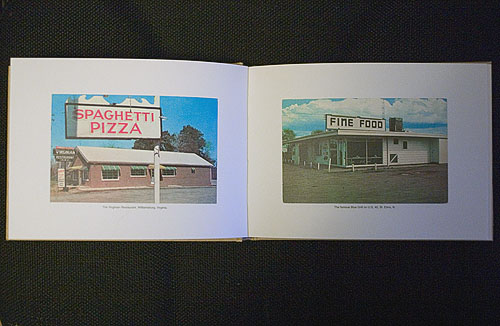
A boring photo from Boring Postcards. Type of conceptual art?
Signatures read “Virginia Restaurant, Williamsburg, Virginia,” and “Famous Blue Grill on US 40, St. Elm, Ill.” (No, this is not a copyright infringement; this is a “derivative work.” Incidentally, the copyright on postcards is already expired, and the book itself does not even have a mention of copyright.)
But still, most boring photographs of the book will not work, even if you put them together. They are just too boring. So boring that even a thick layer of irony in the publication would not provide enough context to make them interesting.
Anatomy of boring photography
Boring photos are not the ones you might think of first. Photos from the home album are not boring. On the contrary, they are one of the most interesting photographs, especially if the album belongs to you or your friend. The feeling of turning over the pages of an album is incomparable; the cards gradually turn yellow and fade with each visit. A photo album is a condensed memory: like a “pile”, Inca nodular writing, it is understandable only in the presence of human memory filling the voids, but mystically awakens memories even in its absence. I would rather be flipping through someone's family album than going to an exhibition full of pretentious, big ... boring photos.
Photo
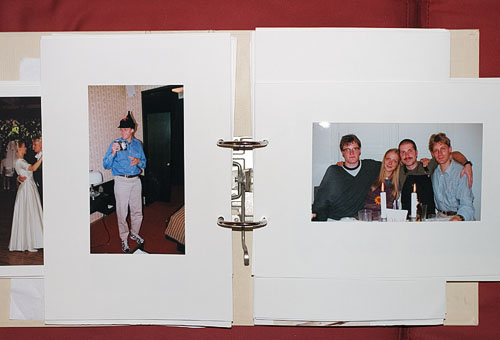
Boring photos? Never! You are talking about my friends. And about me.
Half-closed by the page - the newlyweds Kossu and Outi, on the page on the left, in stupid sneakers and a funny hat - I, perhaps, on one of my rides in St. Petersburg, drinking two cans of Nevsky at once to save time (well, there were days)! And on the right are Andy, Sanna, Yarmo and me. Andy is my best friend, he will get married soon, and on occasion I will go to Montana.
A photograph stands with one foot in art and the other in utilitarianism. Most of the photos are strictly utilitarian - the person who took the picture had a very definite intention, whether it was preserving memory, documenting news, or selling toothpaste. This kind of photograph is rarely truly boring. They are not allowed to do this, otherwise they will not be able to serve their purpose. Boring photography thrives in the realm of the so-called "fine art" - that is, photography whose main reason for existence is the "thing in itself." “Dinge an sich,” the people who gave us the Langweilige Postkarten would add.
Photo
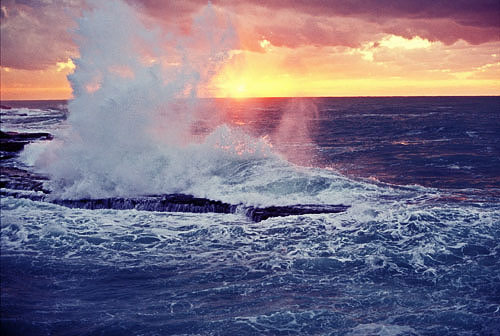
Sunset, waves breaking on stones, low clouds, what else is needed? Although there are no mountains.
Something terrible happens to people when they suddenly realize that the camera in their hands can reproduce things that exist in themselves. They suddenly stop taking interesting photos - photos that fill their albums, tell stories, evoke emotions, preserve their memory. They begin to make endless macro flowers and portraits of ducks. In the end, as they progress in what they consider the art of photography, they can go on to soft, smoky portraits of cutesy women (clothing optional), black and white, dimly lit and carefully ennobled nude models with perfect bodies on black background, eagles spreading wings in zoos or wild reserves, motorbikes laying a sharp turn on the highway, landscapes of the "golden hour" with mountains and water, or macro insects. In the end, one of them can understand the futility of all this and become a rebel, shooting evil series of poorly exposed, grainy and muddy images about nothing, or dressing cutesy girls in vinyl and plastering them with makeup, and calling it a “fetish photo”. Go toPhotosig , and you are guaranteed to see tons of such images on both the Featured Photos page and the Photos page. And, of course, open any forum on DPReview, and almost certainly there will be at least one thread with floral macro on the first page. Chewing gum for the eyes.
I just looked: on the Featured Photos page - four smoky cutesy women, including one in a wedding dress, one dull-lit nude model, two golden hour mountain landscapes, one duck (from the reserve), one macro (with two insects), one rally car racing along the road, and one kind of muddy photo about nothing. Also there is one grimacing child who would look very interesting in the home album, two stormy landscapes ... and one really nice scene in the bookstore, with a lady lost in thought and interesting light from the window.
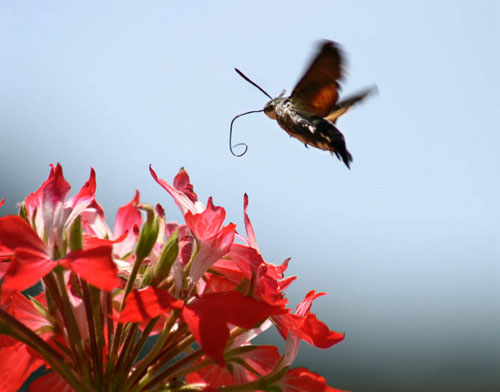
Photo A
bug and a flower in one frame, well, well!
Boredom and more cameras
There is nothing particularly bad about boring photography. It can even be fun; technical difficulties make the shooting process interesting (at least temporarily), and there is always satisfaction from knowing the trick - looking at boring photographs of other people, you can say, “Aha! I know how he did it! ”But still, over time, it becomes less and less tolerable.
Most amateur photographers are tech-lovers to a greater or lesser extent. I know a few who are not those who use the same old shabby Nikon and the only lens for years and years. I would like to think of myself as falling into that category, but alas, this is not so - I am such a techno-lover as it happens. I would spend all my income on cameras if I didn’t have a wife to remind me of more important things in life.
The question is why?
I believe that the underlying cause is the unconscious dissatisfaction that comes after you stop making a hobby for yourself and start doing it for others. It doesn’t matter how many flower macro or smoky girls you took off after the first push, as soon as you got them just as sharp, or smoky or cutesy as you wanted, you end up looking at them and feeling a vague void inside. And then the natural impulse is to fill this void with the purchase of more amazing equipment that is offered to us from all sides.
What can we take to fill the voids
In which hungry waves rumble?
Let's go sailing on the sea of faces
Looking for new applause?
Buy a new guitar?
Let's start a car more powerful?
From The Void, Roger Waters
What's bad about buying new cameras (or lenses, flashes, whatever) - it works. In any case, not for long. While you play with it, you go and shoot. Since your new toy is different from the old ones, you do everything differently and get something that does not leave you empty inside. Then again you start thinking about other people, return to the rut, and begin to give out more flower macro and smoky girls, and the void inside begins to grow again, and you begin to want some more piece of equipment, and one fine day your wallet is enough fat, and you, no longer able to restrain yourself, go and buy, and get another push, from which the next time it is only easier to succumb. Somewhere in the middle of the road, emptiness can turn into bitterness, and you will begin to make sarcastic comments on blurry graceful pictures, or poorly focused technically bad pictures, or people with the wrong camera brand. And all this time - still flower macro and smoky girls.
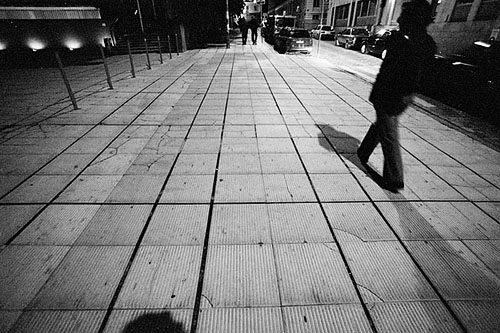
Photo
Poorly exposed and blurry image about nothing. Well, except for cracked concrete tiles. Probably, if I called it “Concrete Abstraction”, it should have become an allegorical description of urban decay and the long road to the house ...
Someday you might think, “let it all go!” And start producing murky, grainy, ugly pictures about nothing, and get temporary energy from the overthrow of all the idols that you so stubbornly created until you realize that now you just follow another set of agreements to please another crowd, only now it's a smaller crowd that likes to wear black, smoke a lot and sag in a cafe. And all this time, a little creative you, who initially pulled you into a hobby, whimpers in some damp, dusty, web-covered corner of your soul, an outcast and forgotten, having no other way to be heard, except through this feeling of emptiness, silence that you are desperately trying to fill with shutter clicks and megapixels and lenses with fluorite elements and A3 + printers,
Do we need it?
Main question. The question that many of us will face, sooner or later, is possible after the void reaches the needle of frustration disguised as anger that night when we drink too much and make a fire from our negatives or CDs or whatever there we store our precious “works." What for? Why are we spending such an exorbitant amount of time and effort thinking about cameras, discussing cameras, operating with cameras, buying cameras, selling cameras? Did it lure us into photography first? Usually, the causes were not named or formed consciously; more often they were simply forgotten.
My first sense of photography as something in myself happened when I was 10 years old and my father made several prints from a black-and-white film shot during his trip to America. On these frames were killer whales. I was with him in a dark room, and watched as black and white silhouettes slowly appeared. I still remember the admiration and feeling that I must learn this.
A photo
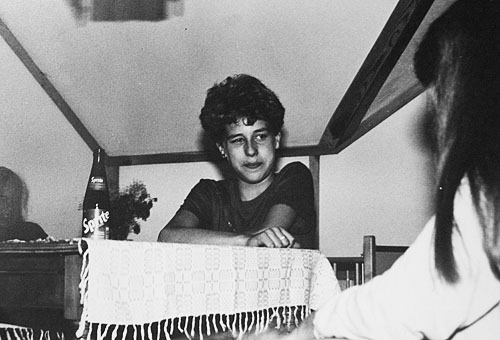
I took it off at age 12. We were on a school field trip to the farm. I borrowed the parent Minolta and took pictures like crazy. The right lens on my glasses had to be replaced because it was scratched by the viewfinder so that I could not look through it. Then I spent the whole weekend printing, because I was selling prints to the whole class, somewhere at 25 cents per card. This is my classmate Tommy in the picture, and the girl’s name is Outie ... or not? I can not say from the photograph; the name just surfaced in my head. Maybe the negatives are still somewhere; this is a photograph of a photograph ...
At first, photography is instinctive. Some people are so talented that they don’t need anything else; only talent and experience. The rest we will have to someday begin to consciously work on what we are doing, whether we pay attention to composition “according to the rules”, dissect the works of our favorite photographers, assign tasks to ourselves (“one photo a day, every day, with one lens and one type of film; no more, no less ”), joining photo clubs on cameras, or sending our work to Photosig. All this begins to pull in the direction of flattery. Most of us succumb to it in one moment or another. Some never succeed in breaking free from the deceptive fetters of floral macro and smoky girls. And others turn their passion into a profession, and begin to shoot floral macro and smoky girls for money, for clients, also chained into invisible chains of general agreements. And with each click of the shutter, our little character retreats further and further into the cobweb-crannies of the soul.
But one way or another, many manage to free themselves. They come to the point where they ask themselves the Main Question. Then they either find some answers and start taking interesting photos again, or they drop the photo altogether, or find inspiration in its search.
This is the key to asking a question. The answers then do not matter much.
A form of art for all the rest of us
Very few of us have the ability to put a pencil on paper and portray something remotely interesting at least. My sister knows this. Her boyfriend can do it even better. He is from Australia, Hin Chua . A spark of Promethean fire burns brightly in both of them. They do not need a photograph, although they are actually very good at it.
For a true, zealous artist, photography is a medium among other mediums. For the rest, this is one of the few ways in which we can get an object of artistic value. Even a completely random shot can be interesting, and the technology is so simple that it takes only a few days for training and coaching in order to get the basic skills of conscious image acquisition. Even this level of technical awareness is completely optional - with modern cameras, a simple “point-and-click” can create a work of art that is as valuable to the last bit as David, painstakingly carved from a marble block.
Photography is an art form that is most suitable for us, non-creative people. Of all the arts, she works in a direct, physical connection with the outside world - and the world itself is interesting. The photographer does not need to be a creative genius to make interesting or artistically valuable objects - he just has to notice everything interesting that is happening in the world. What he lacks in genius will be replenished by his subjects. All you need to get interesting photos is to go out into the world and take them.
2005 © Petteri Sulonen (text, photo)
2006 © www.x3photo.ru (translation into Russian)
CE I
also recommend
WHY MOST LANDSCAPES BORING
CAN THE COMPOSITIONS BE LEARNED?
HOW TO REMOVE ON THE STREET
Well, the rest that you find.
Petteri SULONEN, Helsinki
“Avoid the cliche” (Michael Johnston)
Photo
One of the funniest photo books I've seen in the last few years is a very small, brown, low-key volume from Phaidon. It is called Boring Postcards. It seems to me that the German name “Langweilige Postkarten” is even more provocative.
This is a collection of meticulously selected, carefully printed ... boring postcards. And yet, the parade of gas stations, restaurant cars, supermarkets, highways, airports, and other exclusively non-photogenic objects, often photographed without the slightest effort, is incredibly amusing, being presented in the form of a collection.
A photo
A boring photo from Boring Postcards. Type of conceptual art?
Signatures read “Virginia Restaurant, Williamsburg, Virginia,” and “Famous Blue Grill on US 40, St. Elm, Ill.” (No, this is not a copyright infringement; this is a “derivative work.” Incidentally, the copyright on postcards is already expired, and the book itself does not even have a mention of copyright.)
But still, most boring photographs of the book will not work, even if you put them together. They are just too boring. So boring that even a thick layer of irony in the publication would not provide enough context to make them interesting.
Anatomy of boring photography
Boring photos are not the ones you might think of first. Photos from the home album are not boring. On the contrary, they are one of the most interesting photographs, especially if the album belongs to you or your friend. The feeling of turning over the pages of an album is incomparable; the cards gradually turn yellow and fade with each visit. A photo album is a condensed memory: like a “pile”, Inca nodular writing, it is understandable only in the presence of human memory filling the voids, but mystically awakens memories even in its absence. I would rather be flipping through someone's family album than going to an exhibition full of pretentious, big ... boring photos.
Photo
Boring photos? Never! You are talking about my friends. And about me.
Half-closed by the page - the newlyweds Kossu and Outi, on the page on the left, in stupid sneakers and a funny hat - I, perhaps, on one of my rides in St. Petersburg, drinking two cans of Nevsky at once to save time (well, there were days)! And on the right are Andy, Sanna, Yarmo and me. Andy is my best friend, he will get married soon, and on occasion I will go to Montana.
A photograph stands with one foot in art and the other in utilitarianism. Most of the photos are strictly utilitarian - the person who took the picture had a very definite intention, whether it was preserving memory, documenting news, or selling toothpaste. This kind of photograph is rarely truly boring. They are not allowed to do this, otherwise they will not be able to serve their purpose. Boring photography thrives in the realm of the so-called "fine art" - that is, photography whose main reason for existence is the "thing in itself." “Dinge an sich,” the people who gave us the Langweilige Postkarten would add.
Photo
Sunset, waves breaking on stones, low clouds, what else is needed? Although there are no mountains.
Something terrible happens to people when they suddenly realize that the camera in their hands can reproduce things that exist in themselves. They suddenly stop taking interesting photos - photos that fill their albums, tell stories, evoke emotions, preserve their memory. They begin to make endless macro flowers and portraits of ducks. In the end, as they progress in what they consider the art of photography, they can go on to soft, smoky portraits of cutesy women (clothing optional), black and white, dimly lit and carefully ennobled nude models with perfect bodies on black background, eagles spreading wings in zoos or wild reserves, motorbikes laying a sharp turn on the highway, landscapes of the "golden hour" with mountains and water, or macro insects. In the end, one of them can understand the futility of all this and become a rebel, shooting evil series of poorly exposed, grainy and muddy images about nothing, or dressing cutesy girls in vinyl and plastering them with makeup, and calling it a “fetish photo”. Go toPhotosig , and you are guaranteed to see tons of such images on both the Featured Photos page and the Photos page. And, of course, open any forum on DPReview, and almost certainly there will be at least one thread with floral macro on the first page. Chewing gum for the eyes.
I just looked: on the Featured Photos page - four smoky cutesy women, including one in a wedding dress, one dull-lit nude model, two golden hour mountain landscapes, one duck (from the reserve), one macro (with two insects), one rally car racing along the road, and one kind of muddy photo about nothing. Also there is one grimacing child who would look very interesting in the home album, two stormy landscapes ... and one really nice scene in the bookstore, with a lady lost in thought and interesting light from the window.
Photo A
bug and a flower in one frame, well, well!
Boredom and more cameras
There is nothing particularly bad about boring photography. It can even be fun; technical difficulties make the shooting process interesting (at least temporarily), and there is always satisfaction from knowing the trick - looking at boring photographs of other people, you can say, “Aha! I know how he did it! ”But still, over time, it becomes less and less tolerable.
Most amateur photographers are tech-lovers to a greater or lesser extent. I know a few who are not those who use the same old shabby Nikon and the only lens for years and years. I would like to think of myself as falling into that category, but alas, this is not so - I am such a techno-lover as it happens. I would spend all my income on cameras if I didn’t have a wife to remind me of more important things in life.
The question is why?
I believe that the underlying cause is the unconscious dissatisfaction that comes after you stop making a hobby for yourself and start doing it for others. It doesn’t matter how many flower macro or smoky girls you took off after the first push, as soon as you got them just as sharp, or smoky or cutesy as you wanted, you end up looking at them and feeling a vague void inside. And then the natural impulse is to fill this void with the purchase of more amazing equipment that is offered to us from all sides.
What can we take to fill the voids
In which hungry waves rumble?
Let's go sailing on the sea of faces
Looking for new applause?
Buy a new guitar?
Let's start a car more powerful?
From The Void, Roger Waters
What's bad about buying new cameras (or lenses, flashes, whatever) - it works. In any case, not for long. While you play with it, you go and shoot. Since your new toy is different from the old ones, you do everything differently and get something that does not leave you empty inside. Then again you start thinking about other people, return to the rut, and begin to give out more flower macro and smoky girls, and the void inside begins to grow again, and you begin to want some more piece of equipment, and one fine day your wallet is enough fat, and you, no longer able to restrain yourself, go and buy, and get another push, from which the next time it is only easier to succumb. Somewhere in the middle of the road, emptiness can turn into bitterness, and you will begin to make sarcastic comments on blurry graceful pictures, or poorly focused technically bad pictures, or people with the wrong camera brand. And all this time - still flower macro and smoky girls.
Photo
Poorly exposed and blurry image about nothing. Well, except for cracked concrete tiles. Probably, if I called it “Concrete Abstraction”, it should have become an allegorical description of urban decay and the long road to the house ...
Someday you might think, “let it all go!” And start producing murky, grainy, ugly pictures about nothing, and get temporary energy from the overthrow of all the idols that you so stubbornly created until you realize that now you just follow another set of agreements to please another crowd, only now it's a smaller crowd that likes to wear black, smoke a lot and sag in a cafe. And all this time, a little creative you, who initially pulled you into a hobby, whimpers in some damp, dusty, web-covered corner of your soul, an outcast and forgotten, having no other way to be heard, except through this feeling of emptiness, silence that you are desperately trying to fill with shutter clicks and megapixels and lenses with fluorite elements and A3 + printers,
Do we need it?
Main question. The question that many of us will face, sooner or later, is possible after the void reaches the needle of frustration disguised as anger that night when we drink too much and make a fire from our negatives or CDs or whatever there we store our precious “works." What for? Why are we spending such an exorbitant amount of time and effort thinking about cameras, discussing cameras, operating with cameras, buying cameras, selling cameras? Did it lure us into photography first? Usually, the causes were not named or formed consciously; more often they were simply forgotten.
My first sense of photography as something in myself happened when I was 10 years old and my father made several prints from a black-and-white film shot during his trip to America. On these frames were killer whales. I was with him in a dark room, and watched as black and white silhouettes slowly appeared. I still remember the admiration and feeling that I must learn this.
A photo
I took it off at age 12. We were on a school field trip to the farm. I borrowed the parent Minolta and took pictures like crazy. The right lens on my glasses had to be replaced because it was scratched by the viewfinder so that I could not look through it. Then I spent the whole weekend printing, because I was selling prints to the whole class, somewhere at 25 cents per card. This is my classmate Tommy in the picture, and the girl’s name is Outie ... or not? I can not say from the photograph; the name just surfaced in my head. Maybe the negatives are still somewhere; this is a photograph of a photograph ...
At first, photography is instinctive. Some people are so talented that they don’t need anything else; only talent and experience. The rest we will have to someday begin to consciously work on what we are doing, whether we pay attention to composition “according to the rules”, dissect the works of our favorite photographers, assign tasks to ourselves (“one photo a day, every day, with one lens and one type of film; no more, no less ”), joining photo clubs on cameras, or sending our work to Photosig. All this begins to pull in the direction of flattery. Most of us succumb to it in one moment or another. Some never succeed in breaking free from the deceptive fetters of floral macro and smoky girls. And others turn their passion into a profession, and begin to shoot floral macro and smoky girls for money, for clients, also chained into invisible chains of general agreements. And with each click of the shutter, our little character retreats further and further into the cobweb-crannies of the soul.
But one way or another, many manage to free themselves. They come to the point where they ask themselves the Main Question. Then they either find some answers and start taking interesting photos again, or they drop the photo altogether, or find inspiration in its search.
This is the key to asking a question. The answers then do not matter much.
A form of art for all the rest of us
Very few of us have the ability to put a pencil on paper and portray something remotely interesting at least. My sister knows this. Her boyfriend can do it even better. He is from Australia, Hin Chua . A spark of Promethean fire burns brightly in both of them. They do not need a photograph, although they are actually very good at it.
For a true, zealous artist, photography is a medium among other mediums. For the rest, this is one of the few ways in which we can get an object of artistic value. Even a completely random shot can be interesting, and the technology is so simple that it takes only a few days for training and coaching in order to get the basic skills of conscious image acquisition. Even this level of technical awareness is completely optional - with modern cameras, a simple “point-and-click” can create a work of art that is as valuable to the last bit as David, painstakingly carved from a marble block.
Photography is an art form that is most suitable for us, non-creative people. Of all the arts, she works in a direct, physical connection with the outside world - and the world itself is interesting. The photographer does not need to be a creative genius to make interesting or artistically valuable objects - he just has to notice everything interesting that is happening in the world. What he lacks in genius will be replenished by his subjects. All you need to get interesting photos is to go out into the world and take them.
2005 © Petteri Sulonen (text, photo)
2006 © www.x3photo.ru (translation into Russian)
CE I
also recommend
WHY MOST LANDSCAPES BORING
CAN THE COMPOSITIONS BE LEARNED?
HOW TO REMOVE ON THE STREET
Well, the rest that you find.